5 points from the training camp of emerging athletes in the United States
As the competition season winds down, training opportunities for riders increase to refine their skills during the fall and winter months.
From November 5 to 8, two educational events were hosted by the United States Hunter/Jumper Association in the heart of the Bluegrass region at Midway University in Midway, Kentucky.
The 2026 Emerging Athletes Program National Training Session, led by Joe Fargis as the riding coach and Colin Reed and Jennifer Fesler as stable management coaches, took place.
In addition to assessing riding abilities throughout the week, the United States Hunter/Jumper Association's Emerging Athletes Program Committee also evaluated horse management skills, sportsmanship, stable management, professionalism, and how participants interacted with their horses.
Amy Center, Chair of the United States Hunter/Jumper Association's Emerging Athletes Program Committee, said, "The Emerging Athletes Program was designed to open eyes and open doors.
The goal is to expand the education of classic seat riding, forward seat riding, as well as the importance of stable management and proper horse care, and to pass this on to the younger generation and continue this process; this tradition and this education must be sustained."
At the end of the weekend, Reese Dorsey from Zone 3 claimed the championship title, joining the list of past champions of this program, including Jacob Pope, Caitlin Driscoll, and many others.
Alongside the Emerging Athletes Program National Training Session, the 2026 United States Hunter/Jumper Association National Challenge Test competition was held, supported by East West Equine Sports Medicine; an event that tested the horse knowledge of participants from across the country.
To determine the final rankings, a written test, a skills and horse identification test, and a final practical section were considered, and ultimately, Taya Wicker from Zone 10 was crowned champion.
Practical Horseman had the opportunity to closely follow the Emerging Athletes Program National Training Session for a day.
During this attendance, valuable insights were learned; where experts shared their knowledge with the next generation of equestrian sport.
5 lessons we learned: 1.
Finish your riding the same way you start; with a calm and relaxed horse, participants had the opportunity to practice in daily riding sessions under the guidance of Joe Fargis, a two-time Olympic gold medalist.
In the first session, Fargis encouraged riders to start and finish their practice with a calm and relaxed horse.
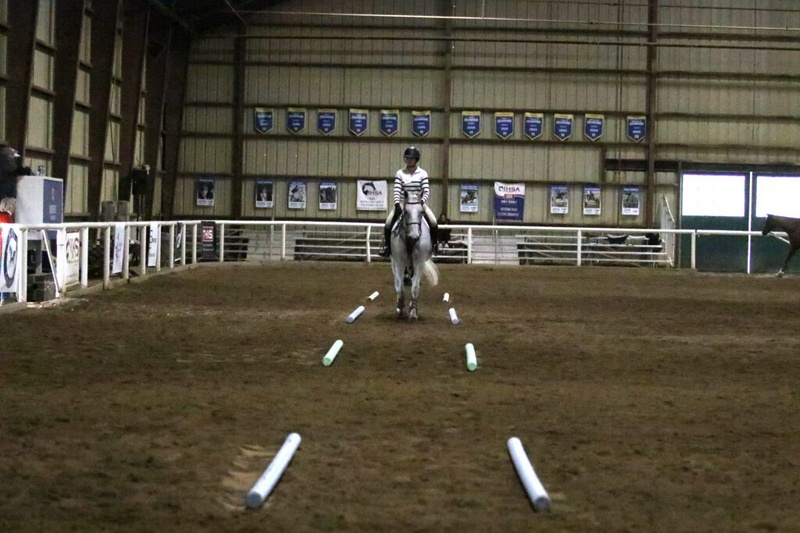
To begin, he asked the horse and rider pairs to pass through a "tunnel" made up of four rows of poles placed along a quarter line and on one side of the arena.
Riders were instructed to let their horses pass through the poles with loose reins.
Fargis said, "Let the horses start relaxed before work and finish relaxed after work.
You want them to feel completely comfortable with what we are doing."
After the horses passed through the poles a few times in both directions with loose reins, the riders established contact with the bit and worked on transitions from walk to trot and then trot to canter at various points along the tunnel path.
Next, participants passed through a grid at the walk to familiarize their horses with the jump layout.
This grid was gradually completed and included three jumps, one bounce, one single stride combination, and one double stride combination.
As the session approached its end, Fargis simplified the exercise so that only the jumps and bounce remained, and then ultimately reduced it to just the poles on the ground.
Riders once again walked their horses through the grid to finish with calm and relaxed horses.
Fargis said, "Pet the horses, go over the rails, and tell the horses: 'Thank you.'"
Daniel Roberts, at the end of the ride, passes Ernie through the grid with a loose and calm rein.
2.
Don't worry about a mistake when participants in the riding session with Joe Fargis along with their horses—unfamiliar and borrowed horses for that weekend—were going through the grid, sometimes a rail would fall or a refusal would occur.
But Fargis was not worried about these not-so-ideal moments.
Fargis said, "Don't worry about mistakes; just try again, okay? It's not a big deal. Just breathe."
He added, "You solved it. If you make a mistake, don't feel bad; we've all made mistakes."
Joe Fargis, a two-time Olympic gold medalist, teaches participants at the national training session of the Emerging Athletes Program at MZ Farm/USHJA.
He asked the riders to simply go through the grid once more with their horses and make any minor adjustments necessary to smooth the path.
Without any drama or major corrections, the pairs always seemed to flow smoothly through this exercise again after that brief slip.
3.
Act wisely in feeding horses prone to ulcers Participants in the Emerging Athletes Program had the opportunity to review their knowledge of stable management with stable management clinicians, Colin Reed and Jennifer Fesler.
Reed has been a long-time groom at Beacon Hill Show Stables and also alongside Emerson Burr and Leslie Burr Howard, and Fesler is a professional trainer who emphasizes correct riding and horse handling principles with her students.
In one of the stable management sessions, Reed and Fesler familiarized participants with the horse's digestive system and the issues that may arise during it.
Among the topics this group discussed were gastric ulcers; a problem that Reed pointed out the horse industry today recognizes much better than in the past when its clinical signs might have been mistaken for behavioral issues.
Reed said, "If you have a horse that shows problematic behavior due to gastric ulcers and you take him to the ring on an empty stomach while all that acid is sloshing around in his stomach, you'll see that behavior because he's frustrated and uncomfortable from the ulcers."
Colin Reed (right) and Jennifer Fesler (second from right), stable management instructors, reviewed the horse's digestive system with participants at the national EAP training session.
Reed advised participants to act wisely and feed accordingly to help horses that are prone to gastric ulcers.
He said, "The point to think about when planning your day with a horse is that if your horse has ulcers or is prone to them, he should always have continuous access to water and forage. You shouldn't increase his grain intake before riding because that's too much. If you eat a piece of cake and then go run a marathon, you'll feel sick, you know?"
4.
The correct adjustment of the snaffle bit with a loose ring compared to the fixed cheek bits of Michelle Ryan-Schwartz from Herm Sprenger had a presentation for participants titled "Bit Fit 101" and emphasized the difference in adjusting the snaffle bit with a loose ring compared to any other type of fixed cheek bits.
Only in snaffle bits with a loose ring, the horse's lips should not touch the edges of the bit to prevent pinching.
She said, "When measuring the loose ring bit, you should measure from the hole that the ring passes through and the closest point to the horse's mouth to the other side; not from ring to ring, but from the edge of the hole to the edge of the hole.
There should be approximately the width of a pinky finger between the horse's lip and that ring."
Michelle Ryan-Schwartz from Herm Sprenger explains how to measure snaffle bits with a loose ring.
In contrast, fixed cheek bits should be placed snugly against the horse's lips.
The method of measuring these bits is also different.
She said, "To measure any bit that has fixed cheeks, you really need to measure from the bend of the bit on one side to the bend on the other side.
The measurement is taken from the inside edge to the inside edge, and the horse's cheek should sit comfortably beside it."
5.
You can also try a small EAP clinic; while participating in a national or regional EAP educational session is a very worthwhile goal, you can start at a beginner level by attending a small EAP clinic.
You might be able to find a clinic in your area or host such a program at your own stable by purchasing a clinic package.
She said, "A special guide for coaches is also provided with this package so that this training continues to spread across the country, both in the stable and in the field.
The specialized terms, riding theories, and all this material will be right in front of the coach and the kids as well."
She added, "This has been done in a way that is usable for short stirrup kids and can also be upgraded for older kids or adult amateur riders.
This program is very engaging, and education is important.
We are always, always learning."
Find the nearest mini EAP clinic in your area or host one at your stable.
Read more about the emerging athletes program here and about the equestrian knowledge test challenge here.
Source: Practical Horseman – Training