Stress management in long approach to a single obstacle
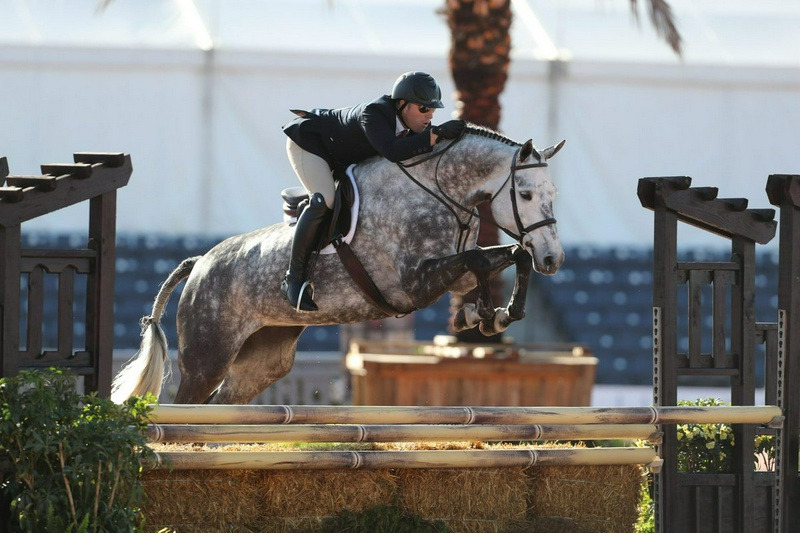
A long approach to a single obstacle is anxiety-inducing for many hunter riders.
This question can arise at all levels of hunter courses, whether at the beginning of the approach, in the middle, or — more often than not — at the end of the course.
For the horse, such a long approach can be difficult; especially if it heads towards the entrance of the arena or moves away from it, as it may encourage the horse to rush back outside the arena or make it slow and unmotivated when moving away.
However, most of the time, this part of the course is more of a challenge for the rider.
When you have so much time to think about the process, what to do or not do, and how to find the right distance to the obstacle, resisting the temptation to "do something" is not easy.
In many cases, riders interfere too much with the horse's work.
Due to uncertainty about the distance, they change the rhythm, push the horse forward, or collect it.
Or they over-guide or under-guide.
All these tendencies ultimately relate to the mental aspect of this sport: when you have so much opportunity to think, staying calm and steady is a challenge.
In most cases, giving in to such temptations yields the opposite result.
For example, you might see a distance while approaching, but then change your mind and unnecessarily push the horse forward.
The result of this is that the horse takes that extra and quick last step — the "chip" — an occurrence that likely wouldn't happen if you had maintained the same counter, even if the distance was slightly less than ideal.
When faced with a long approach to a single obstacle, what you need to do is exactly nothing.
If you have prepared correctly beforehand; that is, established a steady rhythm and tempo and entered the straight line towards the obstacle with a good corner, the only thing you need to do is maintain that rhythm, that tempo, and that line to the jumping point.
This is hard, but it works.
I will explain why this is the case and provide some tips for mastering this valuable technique.
Having and maintaining a steady rhythm and tempo is, in my opinion, the first prerequisite for an ideal long approach of "doing nothing."
If you can master these elements, the right distance usually presents itself.
Even if that distance is slightly long or slightly short, if you maintain the same rhythm and tempo you had throughout the rest of the course, the result will generally be acceptable.
Most horses can jump from spots that are not completely perfect — and the less you interfere with their work, the better they handle it.
Last-minute efforts to adjust the stride can disrupt their balance and lead to a more awkward jump.
This is why judges want to see you maintain the softest and steadiest tempo even when the distance is not completely ideal.
Maintaining a steady rhythm and tempo is the first prerequisite for an ideal long approach of "doing nothing."
If you can master these elements, the right distance usually presents itself.
In this image, Nick Hens is trying to maintain Cristiano's tempo at the Approvail Horse Show.
The best trick I teach my students is to feel your horse's rhythm under the saddle at home.
With stepping exercises with poles, cavaletti, or small jumps, find the correct speed that the horse needs to comfortably jump from regular lines; alongside that, apply the aids necessary to maintain this position.
For example, some horses prefer a looser rein while others like to bring their noses slightly forward.
Some horses need more contact with the rein to stay straight on a long approach, while others have no problem with a softer rein.
Everything comes down to building a relationship with your horse and knowing what to do to help him perform his best.
This becomes very important when you enter the competition arena.
Maintaining speed and rhythm not only helps you find the right distance but also increases your chances of placing among the top competitors.
Against most judges, the key to a winning round is to show a consistent and steady rhythm throughout the course, including on long approaches.
Maintaining this position is the rider's responsibility.
Learning to maintain rhythm and speed over related distances requires plenty of practice at home.
Before trying this on long approaches, practice it over shorter related distances.
Set up a line with two small jumps, cavaletti, or poles on the ground spaced 69 or 70 feet apart; that is slightly shorter than a typical five-stride distance since the obstacles are very small.
Take your usual canter and cover this line in five strides.
Feel how much connection through your legs, reins, and seat you need to maintain stride length and necessary speed for the strides to remain consistent.
Repeat this exercise several times in both directions.
To further strengthen this sense of connection and understanding of rhythm and speed, try to slow your canter down to cover this line in six consistent strides.
When this goes well, increase your stride length and cover the line in four strides.
1.
Gracie Marlow, my assistant, asks her horse Hemsworth to canter this cavaletti line in five consistent strides.
She maintains speed and rhythm while keeping connection through her legs and reins.
2.
After covering this five-stride line, Karina Sanchez, a member of the Stanford Equestrian team, asks Beckett, Wendy Carter's 6-year-old hunter horse, to calmly lengthen his stride and cover the line in four consistent strides.
Note that even with this forward canter, she maintains her connection through her legs and reins.
3.
Brooke Morin, a junior equestrian rider, rises slightly out of the saddle to encourage her stocky pony, Party Favor, to lengthen his stride along the line.
However, she still maintains a consistent and steady contact with the reins.
Note: It would have been better for her focus to be higher here.
4.
As a result of this forward riding while still connected, Party Favor arrives at a comfortable and suitable point to take off for the second cavaletti.
Longer related distances for the next exercise involve practicing maintaining rhythm and pace over longer related distances: two jumps that are separated by eight, nine, or ten strides.
(In competition courses set in open fields or grass arenas, we often see 10-stride bending lines between obstacles.)
To ride well in these conditions, you must adjust your pace while maintaining consistency in your canter stride and rhythm.
If you have enough space at home, in a large field, or outdoors, place two obstacles in a straight line 8, 9, or 10 strides apart (108, 120, or 132 feet respectively).
Perform this exercise in both directions and keep the stride length and rhythm of movement uniform from the first obstacle to the second using your leg, reins, and seat.
Mastering these skills at such relevant distances prepares you to apply them in a long approach to a single obstacle.
Correct corners are the third key element you should focus on, which is your line of travel.
To achieve a successful long approach, you must ride in a straight line to the center of the obstacle.
Corners that are ridden correctly help you to be on the correct line.
Cutting corners or going too deep into the turn creates an inappropriate angle to the obstacle.
Corrections needed after under-turning or over-turning to get back to a straight line make it harder to maintain a consistent rhythm and tempo, and consequently, also make the natural formation of the take-off point from the stride more difficult.
To practice turning correctly into a long approach, place a cone or pole at the point where you should start the turn.
It is very important to keep your eyes up and focus on the path ahead several strides before reaching the turn marker.
This helps avoid the mistakes of riders who keep their heads in a fixed position.
Since they do not look forward during the turn, they ultimately lose the path, turn late, and encounter issues like these; problems that make reaching the best distance difficult.
At the same time, maintain any aids you have identified your horse needs to keep its rhythm consistent through your leg, reins, and seat.
1.
Before each corner and while passing through it, turn your head and look in the direction your line of travel is going to go next; just as Brooke does here.
Make sure your gaze remains level; do not drop your eyes down or lift them up.
When you walk the courses at competitions, imagine there is a cone or pole placed at the exact point where you need to start the turn to enter the long approach.
While mentally reviewing the course before entering the arena, visualize this object so that it is clear to you exactly where you need to turn.
During your round, also remember to find the next obstacle before starting the turn.
This shows the judge that you have a plan and know exactly where you are going.
2.
To help Karina with the correct corner riding, I stand at a point where she should start the turn.
If you are not a professional coach, I recommend using a cone or pole to mark this point instead of a person.
A few strides before she passes by me at the canter, she directs her gaze to the obstacle to find the correct line to reach it.
3.
This positions her on a straight and correct line towards the Swedish oxer and sets the stage for a good jump over it.
Karina puts more weight in her left stirrup and brings her right shoulder further back to prevent the change of hand in the long approach, thus keeping her on the left hand.
Notice how the horse's legs are precisely aligned with the white middle sections of the poles.
The direct importance of maintaining a straight line when approaching a jump and positioning yourself correctly towards the obstacle is half the path to success.
Now you must keep this straight line all the way to the obstacle.
Be careful not to overthink this.
If you have established a good rhythm and speed, you can trust your horse and be confident that the distance will naturally come out right.
Once you have stabilized your line towards the obstacle, do not stare at the obstacle itself.
Shift your focus elsewhere.
Take a brief look into the distance, direct your gaze beyond the obstacle, or even blink; do whatever helps keep your attention from getting locked onto the obstacle itself.
Most horses prefer one lead or tend to drift to one side.
If you are aware of your horse's habits, you can better anticipate and prevent lead changes or drifting.
Both of these are common reasons why a good distance in the approach suddenly disappears.
For example, one of my riders had weakness in her left leg after surgery, and suddenly her horse would drift left because she couldn't control that side.
She needed to regain strength on that side and reinforce her horse's response to the aids at home so that these responses would be available in competition as well.
To do this, the leg yield movement — asking the horse to move sideways away from the pressure of the leg aids — is a suitable exercise along the side of the arena or away from it, or on the quarter line.
Leg yield is a very important flatwork exercise to ensure your horse is fully responsive to the aids.
My method is to use the aids somewhat more prominently than usual at home or in the warm-up ring so that I can work with very light aids in the competition arena.
In moving from the quarter line towards the side of the arena, Gracie with the outside right rein encourages Hemsworth to move to his right, rather than forcing him.
The pressure from his left leg is the main aid for simultaneous lateral and forward movement.
The horse's body is almost straight, except for a very slight bend of the head and neck in a direction away from the side of the arena.
I prefer Gracie's upper body to be a bit straighter here and not lean slightly to the left.
©Kim AF.
The leg yield mainly comes from applying pressure with the leg on the opposite side of the direction you want to go; for example, if you want to go right, you use your left leg.
I am also a strong advocate of using the outside rein; that is, move the hand of the side you want the horse to go a few inches in that direction — for example, for a leg yield to the right, move the right hand to the right — so the horse is invited more to this movement, rather than feeling forced to move.
This is very practical in the competition arena, especially in technical rounds with tight turns.
It helps the horse's balance and gives him a reason to want to step sideways.
When your horse performs the leg yield correctly in both directions, you can use the same lateral aids to prevent him from drifting off the straight line of your long approach.
For example, if he tends to drift right, close your right leg against his side to prevent him from going that way.
Guide rails teach a diagonal guide rail to Hemsworth not to drift left when taking off for a jump.
©Kim AF.
If your horse occasionally drifts to the right or left in the last few strides before takeoff, using a guide rail on the ground, right in front of the obstacle and on the side that the horse usually drifts towards, can be a useful exercise.
I prefer to place the rail at an angle as you see in the top left photo, as this position creates a more pleasant approach for the horses.
(I think when the rail is perpendicular to the obstacle, it may create a sense of tightness and restriction for them.
) Therefore, if your horse drifts to the left, the guide rail should be placed on that side, with the end closer to the obstacle set about one-third of the width of the obstacle from the left side inward.
Sloping jumps are also another training tool at home for strengthening straightness.
If your horse tends to drift to the right when approaching the obstacle or jumps to the right upon takeoff, lower the left side of the obstacle to make that side more appealing to him.
The goal remains to jump from the center of the obstacle, but when you think a little to the left and aim with a horse that likes to go right, you will ultimately reach the center.
I consider this "acting too much in the opposite direction."
Training with sloping jumps has another advantage, as these types of obstacles are often used in equitation courses.
So if you enter equitation from the hunter discipline and encounter these obstacles, you will already be familiar with them.
I also often place two sloping jumps side by side, so that their shorter ends are on opposite sides, to create a Swedish oxer.
This also helps strengthen straightness, even for horses and riders who do not have specific drifting issues.
These sloping rails prevent Party Fiore from drifting to the right.
Lowering the left side encourages him to aim a little more to the left and thus reach exactly the middle of the obstacle.
©Kim F.
All these tools help you successfully execute a long approach with the "do nothing" approach.
When mentally preparing yourself for your round, remember to visualize the cones as reference points for turns and keep in mind the guide rails and sloping obstacles that will direct you and your horse to the center of each obstacle.
With these effective visualizations and a steady, uniform rhythm and speed, you will flawlessly execute long approaches to single obstacles every time; without needing to actually do anything!
On Chaharnal, you see many professional riders in long approaches, especially when the obstacle is the final one in the course, demonstrating a good and effective long approach.
If you do this well, the judges can reward you nicely.
Of course, this requires a lot of finesse, so before you perform it in front of the judges, make sure you have practiced opening your stride smoothly and with complete control at home.
Chaharnal should be in sync with the country rhythm you use for the rest of the course.
You shouldn't take the entire course at a slow rhythm and then suddenly accelerate like a rocket.
This is not a loose and unregulated long approach.
Even when the horse opens its stride to cover more distance, its body form and the rider's leg contact, seat, and reins must remain consistent.
A consistent rhythm must still be maintained; a rhythm that leads to good cadence and appropriate landing, creating a beautiful picture over the obstacle.
Again, to successfully achieve this, you must have a proper sense of your horse's ideal rhythm and know what type of riding is required to maintain it.
Prepare your body and mind; the endurance and physical fitness of the rider play a role in executing a long approach to a single obstacle, especially when that obstacle is at the end of the course.
Sometimes the rider gets tired at that point and can no longer keep their leg on to maintain the stride or straight line.
Especially if you do not have the opportunity to ride every day, engage in some form of physical conditioning that increases your endurance and strengthens your core.
Core strength helps you stay balanced with the stride you have set for the course.
Many times, the issue comes down to mental readiness.
While you should not lock onto the obstacle, a long approach requires you to focus on what you are doing and control your nerves.
Riding is both a physical and mental sport.
Working with a sports psychologist can be a great help.
Riding is both a physical and mental sport, and to deliver your best performance, you must be prepared both physically and mentally; especially when it comes to navigating a long approach.
Staying calm, especially on a young, energetic, or nervous horse, is very important; a horse that may kick a bit, play around, or rush during the long approach to the obstacle and become uncontrollable; a situation often accompanied by hand changes or lateral deviations.
When this happens, the natural tendency is to use your aids quickly and hastily, but you must remain calm and soft and continue to think about moving forward and straight, riding in the same manner.
If your horse exhibits one of these tendencies, be prepared to neutralize its behavior with gentle corrections and bring it back to the original pace and rhythm.
If you make it a big deal, it will become exactly that.
About Nick Haness Nick Haness.
Nick Haness has a diverse and impressive record.
Hailing from Southern California, he made a name for himself as a talented junior rider on various horses and a star in equitation, primarily funding his own expenses.
The income from breeding and preparing young horses and suitable investment horses allowed him to turn professional at the age of 18.
Since then, he has established himself as one of the top trainers and hunter riders on the national A-Circuit and has coached several winners in junior and amateur divisions.
Hunterbrook Farm is based in Temecula, California.
This article was first published in the August 2018 issue of Practical Horseman.
Source: Practical Horseman – Training