An exercise to improve the balance and agility of the horse.
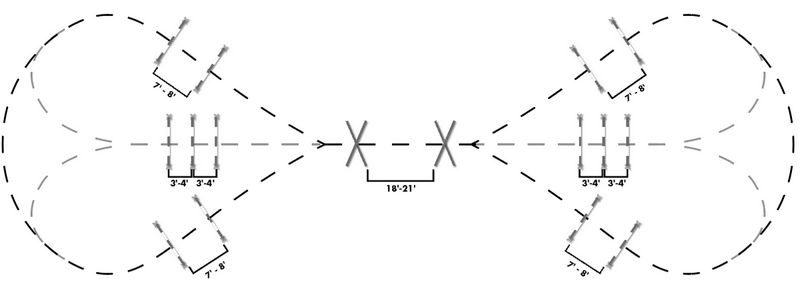
In this gymnastic exercise, you need to place the raised poles in an hourglass arrangement both before and after the cross obstacles.
These raised poles should be positioned four to five strides away from the cross obstacles and should be angled left, right, and also straight ahead so that you can choose different paths after passing through the gymnastic section.
The hourglass arrangement gives you a lot of flexibility, and the only limitation is your own creativity.
For example, you can set the two middle cross obstacles one day with a distance of one stride and another day in a bend; or use three cross obstacles to combine these two states.
To achieve the best result, I also incorporate the change of strides as part of my gymnastic program.
Practicing the change of strides is never excessive, as it helps to balance the horse and allows it to adjust the stride length.
In this exercise, you ask the horse to change strides and make various adjustments repeatedly so that its balance and athletic ability improve before, during, and after each pole or cross obstacle.
Lengthening and shortening strides in this way prepares the horse for more advanced work.
Also, during landing, it stays mentally more with you and will be waiting for your guidance.
Most horses have more trouble slowing down and shortening strides than moving forward and lengthening strides; because they naturally carry more weight on the front end and need to shift this weight back onto their haunches when making shortening strides.
Obstacles intensify this challenge, as the horse's jumping force transfers a significant amount of weight to the front end upon landing.
When you keep the distances short between the raised poles and cross obstacles, you not only help to approach more evenly and balanced, but you also encourage a slower and softer landing.
Executing multiple stride changes in these exercises teaches your horse how to rebalance its weight to stay lighter during landing and helps you regain control.
You also need to quickly recover your body position to reinforce and accompany this effort of the horse to rebalance.
If you do not react and the horse focuses on the next obstacle instead of paying attention to you, it will take control and stiffen against you; change its mind by transitioning to a trot or even a walk, then start over from the beginning.
When the horse thinks with you, not instead of you, it will be easier to manage it when countering on a complete path.
Benefits of this exercise: • Forces the horse to think about where its feet are placed, • Improves the horse's accuracy when taking off, • Increases its agility between obstacles, • Helps with better jumping form, • Improves balance and rideability, • Strengthens the horse's attention to the rider's commands, • And helps to approach more evenly and balanced as well as a slower and softer landing.
Who can perform this exercise? Anyone can perform this exercise with any horse.
For an easier version, you can use poles instead of cross obstacles.
The layout of this exercise should be arranged so that jumping is possible from both directions.
Check the diagram below.
Using two cross rails on the center line, create a one-stride distance of 18 to 21 feet or a bounce of 10 to 12 feet and place ground lines on both sides of them.
Ground lines help improve balance and adjustability further, as they shorten the stride between jumps and thus make the distances tighter than what is typically used in a course.
Set up a one-stride combination with two cross rails and ground lines on the center line; also place three raised poles in a straight line, before and after the cross rails, and two raised poles at left and right angles, before and after the two cross rails.
From "Riding with Life: Lessons from the Horse," place three poles that are raised 6 inches off the ground, spaced 3 to 4 feet apart in a straight line and 4 to 5 strides before and after the cross rails.
Since you change rhythm to a canter to go over these poles, the exact size of this line does not matter much, as the distance is not relevant; however, it can be adjusted to about 60 feet or according to the space you have available.
This set of closely spaced poles forces the horse to think about placing its feet and encourages the downward rhythm change to canter between the cross rails and the straight line towards the raised poles.
Then, at the left and right angles, place two raised poles about four or five strides before and after the two cross rails, spaced 7 to 8 feet apart.
Adjust the height of the raised poles to 6 or 12 inches.
You can approach both heights with a canter or a counter.
If the poles are 6 inches high, you have the option to canter over both.
If the poles are 12 inches high, your horse must jump them as a bounce, whether from a canter or a counter.
How to execute this exercise:
1. First, warm up your horse at the walk, canter, and counter.
This exercise can be part of your ongoing warm-up on the flat with a few poles and small jumps in the course.
This is just an exercise to improve adjustability.
2. Start with a canter towards each set of raised poles.
If your horse was in a counter after landing, either continue in the counter or change rhythm to a canter and head towards the cross rails on the center line.
After landing, return to a canter or continue with a soft counter.
3. After the cross rails, go straight over the three raised poles with a canter.
Turn left or right and canter or counter over one set of raised poles, then take a bending line towards the cross rails, whether with a canter or a counter.
Continue by first passing through the bending line and then returning in a straight line.
4. Continuously change the rhythm and pattern of this exercise so that your horse remains soft, flexible, and fully attentive to you.
The horse must not only respond to your feel and aids but also focus on the line you choose and correctly place its feet before and after the jumps on the raised poles.
5. While practicing, always pay attention to the direct line of the horse's movement.
Aim for the center of each rail or cross rail and, with complete discipline, guide the horse on a straight line after landing and moving away from the obstacles.
Even if your path has bent left or right, continue in a straight line after the turn so that the horse remains honest and straight between your aids.
About Melanie Smith Taylor thanks to Melanie Smith Taylor Melanie Smith Taylor is an internationally recognized rider and coach with numerous honors in the sport of show jumping.
Melanie was a member of the team that won a gold medal at the 1979 Pan American Games in Puerto Rico, achieved an individual bronze medal at the "Alternative Olympics" in 1980 with her beloved horse Calypso, and again won a team gold medal at the 1984 Los Angeles Olympics with Calypso.
She became the World Cup Final champion in 1982 and also placed second in 1980.
Melanie retired from competition in 1987, but she remains active in the sport of riding.
She is a television commentator, course designer, judge, and instructor, and also trains young riders.
Melanie is based at Wildwood Farm in Germantown, Tennessee.
This article was first published in the Winter 2019 issue of Practical Horseman and is adapted from the book "Riding with Life: Lessons from the Horse" by Melanie Smith Taylor and Jimmy Wofford; a book available through Eclectic-Horseman.
.com and Amazon.
.com.
Copies are available for purchase.
Readers can receive a signed copy by contacting Melanie directly through her website at melaniesmithtaylor.
.com.
Source: Practical Horseman – Training