Horse training on outdoor trails
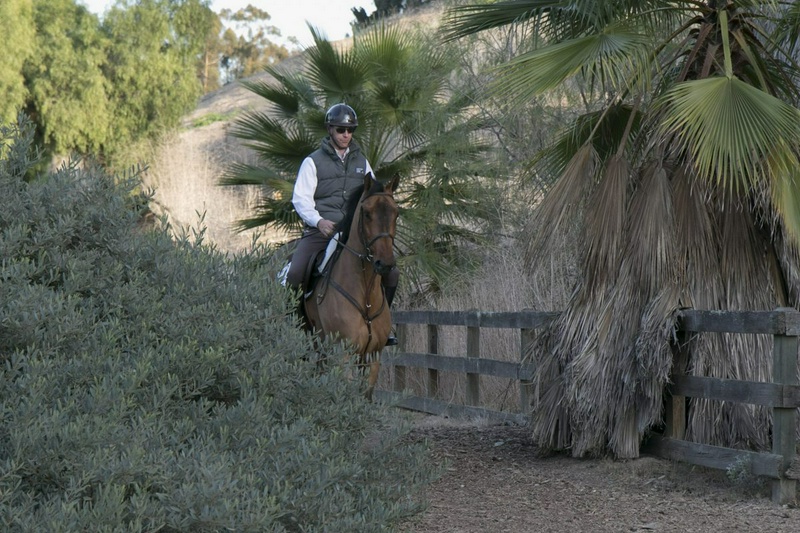
In school, there is a reason that not every day is dedicated solely to math or social studies.
A person can only focus on a fixed topic for a limited time.
I firmly believe that this principle also applies to training horses.
In our training program, which focuses on show jumping, I have often seen that variety in exercises and the working environment with horses has many benefits; whether we are working with young and inexperienced horses or with horses at the Grand Prix level.
As a rider and trainer, I prefer a diverse training approach because it allows me to see my horse from multiple angles and in different situations, which helps in better understanding him.
In addition to the usual exercises in the arena, I work with horses from the ground, I lunge them, I work with long lines, I free school them in the round pen, and I take them out on trails.
Among these methods, riding on trails outside the arena is one of my favorite options, and I recommend it to almost all riders; of course, provided they have the minimum necessary skills and confidence in the saddle to do so safely.
Since trails outside the arena often come with a few scary situations—at least from the horse's perspective—teaching your horse to listen to your aids and accept you as his leader wherever you go can be very beneficial.
Both of these behaviors lead to better responsiveness from the horse and also to a stronger relationship between you and him.
Moreover, every time you go out of the arena, the change of scenery is a great mental break for both of you.
The numerous physical benefits of riding in natural terrains begin with the horse learning to maintain his balance on different types of ground and to navigate uphill and downhill.
Or rather, it is better to say that he relearns these skills.
If we allow horses, they are surprisingly agile on their feet.
They are not made to move only on perfectly flat and prepared ground.
Just imagine wild horses galloping at full speed across the desert or rocky plains.
Of course, if they are not accustomed to moving on varied terrain, it will take some time for them to regain this agility and body awareness; that is, the understanding that tells them how their legs and other body parts are positioned relative to the ground.
When this natural agility improves, the horse's ability to adapt to whatever comes up on a challenging trail or to compensate for a slip or movement error becomes significantly better.
Walking and trotting uphill is excellent for building the muscles in the horse's hindquarters; those very muscles that provide the necessary power for the horse's engaged and correct work on the flat and also for lifting off the ground when jumping over obstacles.
Also, for a true understanding of the "uphill" and "downhill" movement states, nothing beats riding your horse uphill and downhill yourself.
There is no need for the slope to be steep to clearly feel how your horse feels in that ideal uphill movement framework and how this feeling differs from the state when he moves downhill on the forehand.
When you go to places like Spruce Meadows in Calgary or any other derby field where part of the course is on a gentle incline up or down, you will be amazed at how much this slight uphill or downhill changes the balance.
Many times, this amount is enough to disrupt the horse's and/or rider's distance to the next obstacle or puts the rider in an unstable position in the saddle.
I usually combine free work and collected work during my rides on the course.
Free work allows the horse to stretch its head and neck, although my contact with the bit is never so loose that I lose control if something causes it to spook.
In collected work, I keep the horse a bit in frame so we can work on engaging the body and strengthening the muscles.
I usually include walk and trot in the program and sometimes work in a long, flat counter.
Throughout the week, most of our horses go to the course at least once; two times is good, and three times is excellent.
Fitness rides on the course that emphasize serious work on the incline and collected work are never done on two consecutive days, as the horse's muscles need time to recover.
I do not do more than three fitness riding sessions on the course in a week, but I may dedicate more time to riding on the course using a short course as a warm-up for what we are going to do in the arena; for example, 10 or 15 minutes of light work on the course instead of flat work in the ring.
Riding on the course often comes with a few scary situations, so it is very important that your horse listens to your aids and trusts you as its leader, wherever you are.
To start developing these traits, you should begin course riding training in the arena.
Know its sensitivity range in our program; a beginner rider never goes to the course until they have achieved a solid seat in all gaits.
The first session of multiple rides outside the arena is done with a horse that is completely comfortable and confident on the course.
When an experienced rider comes to us with their horse, before I encourage them to go to the course, I first take the horse for a ride on the course myself.
If you or your horse are inexperienced in course riding or are concerned about facing unfamiliar situations outside the ring, it is better to start slowly; that is, first familiarize it with unfamiliar objects in the arena and then gradually extend the work outside of it.
While riding, think about what might worry your horse.
Fear is an interesting phenomenon.
I have a horse that is afraid of the water jump but nothing else.
I have another horse that does not jump the Liverpool with a blue liner, but has no problem with the Liverpool with a red liner.
You can quickly guess what your horse is afraid of.
Just as if you have a friend who dislikes the chair lift at the ski slope, you can probably guess they won't like the elevator either.
With enough experience and exposure, you can gradually discern what is going to be troublesome for your horse.
Unfamiliar objects in the field can be anything that is new to your horse.
Be creative; throw a blanket over a jump, put a banner on the wall of the arena, place a few orange traffic cones in the middle of the arena, or stack some jump poles in a corner.
Among the methods that can help your horse overcome its fear of an unfamiliar object, these include: practicing in a part of the arena that is far from the scary object or area, then allowing it to rest near that same spot so that it becomes a safe place for it.
When you are working with it at a safe distance from what it fears, ignore that fear factor and encourage it to respond to your leg.
If it reacts to that scary object by speeding up, slowing down, or jumping sideways, your main focus should be on how it responds correctly to your aids, not the object itself.
When the horse stays with the aids, you can gradually bring it closer to what it fears.
Instead of walking over the object, walk beside it or around it.
If another horse is a friend of your horse, let it approach the object a little ahead of your horse.
Throughout this part of the ride, try to understand your horse.
This means knowing where what I call its "bubble," the amount of fear it can tolerate in a scary situation, is.
I call it a "bubble" because this boundary is somewhat flexible, and if you push too quickly or too hard against it, it will burst.
Every horse's bubble is different, and you should allow the horse itself to show you where this bubble is; that is, take it to the edge of its comfort zone.
Tension in the muscles and raising the head are often the first signs of this bubble forming.
The next sign may be reluctance to move forward.
So far, the situation is still acceptable, but when you feel that it has shifted from being alert and focused on you to wanting to turn back and escape, it means it has shown you its boundary.
At that moment, you should allow the horse to distance itself from that scary object.
Go to another part of the arena and do some more complex exercises to get its mind focused on you instead of that object; continue this until it becomes calmer both physically and mentally.
It will show you this by lowering its head, relaxing its muscles, and showing a willingness to move forward.
Then go back to that scary object again.
Take this outside the arena when your horse becomes comfortable approaching unfamiliar or scary objects in the arena; you can start doing the same outside the arena.
Familiarize it with the idea of riding on the trail; this can be done by riding it in any safe area of the stable yard.
In my stable, the boxes face the open space; that’s why I ride the young or inexperienced horse up and down the path next to the boxes.
You can also move around the entire area and get as close as possible to the side buildings, manure pile, tractor shed, dumpster, and similar items.
This dumpster is not always in the area.
When we get close to it, the raised head and muscle tension indicate that it is nearing its "bubble"; that is, the limit of how much it can tolerate a frightening situation before a negative reaction.
I engage my legs more, apply more pressure with my inside leg, and use indirect inside rein to move the raised head away from the dumpster so that its body bends.
Contact with the reins and legs can be equivalent to the reassuring hand of an adult guiding a frightened child across the street: "I know you're scared, but we're going to do this."
Although Kash is still worried, you can tell from the position of his ears that his attention is on me.
Kash has almost concluded that he is comfortable with the trash can, but I still guide him a bit more towards the reins with my legs to ensure his focus remains on me.
My right leg is positioned behind my left leg to prevent Kash's hindquarters from drifting away from the trash can.
I also still have a bit more contact on the inside rein to keep his attention on me.
As you did in the arena, gradually progress from the least stressful areas to the scariest ones.
Don't dive headfirst into the situation and try to solve the problem right there.
Always ensure the horse is paying attention to your aids and moving forward.
When you are confident that you can maintain the horse's responsiveness to your aids even when scared of something, you are ready to take this skill out onto the trails.
The unpredictability of things you encounter on the trail adds to the challenge, but if you have established responsiveness and trust, you should be prepared for it.
Riding on the trail teaches the horse to maintain its balance on different types of terrain and while going up and down hills; a skill that helps him better correct any slips or missteps on difficult paths.
This short, sloped hill with a loose surface helps me ensure that Kash is listening to my aids.
I shift my weight back to stay above his center of gravity while maintaining a soft contact with his mouth, allowing him to determine where to place his feet.
The small logs and slight drop of the retaining wall on the trail provide excellent exercises for our teamwork as we approach them at a walk.
The stability of my lower leg and the fluidity of my upper body allow me to stay with him during the first few jumps of his big, unnecessary leaps off of it.
Encountering barking dogs is a common occurrence.
The trails we access pass through a residential neighborhood; a place where dogs often appear next to property fences and sometimes it seems this happens almost without warning.
However, it is very rare for a horse to be unaware of what is ahead.
Usually, before the barking of the dogs starts and they show up, you can sense your horse's energy and nervousness.
When you feel this nervous energy, stop, take a deep breath, and identify the cause of your horse's concern.
At this stage, it is very important to convey confidence in every command you give.
It is usually better to keep the horse on your leg and hand aids while stepping back and forth along the fence that separates you from the barking dog, and perhaps for more reassurance, give a pat on his neck.
Some people do not realize that putting the horse on aids and petting him actually increases his trust.
It's just like when a mother takes her child's hand to cross the street.
You are essentially saying: I know you're scared, but this is our path.
It is rare for a horse to be unaware that it is approaching an animal like a dog.
When I first felt the nervous tension in him, I took a deep breath and tried to understand what was worrying him.
Then, with the pressure of my legs and at the same time with a soft hand, I kept his attention on me.
In response, he releases his breath and answers the pressure of the reins by lowering his head.
I move him back and forth along the fence until he feels completely comfortable.
This relatively calm reaction has not come overnight.
For several years, I have gradually acquainted him with unfamiliar situations, so he trusts me not to put him in any danger.
This partnership has made us stronger competitors in the arena.
It is astonishing how quickly a horse can go from intense fear of something to complete acceptance of it.
Often, if we do not give the horse enough time to understand and digest what is really happening, the fear of the unknown remains.
Of course, all of this assumes that the dog is kept inside a fenced property.
Encountering an aggressive dog that is free is a completely different story.
If you have problems with dogs or any other moving things, return to an area that the horse considers safer and find something that is scary for your horse but is stationary and still.
For example, a water trough may be scary, but it is not supposed to move.
In any kind of training, exercises can always be broken down into smaller parts.
If you cannot canter, walk.
If you cannot walk, crawl.
Progress step by step until you eventually reach where you want to go.
Especially for show jumping riders, it is good to find small logs to jump over or narrow passages to go through.
Horses usually do not like tight and confined spaces; therefore, using such situations is another opportunity to instill the concept that responding to your aids is more important than what the horse does not like.
Our routes include two short tunnels that pass under the roads of Nelly Gill Ranch neighborhood; a horse-riding-centric area.
Unusual situations like this often provoke the horse's resistance and provide an opportunity to reinforce the point that he cannot ignore your leg aids.
If your horse hesitates in front of something or refuses to go, and you decide it does not matter because this happens in front of an obstacle on the competition course, you have actually missed a training opportunity.
I see these course challenges as simulating the same problems that arise in the competition arena when a horse is afraid of a specific obstacle.
In my opinion, other disciplines have a better understanding of the fact that exposing horses to diverse situations and environments is a very effective way to enhance their training in their specific discipline.
In addition to maintaining the training process and the physical preparation of the horse, adding variety to his daily routine, riding in nature is a great way to enjoy spending time with your horse; something that I believe is an important part of good horsemanship.
Maintain his trust regardless of what your horse is afraid of; the solution lies in your ability to keep his trust and also maintain the connection between the rider's leg and hand so that the horse willingly and confidently goes where you guide him.
Your duty is to never put him in a position where his safety is at risk.
When the horse understands this, it realizes that going to where you want it to is not a problem.
Of course, it is never worth putting yourself or your horse at real risk for training.
Tips for successful riding in the natural trail realistically assess your own abilities and see what you know and what you expect about your horse's tolerance for the unpredictable situations that are common in natural trail riding.
If you are even slightly concerned that you might not be able to manage your horse, seek help from a professional.
If you are a beginner, only go to the natural trail when you have found a firm and confident seat at all gaits.
At the start, it is better to go to the trail with a horse that is completely comfortable and confident in such an environment.
A tired horse is usually a calmer horse; for this reason, I almost always recommend taking a horse that is not yet accustomed to the natural trail after a good and complete workout in the arena to this type of trail.
Having another horse can be effective.
Many horses respond better when there is a calm and experienced horse accompanying them on the trail and moving ahead during the ride.
I usually recommend that the rider of the accompanying horse be an experienced individual.
About Lynn Clark Lynn Clark is a partner with her trainer Mickey Hayden at the Hayden Clark Sport Horses riding club in Laguna Hills, Southern California.
She was born in Australia and moved to the United States with her family at a young age.
Lynn's father, Alan Clark, is a well-known figure in the horse world, famous for his success in working with young and problematic horses.
Lynn's mother, Meredith, and her brother, Lynn, are farriers.
Lynn achieved success in the lower levels of show jumping under her father's guidance, which caught Mickey's attention; someone who admired both Lynn's abilities and her work ethic.
Lynn began her career as a working student, progressed to a paid assistant in her teenage years, and became a business partner in the organization in January 2017.
Along the way, she has both trained her students and brought horses to the Grand Prix level.
Recent significant results include winning the $75,000 HITS Coachella Desert Circuit Grand Prix and placing third in the $100,000 FEI Longines World Cup qualifier in Thermal in 2017.
Her emphasis on diversity in horse training reflects the lessons she has learned from her father and from Mickey, blended with her personal experiences.
Lynn, 33, and her husband Jennifer Rees Clark, an equine veterinarian, have a 3-year-old daughter named Emerson.
Source: Practical Horseman – Training