Training a young eventing horse to jump a corner and a narrow obstacle
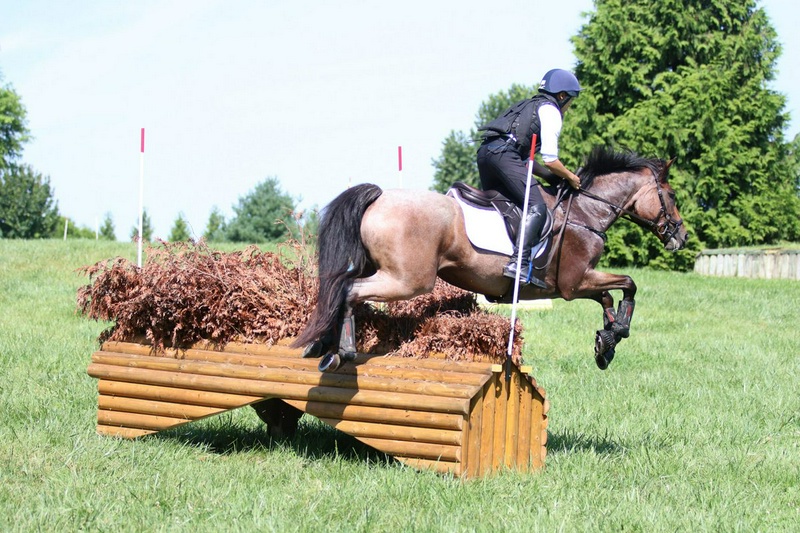
Clayton Fredericks, the Olympic eventing rider from Australia, says that when introducing young horses to corner and narrow obstacles in cross-country, everything depends on calmness, confidence, and encouragement; alongside the fact that the horse must have good balance and provide quality country.
He explained: "If you do the groundwork correctly from the very beginning and bring your horse to a place where it has the necessary driving force and looks for the obstacle itself with good balance and the right rhythm, then you can just stay in the middle and have minimal interference in the last few strides to the obstacle.
This gives young horses a lot of confidence.
Although we are currently doing these exercises in the arena, the ultimate goal is to train for building confidence in cross-country.
"Clayton Fredericks, the Olympic eventing rider from Australia, says that when introducing young horses to corner and narrow obstacles in cross-country, calmness, confidence, and encouragement are paramount.
In this training session, Fredericks helps two riders familiarize their young eventing horses with corner and narrow obstacles, using a traditional approach and perpendicular entry to the obstacle, while emphasizing the creation of confidence and calmness.
He then makes the work more challenging for these riders with a combination of corner obstacles and also increasing the angle of the corner obstacle; an approach that is considered a more modern way of facing these types of obstacles in the sport.
We hope Fredericks' smart tips help you to have your young eventing horse easily navigate corner and narrow obstacles.
Perpendicular entry to corner obstacles He said: "We start by thinking about jumping from a corner obstacle along with this narrow obstacle.
I have placed the rails close together so that it resembles a vertical obstacle or a small oxer.
I want you to ride it softly and calmly while maintaining the rhythm, but due to the width of the obstacle, you may need to push the horse half a degree more forward.
"I have set good ground lines for you and I would like to place one or two side rails as well to help the horses focus better on the obstacle; for young horses, I prefer to use soft foam rails.
If they escape from the side of the obstacle, this prevents injury and getting stuck and slipping.
I also place blocks inside the obstacles so that the horses stay away from the rails while being guided on the right line.
"At this stage, I want you to ride the obstacles completely straight and divide the angle of the apex of the obstacle into two parts; that is, the stem of the apex enters perpendicularly to give you a way to ride the corner obstacle.
This method is considered the traditional way of jumping from a corner obstacle.
A little later in this lesson, we will talk about how the angle of entry to corner obstacles has changed in modern sport.
"The first time you come over this obstacle, the young horse may look a bit at the obstacle; therefore, it is important to not only read the stride but also consider the horse's mood and the feeling it has when approaching the obstacle.
You may need to give a little leg for reassurance.
"To prevent your horse from drifting left here, think of using your outside leg like a wall or barrier to guide it to the right.
With the reins and the outside leg, close the way and try to coordinate your hands so that the horse's shoulders remain straight.
"If your horse is a bit hesitant and you feel it pauses slightly when taking off over the obstacle, act quickly and give it a short aid with your leg so it doesn't even think it has permission to pause.
"I like that this horse jumps very well over the narrow obstacle, but you might want to keep it a bit more on the line of the obstacle.
You don't want to jump this high over every obstacle.
It looks amazing, but it can clear the obstacle with more speed, of course without rushing or bringing it too close to the base of the obstacle.
"The difficult part of riding is that there are so many aspects involved.
You constantly have to think about many issues; your own balance, your horse's balance, its mental state, and the strides.
"Be careful not to lean towards the narrow obstacle.
When you reach the obstacle, your shoulders should be slightly behind your hips; that is, your upper body should be behind the horse.
Everything doesn't just relate to the legs and hands.
Most of the time, your body language is more important.
If you are safely behind your horse, this is much more reassuring for it than when you use your legs too much or hold it too tightly, as this can create a lot of tension.
"Ultimately, the goal is to place your horse in good balance, with a suitable quality of canter that matches the obstacle you want to jump, and then just let it jump the obstacle by itself.
It is the horse that jumps; not us.
"Horses lose their confidence when they are kicked or pulled from the mouth and don't understand why.
The quickest way to teach a horse to stop in front of an obstacle is to pull on its mouth during the jump.
That’s why I insist that enough release is given to the horse so it can use its shoulders, legs, and body arc over the obstacle.
For me, it doesn't matter whether this release is on the mane or an automatic release, as long as you have enough skill to completely follow your horse's mouth movement.
"Jumping corner obstacles in a combination 'Now we want to make it more difficult; first, we jump from the vertical oxer to the corner obstacle and then turn around and connect the blue boards to the corner obstacle.
I haven't set these at a specific distance because I really don't want your mind to be occupied with a number.
It's very important to understand the distances and strides, but more important is to know how your horse moves in different rhythms and speeds.
"So this exercise helps us create conditions where you can gradually feel what your horse's stride length is.
This way, when you go to a competition and measure a standard distance, you can determine whether this distance is a bit short or long for your horse.
Then you can decide exactly what to do at that moment.
Not all horses are supposed to fit exactly into a standard distance mold, as each horse's stride length differs from another.
"This issue is even more important in cross-country.
You need to know your horse's stride length in different rhythms.
The faster you go and the more open your canter is, the longer your horse's stride will be.
"A part of the problem you had in the first section of this line arose because you didn't allow your horse to see the path and find its own way of walking.
You had focused again on your steps and were getting engaged to step with him.
Instead, accompany him.
"I cannot emphasize enough how important it is to always be aware and read what your horse is doing.
You rode very well the second time.
You turned the corner, changed your balance, and allowed your horse to see where it was going.
The first time, he wasn't looking at all, which is why you had a bad jump, and after that, maintaining the flow of movement became difficult.
This time you took a deeper step and it was good again because you were reading his reaction.
Then, as we discussed, you were a bit more forward and fluid.
"When it comes to young horses, it is very important to train them in a way that they see the obstacles and look for them, and when jumping, they perk up their ears so that they want to take you towards the obstacle.
Horses really enjoy jumping, and you can see that when they perk their ears forward and are eager to reach the obstacle.
"Modern approach to corners "In a more modern approach to corners, we see that they are jumped from a much wider angle at the front.
However, corners with these angles usually do not curve as much; they are more aligned in a straight line.
Therefore, the test is a bit different.
You want your horse to maintain the line and still jump the corner, but the risk of refusal at the obstacle also increases.
"So we set these corners in such a way that they have a much greater angle at the front so that you can feel this situation.
Remember that the corner itself has not necessarily become wider; we are just changing its front view to make the line a bit riskier.
"To make this exercise a good training exercise for young horses as well, I use some poles to better show you the line.
You are still on the line of the blocks, but the angle at the front has increased significantly.
"The first time you went through this path, you were overly negative.
Trust your horse.
This exercise is for his training, so trust him.
Go along the Chaharnal line and let him look for himself.
You don't need to rush, but position yourself on the line and recognize what step he is taking.
"The interesting thing is that from your horse's perspective, he sees the line or flag and doesn't really realize that the obstacle is placed at a much wider angle.
What he sees is just the flag or the white wings of the obstacle here.
Ride confidently, keep him forward, and let his gaze stay on the target.
Don't get too involved with him.
If you ride with hesitation, you are actually encouraging him to become a bit negative as well.
"The second time was much better.
Did you feel the difference in your riding?
This is a good exercise for us because, again from your horse's perspective, this angle makes very little difference.
But from your perspective, you are trying so hard to be precise that you end up slowing down, and this takes his attention away from the obstacle.
Just position yourself on the line from the very beginning, ride the same line, and then measure the distance.
"About Clayton Fredericks Clayton Fredericks Source: Practical Horseman – Training