7 body position adjustments for better influence on the horse
We riders usually spend a lot of time focusing on what our horse is doing, and what we are doing ourselves becomes a secondary issue.
However, in reality, if we pay more attention to ourselves and understand how our body position affects the horse, we can establish a better connection with him.
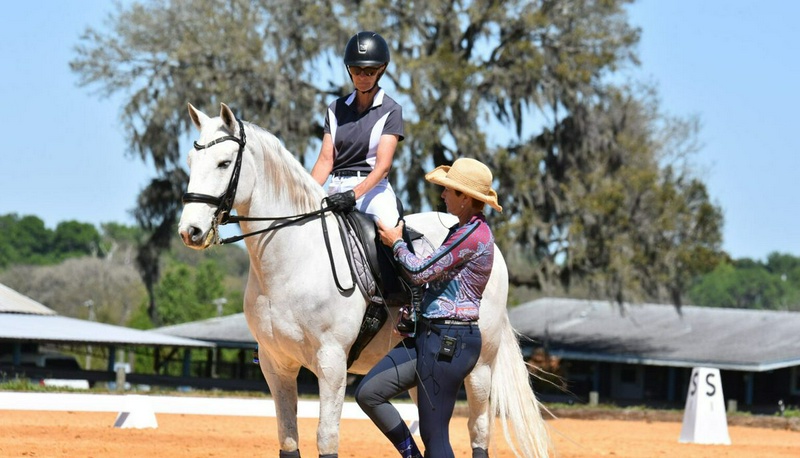
Stephanie Fish-Krasman is working with Jean Mendelzon to improve her body position so that she can have a better impact on her 12-year-old Arabian stallion, Akai B.B.F.
Working on body position requires a lot of focus.
You don’t just sit still like when you’re driving a car.
Instead, you are on a moving animal; therefore, you must constantly check and adjust your position, and this is not easy.
When I teach, I always try to find words and imagery that are understandable to my students and lead to progress in practice.
Here are some of my favorite tips; tips that I have seen are understandable and practical for many riders.
Although we present them in the context of dressage in this article, they are also applicable to hunters, show jumping, and equitation riders.
I hope these tips help you correct the weaker parts of your body position and see improvement in how your horse moves.
1.
Your seat is not just your seat Imagine that your seat is not just the point of contact with the saddle, but also includes your knees, thighs, back, torso, chest, upper arms, head, and eyes.
From the elbows down, your arms are positioned, and from the knees down, your legs.
If you look at the subject this way, your perception of using your seat in the saddle changes.
When you keep your actual seat stable and also maintain stability in these other parts of your "seat," the horse can remain more even and receive your signals more easily.
2.
Use your thighs If you feel like you are pushing in your seat and using more of your back body than your front, you may need to work on your thigh position.
If you do not create continuous stability through your thighs, your upper body will inevitably have to take on some of this responsibility; an occurrence that often causes riders to pull on the reins and lean back to compensate.
Here, Stephanie is helping Cindy Harding feel the correct use of her thighs by turning them inward and raising them slightly to lighten the weight on her stirrups.
There are many misconceptions about the correct use of the thighs.
Think of your thighs as the seatbelt of your seat.
Your thigh has four sections: outer, inner, front, and back.
You need to learn to access and use all four sections of your thigh whenever necessary.
The outer section of your thigh connects you to the saddle, but the inner section guides the horse towards collection.
In a complete halt, turn your thighs inward so that the seat area of your riding pants is visible from behind, not from the front.
If necessary, hold the reins with one hand and with the other, grab and pull back the hamstring muscles so that the main muscle volume comes out from under the thigh bones.
Then think about bringing your thighs closer to the midline or center of your body so that neither your seat becomes heavy nor do you contract the gluteal muscles.
The positive result of the correct positioning of the thigh, when the entire length of the thigh is resting on the saddle, is clearly seen; where Dandy da Prata, the gelding Lusitano of Cindy, calms down and stretches downward, on the bit.
To maintain the correct bend behind the knees, think of shaping the back of your knees like the tip of an arrow.
To feel how much weight should be on the thighs and how much on the feet, first stand on the stirrups and put 100 percent of your weight on your feet.
Then sit on the saddle, rotate the thighs inward, and lift the feet slightly inside the stirrups, so that the stirrups hang and 100 percent of the weight is placed on the thighs.
Then return 50 percent of the weight back to the feet.
To do this, imagine the stirrups rising toward the feet just as much, or even more than your feet are pressing into the stirrups.
The weight you feel in the stirrups will likely be much lighter than what you are used to.
3.
Trampoline stirrups play the same role for the rider's balance as the bit does for the horse's balance.
You should use the stirrups to regain balance without locking yourself onto them.
Riders are often taught to lower their heels more prominently.
While riding, the joints of the ankle, knee, and hip should absorb the horse's movement so that the upper body remains stable.
If you apply too much downward pressure on the stirrups, they become large pendulums at the ends of the stirrup straps that move back and forth.
When this happens, you no longer have control of your balance.
The stirrups play the same role for the rider's balance as the bit does for the horse's balance.
You should use the stirrups to regain balance without locking yourself onto them.
Stephanie works with Emma Joyal, who rides Chili, the gelding Thoroughbred owned by Karen Joyal, to bend and flex her ankle joints instead of pressing and locking onto the stirrups.
Imagine your stirrups are more like a trampoline than the ground.
If you bend and flex your joints, you stay flat and balanced on the trampoline.
But if you lock your joints against the trampoline, you lose your balance and fall.
To better understand this feeling, you can ask one of your friends to place their hand under your foot and on the stirrup's sole.
Try to lift your foot just enough that you can barely feel their fingers.
Then think about lifting your toes, and as you lift your foot, imagine you want to bring your foot up toward your thigh.
4.
Align the seat We riders have learned from the past that when you can draw an imaginary vertical line from the shoulder, alongside the hip, and down to the back of the heel, you are in the correct alignment.
However, Mary Vanless, my coach and guide, has a slightly different view on the alignment of the rider's body.
In her opinion, this imaginary vertical line should pass through the rider's shoulder, the front point of the hip, and the outer side of the ankle bone.
Petra Wilder, riding her Lusitano stallion "Golden Star," has a very beautiful alignment in her seat and upper body; so that her shoulder is above the front point of her hip, her hip is above her ankle, and her sternum is pointing toward the ring of the bit.
The alignment of Petra's body is a very good example of how the visualization of "stacking boxes," "targeting the sternum," and "carousel pole" can help the rider's positioning.
Riders usually have a very strong back, but often a group of muscles in the front of their body is less engaged; muscles that can help them maintain better balance over the horse's center of gravity.
Below are some visualizations to help you align your seat and upper body correctly so you can ride with more balance between the front and back of your body.
Stack the boxes: Many dressage riders tend to sit more in the back of their body than in the front.
However, if you ride a little forward and over the horse's center of gravity, this will have a positive effect on the horse's way of moving.
Imagine your body is made up of three boxes that connect the four parts of your body.
The collarbone is the top edge of the first box; the sternum is the bottom of the first box and the top of the middle box; the navel is the bottom of the middle box and the top of the bottom box; and the pubic bone forms the bottom of the bottom box.
The main idea is to stack each of these four parts of the body directly over the other.
Usually, one of these four areas causes issues, and this visualization can help the rider identify it.
Target your sternum: If it seems that the middle box is the area that has the issue and is not staying aligned, imagine a flashlight coming out of your sternum and practice keeping its light fixed on the third cervical vertebra of your horse.
When you do this visualization at the walk, trot, and canter, pay attention to whether your sternum continues to point to the same spot or if it changes depending on the different phases of movement.
Play with this and experiment.
If targeting your sternum towards the third vertebra of the horse does not work for you, aim it towards the front of the reins or towards the bit target.
Carousel pole: The carousel pole provides a very useful visualization for riders who are already in good body alignment but need to engage the central muscles of their front body better.
To keep your upper body forward and positioned over the horse's center of gravity, imagine you are a pole from the carousel that is attached to the ceiling, passes behind your horse's withers, goes through the area around the chest, and continues down to the ground.
If you lean back, you will tilt the entire carousel horse.
Since your body is not used to this sensation, it may feel like you are leaning forward to maintain alignment with that carousel pole, while in reality, your body is positioned correctly.
You can also think about expanding your belly towards your belt, then puckering your lips; as if you have a straw in your mouth and you are inhaling air through it and then exhaling.
This creates a strong outward pressure and allows you to feel your core muscles engaging.
5.
Engaging core muscles with breathing exercises Breathing exercises are a way to familiarize yourself with your body's core muscles and engage them; that is, the abdominal muscles, back muscles, pelvic muscles, and even to some extent the gluteal muscles; so that your upper body stabilizes and you gain more control over your seat in the saddle.
As we want the horses to engage their sides and lift their backs to carry us with more comfort and balance, we also need to engage our core muscles.
Vanless describes engaging the core muscles like this: pull your stomach in and then push out against the wall you have created.
What I have seen is that people usually do one of these two more.
Having more pressure or tension in one direction of engagement is not actually real engagement; rather, it is a kind of stiffening of the body.
Imagine this imbalance from the left and right perspective: if you give your left leg much more to the horse than your right leg, do you expect your horse to stay straight?
Jean practices engaging her core muscles using breathing exercises.
Breathing exercises are a great way to gain control over the engagement of your core muscles.
Inflating a balloon without using your hands shows you which parts of your core muscles are weaker and which parts are stronger.
You can also touch your stomach muscles with your fingertips to help your brain focus on that area.
Your brain doesn’t think much about your stomach muscles; it just assumes they are in place.
Your fingers have a lot of neural connections to the brain, so you can "borrow" these connections to your less familiar core muscles.
You can also think about expanding your stomach towards your belt, then purse your lips; as if you have a straw in your mouth and you are sucking air in and then blowing it out.
This creates a strong outward pressure and helps you feel the engagement of your core muscles.
6.
Have you found it or lost it?
I like to play a game with my students called "Did you get it or lose it?"
In this exercise, riders hold certain specific body positions; similar to the points we discussed earlier, and then examine what effect these positions have on their horses.
Sadeh Kin, riding Boo, a 5-year-old gelding of Georgian Grand breed, is "having it" in this picture and has very good alignment.
His collarbone is above his sternum, the sternum is above the navel, and the navel is above the pubic bone.
Here Sadeh has "lost it."
He has clearly been pushed back and is out of alignment, and you can see that Boo's neck has come up and the middle third of his body has dropped down instead of rising and engaging.
Riding instructors do not always remind students to pay attention to their own bodies.
Therefore, you must take responsibility for this and constantly assess your body position and what you feel throughout the ride.
How does one side of your body feel compared to the other side?
Are you balanced?
What effect does focusing on one part have on the other part?
Was it better, worse, or about the same as last time?
If it was better, what exactly improved?
This game helps you realize how quickly you can lose something, but at the same time gives you the opportunity to correct it.
And if you are not sure what the right feeling is exactly, take a few steps to let everything go completely wrong.
You and your horse will not be harmed by this short period of poor body position.
Making mistakes can help you compare and better understand the changes you need to make to succeed.
7.
Balance, not strength, is a large part of riding, understanding how little muscle engagement you can use to maintain your body position.
This is similar to holding a yoga pose; you want to see which other parts of your body can relax and stay calm while you hold a position.
It’s better to stay organized and controlled in your balance than to try to forcefully influence the horse, as this only creates tension.
The body’s proprioception refers to the brain’s awareness of the body’s position in space.
I like to tell people that proprioception is a complete liar!
Your body does what feels normal to it, but normalcy in riding does not necessarily mean correctness.
Mary Wanless has a phrase that sums this up well: “Embrace the weird.”
Getting into the correct riding position may feel very unfamiliar at first.
To improve your body position and overall quality of riding, it’s very important to be curious, but not critical and judgmental.
Use mirrors to check your body alignment.
Work with a coach and create descriptions for yourself that help you understand what your body feels like in each position.
Also, focus on what your horse is doing; does he move better because you are in better balance?
For more information: About Stephanie Fish Crossman Stephanie Fish Crossman.
Stephanie Fish Crossman began riding as a child in Maine and was introduced to dressage at 18, leaving college to work as an apprentice alongside Michael Poulin.
After a successful career in management in the Florida hospitality industry, working with large and small animal veterinarians and grooming for Jane Savoy, she studied at the International Academy of Equestrian Studies in Warendorf, Germany—which is no longer operational—and graduated with a national coaching certificate.
She is also a holder of the bronze and silver USDF medals and is one of only 9 coaches certified by the “Ride with Your Mind” biomechanics system of Mary Wanless in the United States.
She is currently based in Brooksville, Florida.
Sources and Attachments: EQUESTRIAN+ here Source: Practical Horseman – Training