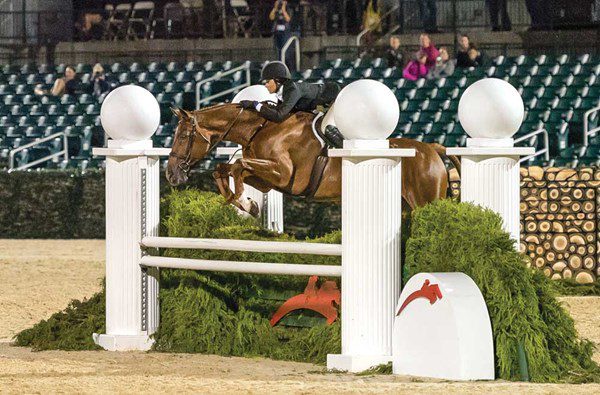
But for Kristy Herrera, the winner of the International Hunter Derby Championship of the United States Hunter Jumper Association this year at the Kentucky Horse Park in Lexington, this challenge was particularly tougher.
Her horse, Miss Lucy, belonged to Helen Lenahan; a horse that Kristy had only been riding for two weeks.
Jennifer Alfano, the coach of this team, is standing next to the last obstacle of the hunter round; a wall with a height of 5 feet and 1.5 inches.
Miss Lucy usually competed with Jennifer, but she was unable to participate in this competition this year due to injury, so her former student, Kristy Herrera, in a red jacket, rode this chestnut mare.
Miss Lucy was an experienced horse and, with Jennifer Alfano in the saddle, was considered one of the successful and steady horses on the derby circuit.
Jennifer was not an unfamiliar face in this class either; she had won the derby with Jersey Boy in 2012.
However, in May, Jennifer suffered serious injuries during a fall at the Devon Horse Show and had several months of surgery and recovery ahead.
When she couldn’t go to this championship herself with Miss Lucy, she preferred her former student to ride this talented but special mare.
Jennifer explained, “If I was going to hand the reins to someone, it would have been hard for anyone other than Kristy.
“We have a long-standing and old relationship, and that makes it easier.
“The fact that Kristy and I are this close was very important.
“Because she didn’t know this horse, she had to trust me.
“This trust paid off; Kristy was able to guide this 14-year-old mare correctly to the last obstacle of the hunter round, which was the wooden wall with a height of 5 feet and 1.5 inches.
This pair became the champions of 2016 with a total score of 587 achieved over two days of competition, pulling ahead by five points from Kodakrum, the horse of Kelly Farmer.
This championship is the culmination of over 70 derby events throughout the year and includes both a classic round and a hunter round.
This year, 40 out of 66 horses present in the championship qualified for the hunter round held on Saturday night, August 20, at the Sheila C. Johnson Arena.
Each horse and rider combination was scored by 6 judges in the form of 3 two-person judging panels.
Riders received an additional point from each panel for every high option obstacle they chose.
Each panel could also award up to 10 bonus points to each rider based on the level of agility and skill in executing the course.
The final ranking was determined based on the total score of the classic round and the hunter round.
The championship derby courses were designed by course designers, Danny Moore and Bobby Murphy; they wanted to present a traditional course in the style of hunting that was also technically challenging enough to distinguish the participants.
Despite the sharp turns of this hunter course and the high and heavy options, Kristy said she felt confident on Miss Lucy because “there is no obstacle you can’t take her to.
She is an extraordinary horse.
Everyone has the capacity for jumping and power.
I mostly just tried not to disturb him and trust that he has the necessary jumping capacity; that you can go with a counter and a loose rein to the base of a huge jump and he will handle it.
"Tom Brennan, the judge of the competition, said Kristy and Miss Lucy were 'consistently excellent' throughout the championship weekend, and this overall performance brought them the championship title.
Tom explained, "Miss Lucy was very competitive on the Indian course, but where she won the championship was her consistency over the two days.
She was agile and Indian enough to stay in the race with bonus points, but she wasn't the most Indian of all.
Where she really pulled ahead of the rest was with a stable and consistent performance that came with a bit of risk.
This mare jumped very well.
She jumped time and again with the same correct and proper style we were looking for.
There really was no fault to be found with her.
"A sand sculpture depicting a cow peeking out from a stable was among the tall and short options of obstacle 6.
Course designers, Bobby Murphy and Danny Moore, included 10 custom sand sculptures as part of the obstacle design for this championship.
Next, you will read a fence-by-fence review of the Indian round; along with Kristy's insights on how she navigated this challenging course and also comments from Jennifer; a coach and spectator who was rightly anxious.
Obstacle 1: Picket gate and hedge Height: tall option on the right, 4 feet and 7 inches; short option on the left, 3 feet and 10 inches Structure: a vertical obstacle with bush shelves behind a white picket gate.
The width of each option was 18 feet (left to right) and the depth of the bush shelf was 16 inches.
Course designer notes: Riders came to the center of the arena with a counter and then turned back towards obstacle 1, moving towards the spectator stands.
After the classic round, more ground lines had been added to this obstacle, as some horses were having trouble jumping it with the proper form.
Bobby said, "We wanted the horses to jump this beautiful obstacle.
There was no pole to be knocked down.
This obstacle was the focal point of the arena, and it felt like the horses were saying, 'Hello, I'm here to start my course.'
" Both options of the first obstacle were accessible from the right or left lead.
Bobby said, "This course was about equality.
We wanted horses that each preferred a lead to have an equal start.
" Kristy: The most important thing Jen told me was to ride this like the first round and take the turn tighter.
This tip helped me, because sometimes in Indian rounds I get overly ambitious and push too much.
I was both anxious and confident in Lucy.
When I entered, I told myself, 'Come on, we can handle this.'
The first thing was to get a good Chaharnal.
Chaharnal is part of the Indian, so I just wanted to show that we are moving forward.
I had to slow down for that turn, and the distance came up a little short from the water, but Lucy is amazing at opening up and that made everything go really well.
Obstacle 3 on the right was surrounded by a sand sculpture of the USHJA logo.
I jumped over the first obstacle and right there I realized things were good.
That obstacle was really a big gate.
It had an incredible feel in the air and was the first tall option.
It went so well that it gave me confidence and made me able to think about continuing the path from there.
Jennifer: We reviewed the course — maybe about a hundred times — and then I said, "Good luck and enjoy."
I just wanted everything to go well and for Kristi to have an enjoyable experience, but I was really anxious myself.
To be honest, I was a bit out of it.
I'm not a good spectator.
I kept going up and down.
And believe me, I jumped every obstacle with her.
Kristi executes the instructions incredibly well.
She did exactly what I told her to do.
When she started, I was worried about the turn between obstacles 1 and 2; it was very tight.
Lucy is a big, long horse and turns like a school bus.
But when she passed that turn and reached obstacle 2, I felt good.
Obstacles 2 and 3: Oxer to vertical height: both obstacles were set at a height of 3 feet and 10 inches on the seven-stride line.
Structure: Obstacle 2 was an oxer framed with large white columns.
This obstacle included three brush sections, a white Riviera gate at the front, and double rails at the back.
Obstacle 3 was the first obstacle with a sand sculpture: a vertical resembling a bridge made of brush, with sand sculptures of blue ribbons and the USHJA logo on both sides.
Course designer notes: For this obstacle, it was necessary to take a sharp right turn from inside obstacle 11 to straighten out for this line that was moving away from the entry gate.
Bobby said, "Obstacle 2 was just a heavier version of obstacle 1.
We just wanted to set the horses up.
But the 103-foot distance from the oxer to the vertical created a technical challenge for riding.
The horses needed to have high agility to make that inside turn."
Kristi: You had to take that turn with purpose because the oxer was wide and the line angled to the right.
If you cut the turn, you would be directed to the left and the line would become longer.
I tried to take the turn smoothly so I could come forward after exiting it.
Miss Lucy jumped the oxer so well that passing through the seven-stride line after that became easy.
Obstacle 4: Oxer with natural rails height: the tall option on the left was 4 feet and 9 inches; the short option on the right was 3 feet and 9 inches, creating an oxer with natural rails positioned at an angle towards the entrance gate of the arena.
The sand sculpture in front depicted a scene from the Chicago Hunter Derby, and behind it was a scene of a fox and hunting dogs, situated between the tall and short options.
The tall option was 4 feet wide and 12 feet long, while the short option was 3 feet and 9 inches wide and 16 feet long.
Course designer notes: A technical left turn towards the angled oxer.
The taller and narrower option was on the left, making the turn more difficult.
Bobby said, "In this section of the course, we had to turn left."
He added, "And we decided to use a rail, so we ultimately added an extra rail to give this obstacle a sturdier appearance."
This obstacle was one of a total of 3 oxers that, according to the rules of the United States Equestrian Federation, had to be placed on the course.
Kristi: Throughout this turn, I had to think about reaching the base of the obstacle because it was a big oxer and some horses had trouble with it.
But she came out of the step very well.
She jumped over it amazingly.
I just held onto the braided mane and managed to stay on the horse.
After landing, I heard someone's whistle.
I had to stay in my balance center and make the next turn towards the jump at a canter.
Kristy jumped the tall option of obstacle 4, with a height of 4 feet and 9 inches; oxer with a width of 4 feet and natural rails.
Obstacle 5: canter jump height: 3 feet made: a natural log.
Its width was about 2 feet and 6 inches to 3 feet and it became slightly narrower in the middle section.
Course designer notes: This rustic log was borrowed from the cross-country course on the other side of the Kentucky Horse Park.
Bobby described its placement as "a suitable spot for a canter jump," as the roll-back gave riders time to adjust themselves for the canter passage.
Kristy: Jen and I had talked about needing to approach it completely straight.
Since it was a log, it counted as a solid obstacle and was also a bit wide, so it couldn't be approached at an angle.
But Lucy is amazing at the canter jump.
She passed over it very politely, as if it were a cross-rail.
This made the landing very good and allowed us to move forward towards the next obstacle.
Obstacle 6: Classic Log Icon height: tall option on the right, 4 feet and 9 inches; short option on the left, 3 feet and 8 inches made: this impressive yet traditional obstacle of logs and bushes, named "Denny and Bobby's Barnyard," honored the course designers and the sand sculpture between the two options depicting a cow peeking out from inside a barn.
This obstacle consisted of stacked tall logs, and on the approach side, the bushes were sloped against the obstacle.
The shorter logs on top of the obstacle were cut into 2-foot pieces and placed in a shallow trough so that if a collision occurred, they would roll off from their place and fall down.
On the landing side, cut-out images of an opossum, several chickens, and a fox hidden in a tree added to this theme.
Course designer notes: After turning right after the canter jump, riders moved along the top of the field with a counter to jump one of the two angled options of obstacle 6.
Bobby said this obstacle appeared to have a vertical face, but due to the bushes and branches leading to the log, it acted more like a triple bar.
He said, "We wanted the rider to just let go of the reins a little and bring the horse up to the base of the obstacle."
Kristy: At that point, I had passed half of the course.
I always try to break the course down into different sections and think about it piece by piece.
So for me, it felt like everything was starting over; after the canter jump, I had to gather myself again.
That obstacle wasn't troublesome for me.
The day before, jumping it was easy, and there were a lot of bushes and branches on it.
On the other hand, Lucy jumps almost all obstacles in the same way, so you just had to stay with her for the time in the air.
Kristy didn't look at obstacle 11, the last jump of the course, until 7 or 8 strides before it to avoid getting too long of a distance.
Jennifer: At that moment, I really felt a lot of confidence because everything was going incredibly well.
Kristy is really thoughtful and analytical while riding.
Everything was coming together.
Obstacle 7: Kentucky Horse Race height: 3 feet and 10 inches from both sides made: a pair of inviting vertical obstacles with a filler 3 feet wide from the hedge.
This obstacle was designed to resemble the railings of a competition track and was made from a hedge, bushes, and a row of holly shrubs.
The bases of the obstacle were shaped like the towers of Churchill Downs, and the sand sculpture between the two obstacles was also a tribute to American Pharoah, the Triple Crown champion.
Course designer's notes: a quick turn to the right for choosing the right or left side of this obstacle, but without an option for a height difference.
Riders had plenty of space to find the right angle and prepare for a sharp turn towards obstacle 8, as both sides were 20 feet wide.
Kristi: I jumped the right side of the obstacle because it had a more practical entry and created a nicer and more compact turn towards the sand obstacle, which is obstacle 8.
The course always affects the distance, so when I approached the obstacle, I saw the distance very well and was able to maintain the same angle.
Obstacle 8: Sand obstacle height: 3 feet and 8 inches made: a unique vertical obstacle made of compressed sand with a 3-inch thick foam layer on top covered with artificial grass.
Course designer's notes: In the week leading up to the Derby, media were invited to observe the process of creating the sand sculptures in the field.
Bobby said, "One of them asked me if the horses were really going to jump over the sand?"
He continued, "And I said, 'Yes, they will do just that.' So I committed myself to this idea and knew we had to execute it."
Even though the sand obstacle was reinforced with adhesive, it likely wouldn't hold up in the event of a major misstep by one of the horses.
Bobby said, "We took a lot of precautions to make this idea work."
"But I told everyone, 'Don't mess up this obstacle, because it will definitely be photographed in the media.'"
Kristi: After the turn, I went a bit more patiently, but Lucy can jump from a nearly standing position, so I was still able to keep her compact.
I think I was lucky to go later in this class and no one had messed up the obstacle.
It was just a clean turn towards the obstacle.
Obstacles 9 and 10: Wagon Wheel In-Out combination height: obstacle 9, which is the vertical entry, was 3 feet and 9 inches tall and consisted of a single pole placed on a roll-top that was 3 feet wide.
Obstacle 10, which is the oxer exit, was also 3 feet and 9 inches tall, and the distance from pole to pole was 3 feet and 9 inches.
Structure: Grass walls with natural poplar poles on top.
The width of the vertical entry was 12 feet from left to right, and the width of the oxer exit was 16 feet.
On either side, the wagon wheel bases were 6 feet tall.
Course designer's notes: Riders would counter after the sand obstacle and, with a tight rollback to the right, would go directly to this challenging two-stride combination.
This combination was set with a long distance of 39 feet.
Bobby said, "This combination was the final test of the horse's jumping ability."
He added, "They would reach this obstacle with a rollback, and the distance was long, so it created a tactical challenge.
We wanted them to demonstrate their physical ability, jumping power, and quality of the counter and to pass through this in-out with rhythm and brilliance."
Kristi: I had seen that others were jumping this tall obstacle, so I wanted to go completely straight.
As I approached this in-out, I loudly told myself, "Just keep it together."
The judges probably heard it too.
I just tried to stay outside the turn and gather the horse again, and as I exited the turn, I reached it with a forward movement.
From some photos I've seen, Lucy's best jump was over the exit obstacle.
Obstacle 11: Chaharnal hand towards the wall height: tall option wall, 5 feet and 1.5 inches; separate short option obstacle, 3 feet and 9 inches structure: this wall, designed to look like a resting horse, was made of logs, bushes, and artificial grass.
The height of the horse's head was 10 feet and 6 inches, and the total width of the obstacle's view from left to right was 28 feet; while the jumpable section was 14 feet wide.
Considering the bushes and hedges on the approach to the wall, the width of the obstacle was about 5 feet.
The short option of obstacle 11 was a separate wall of ivy in a spiral shape, topped with blocks, located about 20 feet to the right of the main wall.
Course designer notes: Bobby said the front of the wall was landscaped to be "as inviting as possible for an obstacle."
He said, "Even though it was a wall, it jumped like a triple bar.
Those riders could go right up to the foot of the obstacle.
Bobby added, "The thing about that wall was that it was an optional obstacle," noting that almost all 25 riders present in the championship final chose the tall option of obstacle 11.
"In fact, jumping over the spiral curved wall was less inviting than the big horse wall.
We hadn't left that much ground line there.
Using the spiral obstacle, the rider had to choose a point on the obstacle, look straight through the horse's ears, aim at a point, keep the line straight, and hope that a rail wouldn't fall.
" Kristy: Honestly, I wasn't scared at all of the height of the last jump, and Jen had told me that I only had this one option on Lucy.
When we walked the course, I just thought its height was on par with the big prize obstacles that I had the chance to jump this summer, and with my knowledge of Lucy's jumping ability, I was really confident about it.
I tried to show a controlled Chaharnal early and then balance the horse.
I have a habit of looking too far ahead when the obstacle is distant.
So until I was seven or eight strides away from that wall, I didn't look at it at all so that I wouldn't see it too early and become anxious about reaching it.
Fortunately, it came out exactly as I wanted; I could still move the horse forward, but the distance wasn't too long either.
At that moment, until the score came up on the board, I didn't know I had won.
I've learned not to think about winning when I'm in the ring because then I lose focus on riding.
Winning doesn't happen until the whole course is finished.
Hearing everyone shout from the stands was really a big deal.
When we landed, I felt so at ease that I felt like I had done exactly what I came to do.
I was trying to go through the course obstacle by obstacle, not rushing Lucy, and letting her perform as she knows how to.
She is truly a complete professional in that class.
I knew if I placed her in the right position, everything would go well.
Jennifer: I almost couldn't watch the last jump at all.
I would turn my gaze away for a moment and then look again a moment later.
To be honest, if I were on a horse that I had only ridden for this round, I would never have approached that counter jump.
Kristi rode it flawlessly, as if it were just another one of those jumps...
It neither sped up nor slowed down; it just came at it in a canter and jumped it in the same rhythm of strides.
As soon as it passed the wall, I was completely overwhelmed with excitement; I was shouting and crying.
It was truly a special moment.
Setting a new standard while the International Hunter Derby program of the United States Hunter Jumper Association was entering its eighth year, Bobby Murphy, the course designer, wanted to change the atmosphere a bit.
Bobby pointed to the bold and daring options and the daunting 5-foot-1.5-inch wall of this year's Championship round, saying, "It has always been said in this discipline that hunter horses don't jump that big.
But there has to be a time when hunter horses are challenged.
That wall was a big jump.
And that jump was the moment when hunter horses proved their equality with jumper horses."
Additionally, Bobby and his co-designer, Danny Moore, set a new standard of creativity in the derby by incorporating 10 unique and custom sand sculptures as part of the obstacle design.
He said, "I saw this idea in 2010 for the World Equestrian Games here in Lexington.
The Joseph-Beth bookstore had a massive sand structure that represented all the disciplines of the World Equestrian Games.
Bobby said, "That's where this idea slowly took shape in my mind."
The Sandtastic team from Sarasota, Florida, created these sand sculptures using over 125 tons of sand and more than 20 gallons of glue.
Bobby acknowledged, "The execution was much more than I expected.
I thought we would lay down a sheet of plastic, pour some sand, and carve a few sculptures.
But the work was much harder than that.
On the other hand, we had to deal with the weather conditions.
When one of Kentucky's storms came through, Hugh Kincannon, the show manager, and Rob Murphy, my dad, were busy setting up tents with a team of 20 to protect it.
It was truly an exciting adventure."
Bobby said the course was built on "a large scale" and a second team worked throughout the derby week until midnight to get everything organized.
This team even built a small jump obstacle, namely obstacle 8, out of sand; an occurrence that happened for the first time in derby history.
Also, in keeping with tradition, this year a hand-gallop section and a canter jump obstacle were added to the course; sections that had been removed from the championship course for several years.
This was a request from Ron Danta, the chair of the USHJA International Hunter Derby Committee, who wanted to ensure that the innovative course design still reflected the history of the hunter sport.
Bobby said this year's challenging course for the derby program has been a "step forward" and added that riders in 2017 can expect options with heights of 4 feet 3 inches and 4 feet 6 inches on their way to achieving a full score for a derby horse.
Bobby said, "I think with this course, we wrote a flawless scenario.
But not everything is supposed to always look like a hunter round.
In 2017, it's not about a big wall.
It's about the full score."
This article was first published in the November 2016 issue of Practical Horseman.
Source: Practical Horseman – Training