How to safely and effectively increase the speed of the horse for the barrage?
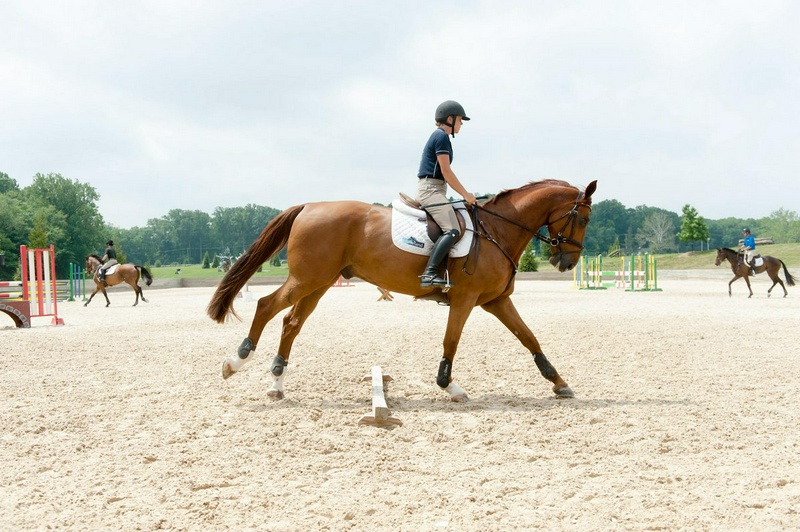
Question: Can you guide me on how to get used to the faster rhythm required in the jump-off?
And how can I encourage my horse to increase its speed without flattening out too much and risking knocking the jump up?
~ Sara W.
, Wisconsin Answer: Ultimately, to be competitive in the jump-off, you don't need to race through the course at a breakneck speed.
It's enough to ride the best possible line while also slightly increasing your horse's rhythm.
If others are faster than you in the jump-off, it just means their line and rhythm were a bit better.
Sometimes speed can be misleading.
For example, if it's a windy day and you are countering around the course with the wind swirling in your ear, you might feel like you are moving much faster than reality.
In other cases, the round of the winning rider may not seem as fast as some competitors.
Marcus Ehning, the renowned German show jumping rider, often records very fast times in jump-offs, but this speed is not apparent because his line and rhythm are very organized and calculated.
If you watch a few of his jump-offs and compare him mid-course to the leading rider, you might never think he could catch up to that rider who has sped through the jump-off.
But in the end, Marcus finishes a few seconds faster.
When you compare the track of a horse that has raced excitedly around the jump-off with the track of Marcus, you can clearly see that his turns were 3 or 4 meters tighter.
The point is this: to be competitive or even to win, your riding does not have to be chaotic and disorganized.
Success in show jumping always comes down to finding the best rhythm and the best line for you and your horse.
Personally, I try to cover the jump-off course with the least number of strides possible, and I complete this with a movement in a slightly faster rhythm.
Gradually lengthen your horse's stride to work on increasing your horse's rhythm in the jump-off, start by just slightly lengthening its stride to cover more ground with a slightly faster rhythm.
If you gradually and step by step increase your horse's stride — not jumping from zero to 100 all at once — your mind will slowly be retrained to feel comfortable with a faster rhythm in the jump-off.
To practice this, I like to set up a line with two ground poles spaced the usual five strides apart, which is 22 meters.
After my riders have gone through this line at a medium rhythm, I increase the distance between the two poles to 23 meters so that in the next pass, the rider has to lengthen the horse's stride a bit more to still maintain five strides.
Then I increase the distance to 24 and 25 meters so that the rider is forced to open the horse's stride even more to maintain the same five strides.
As the distance between the poles increases, the rider must pass over the first pole with a bit more rhythm and then maintain a longer stride to still be able to cover the line in five strides.
From there on, it all comes down to repetition; getting used to that longer stride and understanding how much you need to lengthen the stride to cover the line in five strides.
Like any skill you want to acquire, the more you practice it, the better you will get at it, and it will become more natural for you.
Practicing inside turns is also a very good tool for the jump-off; as well as any exercise that forces you to focus on what I call "line awareness."
One of my regular exercises to make riders more aware of their line is to place two ground poles on a curved line.
(Imagine a 20-meter circle.
Then place one pole at the 12 o'clock position and the other at the 3 o'clock position.
) If you go on the outer line, you should take seven steps; if you go on the inner line, you should take four steps.
So I might ask the riders to first take seven steps on the outer line, then four steps on the inner line, then five steps on the middle line, back to four steps, then five steps, and finally return to seven steps.
This exercise helps you always know which line you are moving on.
Plan your speed and line of movement based on the course walk; your mental preparation for the jump-off is also very important, and this starts with the course walk.
When you walk the course, you should consider how you will approach the first round and how you will ride in the jump-off.
For the jump-off, think about where you can make an inside turn to save some time and where it might be better to choose the outer line.
For me, this decision often depends on the angle at which I approach the obstacle and how I exit after jumping it.
I usually walk both the inside option and the outside option, as well as the lines that each of these choices puts you on.
For example, going inside might place you on the outer line in two or three steps leading to the next obstacle because it pushes you outward; whereas if you turn around and then find the inner line, you might be able to take two or three steps less.
In the jump-off, it is important to consider where you can save some time with an inside turn and where choosing the outer line is a better decision.
After that, it just comes down to simple calculations.
Make the decision based on what makes more sense.
For example, suppose there is an eight-step line, and you have seen other competitors in the jump-off take it in seven steps because they took the outer line and entered the line with momentum.
If you choose the inner line and slow down for the first obstacle, you won't be able to make that seven steps.
But by going inside, I have taken three steps less; therefore, I am already one step ahead of the riders who went outside and only took one step less on that line.
When you watch top riders in the jump-off, you see that the stride of the horse approaching single obstacles differs from approaching combinations.
In straight and long lines leading to single obstacles, they open up the stride, and a few strides before the combination, they collect the horse again.
Then, as soon as they land after the combination, they open the stride again to go towards the next single obstacles.
The distance inside combinations does not change from the first round to the jump-off, so you should approach them with the same rhythm you had in the first round.
If you enter at speed and recklessly, you will experience repeated jumps on single obstacles or completely disrupt the combination.
The role of balance when adding speed is crucial; whenever the horse moves faster, more weight shifts onto the front hand, which is not desirable at the jumping point.
So the faster you go, the more balanced you as a rider need to be.
To help with this topic, I teach my students to stay away from their jumping point and especially to keep their body further back in faster approaches.
When your horse moves at a greater speed, more weight shifts onto the front hand.
For this reason, using balance to counteract this extra weight is absolutely vital.
The more you can sit towards the back end of the horse and away from its shoulders, and the more you keep your upper body elongated, the better you can neutralize that extra weight on the front hand with your balance.
This makes the horse's job easier at higher speeds.
When your extra weight is not on the front of the horse, it has more freedom to shift its weight back and sit on its hindquarters; as a result, it can lift its withers and shoulders instead of you leaning forward to meet the horse's movement.
I hope these tips help you give your horse more confidence in your next approaches.
Do you have an educational question?
Team Prak — a group of prominent coaches in the disciplines of hunter, show jumping, eventing, and dressage — is ready to provide practical and impactful advice to help you progress in your specialty and build a more harmonious partnership with your horse.
Here you can see how to send your questions to the members of Team Prak.
To learn more about the training program of RCR Equestrian Ronny Reimer, click here.
About Ronny Reimer, a member of Team Prak Ronny Reimer with his loyal dog Heidi; a dog that rarely allows this show jumping rider to be out of her sight.
German show jumping rider in Grand Prix competitions, Ronny Reimer has successfully competed at FEI and national levels.
He trained under German Olympians Franke Sloothaak and Paul Schockemöhle, making a name for himself as a rider and coach across Europe and North America.
Ronny and his wife Chanel run a horse sales and training business called RCR Equestrian at Dias-T Stables in Ocala, Florida.
To read Ronny's full biography on Team Prak — including major professional achievements, favorite horses, and interesting facts about this show jumping rider and a man who has spent his entire life with horses — click here.
Source: Practical Horseman – Training