Fitting a horse with a cavaletti using Jessica Phoenix's method
My home is in Ontario; a place where we often have to ride in indoor arenas from December until the end of April.
The early season competitions start in May, so we need a way to begin the physical preparation of the horses before we can take them outside for Chaharnal, uphill work, and other exercises that are part of a standard fitness program.
A simple strategy that works very well for me and my students is to use counter exercises on raised cavalettis to build the horses' fitness by increasing their breathing rate and heart rate.
This program is beneficial for preparing both hunter and jumper horses, as well as eventing horses; it can also be executed in an outdoor arena with suitable footing when mud or other issues keep you away from your usual training locations in warm weather.
The method works like this: I start with poles on the ground spaced similarly to consecutive jumps, so the horse steps over a pole with each counter stride.
For most horses, this means a 9-foot distance between the poles.
I start with three poles in a line, and as the horse becomes more comfortable with this exercise, we increase the number to seven and sometimes even nine poles.
When the horse is calm and relaxed over the poles in a straight line, I arrange them on a curve so that when countering from the center of the poles, the horse moves in a 20-meter circle.
As I will explain later in this exercise, working on a circle creates more demands for both the horse and the rider.
The next stage of the exercise is to raise the cavalettis so that the horse actually goes over a series of small consecutive jumps.
For lower-level horses, I use standard cavaletti blocks—the same type of block I use in these photos—to raise the poles a few inches off the ground.
For more advanced horses, I may eventually place the poles on stands to create small vertical jumps that do not exceed 2 feet in height.
I make the transition from ground poles to raised cavalettis step by step: if there is a line of three cavaletti, I first raise the middle pole.
When the horse comfortably goes over it a couple of times in the counter, I raise the third pole.
Finally, I raise the first pole.
If I want to raise a line of five, I start by raising the third pole, which is the middle pole.
After a couple of repetitions, I raise the first and fifth poles so that every other pole in this sequence is raised.
In the end, I raise the second and fourth poles.
After about three repetitions on the grid or on the circle, I give a horse that has just started this program a few minutes of rest at the walk and then repeat the exercise.
It is up to you to determine when your horse is breathing deeper and sweating; both are signs of increased breathing rate and heart rate.
At this stage, one more repetition is enough for that day.
As the program progresses, when the horse reaches fitness and easily performs the regular raised cavalettis, we can increase the intensity of the exercise and encourage the horse to collect more and bring its hind legs further underneath its body by shortening the distance between the cavalettis to 7 or 8 feet.
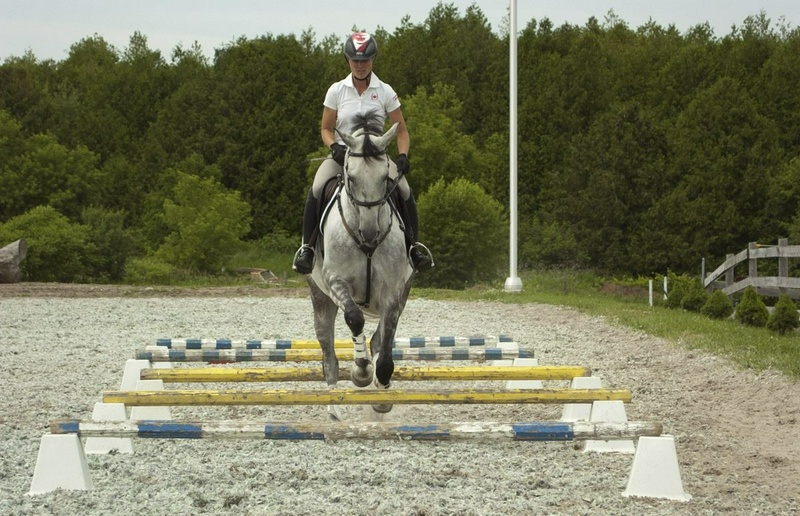
To demonstrate the execution of this program in practice, I will guide Bentley, an 8-year-old Trakehner horse owned by Dan Good, through the raised poles of 3 and 5 Cavaletti and then over 3 raised Cavaletti on a curve that is part of a 20-meter circle.
When you set up this exercise for yourself and your horse, remember to introduce this concept with poles placed on the ground.
Three Cavaletti in a line 1.
I approach the 3 raised poles with a good collected canter on my right hand and sit in the saddle to encourage Bentley forward with my seat.
I maintain a light and consistent contact with his mouth so that I can feel the energy of his hind legs flowing from his back forward toward the reins.
Bentley's ears are forward and his eyes are alert; a sign that tells me he is focused on this exercise.
©Michelle Dunn 2.
Higher-level horses like Bentley often jump with a lot of pressure and spring over each Cavaletti at the start.
When they get into the rhythm of the exercise and understand its nature, they simply take regular canter steps.
This is Bentley's first jump in canter over this line, and he performs a very powerful jump over the first Cavaletti.
Here, I think about maintaining connection with the reins, with a very steady angle in my elbows, while moving with my horse and adjusting my upper body to his movement.
©Michelle Dunn 3.
Bentley lands a bit stretched after the second Cavaletti, and in photo 5, you can see how he brings his legs more under his body and collects himself to prepare for the jump over the third Cavaletti, which is very close.
©Michelle Dunn 4.
At this initial stage of the exercise, I still make it easier for him to use his back by riding in a half-seat over the jumps and then sitting closer to the saddle between the Cavaletti.
I know that with one or two more repetitions, he will become calmer.
©Michelle Dunn 5.
Bentley's ear position shows that he is still paying attention to me while he crosses an obstacle with a relatively long stride that, from his perspective, is the last jump of this line.
My goal is for him to remain soft, round, and consistent from the beginning to the end of the exercise; to really engage his hind legs, soften over his back, and hold himself together.
You will see how this gradual process of exercises helps him achieve this quality.
6.
Bentley's ear position shows that he is still paying attention to me while he crosses an obstacle with a relatively long stride that, from his perspective, is the last jump of this line.
My goal is for him to remain soft, round, and consistent from the beginning to the end of the exercise; to really engage his hind legs, soften over his back, and hold himself together.
You will see how this gradual process of exercises helps him achieve this quality.
Five Cavaletti in a line when Bentley is released to canter over the raised Cavaletti spaced 9 feet apart, he is ready for something a bit more challenging.
The five Cavaletti in this sequence have the same height as the three Cavaletti we worked on in the first set of photos, but their distance is 8 feet; that is, 1 foot closer together.
This arrangement increases the amount of collection required from Bentley; he really has to "sit" in order to successfully navigate the entire line.
I have placed a guide pole 8 feet ahead of the first cavaletti to help Bentley adjust himself to the stride needed for this line.
He is focused on the cavalettis, his body frame has shortened, his top line is rounded, and I also have a good and steady connection with his mouth.
At this stage, his back is warmed up, and I sit close to the saddle throughout this sequence.
2.
The excitement and energy that Bentley showed at the first cavaletti has calmed down, and he is more relaxed, with his back working better; this allows him to be more collected in these moments.
He also maintains his correct hand throughout the line.
I keep the contact with his mouth steady through my elbows and move with him as he lands from the first cavaletti to prepare for the next obstacle.
3.
This image clearly shows how much Bentley steps under himself with his rabbit-like joints and how his back has come up during this exercise.
At this moment, he really needs to "sit" and wait for the next jump.
4.
In this photo, you can see how much his body frame has compressed.
This type of work is a very good help for strengthening any horse.
5.
The placement pole at the end of the line reminds Bentley to jump the last cavaletti with the same collected stride he used for the previous four obstacles to finish the line in a collected form.
Three cavalettis on a curved line may seem simple, but it is more challenging than the previous two exercises because you need a good connection with the horse to keep it on a defined circle.
When the horse and rider try this exercise for the first time, usually one of two situations occurs: 1) The horse falls on the inside shoulder of the turn, and the exercise immediately becomes more difficult because the circle has become smaller and requires more collection.
2) The horse is pushed to the outside of the curve, and the rider cannot control the line of movement to create a smooth and round circle.
Just like the straight line exercises, I start this exercise by placing all five poles on the ground.
First, I want the rider and horse to be able to comfortably and confidently stay on a line that takes them through the center of each pole on the curve; a line that creates a 9-foot distance from one pole to the next.
Then I ask them to take a more collected canter and move on a line closer to the inner end of the poles on the ground; where the distance between the poles is less.
Finally, I want them to take a more open canter and travel the circle more from the outer end of the poles; where the distance between them is greater.
I only raise the poles when the rider can truly control both their line of movement and the balance of the canter they have when entering the exercise.
1.
When Bentley canters over the placement pole towards the first cavaletti, you can see how rounded his top line is and how collected his shape is.
I am sitting in the saddle and maintaining a steady connection with his mouth through the reins.
My goal is for Bentley's body—from the tip of his tail to the top of his mane—to follow the curved arc we are riding on.
2.
Whenever you bring a horse from a straight line into a curved path, its balance changes.
He often tries to lean into the turn like a bicycle or motorcycle.
For my students, visualizing this concept helps to correct the problem that they should hold their horse in the turn as if a four-wheeled vehicle or a minivan is turning; with all four wheels on the ground.
This is the classic exercise of keeping the horse straight on a circle.
It may not be clearly seen in these photos, but by firmly holding my inside leg on Bentley, I keep him from falling in, control the size of the circle, and support him with my outside rein to stay straight on his circle.
3.
I really like this photo because you can see how much calmer Bentley has become in his body and his neck is also starting to stretch.
At this moment, the engagement of his hindquarters and the lifting of his back are quite evident.
When we jump through the arc, I am mindful to keep my shoulders and hips aligned with the shoulders and hips of my horse.
Bentley is not trying to lean in during this arc, but if he were, my sitting straight and balanced would help correct that tendency.
4.
I also like this photo because we are nearing the end of the final exercise, and Bentley's overall posture shows that he is still completely with me.
His ears are fully alert and attentive.
5.
When we come out of the last pole of the distance with a counter, it is clear that he has sweated during this work.
It is truly remarkable how this series of exercises can elevate the heart rate and breathing even in very fit horses with repetition.
About Jessica Phoenix Jessica Phoenix, from Ontario, has competed for the Canadian eventing team in two Olympic Games.
She rode Exponential at the London 2012 Games and A Little Romance at the Rio de Janeiro 2016 Games.
She and Exponential helped the team win a silver medal at the 2010 FEI World Equestrian Games.
She also finished sixth with Pavarotti at the 2014 FEI World Equestrian Games.
This pair won the individual gold medal at the 2011 Pan American Games in Guadalajara, where the Canadian eventing team, with her, also earned the team silver medal.
They also achieved team bronze and individual silver at the 2015 Pan American Games in Toronto and won team bronze at the 2019 Lima Games in Peru.
In late summer 2014, she returned with Pavarotti to the World Equestrian Games in Normandy, France, where she finished as the best member of the Canadian team, which placed seventh overall.
She commented on the cross-country course that had caused trouble for some eventing riders in those competitions: "I was lucky because Pavarotti just went through the mud of Chaharnal and it didn’t seem to tire him out."
They completed the course without a jumping penalty.
She said, "This was his first four-star, and I really couldn't ask for anything more from him."
Jessica and her husband, Joel Phoenix, have two children named Jacob and Jordan.
We thank Mane ‘n Tail for supporting our coverage of the 2024 Maryland Five-Star at Fair Hill, including interviews with riders, competition reports, horse introductions, photos, videos, and more.
This article was first published in the January 2015 issue of Practical Horseman.
Sources and Attachments: Jessica Phoenix Mane ‘n Tail Source: Practical Horseman – Training