Contact with the bit; neither complete restraint nor constant pressure.
Contact or no contact; that is the question.
Or maybe it isn’t?
I don’t think so…
– Written by Dr. H. L. M. van Eschijk
When we follow the training of a horse from the very beginning to the highest level, namely "dressage," we realize that throughout this journey, the level of contact between the rider and the horse varies at different degrees and levels.
In my opinion, when our audience has very little experience, talking about "no contact" is very dangerous.
I hope the following example clarifies this issue.
In the mid-1950s and early 1960s, a Russian immigrant named Litauer had a very large following in the United States.
Most horses were ridden with a Kimberwick bit; riders had offset stirrups; and in the first few months of training, riders were not supposed to make contact.
The Kimberwick bit/kimberwick has offset stirrups; the aim of this design is to help with proper foot placement. In the early 1960s, Vladimir Litauer had several girls come to my school for training.
The youngest had a beautiful mare.
The problem was that during the lesson, this horse, which was ridden without contact, passed by all the other horses.
Since that girl did not respond to my instructions on how to control her horse, I asked her if I could get on the horse to demonstrate my point in practice.
The horse had no issues; I had light and elastic contact, and there was no difficulty in slowing the horse down.
After I got off, I told the girl: "You see, it’s not complicated at all."
The girl suddenly burst into tears and, while sobbing, said: "But I don’t think this was very pleasant for the horse."
This girl had a completely incorrect perception of no contact.
Young horses, after being accustomed to a simple bit on the longe, need help to accept the bit.
The rider must strive for very light and elastic contact.
A young horse should never feel that it is under pressure and restriction.
This restriction not only causes resistance but also disrupts the horse's forward movement, especially at the walk.
In this context, it may be appropriate to refer to two confusing terms.
The first term is "la desensibilisation" (complete release of hand contact without changing the horse's body form).
This was an invention of Boucher.
Since Boucher placed a lot of emphasis on the position of the head and neck, he also used his hands a lot.
By executing a short-term la desensibilisation, he eliminates pressure on the bit.
Because we believe that the raising of the front limbs is the result of engaging the back part of the horse's body, and since we emphasize the elasticity of contact with the reins, we do not believe in practicing this movement.
The second misleading term is "das Überstreichen" (rubbing hands upward on the neck to encourage the horse to stretch its neck).
For more information about desensibilisation and Überstreichen – visit this address: https://www.
At one time, Germans rode their horses in a relatively compact form.
The result was that when there was no pressure from the reins, the horse did not become free and loose, so riders tried to push the horses' heads down.
If someone rides with elastic contact and in harmony with the horse's movement, any horse, as soon as the rider opens their hands and lets the reins slip through their fingers, will stretch its neck and come out of contraction (though this is not exactly equivalent to the German term "aus der Hand kauen lassen").
This sliding of the reins is, of course, only possible with smooth and soft reins.
Why do we want contact?
Because we want to improve the lateral flexibility of the horse.
In other words, because we want the horse to become "permeable" (in French: "permeable," in German: "durchlässig").
This means the horse allows the driving energy created by the rider's driving aids to pass through the back part of the body via the back and neck muscles; in such a way that it causes flexion at the poll and the horse accepts the bit, without creating stiffness in the jaw.
Acceptance of the bit means that the driving aids and guiding aids have come together.
At this stage, the process is reversed: the guiding aids regulate the driving energy and monitor longitudinal and lateral flexions as well as various gaits and movements.
I hope the reader understands that the above content pertains solely to classical riding.
Other riding styles, such as Western, have completely different objectives.
Since the Western rider needs to keep their hands free for roping, they do not want their horse to accept the bit.
They have no interest in longitudinal or lateral flexions.
They guide with reins over the neck and take sliding stops by suddenly pulling their hands.
They achieve this with very sharp bits.
One of the most important and challenging issues in classical riding is having elastic contact.
In my opinion, the issue is not whether there is contact or not, but rather the quality of the contact that matters.
Therefore, I believe that as soon as a beginner rider finds a bit of balance on the horse while lunging, they should immediately be taught how to develop elastic contact.
First and foremost, they must learn not to use their arm muscles, but rather to utilize their back muscles.
Furthermore, they should develop elastic contact; meaning the elbow joint should never be in a stretched and stiff position, but rather flexible and able to open and close.
The best way to teach this point is to work with a horse that has a good walk.
The rider must learn to follow the horse's head movements while always keeping the reins with a light and direct contact.
If the rider confines the horse using their arm muscles and does not have elastic contact, the horse will resist the rider's hand.
In my words, the rider pulls the handbrake.
During the training period, where we want the horse to bring its hindquarters more under its body, there are times when it is necessary to apply a lot of contact.
At this stage, the horse must learn that when we create more driving force and increase resistance, it should not try to go faster and stretch its body, but rather should try to bring its hindquarters more under its body.
When the horse learns to do this, it will carry itself.
The more it carries itself and understands better what the rider wants from it, the lighter the contact will become.
Ultimately, having no contact is an ideal that only very few people achieve.
I may have only recognized five people who have reached this unity with their horse.
It is sad to say, but I have never seen this in competitions; not even in the Grand Prix or in the Kür.
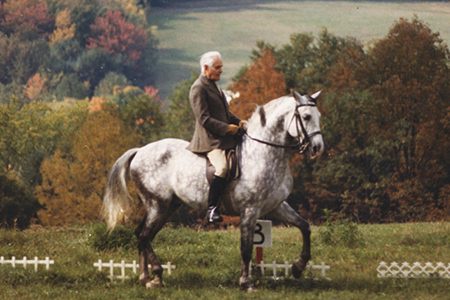
Dr. H. L. M. van Schaik 1899-1991 Henri van Schaik was born in the Netherlands and began his riding career as a show jumping rider, winning a team silver medal with Santa Bell at the Berlin Olympics.
Henry van Schaik is riding on Santa Belle in the 1936 Games. After World War II, he immigrated to the United States and established a riding academy in Vermont.
He was in high demand as a trainer and judge and was highly respected as a rider trained in the classical style.
Throughout the 1960s, 70s, and 80s, he was one of the few riders who were concerned that classical principles were increasingly threatened by the emerging style of competitive dressage.
His book titled Misconceptions and Simple Truths in Dressage was initially a collection of articles defending the classical training method.
After the World Championship in dressage in Canada, he wrote in Dressage and CT with a sharp tone: this last World Championship clearly showed that judges completely ignore the artistic aspect.
This issue was also evident in the blind judging.
I am convinced that this is the reason why the art of classical riding has practically disappeared.
One of those sitting close to me expressed this very well: "The quality of horses is getting better and better, but the level of riding is continuously declining."
I only saw two horses that gave the impression that what was being asked of them was done willingly and from themselves.
However, their riders, although not very good, both had very soft hands.
Everything had a casual and easy quality; both the riders and the horses seemed to enjoy their work.
Of course, they had a very low ranking in scoring.
On the contrary, the riders who scored high had very active hands and intervened almost at every step.
One of the riders during the Grand Prix freestyle used his hands just like a conductor of an orchestra.
With every beat of the music, his hands would rise.
Some riders had a lot of movement with their bodies, especially in the extended canter.
I do not understand why the judges do not react to this issue.
This style of riding mocks the classical riding school and is against the rules.
The reason many people have problems with their hands is that they use the wrong muscles.
The connection with the horse's mouth should have a stretchy and flexible quality.
This is only possible when the rider keeps the elbow bent and never rides with straight elbows, and also does not use the arm muscles, except for the triceps.
The rider must be able to keep their hand balanced; a task that cannot be accomplished if they use the biceps or forearm muscles.
The rider must create resistance with their back muscles.
Before World War II, people were taught to ride with their backs; not just to create propulsion, but for resistance as well.
Nowadays, most people pull with their arms, often making their hands stiff and fixed, and try to create propulsion with their heels and spurs.
Their legs are also often constantly moving and unstable.
" After World War II, he immigrated to the United States and established a riding academy in Vermont.
He was in high demand as a trainer and judge and was highly respected as a rider trained in the classical style.
Throughout the 1960s, 70s, and 80s, he was one of the few riders who were concerned that classical principles were gradually under pressure from the emerging style of competitive dressage.
His book titled Misconceptions and Simple Truths in Dressage was initially written as a collection of articles to defend the classical training method.
After winning the World Championship in dressage in Canada, he wrote in a sharp tone in Dressage and CT: This latest World Championship clearly showed that the judges completely disregard the artistic aspect.
This was also very evident in the blind judging.
I am convinced that this is the reason why classical riding has practically disappeared.
Someone sitting next to me expressed this very well: "The quality of horses is getting better and better every day, but the level of riding is continuously declining."
I only saw two horses that conveyed the feeling that they were performing the requested movements willingly and with their own readiness.
However, their riders, although not very good, both had very soft hands.
Everything had a casual and easy feel; both the riders and the horses seemed to enjoy their work.
Of course, they had very low scores in the judging.
On the contrary, the riders who received high scores had very active hands and intervened almost at every step.
One of the riders during the Grand Prix freestyle used his hands like a conductor of an orchestra.
With every beat of the music, his hands would rise.
Some riders had a lot of movement with their bodies, especially in the extended canter.
I cannot understand why the judges show no reaction to this.
This style of riding mocks classical riding and is against the rules.
The reason so many people have problems with their hands is that they are using the wrong muscles.
The connection with the horse's mouth should be elastic.
This is only possible when the rider keeps the elbow bent, never rides with straight elbows, and also does not use any muscles of the arm except for the triceps.
The rider must be able to keep their hand balanced; something that is not possible using the biceps or forearm muscles.
The rider must create resistance with their back muscles.
Before World War II, people were taught to ride with their backs; not only to create propulsion but also for resistance.
Nowadays, most people pull with their arms, often locking their hands and trying to create propulsion with their heels and spurs.
Their legs also often move in all directions.
Published works: Misconceptions and Simple Truths in Dressage (1986) Source: The Horse Magazine