Arash Rahmati on the dark days of war at the equestrian club
خلاصه
In the seventy-fourth episode of Radio Chaharnal, Arash Rahmati discusses the challenges of keeping horses during the dark days of war. He addresses the concerns of horse lovers about maintaining the health of horses and improving the conditions of the manèges, and talks about recent advancements in this area. Rahmati emphasizes his responsibility in caring for the horses and his workers, and addresses the challenges of providing feed and reducing stress for the horses during attacks. He also mentions the negative impacts of war on the equestrian economy, including market stagnation and rising costs, and suggests that club owners think about collaboration and cost reduction instead of focusing on profit. Finally, Rahmati stresses the importance of economic stability and peace in society and expresses hope that conditions will improve so they can achieve better planning for equestrian competitions.
متن کامل گفتگو
One of the biggest concerns for all of us who love horses and live alongside them is maintaining the health of our horses. In recent years, we have made significant progress in many areas, such as equestrian equipment, horse transport, farriery, veterinary medicine, club construction, and other issues. However, one concern that preoccupied all of us until a few years ago was the footing of riding arenas. The type of sand we jump on and the conditions under which we work our horses have always been an issue for us. Until a few years ago, we were dealing with heavy sand or hard or deep ground. Since 2011, riding arenas have improved, and the sand models have changed, but we were still far from global standards at that time. Until Bester Gostar Asb Company, managed by Arash Rahmati, was able to fill this gap for all of us. After Bester Gostar started its work, we are no longer worried about how our arena is today, how our paddock is, whether the herd arena is hard or deep, and all of these have been resolved with Bester Asb. You can also contact Bester Gostar for your arena surface and bring your arena conditions up to world standards. I will leave the Instagram link of Bester Gostar in the description of this episode, and I hope that all riding arenas in Iran will one day reach global standards.
Greetings and respect. After nearly four months of absence and not producing any content, I am happy to be able to serve you dear ones again.
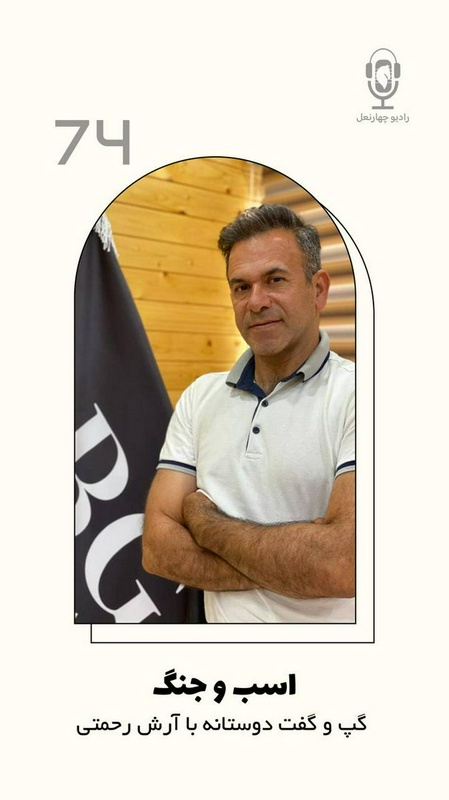
We are still going through tough times. Perhaps many have left us during this period, and many have been harmed. We all have a great sorrow. We are worried about our Iran. I hope to see a day when all of us live happily together, without hassle and worry. With episode 74 of Radio Chahar Naal, I have returned to serve you dear ones. In this conversation, my guest is Arash Rahmati, one of the renowned and beloved equestrians from Isfahan province. This episode of Radio Chahar Naal is about recent events in the equestrian system.
The hardships we endured during the war to preserve our horses were truly difficult. That's why I decided to have an in-depth conversation with Arash Rahmati about this war and the wartime conditions in the equestrian club. I hope this conversation is informative for all of you and that you enjoy listening to it. As always, I introduce my colleagues: the poster designer for this episode is dear Farshid Jahanbazi, and the composer and singer of the opening and closing theme are Negin Goudarzi and Erfan Moghadam. I hope you enjoy listening to this narrative.
Dear Arash Rahmati, I greet you and thank you for the honor of being a guest on this Radio Chahar Naal program.
After the war conditions and unfortunately the conditions of January, this is the first program I have started recording, and I have thought a lot during this time about what program to create that both feels this war and has someone who has experienced this war up close, and no one but you came to mind. Mashallah, you are both eloquent and knowledgeable about the issues. Now, if you have a greeting, let's start so we can ask the questions. I also greet you and the dear listeners and viewers of Radio Chahar Naal. Stay healthy. Thank you for giving me this time again.
Let's not make the podcast atmosphere too informal. Throughout the program, I will call you Arash, and please call me Mohsen so that our interview does not become too formal. You reside in an area in Tehran that I can say, if we want to consider the second part of Tehran in terms of missiles and stories and noise and defense, it would be the west of Tehran and district 22 where you are. Now, I also went to the Farabad club and was truly choked up by the conditions there. Then one day, when I was passing by the club, I saw, oh my, everything had collapsed. Poor thing, what did you do on the first day of the war?
What happened? Let's move forward with this war narrative together. Now I will ask the questions piece by piece. On the first day when the missile hit and then they came, what was the first sound you heard here, and what happened? Well, let me tell you that the first days, I mean one of the lucky parts for us, I mean the places where we have horses, was that in the first days, the intensity of the attacks and the intensity of the sounds were not that much, and for this reason, we were able to, well, one of the reasons we were able to endure was this. Because anyway, when the sounds were farther away.
A horse is a living creature, and well, we all know a horse is a prey animal, not a predator. It is fearful, its nature is fearful, meaning it runs away from sounds, especially if the sound is loud and close. But fortunately, in those first days, the sounds were not very close, and the sounds were not very heavy. That's why the horses gradually became familiar with the sounds, adapted to the noises. Yes, and now I will tell you what happened in the last days. Now, on the day the war happened, well, all of us are ultimately looking for this, that now we cannot because.
Many might think that these people who had fun, the war and they had nothing to do. But the reality is that perhaps the hardest part is to let go. I mean, a living creature, not in Corona, not in what I know, war, to let go. On the first day, what did you think? I mean, what was your main concern after hearing the news of the war? At that moment, well, now we also had an experience from that 12-day war. Again, it was the same conditions, now a bit lighter. But anyway, you know when such news comes, we who deal with living creatures, especially a creature that is now difficult to move.
Anyway, there is no choice but to resist and stand firm at that moment. In the first instance, unless now the conditions really become such that you see it becomes very severe, then you have to relocate the horses, now take them to a place where now the danger is less. But well, in the first days when it started, now if you want, I can tell you in general or if you want, I want to go piece by piece because I want to follow this sequence from the first day to the end and even after that, which may now, God forbid, this happens again, I truly wish from the bottom of my heart but.
It's out of our control, it may now come again very soon. I hope it doesn't happen, but anyway, we cannot escape from it. At that moment, perhaps the first concern that came to Arash Rahmati's mind was that, sir, the war has started, and considering we had also gone through the 12-day war, now what should we do? You see, well, now because I have about 40 horses in the complex, well, the first thing that comes to my mind is how should I now take care of these horses. Well, we have a number of workers, the workers themselves anyway.
Very well, they don't have such responsibility to stand if something happens; they can run away and leave, but I can't run away and leave. After all, my belongings are here, they belong to the people, they belong to me, and most importantly, the horses are things we've spent our lives with and are truly like friends to us. At this point, the first thing that came to my mind was that I needed to create a sense of security for the workers so they could keep these. Because of this, during the entire 40 days that this happened...
I was here every hour. I mean, if I didn't come one day or came late, the worker would call: Mr. Arash, where are you? Are you coming? So they wouldn't think I ran away and left. That's why I stayed here every day, even at night. The first concern was to be able to keep my human resources. Then, well, we moved forward. Certainly, I know the situation of the horse owners and students, and it's unlikely anyone stayed or not. No more, the owners of the kids who now have horses, well, now I'm in contact with them by phone. The owner now...
After all, each one had their own conditions to save their lives, but they didn't come here. Anyway, we weren't very happy for them to come here because, after all, the conditions weren't ideal. It's true that you stayed with a club, a number of grooms, and 40 horses. I myself always, I mean, myself, now that I didn't manage the club, during the war, but my concern was always providing food for the horses. How did you manage it? Because many faced problems with this issue, but I know many clubs first changed the food ration.
You managed it. Let me tell you, see, because I had the experience of that 12-day war, as soon as this started, with the relationship I had, I quickly purchased some of the goods that were on the way. Of course, out of necessity, well, anyway, we predicted it beforehand. Whenever we buy hay, we predict that by the end of the year, we would have purchased until months one and two. Now, because I had a shortage, I first thought this might be prolonged, and we didn't know what would happen in months two and three. I bought some...
There was a machine. By chance, the second stage was that yes, we had to reduce the horses' food because, first of all, in these conditions, there are no competitions, and you don't want to do anything special with the horses, so naturally, it's better to completely cut the concentrate, reduce the hay a bit. Anyway, one of my other concerns after being able to keep my workers was that, God forbid, I wouldn't run into an emergency or clinical problem with the horses, which I know for sure that the clinics are closed and no one is there, and anyway...
Did you manage it like this, anyway, when you reduce your food with a correct rhythm, not suddenly, we reduced the food with a correct rhythm and, thank God, we managed this and moved forward correctly from this stage. Well, a very, what do they say, I want to ask you a heartfelt question, were you more worried about your horses or yourself and your workers? You can definitely not answer, maybe it's an irrelevant question, but I'll ask personally. Naturally, people's first concern is for each other.
Primarily, our fellow humans are important, now the horse is important too, but it becomes the next stage. In our lives, family is important, the people around us are important, but anyway, the horses also had their importance. If they didn't, I wouldn't have been with them day and night for 40 days. Here, during these 40 days, did something happen that made you say, let's pack up and leave? See, the conditions that now these attacks were made around us, now it's interesting to tell you.
Gradually, well, the western part of Tehran didn't start attacking or being bombed from the first day. It started almost in the middle. Well, our horse was well released in the paddock. Some of our horses each had about 4-5 hours of paddock release. Lately, when I saw, for example, a sound came, they hit somewhere, I looked at the paddock as it was eating.
It raised its head, believe me, it looked, and started eating again. One of the other things I did was, I put the horses. Some of them, when I saw they were anxious and more stressed, I put them in an incident. The incident supplement to reduce their stress a bit. Yes, thank God, in reality, during this time I was here, one of our horses, a three-year-old foal, was very scared. In the paddock, I mean, one day I was sitting here, in the same place we are now, well, I saw a small bomb sound came.
You see, when the sound comes, we don't go to the shelter, we don't have a shelter to go see where it hit. I went outside and saw that at a distance of about 600-700 meters, there is a place. I saw a missile hit and the sound of an airplane was coming and I stood and saw that when it started its missile, I realized it was starting its missile and maybe three seconds later it hit that point and I saw one of these places that it hit.
I looked and this animal, this 4-year-old, was running from one side to the other, neighing, making sounds, it was clear it was scared, but the others were eating. Nothing else, I went and hugged it, stood by it, its heart rate had gone up and the animal was very scared. It's interesting, but I stood by it, it started to calm down, it didn't have stress anymore until it also started eating like the others, it got used to it too, it got used to it. Yes, it's interesting that there was no major change in behavior, like taking a habit...
Abort, I don't know, its place gets wounded and torn, no thank God. Near you, many explosions, the explosions that were near us, well, at least a distance of 500 yes, but I don't know, now like before, these sounds weren't so much that you would say, for example, because before during the Iran-Iraq war, a series...
The Iraqi airplane missiles would come, I remember as a child, now I don't know, maybe as a child, the sounds are still in my ears, the areas that were hit, but these didn't have that much sound, maybe in the end, it was the sound of a small explosion, but well, you see a lot of destruction around us now that I was at the club. Now I'm in the Firooz Bahram area, I mean, I was on that side, a sound came that I called Mahmoud, who works in this area, I said they hit something and these stories, I heard its sound there, how about you maybe.
Your relaxation seems very remarkable to me. Yes, when the sound came, now I don't know, maybe I say it became a bit normal for me, I saw the workers, poor things, all of them would jump into the garden, take shelter, hide. Really, only we would go up to see where it hit.
It's very interesting, Arash. One of the major issues related to war that we got involved in, and which has metaphorically traumatized all of us, was the psychological management that we had to deal with during these days and which still lingers. For instance, when I hear a door slam, I unconsciously get scared. As the manager of this system, as someone responsible for both your own and the people's...
And since you had a better grasp of the number of workers, how were you able to manage this and eventually move the cycle forward? You see, the reality is that it was all with stress and anxiety because you didn't know what was going to happen to you. If a person knows, for instance, that their position is 100% in danger, well, they would think of something. But I don't know why I had a feeling that I should continue right here and hopefully nothing would go wrong. I don't know, it was an inner feeling telling me.
But well, after about ten days had passed, from the eleventh day, we started our riding. You started, but from the eleventh day, I almost started riding. Anyway, I saw that well, until when because we didn't know if a situation would arise where we couldn't ride again, we were riding. Now, during riding, why were there noises, there was talking, the sound of airplanes was coming because this area above West Tehran was a major transit route. They hit around my club.
Everywhere you looked, every day a point was being hit, smoke was rising, sounds were coming. Anyway, at that moment when the sound comes, a person gets stressed and anxious, and worry arises in their heart. Anyway, but well, we were forced to continue our work, and thank God we moved forward. Didn't you have family pressure, like from parents or family saying, "Hey, leave it, come on, why are you still there when they hit so much around you?" Yes, why, well, you see, suddenly in the news, all of them.
They didn't hit me yet, but they hit around us. Why were you riding here, for instance, didn't any incident happen to anyone because I heard from two clubs that, for example, they were riding, the coach was riding, and they hit, then they hit the ground, and four or five people simultaneously got hurt. No, thank God, well, we say we weren't, I was there, and now the riders of the complex, who, anyway, their riding isn't weak. Now, why were they playing with toys?
Maybe that sound made them a bit excited, but no, thank God, no incident happened, but now the closest hit we had, as I say, was about 400-500 meters away, where some things even got thrown, I didn't see it, I heard the sound of it hitting the trees, but I didn't find anything as shrapnel like iron or anything, but some sounds were passing through the layers of leaves. It's interesting, maybe the question is a bit off-topic, maybe many would say, "Hey, the question seems ridiculous."
As someone who passed through this system and moved forward, if you want to take a lesson from this war in the form of, "Hey, I learned this lesson, for instance, in managing the club system, in managing my stable, in managing even my own work and even the main economy," what was that lesson for you? It's really hard to answer that because the conditions of war are not good conditions anyway, but what a person learns is to stand firm, have perseverance, and not be afraid.
Now, part of the issue is that, but well, some might say not being afraid can also be considered foolishness, saying, "Hey, what if something happened to you? What if that incident happened next to you?" But anyway, you know, in those conditions, everything had become difficult, meaning even buying fodder for the horses, all friends who have clubs know, in past years, we used to buy that fodder, maybe for a while, we bought it abundantly, in these conditions where there was no fodder, nothing.
Nothing was available, and you had to buy it in cash, meaning these were also problems that were added, but we tried to slowly adjust the conditions, meaning whatever we wanted, we had to somehow arrange money and buy it. As they say, what lesson did it leave for me? It was that you have no idea about your future, not even about tomorrow, and you should gather your conditions for that very day, meaning generally, there should be pre-thinking, now if a war arises, what should you do?
It's just not being afraid, just giving calmness to those around you. In your work field, being professional and calm. There's nothing else you can do. If, for instance, imagine my fodder was running out at that moment, where could I have obtained it? It's that you should always have a plan in place so that you never reach this point, not just because of war, but in all stages of club management, this is very important in my opinion. In your opinion, the key, as Soroush Sehat says, is in continuing, in continuing. You came forward.
Really, see why, now imagine from the very first day we were going, I mean I was going, well, this worker here, that responsibility, maybe they were owed a month's salary from me, imagine they would leave and run away. It was really tough conditions, yes, meaning a club and a complex would remain with 40 creatures that you had locked in a cage, now maybe only water would reach them, no food, exactly this, well Arash, if.
If those conditions repeat again, God forbid, God forbid, if they repeat again, would you manage the same system or have you learned this time to manage in a different way? I will stand firm unless I really feel endangered. Now, feeling endangered is that, well, you see, in my previous talks, I said I don't know, there was a feeling, now stand, nothing will happen, but one day I was really scared, tell me about one day.
A sound came, as usual, we ran up to see, after all, we are all like this, you can't say yes, I went and saw 500-600 meters lower, smoke was rising, but the sound of the airplane was still there, but well, I saw the airplane changed direction and went, changed its angle, well now when it fired its missile, this sound of its start when it separated from the airplane, now not me, when the airplane fired, I was watching the hit, its fire was going up.
It hit once, I said, well, it hit, it's over, it was really over, nothing was left of it, the way I saw with my eyes, it fired the second one, I said God, don't let this one come this way because you know, if it deviates a little, we were at a distance, it hit the second one there again, we saw it fired the third one, this one we saw, no, it hit there, the fourth one, just like this, it fired up to six.
I was really more scared that day than ever, what did you do at that moment, I was just watching, there was nothing else I could do, for instance, take cover, well, we don't have a shelter here, always hiding behind trees, poor people were running, crawling on the ground, lying down, we were there.
We were showing and watching the reports, but that day was really a scary day for me. I was really saying that at Shahid Club, I saw some scenes that were very painful. The section had collapsed, and the page was really moved, and I really said there, what they went through with this noise at such a close distance and many shrapnels. Well, you experienced all of this here.
When you look at those days today, what is the first image that comes to your mind? After all, war is not a beautiful scene. What image comes to Mr. Arash Rahmati's mind? The first image is the stress and anxiety of that scene that comes to my mind. No, no specific scene comes to my mind, but well, if I want to say, it's the fear I just talked about, I was very scared. This scene is really in front of my eyes, fire in the air.
That warehouse in the air, everything in the sky. One of the advantages we had amidst all this chaos is that our surroundings are open, our space is completely open. On one side is the forest, on the other side is the lake. This is for open space, meaning it's not a closed space that would be damaged by the explosion wave. Thank God, there was no damage to the building or even, I don't know, thank God. Well, Arash, considering that our economic situation is not very good and we all have concerns about the future of our work in this field, now everyone to the extent of their ability. What do you think is the impact that this war has had and will have on the horse economy? Because you are active in the economic field in this area as well, it's not just that you ride. What impact does it have? Right now, we are feeling the fear, and in the future, we will have these challenges. Look, in my own field of work, if I want to say, since we look at this issue economically and it's our job and income, when you go into these war conditions, everything gets closed, meaning everything collapses first, it gets closed. After all, competitions are canceled, people are not there, no one is thinking about buying or replacing horses. Because of this, my colleagues and I went through a lot of pressure. Because, for example, imagine now 30 to 40 from the collection. Now these 30 to 40 are for our own company, and these are business horses that need to be sold, for customers to come and buy. Well, in these conditions, no one comes, but all the costs are in place, meaning all the costs are in place, there is no cash flow, and we have to move this forward. Meaning exactly everything is cost without any input. Exactly in the past three months, we had no specific input, meaning everything is cost. Where will we be next year at this time? What is the prediction? Well, I don't know politically because I'm not a political person, but in general, the things I hear and see here and there are good. God willing, next year at this time, the conditions will be better, and I think we can take better steps in this field even, but the current conditions are not very good. But well, from next week, competitions are starting, the cup competitions are starting, big competitions are starting, meaning the work is starting again. But in any case, considering the exchange rate, the high prices, inflation, still our job market, the main market is somewhat in recession, it still remains in recession. But God willing, I think better conditions will be created in a year. As someone who runs a club and has your own business system, what is your suggestion to club managers, club owners? Especially now that those costs are in place, our incomes are not like the costs. Everyone has this concern in their field of work. As someone who has had this experience and has this cycle, finally with any hardship, what is your suggestion for us to increase our resilience towards the future a little and be able to survive in this game? The first thing is that we must try to formulate and plan to get through this stage. Getting through a series of conditions is related to the confrontation of the parties, meaning the parties must reach a balanced condition with each other. For example, the coach, student, club owner must reach a condition to understand each other. Really, look, well, I know now the cost of keeping horses has become expensive. Well, why has the cost of keeping become expensive? Because workers have become expensive. Why have workers become expensive? Well, you know that most of our workers are foreign workers. After all, they have to convert their money into Afghanis, dollars. After all, the money they were getting with this dollar rate may have been halved. Their salary too, meaning if last year you could get a worker for 20 million Tomans, now you have to get them for 40 million Tomans. Meaning this is from this. The hay you were buying last year, at this time of year when it should be the cheapest because hay comes out in this season, well now you are buying at a high price. Rent is also expensive. Just go forward like this. Now equipment has become expensive. All these have caused the costs to go up. On the other hand, after all, horse owners too, when costs go up, if they have two horses, they can't keep them, then they keep one. If there is one, they keep it with difficulty. Now I ask club owners to not think about profit as much as possible. We can at least cover the costs, receive the costs so that God willing, we can move forward and see how the conditions progress. God willing, the prices will come down. Well, of course, I say I'm not an economist or a politician to know what's going on, but I hope these conditions pass and we reach favorable conditions. Arash, we witnessed near the end of the war that there were whispers in the clubs about price increases. Well, for all of us, price increases are natural and inevitable. But after all, in these past few years, because we had sudden price increases, it gives a shock to the community, meaning it gives a shock to the horse-owning community and friends. Because after all, whatever price you keep goes up, and well, here we have a decline, and as many have changed locations, they have completely left horses. Now, to put it bluntly, the middle class now finds even equestrian training classes difficult, and we had a very severe decline, especially in the student section.
This seems to be you running this system, was there another solution to slowly move this forward or wait for the storm to pass, for the dust to settle, and then sit down and think? Do you think it was possible or was the sudden price increase really inevitable? You see, after all, the price increase wasn't just in the horse sector. It's also in our personal lives. It's in the automotive sector. In everything you can imagine around you, you see how much the prices have increased anyway.
As you know, workers' wages have increased this year by the government, but anyway, as per the usual routine of past years, at the beginning of each year, all clubs consider a price and wage increase based on inflation. The fact that clubs have considered these price increases, in my opinion, was really inevitable. Because, for example, imagine I bought the season's hay until the end of May in advance, only a portion of it was bought cheaper beforehand.
If I want to buy it now, it’s more expensive. I say, well, that cheaper product was purchased. I have to pay my worker with higher wages, I don't know, the facilities are also more expensive, everything I want to buy, even the electricity bill has become more expensive. I don't understand this, my water trough breaks, I have to buy it more expensively, my projector burns out, I have to replace it more expensively. Anyway, these are really unavoidable. That's why I say we have to show solidarity and cooperation. Now, as you say, the drop was heavy, but there is always a drop, but this time it was very severe.
War, in any case, instills fear in all of us, leading us to first focus on survival and assets, and now the risk-taking ability decreases in any way. But the reality is that this time it was much heavier. Well yes, anyway, the fact that the drop was heavier was because it was both the beginning of the season, the beginning of the year, and these conditions. That is, both combined to make inflation heavy and lock people. As you say, the fear of what will happen now.
It ties everyone's hands and feet, and everyone wants to reduce their expenses. Because the first thing that comes to anyone's mind in war or these conditions is what should I do to reduce my expenses. For instance, we now reduce the horse's feed so that it doesn't develop digestive problems because its physical activity decreases, but we are also thinking economically. We do it in such a way that they reach a condition where now it's economical to put them to sleep. Now if, for example, it used to eat 12 kilos of hay a day, we've made it 9 kilos.
We reduced it by three kilos, now this is a condition in itself. Now I don't have many boarders here, I am with our own horses. For us, too, who have our own horse, the conditions are wartime inflation. That is, if before this year, for example, a horse for me until last year cost, I don't know, 35 or 40 tomans, now it's costing me about 50 tomans. For me, who anyway has to pay rent, has a worker.
I have conditions where I don't know, I have advertising, I have a business, I have to run and manage these too. For me too, costs are increasing. What would make you happy after going through these conditions and this crisis? The wish for tomorrow first is that, God willing, these current conditions, these worries that all of us have, reach a stable and logical place, the uncertainty ends, the uncertainty as you say ends.
Anyway, when the uncertainty ends, after a while it reaches stability. Now I don't care what happens, I don't care if the dollar wants to become 300,000 tomans or 100,000 tomans or 50,000 tomans. The fact that it reaches stability, you wish for peace and stability. Stability yes, no, everything, after all, everyone's life depends on these things, we can't deny it. Yes, if it reaches a morning where people can plan, but when it's always changing, you know.
Change is what makes people anxious. This turbulence takes us up and down. If we reach stability, after all, we can plan better and envision a better future. Well, say your last heartfelt words. My last words are to say whatever your heart desires. God willing, these conditions will improve, all of us will reach good stability and good peace. God willing, our competitions will be launched, we will produce good horses in the country and also import good horses.
Hold top-level competitions. God willing, more people will enter this field and professionally, we all move forward happily. God willing, I hope that really all these events end. In front of the camera, I want to get a promise from you. I want us to have a program in the specialized work we do and really, one should pray because you brought down a parameter in equestrianism. The statistics of wear and tear on horses' legs and feet considering the work we do in the construction of the manege and the manege bed. I want you to promise that we will sit down and make a very detailed program because.
Many clubs are in Tehran now, but I come, this should find a little reference at the national level so that it becomes something institutionalized that until now is really among the options of the work you do, give me this promise now, God willing, we will also make a program about a training program about perhaps club management together, God willing, and use your experiences and knowledge. Again, I thank you for the time you spent and I came in the middle of your work. God willing, you are always healthy, the stable, as they say, keeps turning, and you see more success day by day and we celebrate together. Thank you very much, thanks for the time.
I hope that the shadow of war, famine, crisis, and everything is always far from our dear Iran. I hope that you are always healthy and your heart is happy and take care of your horses.