Ostad Babak Mohammadi
خلاصه
In the fifty-fifth episode of Radio Chahar Nal, the host congratulates the listeners on the New Year and introduces Master Babak Mohammadi, a veteran of equestrianism and art. In this interview, Master Mohammadi talks about his experiences in horseback riding and its challenges, emphasizing the importance of control and stability when riding young stallions. He also discusses the cultural influences of the Tudeh Party on his life and how he approaches his past political activities. Reminiscing about his school days in Austria and his experiences at a prestigious club, he addresses the importance of hierarchy in equestrian training and the challenges of controlling fast horses. Master Mohammadi, emphasizing his love for horseback riding and art, portrays the beauty of this sport and shares special moments he had alongside great masters.
نکات کلیدی
- پدر مصاحبهشونده از اعضای فعال حزب توده بود اما بعد از انقلاب از آن فاصله گرفت.
- فرهنگسراها و فعالیتهای فرهنگی در ایران با کمک حزب توده شکل گرفتند.
- مصاحبه شامل تجربیات شخصی و تحصیلات فرد در زمینه اسبسواری و سینما است.
- تجربه اسبسواری فرد به ۴۰ سال پیش و سفر به اتریش برمیگردد.
- کنترل اسبهای تندرو نیاز به تکنیک خاصی دارد.
سرفصلها
- تاریخچه و زندگی شخصی — گفتگو درباره تولد و اولین مواجهه با اسب و نقش پدر در حزب توده.
- تجربیات اسبسواری — بحث درباره شروع اسبسواری و تجربههای حرفهای در این زمینه.
- فعالیتهای فرهنگی و هنری — نقش پدر در تأسیس فرهنگسراها و تحصیلات فرد در سینما و تئاتر.
پرسشهای متداول
شما متولد چه سالی و کجا هستید؟
من متولد ۱۳۲۷ هستم، در تنکابن، شهسوار.
اولین مواجهه شما با اسب چگونه بود؟
اولین مواجهه من با عشایر بود و در تابستانها با پونیها در ییلاق میرفتم.
پدر شما چه نقشی در حزب توده داشت؟
پدر من در جوانی جزو حزب توده بود و جزو بزرگان آن حزب به حساب میآمد.
چرا پدر شما بعد از انقلاب از حزب توده فاصله گرفت؟
پدرم و دیگر اعضای حزب توده متوجه شدند که هدف حزب چیز دیگری است و خودشان را کنار کشیدند.
چرا سواری را به صورت حرفهایتر دنبال کردید؟
برای اینکه به صورت ورزشیتر و جدیتر اسبسواری را انجام دهم.
چگونه سواری آزاد در دشت انجام میشود؟
در سواری آزاد، هر کس میتواند از هر کس جلو بزند و اسبها به رقابت میافتند.
متن کامل گفتگو
Hello, Happy New Year to everyone, and the best prayer I can make for all of you is that I hope you make this year good and full of daily successes for yourselves.
Because I personally believe that life should be built, and do not wait for a savior. I am here with the fifty-fifth episode of Radio Chahar Naal and the first episode of the year 1404. I am very happy that you were with me in 1403, and your presence and energy have helped me and Radio Chahar Naal to continue. I am grateful for the beautiful words you have said to me, and I have never felt tired or unable to continue.
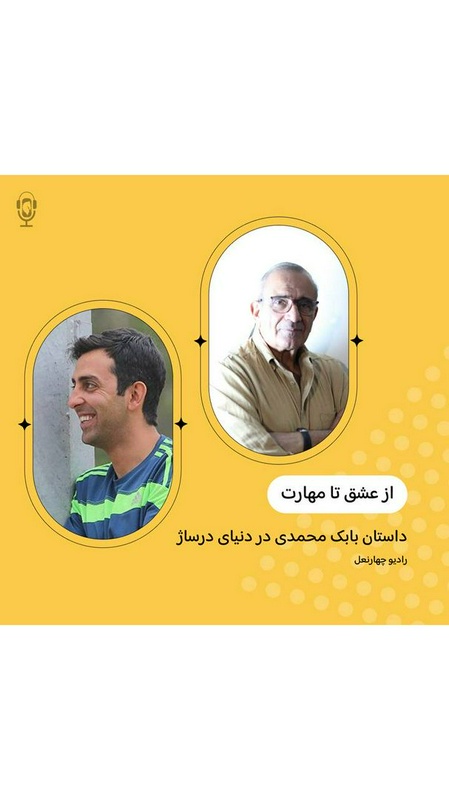
The presence of each and every one of you dear ones made me start this year even stronger than last year, and I kiss the hands of each of you and hope that you will support me with your presence this year as well. Episode 55 of Radio Chahar Naal is an interview with Master Babak Mohammadi, who is one of the greats and pioneers in the field of equestrianism, especially in the specialized field of dressage. He is also one of the greats in the world of art, especially cinema and theater. Today, in Radio Chahar Naal, we have a gift from Ms. Sanaz Seyed Esfahani, who is one of the writers and greats of the art community, and she honored us by sending one of her stories with her own voice, which I will play for you in this episode. It is a very interesting and attractive story, especially with the eloquence she has. As always, I request your support. If your support is financial, you can make your financial contributions through the link I have placed in the description of this episode. If you would like your gifts to be spiritual, send the episodes of Radio Chahar Naal to your friends and let others learn and benefit from these talks. My colleagues in this episode, like last year, are Farshid Jahanbazi, the designer of this episode's poster, Ms. Negin Goudarzi, and Erfan Moghaddam, who are the composers of the music at the beginning and end of the episodes. I won't take more of your time and invite you to listen to episode 55. In the name of God, Mr. Master Babak Mohammadi.
From the pioneers and greats of the equestrian community, I am very grateful that you allowed me to disturb you in your personal home and I am even more grateful that you accepted to be a guest on the program and gave this honor to me and the audience. If you have any greetings, please go ahead so we can move on to the questions. Thank you very much for giving me the opportunity to participate in your program. I am at your service, many greetings to our viewers. We are at your service, ask any questions you have. May God protect you. Well.
Exactly what year and where were you born? I was born in 1327. It is 11 Bahman 1327. So you are a Bahman-born. I was born in Tonekabon, in Shahsavar. I was there until I was 11 or 12 years old. Then, because of my father's job, who was the head of culture, we went to various places. He was the head of culture in several counties, and I was with him. For example, the first place we went from Mazandaran, from Shahsavar, we went.
To Fereydan Isfahan, where I found the opportunity to live with nomads, and it was a suitable place for me. For example, we rode horses, went hunting with horses, and so on. I used to ride before, but there it was a very suitable environment for me. Then we came to Isfahan, and I was in Isfahan for a few years. Then we went to Natanz, and from Natanz, in the year 50, I went to Tehran, Farahabad, for military service. I was there for two years, and from the year.
52 I went to Austria. Now let's go back a little. I want to see how your first encounter with a horse was in your early teens? You see, I don't remember, but I must have been very young. My first encounter was with nomads. No, because in the summers when we went to the highlands, there were these ponies that carried and brought tea. For example, there was a blue pony that I would sit on the balcony all day until the peasants brought it, unloaded the tea, and I would take a ride with it. But I would ride in the city itself. Now, for example, people would come to buy, tie their hands under that river, go shopping, ride, or these horses that were loose, which is now customary in the north for horses to roam, we would catch them and ride. But when we went to Isfahan, I was about 13 or 14 years old and entered the Bakhtiari nomads.
Because my shooting was good, we would go hunting with them and ride their horses. I would ride a horse with a saddle. Until that date, we rode horses with a pack saddle in the north. And for me, because I had many animals at home, they wouldn't buy me a horse. They said we have a villa, where to keep a horse. But there was access to horses in nomadic and tent-dwelling areas, and we were almost with them all summer, with nomadic clothes, guns, and horses, it was a kind of paradise for me. These are the early conversations before we started recording.
You mentioned that you are also related to the late Ayatollah Amlashi. We are descendants of Sheikh Rashti. They are called Sheikh Rashti because they went from the north. They were originally Kurds, Kurds who migrated to Quchan and were Kurdish khans. Then they were sent to Amlash. Their Sheikh was Sheikh Mirza Habibullah Rashti, known as Najaf, and those who are familiar with these matters know them well, and he gave ijtihad to 10 people, one of whom was Sheikh Lotfollah Nouri.
Sheikh Fazlollah Nouri was among them, who were very important clerics. My grandfather was also a cleric, a great preacher of Amlash. After my grandfather, no one went into the seminary and clergy. You yourself did not have any encounters? No, no. I was only invited once and sent to the Qom seminary to talk about screenwriting with the clerics. It was very sweet and funny with the students. But I advised them to give up filmmaking and engage in ordinary activities. I say on my father's side, they were all clerics, and they were very important clerics and had many students. My grandfather also had many followers, as they say. They have been deceased for years. Very well. Before the revolution, you mentioned that after Isfahan, you went and spent a few years in.
Farahabad Club. No, see, my military service was correct, I was a sergeant and spent two full years in Farahabad. The Guard Division was also nearby. Then, during the 2500-year celebrations, everyone was sent to Shiraz. They didn't know how to ride, but they went. They didn't send me, they said because they were investigating, the father and mother must be the same or have confidence. Because of my father's political background, they didn't send me. Bijan, the son of Tai Haj Rezaei, and I stayed. Tai Haj Rezaei.
They sent everyone to Shiraz to ride horses in the 2500-year celebrations. I was very upset, they said no, it's not possible. You had investigated. They asked if I could ask what my father's political background was? If you like, go ahead. My father was among those who were part of the Tudeh Party in their youth. Yes, he was a Tudeh member, one of the prominent ones. However, later on... we didn't know them, our view was towards that and the sea.
We thought the Tudeh Party was a party that could be effective in the country's progress. Later, when we realized it wasn't the case, we withdrew. Even after the revolution, we went after him, saying, sir, come here and sit, just be present, he said no, I don't want to. Meaning later, they were unaware, those who were members of the Tudeh Party.
One of the reasons for their unawareness is that all our Tudeh members, after the revolution or whenever they retired, didn't go to the Soviet Union, they went to America. My father was the representative of Ramsar culture in the construction of that Ramsar hotel and was very involved. He was a 24-year-old man but very active and among the very active leaders. His goal was to serve the people and such.
Modern, all intellectuals went to the Tudeh Party. Then we realized that no, their goal was something else, and they withdrew themselves. However, their name remained. Correct, you have a memory of my father. It was one day recently, an old man was brought to our house to work because he was fixing the kiwi garden. Suddenly he said to my father, sir, do you remember me? He said no, I don't know who you are. He said yes, do you remember you used to give us leaflets at night?
We distributed our 50th anniversary, they were Tudeh members and such. And I remember my father's Tudeh activities and I memorized poems that, for example, my father had taken some Tudeh members into his guest room. It was a crackdown, after all. Yes, we were kids, we didn't know what was going on, but it was customary to recite Tudeh poems in the street. We memorized them, I still recite: Tudeh has fled, the hunting dog has become, Mossadegh the cobbler has ridden the cart. We recited it in the yard with other kids.
You in front of your father, who was among the professors and, as they say, bigger than friends, hid them so they wouldn't be caught, and we recited this in the yard. Well, these were suspicious to the police. Then the Shahsavar police station was also near our house. Eventually, one day they take all of them and shave their heads and such. Was your father among them? No, they hadn't caught him. They had caught Ghadam, taken him out. They catch Ghadam from Asia, take them, shave their heads, and hadn't caught my father.
But later, years later, we had a physical education teacher named Mr. Farhadian, he said to me, aren't you Babak? I said why? He said I should strangle you. Why? They had imprisoned us, we had escaped outside, sought refuge in your house. What was this poem you were reciting in the yard? Which poem? Tudeh has fled. You were a kid, everyone recited it, we recited it too. I really felt it was something. I remember my father had an interesting memory, he had tattooed a hammer story on his arm.
The Soviet flag, the flag, the communist symbol. He regretted it, poured acid on it to erase it, it turned into a crown. He was very upset too. But later, when we became more sensible and older, we really knew what he was asking about, what he was talking about. I asked him, he said we were unaware. He said we had no information. The first cultural centers were established there, where books were translated, theater plays were staged, all with the help of the Tudeh Party, and we thought we were advancing.
Our country. My father himself worked in theater and Miri the comedian was Miri Shomali. Oh, I think he was Rashti. Abad Shahsavar was and this was one of those little kids who grew up with my father, I even have a picture of him with me. This one only his foot is visible. I have it so I don't fall in the alley. They said because we had established the first cultural centers in Iran there, allowing women to be the first women to go to school and such, they were Shomali, and others said they were shameless because their women came to study.
They always used these tricks to create division among Iranian ethnicities. Then my father and others said we thought this Tudeh Party was a chance for cultural advancement for our people. Translating books and such. You still think our government and other governments think all artists are Tudeh members because artists used to have leftist thoughts. Yes, not Tudeh, social democrat. Yes, they were leftist Tudeh members. They were Tudeh members. Even now they think every artist is a Tudeh member while.
It became clear, thank God, these Tudeh members realized what a mistake they made. They were all uninformed. Yes, unfortunately, they came to the bank very soon. They were among the big figures in this party but withdrew themselves. I just wanted to see, dad, why were you? Then I saw they themselves didn't know why. No, they said we thought we were children of their time. Progress, yes, we were intellectuals and intellectualism and progress depended on these activities. They were against the Shah, these were tyranny and such things.
Very excellent story of the mare that had been cornered in the narrow corner of the manger, you were rolling from side to side. You turned your head at every sound. Sweat had settled on your body.
I was trembling, you were moaning. You had driven the doctor away with your hind leg. I was punching, you were moaning from the doctor and the horseman, from the farrier and the horses. Everyone came and looked at your crescent-shaped belly of the last month and found no cure for your pain. I'm angry, I kick your side.
But you turn your head to the slanted light of the window to see the light. Your life is ebbing away, my life is ebbing away. I know you know the doctor and the horseman, the farrier and the horses are afflicted with what to do, what to do, and you don't let anyone get close to you. The syrup reaches the hay, I to constant rolling and hitting.
At last, the manger. A young man with calloused hands asked permission from the elders and said in our village in such situations they say the evil eye has caught the horse, it has been envied. Allow me to burn esfand and apply mud to the mare's body so that the evil eye may be far from her. She's pitiful, she's pregnant. In short, the gathering of horsemen said.
Although this story is superstition, it costs nothing. They said go bring your esfand and mud. This mare is lost. You were being lost and taking me with you into darkness. My heart was beating in your belly and I was swaying. You were lamenting on that sweat-soaked stretch. I was getting warm, you were getting cold.
You were getting cold, I was getting warm. In the end, what? He threw the hook from his hand and quickly went and quickly returned. One hand was a bag of salt, the other hand was mud. He softened the salt and mud together and applied it to your body, like setting a broken limb.
You cried out when I pressed on your belly. Your swollen breasts touched the straw in the manger, and every joint of yours ached. You want to get up and sit, I spin in your belly. You want to roll over, to lay your body on the other side, but you can't. I emerge from your womb, causing a commotion.
The farrier, the horse owner, and your owner happily and smilingly say the mare, blessed by the gracious Creator, finally gave birth. Look at the foal, Zaro. Bravo, Mashallah. I stood up, fell down. I stood up, fell down. You licked your face, and I looked into your eyes.
And I know that I love you very much, my mother. How many months I waited to see your face. The end of the story and the reading by Sanaz Seyed Esfahani, dedicated to Radio Charnel.
Well, Mr. Mohammadi, when did you start the classic riding style, which is now almost a system that nomads used for hunting and brought Venus with a horse, to make it a bit more professional and sporty? See, 40 years ago when I was about 30 years old in Austria. What year did you go to Austria? I went in 1352. That's right, we went to learn college and language and...
Then it was very difficult. I had to go to the cinema university, that was my goal, and at that time it was the only university that required an entrance exam. You would take the exam and out of 2000 people, they would accept seven men and three women. I also wanted to go to this university. And did you study film writing? See, no, I am a cinema and theater director, a graduate of the University of Vienna and Italy. In Italy, I studied photography, a bachelor's in photography, advertising, and screenwriting in Austria.
Cinema directing, I have a master's degree in cinema. In fact, I started there. We also made films and so on. For example, let's talk now. When I went to Austria, I say at first we had the problem of what our main field was. Austria was also the center of horses, and we usually watched from afar. Excuse me, just before you went to Austria, you said you served near Abad.
Did you ride there too? I was on this side, I was in training. Every four or five months, students would come with these diplomas. We would see them jumping over fences, wondering what they were doing. Especially me, who was on this side of the fence, didn't ride before the revolution. In fact, in Iran, I rode with these nomads. At that time, it wasn't customary at all. I don't remember being in a club in Tehran, maybe I was in Shaki, but not in the main way of being in a club. But there, I saw it.
The ruins of those mountains for patrols with our soldiers, they would come with their horses. They were always in front of our eyes, riding well, jumping. We were on the other side of the fence. Then they said our students should all go there for the 2500-year celebration. We said what are they going to do there? They said they would teach them to ride there to participate in the 2500-year celebration on horseback, and I was the first to say I would go.
But I was in the army wrestling team. I wrestled for Farhad and others. I was also a wrestling coach. For example, I was the founder of wrestling in Natanz. I was Fereydoun. Well, we were Mazandaranis, after all, we were involved in wrestling. Then I said okay. Then suddenly they read the names, and two names were missing. One was mine, and the other was Bijan, God bless him. Bijan, it seems, passed away among friends. Haj Mohammad Reza Haj Rezaei. Haj Mohammad Reza, yes. Father Bijan, we were here for two years with your father's political issues.
One was that we were the children of a cleric. My father and others were involved. They were neighbors. He was both a communist and a Tudeh. Both sides didn't let him wrestle. But he was a very devoted person. In short, I was very upset. They were training there. Amiri and others should know this. I didn't fall in the 2500-year celebrations. We were very upset about this issue. But as soon as I went to Europe, at first we were involved with students because we didn't know the language. As soon as it became firm, I went to the main thing. First, we went to these small clubs with facilities and so on. Then gradually, I came to the second riding club with white horses. Not this one, but the second club. Then there were various coaches there.
It was very serious. Very. One day, one of these coaches in the locker room told me. I told him how is riding? He said it's very good, but you just don't know how to ride. What do you mean? I'm good. I mean, I rode everywhere. For example, we went to Hungary. The patrols were so dangerous. Out of 40 people, only 14 would arrive. It was actually autumn. This riding they say, the male horses in the autumn of Hungary had the plains of Busta. I mean, from here to Karaj, you could gallop.
It wasn't visible. You would fall into a mouse hole. Out of 40 people, I was always there. I had claims. I could do whatever I wanted with the horse uphill and downhill. They did it. He said you're very good, but you just don't know how to ride. What do you mean? I ride. But there, later in the arena, he said do you see this line? I said yes. Do you see it? Yes. Go straight to there. He said now look. We saw it was crooked. We came. He said no, we have to go straight. We went again and saw it got worse.
A 10, 12-year-old girl was there. Let's circle this girl. Whatever we did, our circle would become an oval. It would be crooked. Then she did it. Everything was correct. It was a standstill. Then we saw our situation was very bad. He was right. How here? Because I understood riding differently. Do you understand? The patrols were very good. Then I saw no, they are really right. Gradually, I stayed with this coach for 25 years. 25 years, yes.
For example, he gave me a book called "The Little Riding Book." After 10 years, I told him I've been reading this for 10 years. Every time I see something new. He said I've been reading it for 50 years. Every time he said the more you progress, the more you understand what's written in it. Whose book was that? It was by Generalski Perski. One of the founders of the white horses. The white horse has a 450-year history. There is a film called "White Horses" made by Americans. It's about this. He was a general.
At 85, they told him to retire. He said where should I retire? I just got better. They sent him in 1936 during Hitler's time. He was both a breeding champion and a champion on par with him, who was only the head there for 10 years, who invited him to dinner. He had also come to Iran. General Albert, his picture is here, I'll give it to you. Then my coach was his assistant. He was an assistant until the age of 70, 80. I talked to him a while ago. He said I'm old now.
Are you going to university? I said yes. He said you are strong. I've grown old. This filled all the riding ranks for the rest of my life. At 60, 70 years old, and since you grew up in this environment and saw these things, other riders won't impress you. You understand what riding means, and these were great people, and I was lucky that they accepted me. They said, very well, you can come and ride with us.
Normally, someone would approach them and say we want to ride with you. They would say, first learn to ride, then come to us. But you can ride with me, and I started riding with them. I was allowed to sit around their table or stand in the café. There, I once raised a very big newspaper. In the café of the General Albris club, my teacher was Saba. Other teachers, old men, were sitting. Others were standing around. I was standing next to them. General Albrecht.
He explained that sometimes horses that go fast are hard to control. Instead of tightening your reins, it's better to lighten them so the horse calms down. Everyone thinks the reins should be heavier because the horse is uncontrollable. Since I had experience, now I say where I got this experience from. I completely agree with you, you are absolutely right. We were in a large gathering, and then everyone looked at me, and no one said anything. We looked.
It's completely correct. After that moment, my teacher said, what was that? This action you did. I said, what was it? You are not allowed to confirm. Who are you to confirm? We stood right there. He told me it's clear it's correct. Sorry, I saw no one saying anything, so I confirmed it. It's very bad that you confirmed it. Now we are telling you this time, but don't do it again. Now I was 38 years old, I was a director, everyone knew me. Next time, you can't come to these meetings and drink coffee. You shouldn't confirm there.
The order of this hierarchy was so important that I used to go. It's impossible for you to wear a T-shirt with a picture of Jackson or have a blue table or wear pink boots. Such things were not customary there at all. That is, outside immediately Austria, what was it? Sir, this was called the thirteenth street, the thirteenth district, the second riding club.
What is the name of the main one? The Austrian who was in Spain brought it there and it stayed by the same name. You were in its second school. Just with this hierarchy, everyone was employed there. Then you would ride there for 12 years. After 12 years, they would tell you if you passed its exam, for example, after 12 years, they would tell you whether you were suitable for there or not. After 12 years, yes, yes. It starts there at 4 in the morning. You don't have 12 hours of talking in the arena. Since we had teachers there, we were allowed to sit once a week and just watch the best of them. But these great teachers taught at our club. They didn't go anywhere else. These were special people. It was very important. I say the chance we had was this, and we gradually got mixed in and then learned how to behave. For example, one day I was riding a horse, as soon as I mounted.
We had another teacher here. During World War II, he taught someone who didn't know how to ride in two months and sent him to war. He was an old man. Why dismount? They were all military. Military, take it, then bring it. He showed that a Kalashnikov was hanging from the horse's tail. He brought the best into the arena. Take its snap again.
Here the horse comes clean and leaves clean. Then when we... because I saw different courses. I was first in three-day events. We hit obstacles, we jumped. We did these things. Yes, the three-day events were fixed in the field, it's fixed. They jump rivers. I really liked this. I really liked doing this. It was for this reason that we realized there that if something is lighter, the horse is easier to control. Or this fox hunting that we did these things. Then we did other things among ourselves.
Our people raced in the forest together. Whoever could open the other's girth would do so. Oh, oh, when they open the girth there, you have to sit straight. If you do it a little like this, you're gone. These were not the right things, but we did them for youth. My nose broke. For example, my main helmet and you look now. That three-day and from the obstacle to the river above, it's all iron. It's all pierced with a drill.
The iron here covers so that the head doesn't get damaged and such. It was there that I realized in that forest desert where you were riding. Look, now a problem I have here, the patrol here, I'm not satisfied. The patrol here is like they're having a wedding. You walk, you come. The patrol there is from a place in the Yurtma area or Hungary where you went with 40 horses in the field.
From a point, the guide says free riding, meaning anyone can overtake anyone. Still, you had a guide there. At first, he goes forward, then he says free riding, meaning you can gallop your horse. First, he tests to see if these 40 people who came from different countries, Japanese, can or cannot. Then no, everyone is a rider. Because look, a vast field, when 40 horses gallop, the horses compete with each other. Like a horse race, they narrow down. Then there's a problem there. You noticed the ditches from the color of the grass.
You realized it's darker. Here's a ditch, and you have to jump your horse. Do you understand? There was no sign. Another very dangerous issue was especially near the roads. They would put barbed wire or wire fencing so that wild deer wouldn't come onto the road. Then these twists would wrap around them, right and mixed with the grass. You wouldn't notice. If 40 horses were galloping and you weren't paying attention. If you were in the second row, the third row.
The ones in front would jump or fall, you were aware. But when your horse was in front, you would see from the color of the mud when the mud was high, here you had to be ready to jump. Then these horses never stop. These horses knew they weren't going to a café in the forest. They only stayed there. These horses, under no circumstances, can you stop the horses. They galloped side by side. You just watched your friend who no one was riding, fell to the ground, and this happens in the fall. In the fall when.
It was that the novice riding horses, the young stallions, were really demanding strong riders. It's no joke, especially in horseback riding. The horses gallop. You have no control over this horse. You just have to hold yourself well there so that everything is set at this speed and these things because you shouldn't think at all. When the horse is galloping, I keep my nerves or slow down its speed.
Take care of your health. Pull a little more. The bridle becomes the horse's fifth leg. It puts its head there and just goes. You can't do these things at all. You understand, and really everyone was interested in going there in the fall. From all over the world, it's very excellent. I hope you have enjoyed listening to these talks and beautiful memories.
This was just the first part of Master Babak Mohammadi's talks. God willing, in the next episode, I will also present the second part of his talks for you. Thank you all for being here, and I wish each of you good health, and as always, take care of your horses.