Siavash Ardestani on horse genetics and breeding
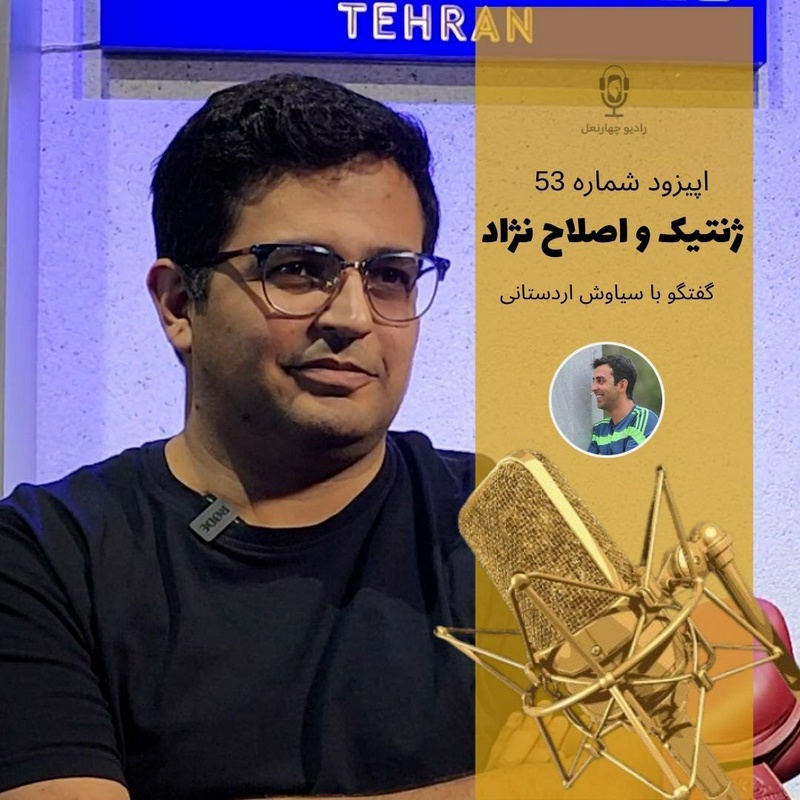
خلاصه
In the fifty-third episode of Radio Chaharnal, Mohsen Pourheidari discusses the importance of breeding and its economic impacts in the equestrian industry with Dr. Siavash Ardestani, a specialist in genetics and horse breeding. Dr. Ardestani emphasizes the need for accurate data and management of genetic reserves to preserve specific breeds and prevent their extinction. The use of modern technologies, including artificial intelligence and statistical techniques in evaluating and predicting horse traits, has also been discussed. He points out the problems of the lack of statistics in Iran and the necessity of creating information collection systems, stressing the need for collaboration among breeders to improve breeds and meet the specific needs of each breed. Finally, the impact of climate and heredity on the quality and performance of horses is also seriously examined.
نکات کلیدی
- اصلاح نژاد شامل مراحل مختلفی است.
- جمعآوری اطلاعات و تعیین شاخصهای مهم برای اصلاح نژاد ضروری است.
- حفظ نژادهای در خطر انقراض نیاز به برنامهریزی و مدیریت دارد.
- آمیختهگری ابزاری مهم در اصلاح نژاد است که باید به درستی انجام شود.
- مدل بلاپ به عنوان ابزاری برای پیشبینی و اصلاح نژاد اسبها استفاده میشود.
سرفصلها
- مفهوم اصلاح نژاد — بررسی فرآیندها و مراحل مختلف اصلاح نژاد در اسبها.
- اهمیت فنوتیپ و اطلاعات شجرهای — نقش اطلاعات فنوتیپی و شجرهای در ارزیابی و اصلاح نژاد.
- چالشهای اصلاح نژاد در ایران — بررسی موانع و مشکلات موجود در اصلاح نژاد اسبها در ایران.
- نقش آمیختهگری و مدل بلاپ — توضیح کاربرد آمیختهگری و مدل بلاپ در بهبود نژاد اسبها.
پرسشهای متداول
اصلاح نژاد چیست؟
اصلاح نژاد یک فرایند است که شامل مراحل مختلفی از جمله جمعآوری اطلاعات شجره، ژنومیک و عملکرد فنوتیپی میشود.
فنوتیپ چیست؟
فنوتیپ به معنای صفات قابل اندازهگیری یک جاندار است، مانند ارتفاع قد از گلوگاه یا طول گردن.
چرا اصلاح نژاد اسبها باید توجیه اقتصادی داشته باشد؟
زیرا اگر نتوانید دام خود را بفروشید و گردش مالی ایجاد نکنید، اصلاح نژاد اصلاً توجیهی ندارد.
چگونه میتوان نژادهای در خطر انقراض را حفظ کرد؟
باید برنامههای مدیریت حفظ ذخایر ژنتیکی و جشنوارههایی برای حفظ آنها تعریف شود.
مدل بلاپ چیست و چه کاربردی دارد؟
مدل بلاپ یک سری معادلات ماتریسی است که برای پیشبینی و اصلاح نژاد اسب استفاده میشود.
متن کامل گفتگو
Hello, I hope you are all well. I am Mohsen Pourheidari, and I am once again your guest with the fifty-third episode of Radio Chahar Naal. In these last days of the year, when we are all busy wrapping up our work and lives, I wish you all happiness and peace of mind, and I hope you are always healthy and cheerful. The fifty-third episode of Radio Chahar Naal is my conversation with Dr. Siavash Ardestani, whose expertise is in the field of genetics and horse breeding. Unfortunately, we are deprived of his presence because Siavash Ardestani has emigrated, and his absence is greatly felt, but I wish him health wherever he is. In this episode, we discussed the topic of genetics and breeding in detail, and I personally believe that one of the most educational issues we need in the field of horses and equestrianism is knowing this information and also the important resources that listening to can help us make better decisions, especially now that we are in the winter of 1403 and are supposed to have better productions for the beginning of the year, we should be more careful. Today is the fourth of Esfand, when this episode is being uploaded, and on this day, Arshia Feyz won the championship in the Asian Youth Championships in Thailand, and I would like to congratulate him, his family, and most importantly, dear Hamid Darestani, who has been with Arshia since childhood and has nurtured this sapling, as Arshia Feyz now competes with adults in the senior ranks. I say well done to both and wish them health. The sponsor of this Radio Chahar Naal program is the brand Zain Safavi. Meysam Safavi, with the enthusiasm he has had in recent years, has been able to register and produce his own saddle brand with a lot of research and precision, and I honestly think he has been very successful in this field, and the fact that we have a saddle producer in Iran is a great source of pride for us. Besides this, Meysam Safavi has beautifully and with the quality of foreign brands made jumping girths, stirrup leathers, and many leather equipment for you, and they also do saddle repairs and equestrian equipment. I will put his Instagram page in the description of this episode for you. Well, as I have always said and asked of you, if you feel that this content is useful to you or that Radio Chahar Naal is educational for you, support me so that I can produce more and higher quality programs. After all, producing content in this style is both costly and time-consuming. I hope you will take care of me. Well, as always, my colleagues in this episode are Negar Goudarzi and Erfan Moghadam, the music composer and solo singer, and also dear Farshid Jahanbazi, the Instagram poster designer for the fifty-third episode, and I won't take more of your time and invite you to listen to the fifty-third conversation with Siavash Ardestani about the topic of genetics and breeding. In the name of the Creator of beauty, in this episode, I believe it is one of the most important episodes of Radio Chahar Naal that we have paid less attention to and have not been aware of at all, the discussion of genetics and breeding.
Today, I have the honor of being with one of the professors in these fields, Dr. Siavash Ardestani, to discuss the important topic of breeding and genetics with him. I ask your permission to call you Siavash during the interview because we don't have an interview setting here; our discussion is more of a chat, and I want to thank you for taking the time. I know you are a traveler, and it's a pity that we don't have you anymore, and I am grateful that you honored us by participating in the program.
Say hello so I don't take more of your time. I also greet you and your listeners. It is an honor to be with you and to be able to help in this regard so that we can create transformation and improvement in the horse industry with your help, because I myself am very without knowledge in this field, and I want the discussions to be very easy for the public.
If you want to give a general explanation about breeding so that I can ask my questions in between your explanations, we are at your service. Look, breeding is a process and has different stages. The first stage in any country, in any developed and modern country, you can see this breeding process very clearly and transparently.
Look, in breeding, as I mentioned, we have to go through a series of stages. The first stage is collecting a series of information such as pedigree information, genomic information, and phenotypic performance information. Now, maybe your listeners are not very familiar with the phenotype. One of the words we use a lot when we want to buy a horse is phenotype. Well, none of us know. I say I don't know. This may be confused with type in the mind. The word phenom or phenom.
Those friends who are in philosophy or political science or art should be familiar with this word; phenom means to appear or manifest tangibly. Anything that has a tangible manifestation and you can measure it is called a phenom, and well, in fact, in Persian, we can use the word trait, which means that each animal has a series of different traits.
For example, the height from the withers is a trait, the length of the neck is a trait, and so on, and now you can say phenotype or you can say pheno type. For example, the height from the withers or each of these has a tangible manifestation, and you can measure it, and anything you can measure, in fact, your living being or livestock, you can say this is a type and now.
It may have been mistakenly established that, for example, this horse has a good phenotype. This is a word that can be used for different traits. I think it's more because of that type or type part; for example, you go and see a horse that you like its type, you say it has a good phenotype. We don't say this phenotype. Yeah, well, flow is something else, type is something else, meaning something else. Two booklets and well, we need a series of information as I mentioned.
One is phenotypic information. In fact, before collecting this information, a series of indicators must be determined. What are you looking for in a jumping horse or in a dressage horse? Are you looking for tall height? A stretched body length or not? Only biometric traits. Biometric refers to those traits that measure the dimensions of the body, you can say the same biometric traits. Well.
Its performance in competition, this is also a phenotype. These must first be specified which of them is the most important and has more importance compared to the main input, which is the horse. Look, what is important for me? For jumping, yes, of course, this is somewhat market-oriented, meaning the market may lead your mind elsewhere. The point is what an Iranian rider prefers or.
This subject is very influential. Usually, for cows or other livestock, we have a factor called the selection index. The selection index, for example, for Holstein cows in the Netherlands, is different from the selection indices in Japan. For example, in Japan, milk fat and protein are very important. I mentioned this livestock example, and in the Netherlands, you are looking for cows with a suitable type and high body condition score, which is important for them. Well, in horses, this can also be different. For example, the Dutch may be looking for specific features, and in Germany, you can say practically wherever you are, the standards defined by associations or local individuals are different. Yes, it can be different. For example, in Iran, you have experience with which items are more important. Statistical work must be done on these. It's not like saying my taste is this or Mr. X, Y, Z's taste is something else. These must be based on statistics and market needs. Look, breeding has a direct relationship with consumer economics. Yes, if you cannot sell your livestock and create financial turnover, breeding has no justification at all. It must have economic justification for production to take place. It's the same supply and demand issue. The market must be considered because the producer is essentially meeting market needs to earn income; otherwise, production will disappear. You see this in relation to purebred breeds. Some breeds are at risk of extinction.
Well, what's the reason? Because they didn't have a good market and their production was not profitable. You see this very much in relation to draft horses, heavy horses that were previously used for carts and agricultural purposes and now have no use.
In Iran, we are categorizing. Morphologically or in terms of appearance, we have three racial groups: draft horses, ponies, and light horses. Draft horses like Shire, Percheron, Suffolk Punch are breeds that are considered draft breeds. Now, some countries may have specific programs for these to preserve them and prevent them from becoming extinct.
Or they define festivals for them, like beauty festivals, where they bring them to show competitions. Look, in this breeding and this field, we also have the discussion of protecting and preserving breeds, which sometimes these may conflict with each other.
For example, where you want to do crossbreeding, this may be to the detriment of some breeds, and you need to have a management plan for it. For example, you want to cross two breeds, let's say breed X and Y. Breed X may be at risk of extinction and disappear, but there should be plans, genetic resource management programs that are their job.
Especially in relation to this subject, for example, FAO is one of the places that has activities in this regard and reports. These are the ones who can make policies for preserving genetic resources.
Which I say may not necessarily be aligned with breeding goals. Many times they are aligned, and some places they are not aligned, but they don't conflict with each other. No, they can conflict if you consider genetic resource management. Finally, you crossed two breeds and then caused one of the breeds, for example, to disappear. Well, this is not interesting at all. You have to manage and plan that from breed X I have to produce X number per year. Produce Z number of those productions per year. For example, a series of numbers and figures must come and be done with calculation, otherwise, without calculation, we have many of these cases in nature as well. One of the reasons why, for example, you go to a lake and release fish there.
Could the population composition of that lake be disrupted by the fish that are in that lake? These must be done with calculation. It is not like saying this is a separate field in this field, and well, there are those whose specialty is managing the protection of genetic resources who can do this work and plan for it.
Well, let's go back to breeding. I think we got a little off track. Yes, well, it was a good event because now my audience and I learn very well, and I was thinking about why we didn't know these issues sooner. Those who can at least in our field of work choose with more precision. In relation to this crossbreeding, look, finally, crossbreeding is a tool that is used in breeding. However, all these tools.
Whether crossbreeding, these mating methods that exist, the selection methods that exist, all of these must be done in their place and at the right point. Look, for example, a misconception that exists about crossbreeding is that, for example, they say that well, for example, we crossed breed X with Y, then their offspring, for example, the offspring of X and Y were able to show better performance than their maternal line, which is the same X. Well, this is not breeding.
This is not a breed. Look, we have a discussion called hybrid vigor or improvement resulting from crossbreeding. Why did you come and cross breed X and Y to create an offspring or a being that has weaker performance than Y and better than X? This is progress. Well, you produce the same Y breed and expand it. Well, its performance is better.
Crossbreeding also later requires a series of programs. Crossbreeding is really costly, especially in essence, it will be very costly because for you to be able to calculate that hybrid vigor and see if you had that performance improvement compared to the paternal and maternal line, you have to do this practically once.
Take 1000 heads from breed X and 1000 heads from breed Y. Yes, you have to do this in the population. Look, all breeding, genetics, all of these are in the population dimension, and if you don't do this with significant information, you can't really be confident in the accuracy of the work you've done. The specialist now gives an opinion and certainly must have a program. Yes, records must be kept. All.
Phenotypic records that they need and want to improve must all be recorded. Well, we got off track again and went to crossbreeding. I go back to the same things we need for breeding. The reason I don't let, I mean, I don't say anything to get off track is that this information is interesting, and it's a pity that we don't know. I mean, I say I enjoy knowing these issues and thinking more. Look, as I mentioned, we.
We have a series of phenotypic information, pedigree information, and genomic information. Now, genomics is optional and it's better to have it, but if it's not there, then it's not there. But well, we need these two sources, meaning these two, that is, phenotype and pedigree information records. These two must be there. These two information sources are the two main pillars. Yes, these two pieces of information must be there. In addition to that, environmental information must also be there.
For example, in which club was your horse born, how old is it, what is its gender? These are actually factors that can affect different phenotypes. As a result, for us to do the evaluation using this information, we need to run a series of statistical models. One of these models is called BLUP or Best Linear Unbiased Prediction, which in Persian means the best linear unbiased prediction method.
This model was presented in the 1950s by a mathematician for breeding and this breeding field was actually born from this BLUP and expanded. However, this BLUP is a series of matrix equations that, for example, for the number of horses you have and the phenotypic records you have from your horse, for example, you will have equations and unknowns. As a result, for this to be solved, in the 1950s.
There weren't very powerful computers that could do this work. As a result, this happened in the following decades, and with the increase in computer speed, their RAM, and scientific progress, it actually allowed them to solve these equations. Now this process should be much easier. Of course, artificial intelligence is something else. This is a linear equation.
Artificial intelligence also has machine learning or deep learning models, their job is exactly this. You give them a series of information and say go predict for me. You also give it a series of new information and say go predict these for me, for example, what do I know, in such a situation what happens or in such a factor you can test these different states with it. I mean, if I want to summarize the conversation so far, this story requires having statistics.
It requires pedigree and phenotype information. This interpretation was there, yes, that's correct. And well, of course, this information must have a series of features that you can use them. For example, in relation to pedigree, you want to run these BLUP models that I mentioned to you for a breed, for example, you come and do this work.
Well, in that breed, in the breed you have, there are a series of connections in terms of pedigree. What does it mean? Horse number 1 with 2 with 3 with 4 may be related, and for you to be able to calculate those relationships more accurately, you need to have a population that this population is related in pedigree and you don't have separate families and at least your pedigree depth is three generations.
That is, you have information for up to three generations. How old is a 70-year-old generation? I don't know, it depends on the country. If we want to relate the generation to the age of the horse, well, it's different. It doesn't have a standard. Why, why do we have a generational gap? We have something called a generational gap. What is a generational gap? The generational gap is when a generation changes. This can be different in horses of different disciplines.
Well, for example, in racing, this generational gap may be 4 years, 5 years. But in jumping, for example, if you want a stallion to be approved and then its offspring to come to the competition, how long does it take? A stallion in a jumping horse to be approved and then its minimum age is 12 years old approved. Now we have seen in the Netherlands, for example, 5 years old approved. Germany also has this. Look, maybe I should explain this better.
Look, you have a young horse, well, this comes and you bring it to, for example, competitions or, for example, it has a series of records from itself and its relatives. This is very different from a stallion that is 12 years old, for example, 13 years old, has 50-60 offspring, for example, and those offspring have come to the field in competition. Well, these affect the analyses. The more relatives an individual has.
In fact, the more information you have from the relatives of an individual, the more reliably you can trust the numbers that come out of that BLUP, yes, because it gives you higher reliability. Well, now a horse is 12 years old, I refer you to the 30-day and 70-day tests in Germany.
In Germany, FN, which is their equestrian federation, has a department called the Horse Breeding Department. That's its name. Then what do they do? They take a series of 30-day and 70-day tests, first a 30-day test. The 30-day test is such that you take your horse. 3-year-old stallions and mares can also, meaning it doesn't have to be a stallion. Of course, these before that have a series of other tests for their sperm for stallions to see what the motility and mobility of the sperm are like.
Does it have mobility or not, and after these tests are done, your horse can enter that 30-day test. That is, it has a prerequisite and it is accepted. Of course, before that, they bring them to things, to a series of festivals like beauty festivals in that way. When the foal is very foal, they bring them to the fields to see, for example, their productions last year, the productions they had the year before, what it is like. Always on display, yes, yes, it is like this.
It is done. Then at the age of two and a half to three years, they do that sperm mobility for stallions and then they call it VA. This 30-day test is such that you take your horse. From multiple judges, those who are trained for phenotypic evaluation, they come and evaluate your horse objectively. The quality of its movement in the step, the quality of movement in the trot, the quality of movement in the canter, and free jumping are given scores for these