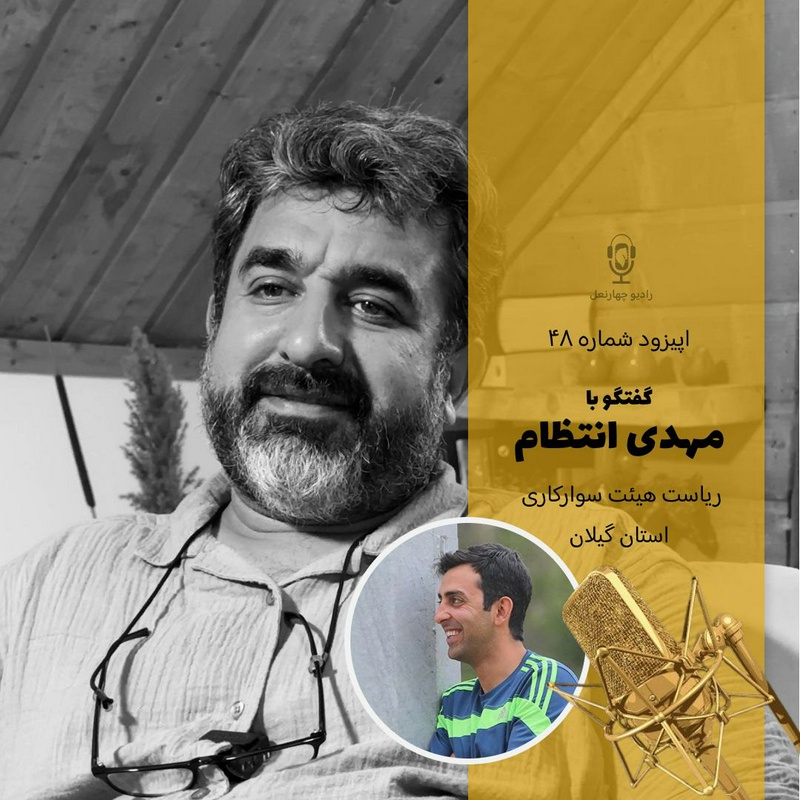
Head of the Equestrian Board of Gilan Province
خلاصه
In the forty-eighth episode of Radio Chaharnal, the host discusses with Mohammad Mahdi Entezam, the head of the Equestrian Federation of Gilan Province. The aim of this program is to keep hope alive and develop equestrian sports in the country. Entezam points to the existing challenges in this field and emphasizes the necessity of establishing public clubs for equestrian training. He highlights cultural, infrastructural, and financial issues, stressing the need to create suitable spaces for youth and support them. He also talks about the smuggling of Caspian horses and the importance of registering the identities of horses, calling for the cooperation of the equestrian community to hold competitions and enhance the technical level of coaches. This interview also encourages youth to engage in equestrian activities and promotes awareness for protecting horse rights, emphasizing the need for collaboration among institutions to improve the state of equestrian sports in Gilan.
نکات کلیدی
- گفتگو با رؤسای هیئتهای سوارکاری در استانهای مختلف آغاز شده است.
- توسعه باشگاهها در گیلان با استقبال بخش خصوصی مواجه شده است.
- نگاه به سوارکاری باید به سمت آموزش و آشنایی عمومی با اسب باشد.
- ضرورت کار فرهنگی و بهبود زیرساختها برای حل مشکلات سوارکاری در گیلان.
- توقف کوتاه کورس برای بهبود ردهبندیها و حل شبهات است.
سرفصلها
- وضعیت سوارکاری در آغاز ریاست — وضعیت سوارکاری در استان گیلان ضعیف بود و تنها دو تا باشگاه فعال داشتیم.
- توسعه باشگاهها و مربیان — توسعه باشگاهها با استقبال بخش خصوصی مواجه شده و مربیان جدید در حال آموزش هستند.
- چالشها و پیشرفتها — محمد مهدی انتظام از چالشها و پیشرفتهای هیئت سوارکاری صحبت کرد.
- اهمیت فرهنگسازی و اطلاعرسانی — فرهنگسازی و اطلاعرسانی برای جلوگیری از جنگ اسبها و توسعه سوارکاری ضروری است.
پرسشهای متداول
شما تقریباً چند سال است که رئیس هیئت استان گیلان هستید؟
تقریباً ۵ سال است که رئیس هیئت سوارکاری استان گیلان هستم.
چند تا باشگاه فعال و مجوزدار دارید؟
ما ۱۷ باشگاه داریم که برخی از آنها پروانه تمدید نکردهاند و در مسیر تمدید هستند.
چگونه میتوان مشکلات سوارکاری در گیلان را حل کرد؟
با کار فرهنگی و ایجاد زیرساختهای مناسب، باید فرهنگ سوارکاری را توضیح داد و بهبود بخشید.
چرا امسال کورس یک توقف کوتاه دارد؟
برای انجام ردهبندیها و صدور دفترچهها و برطرف کردن شبهات.
چگونه میتوانیم با شما در ارتباط باشیم؟
میتوانید با من یا رؤسای هیئتتان تماس بگیرید تا گفتگوهای بیشتری در مورد اسبسواری انجام شود.
متن کامل گفتگو
Greetings and respect to all you dear listeners of the radio. I am once again your guest with episode 48 of Radio Chahar Naal.
I am happy to have the honor to be with you dear ones again. One of the sections that has started in Radio Chahar Naal is conversations with the heads of equestrian boards in various provinces. Those dear ones whom I have the fortune to visit their city, I will certainly interview them, and those dear ones who kindly connect from afar can be guests on the radio via the internet and talk about their stories, issues, and problems in their city.
The only purpose of this is for the heads of the boards to talk about their programs and keep hope alive in the hearts of the main equestrian audience in their city. There is no other goal behind this work except to make this sport more professional, and Radio Chahar Naal is not going to put its audience and guests in a bind. Any dear head of a board who hears my voice and listens to this episode can contact me. I will be honored to serve these dear ones.
Again, I thank you for the support you have given to Radio Chahar Naal. As always, you make me feel indebted to you, and I wish health to all of you. Whether those who kindly helped and those dear ones who are just accompanying Radio Chahar Naal, you are all respected by me. I am a friend to all of you, and if you feel again that you would like to support Radio Chahar Naal, you can enter through the link I have placed for you in the description of this episode and generously help Radio Chahar Naal. I kiss each of your hands and wish health for all of you.
I invite you to listen to the forty-eighth episode of my conversation with Mohammad Mahdi Entezam, the head of the equestrian board of Gilan province. In the name of the One whose name existence found, the sky movement, the earth calmness found from Him. Greetings to all the good listeners of the radio. I am very happy to be with you dear ones with another program, and thank you for supporting the radio and helping us make better programs. In this part, I have a special guest, and I have started a new chapter in Radio Chahar Naal, which is a conversation with the heads of equestrian boards.
From various provinces, my first guest in the program of the heads of the board is Mr. Mahdi Entezam, the head of the equestrian board of Gilan province. I offer my respects. I am very happy that you gave me this honor and accepted to be my guest on Radio Chahar Naal, and I thank you for hosting your city and enjoyed both the time I was here for the clinics and now that I am your guest. Truly, they are lovable and respectable people. If you want to say hello, we can start. In the name of God, the Most Gracious, the Most Merciful. I am Mohammad Mahdi Entezam. I also offer my greetings.
To you and the audience and viewers of the Radio Chahar Naal program. Thank you for the effort you make for the equestrian community and horses. You are welcome, it is a duty. So as not to waste much of our time, I will try to go through the questions one by one with you. You have been the head of the Gilan province board for almost five years. How has your process been from the start of your presidency until now? Let me tell you that we became the head of the equestrian board of Gilan province through an election process that was carried out legally.
In the first stage, by the grace of God, we became the head of the equestrian board of Gilan province. Before that, I was responsible for equestrian in Rasht city. In the provincial field before that, my background goes back to being the founder and establisher of the Chogan board in Gilan province, which has a 10-year lifespan. We have been familiar with horses and equestrian for about 10 years and have had the honor to work and live with this community. The elections were held, and the election process was somewhat surprising for us because.
Three months, three years had passed since the first election, and we had been in a challenge for 9 months. Following the same stories of the federation's caretaking, during those nine months, we were on the sidelines, the board was undecided, and again a larger election was held. In the first stage, if I am not mistaken, we became the head with 18 votes and two votes in favor of the honorable opponent. In the next election, because the assembly had become much larger and the equestrian community had also developed, we had something around.
22 votes, and let me tell you that our opponent was eliminated with one vote. We became the head of the board powerfully by the grace of God. After the day we took over, let's not go into much detail about these 9 months and so on. I want to monitor more of your main and work process. What did you take over on the first day you came? How many horses, how many clubs, how many riders? At what level were you? Look, the 40-year-old revolution, how many years the revolution has been going on, equestrian in Gilan was growing at the same level as the provinces.
Big ones were growing. That is, we had clubs, we had boards that we could speak in the country. No, we are the birthplace of horses. Yes, we are the birthplace of horses. We have Caspian horses. However, what I remember is that the provincial board was never in the hands of locals and Gilanians except for a period before me when Dr. came. Before that, non-local individuals were the head of the provincial board. The content production of a few riders and ultimately one club was that collectively this club.
Had reached three to four clubs when I came. The same two were not active, it can only be said that there were two clubs in the entire Gilan province when I came. We had one official coach, and one coach had been eliminated due to age conditions. It had not been updated. We took over Gilan province in this space. The rest remains. What was the sheriff and judge and equestrian infrastructure? We had a very large one, seven hectares of land. This was due to the mismanagement of the previous heads of the board.
It was sold but not transferred. The provincial officials in the judicial and supervisory governing body are helping so that today, despite being sold, it has not been transferred. Hopefully, we will witness this track because it is not just a racecourse, it had an equestrian club and a series of jumping facilities. Unfortunately, it had turned into a grazing place for cows, and football was being played inside it. When we came, despite it not belonging to the board and not belonging to sports, we organized the race competitions there.
Every year, we held and conducted 9 to 10 to 11 provincial race competitions there. Even now, this event is happening with a gap, and we have moved the field towards familiarizing people with equestrian and horses. That today, in those 4 to 5 years that you say, we had many clubs, we had development, we had the development of equestrian clubs. A club that I came to was there, but because it never.
Collaboration with us has not been established, and he only brings foreign horses to his club for competitions and does not provide public services, which we usually do not include in our statistics. Well, currently, how many active and licensed clubs do you have? Unfortunately, I do not have the exact statistics with me today that I mentioned on television a few days ago.
I remember that we have clubs that have licenses. Out of these 17, some have not renewed their licenses but are in the process of renewal, and we have a few clubs under establishment and obtaining licenses. They are also in progress, but we do not mention them in the statistics until, God willing, they obtain the necessary licenses. This development that we had club equipment on average in three to four months.
There has been an amazing reception from the private sector in this area, but since the lands of Gilan are considered strategic goods and changing their use is difficult, we did not have that speed. But even now, with these conditions, our speed in these few years has been excellent. Now, it is important to compare our clubs with which club, but my view is a specific one. Please, yourself, your view, the view of your equestrian friends in the country in terms of comparisons and criteria differs from ours.
You have a professional view and are exclusively seeking to achieve honors, but my view was to be able to establish a club in Gilan province that benefits the general public. Your view is better. My view was that the child born in the employee class could have a club. If he cannot be a jumping champion or own a horse, at least he can experience a few riding sessions.
Become familiar with horses. I was from that social class that could not, and in Gilan, where you go, you see horses everywhere, but this horse is not in its place. Why should the Caspian horse be in the forest? Not to confine it, but why has the potential of this horse not been utilized? Yes, it should be protected. This principle can reduce the costs for club owners and lower the training costs. The main reason you cannot, the cost of maintaining the horse remains.
But the Caspian horse costs one-third to one-fourth of a large foreign horse. Lower the training costs. Well, we have created a series of other wealth here. Our view is not just jumping; we love jumping very much and are reviving the quantities and specialties for it. We are pursuing those needs from jumping coaches, judges, sheriffs, and course designers, all of which we are doing.
Things have been done that we have now. Now we only have a weakness in course design, which 7 to 8 of our dear young people, ladies and gentlemen, have completed the first course. Soon we will have course design in the province. We have a coach. This is the discussion I want to present to you. Look, we currently have two types of clubs in Gilan: public service clubs. In these clubs, you go there at any moment with your child, register for ten sessions, and what they learn is unknown. It becomes possible for the father to afford it and continue.
We do not know what riding experience they have, they have enjoyed it. Therefore, in the processes of life in economic games, we have a small club. In the same club, God knows, we corresponded so much with individuals to bring your employees and children for training, and it was welcomed. We had departments where the deputies and managers themselves brought them there. See, the horse we talk about, what is the definition of a real horse. We really did not have a correct understanding of it. We did not have good information in the discussion. This four-legged animal we called a horse. Not now.
We know the call, we understand the dignity of the horse, we understand the quality of the horse. The specialized applications of society itself understand this. In Gilan, when you mentioned the Arabian horse, they were unaware of their own Caspian horse, which may have taken its roots from the Caspian horse, and we had this good horse, and people were not aware. This happened by the grace of God and in teamwork in these five years. You created excitement, which brought club development. In this path, this sweet event happened.
Well, we had a round of our policies that we announced in the elections and, thank God, we implemented them. We increased the number of clubs. Will the club licenses now be like four years ago? No, it becomes more specialized. Now we have a request to establish an indoor club. We are helping it from the private sector. Now we no longer come to non-standard environments. Entry to the land should be easy, it should be expandable. Someone who wants to set up a club, we predict what they should have in the next decade, what boxes they should have. Tomorrow this economic cycle responded, you have a very good hall.
And that people are now entering, our view is not just setting up a club. We monitor. Does the person even know the horse, and we explain that we do not create false motivation for this person to spend their expenses on the horse and remain in it. Therefore, you also know if the person is not a horseman and rider and enters the riding environment, they get hurt. Now in this path, you had a very interesting point in your talk, and that was your very honest admission that you said, sir, I did not know, and that means you acknowledge.
That you have updated yourself from four years ago. If four years ago we gave licenses under any conditions, now we have made those conditions harder to become more specialized. Really, well done. In this field, at least we worked well. Well, how many official licensed coaches do you currently have? We have 12 male licensed coaches, 4 female. And let me say, I enjoy it very much. These are the products of this five-year period. We did not have a female coach, it was very painful.
Many people just know that the club introduces a lady. This number responds, but we have some problems in the clubs that you asked about, and we will address them. And that you were the instructor of our pentathlon clinic and saw a large number of riders welcomed. Now friends were saying why you left this welcome open like this. Well, in equestrianism, all sports and all disciplines.
They have their own issues and problems. We now have a very classy and educated elite society. At that level, we have our own problems. The more the society's level of education and income and assets, the more expectations and their mistakes are bigger. You cannot tell this person you cannot become a coach. We have to bring analysis for him, bring documentation. The best place you can inform people that you do not have the technical qualifications for coaching today is the same clinic.
Why? Because the clinic does not just create trainers. The clinic offers 5 courses. This person came and saw that I don't know, it's fair. We had a very interesting dropout. It's not just that. If today we have 10 to 12 trainers, it is because of the clinic we held two or three years ago. 50 to 60 people had registered. They dropped out in the first, second, and third clinics. The person has just come and should go to learn horseback riding. Just because someone rides a horse doesn't mean they are a rider. We have these problems much more in Gilan because right now you go towards the west of Gilan.
You see a type of riding that doesn't exist in the world at all. What style do we have on a ground where mountain stones have fallen and this road is such that a car gets a flat tire or gets damaged and has ups and downs. On the right side, they probably have an uphill race here, which is a clear example of animal cruelty. You haven't entered until now, we have entered for you. The way the Prophet of God wanted to eliminate, they didn't do it right at the beginning. There are some structures that because as soon as we say, they don't accept it at all.
It wasn't a good example, but the reality is that you go into that community and they say we have had uphill races for 150 years. What do you say? I say, sir, it's very interesting. I was invited and went to see the race a while ago. As soon as I saw the road, I turned back and saw a dear one bringing one of his very beautiful horses uphill in a trot. I called him and said, don't you feel sorry for your horse? He said yes. I said, for God's sake, here this uphill...
I went with a heavy gear car until tomorrow. I withdrew my expectation from this race. The point was correct. We are doing cultural work. Go and arrest and hit. No, the same cultural work puts pressure. Well, from this point of view, you have entered so that I can explain this culture. It requires infrastructure. When you want to give it a more beautiful field, create a more exciting space.
Give it a possibility that it has both its horse, riding, and does not forget that pleasure. Because as soon as you use coercive force and stop the race, each member of the community says it is hard to say what bad thing happens in this. In this regard, we have come to classify the horses and issue local papers for them. Because sometimes the horses have been bred and their ownership is not clear at all. That is, one looks at it and takes a line. We have these in the identification discussion.
We act on identity at the local level. Then bring them classification booklets. We have two types of races. One of our races takes place on the beach, which the honorable president of the federation emphasized should be regulated. We made it more regulated. The coastal market next to the beach, yes, in a very beautiful space with observance of points and sheriffs and judges and all these are planned, you see 5,000 people come here to enjoy.
These races are held from town to town. Then the provincial championship level will have. We had these competitions at the Pirbazan track. We have some specific problems ahead. We have a sponsor problem. We have some internal self-harm. Internal self-harm doesn't hit from outside, it hits from within. Who hits? The one who has received the most services from the board. Someone who didn't even see becoming a trainer in his 10-year dreams. He didn't see himself in 10 years, for example, doing jumping competitions at this level. This one comes on now.
Consciously or unintentionally makes a series of mistakes. What mistake does he make? Mr. Mohsen, I went to the TV today, zoomed in 4 times, took three folders like this, I took the provincial president and put them in the car. These were financial folders that the inspection and relevant sports supervision departments examined. Five of them belonged to your board, which I took over, and they didn't even know its account was five million. Your community today has financial turnover. We only pay three people to the administrative staff of the board.
A board that has no income, has a very low weak budget, a dropper budget. You can't always get help from government sources for equestrianism. Look, I have so many social problems that I take this money, I give this money to get four small flower sticks, these kids don't do bad things for the horse in the place, and therefore the equestrian community must heal itself, support itself. But unnecessary distrusts.
Pain in pain is a pain that you see the other side is receiving services from you, from the office and staff and these. I say this on TV here, why doesn't someone come and say this? Why am I the president of the board who has worked operationally for the board for 8 to 9 hours a day and doesn't get a penny? Don't we have expenses and costs? Now we came for love, we don't take it, we don't want it now. You don't trust me, you don't help me, you even throw stones. I wish they threw stones. Some people throw stones.
Sometimes stones hit the head, they are treatable. The stone that hits the heart is painful, it emotionally hurts. I know for you, Miss Little, Mr. Little, that I loved you, the young equestrian community of Gilan, you didn't notice. In the clinic, we have the youngest equestrian community in our country. All our kids are under 30, all 17, 18, 19, we had a problem with the clip. Some came to the challenge because their age didn't match the trainer.
I came at 19 or 20 years old. These young people are love. We nurtured them. The equestrian board is 5 years old, Mr. Mohsen. Before that, I had only heard that nothing much had been done. In these few years, really Alireza calls beautifully, the national champion, your fellow citizen, the kid, as they say, originally from Pirbazari. I always asked him, there is no news there. It's the same shark and these, and I'm amazed that you have such potential, space, and climate, you have a very good position here, but unfortunately, now you have come, you are putting energy, God bless you, you are really doing well.
Well, sir, your province and the city of Rasht, especially the province of rain. How in this rainy situation with not very good infrastructure, how in these few years have you thought about going, sir, for example, to establish a place for holding competitions?
Only in a covered way, whether at the provincial level or even at the national level. I know it has a lot of costs, but was it in your plans at all? Look, having an indoor club has created a ground for investor entry, and we have applicants. They are in the process of buying land. However, we must not forget this reality, we are not today and yesterday's Gilan. We are a thousand-year-old Gilan. It has always rained, and people in the same conditions and geography have produced content and nurtured champions.
And these rainy conditions aren't every day. It's true we need to have good infrastructure. Today, we don't have it anymore. How many times a year do we have competitions that we use the excuse of not having an indoor facility to not produce champions and not foster champions? No, this is an excuse to hide some of our shortcomings and laziness and to open a new position. Not like this. Right now, if we have a good horse in Gilan and this club management that has come and changed its usage and established a club is fixing its infrastructure, it can do it now.
We are currently in high positions in Tehran, and our young people are progressing in the jumping discipline. For example, Mr. Arya Marzban, who has a very good performance in jumping. The same gentleman you mentioned is beautiful, he is from Gilan. We need to scout talent from here and as we progress, rest assured that soon dear investors in the province will establish indoor clubs. But this is not an excuse to escape our responsibility. The club must be managed properly.
Buying a horse is much cheaper, and the hall is indoor, and during the day when it doesn't rain, we are in Gilan, and we must live with Gilan's conditions, and we Gilani people enjoy these conditions. Well, we must foster champions under these conditions. I have a question, do you have a number of quality horses in your city? Do you have a coach or trainer to keep these horses in good condition and provide proper training? Do you think you are moving towards professionalism or not?
Let me tell you that now there are a number of these types of horses. Look at the master trainers, I repeat again that we didn't have them before, but now we do, and we have young people and children and this energy ready to work. Now if an investor comes, we have a coach and we have time to train the horse. This space exists, and when you graduate, it will be added for them. There is a job market, and if an investor comes, this will happen.
But we must trust this young community and give them a small trial and error opportunity and simultaneously educate them. The federation and the Ministry of Sports gradually hold training courses. We invite excellent coaches from Tehran and bring champions. In our next program, which we have said until today, we have a camp program, and we identify some of the kids and invite them to participate in national competitions.
We take them with a sponsor so they are not just spectators and see the field, and on the other hand, we prepare to hold professional national tours on the beach like in previous years. We have a responsibility in the federation to go to the provinces, and several provinces have asked me, from Yazd to Qazvin, Zanjan, and even Hamedan. These provinces have told me to hold a competition in your discussion, and we come. If we can, by God's grace, hold jumping, racing, and endurance competitions every month, we will no longer have a big trial and error, and this cadre-building will take place. God willing.
A painful point that I have seen and heard is the issue of horse fighting, which I know you are also aware of. What have you done about this? As the custodian of this sport and as a horse lover, what steps have you taken to stop this? What have you done legally and culturally? Look, the alienation of the horse in a province that benefits from horse breeding is an injustice. We are just now eliminating this alienation so that people become familiar with their horses. I don't know if you've seen it on social media or not, but a while ago in Tehran, I saw a Nissan with five to six horses chained and being taken away, and no action was taken to prevent it. We made a heartfelt move there and stopped the car and called the police and veterinary services, but nothing special happened. But a step forward was taken, and people realized that horses should not be oppressed.
We must cultivate culture. This horse fighting that you mention, maybe two percent of Gilani people have heard of it. Because it is very rare. There are other fights that the police and law enforcement forces notice and stop. The volume of work in culture-building is very high. Maybe you are among the first people who help with a positive outlook. Because some people have come and just wanted to put a stick in the wheel. In social media, your friends are there who only criticize and do not have the courage to sit in front of me and debate. That is not the goal.
They say media lies and cultural lies. If you repeat this work with this intention, people will understand. This is our fight. It is an injustice that religion deals with, and every aching heart feels pain and protests. We must inform and confront. Praise be to God and thanks, it didn't happen that we contacted the law enforcement and monitoring system regarding these matters. Thank you very much. Thank God that even in places where dangerous competitions were held, the police intervened and stopped it. I was very happy and thanked the honorable police command. The governors help and intervene quickly. Everyone loves horses. It didn't happen that I didn't mention the horse in a meeting and a smile didn't come to the person's face. Why do you make such an animal fight? We will stop it, God willing.
We help and join hands. The media, law enforcement, and informed monitoring devices inform, and people inform us, and we intervene. The area must break, and they think they have to tell us. We call and contact the agents and people we have and send them towards the issue. Now we are at our capacity. It's a hard job. There are many who ride locally that I really can't watch their films. That bit they put on the horse and the movements they take from the horse are really hard and painful for me, who is now a horse lover and animal lover, to bear.
One of my friends sent me this film, and it wasn't about horseback riding. I really stopped the film at the first moment and told him what are you sending me? He said I wanted you to see it too. For example, I'm feeling bad, and it's very hard for me. I hope I find the success. We ask people that if they see such cases, send us the location so we can quickly inform and follow up, God willing.
How many cities do you have that hold racing competitions? Most of our coastal cities hold races. From Chaboksar, Rudsar, let me tell you, Astaneh Ashrafieh, Kiyanshahr, and of course, Astaneh itself, we did it under the Sāyesh subset on the western beaches of the county.
Khammam has been and is very active in horse racing. We had races in Anzali, we had beach races in Rezvanshahr, we also had in Astara, and now we are pursuing to continue this work. How is the supervision? Look, we have a very strong course committee with a professional team. The issue of sheriffs and judges is raised, and our disciplinary committees are very active. We have a codified regulation for violations and have communicated it.
But this year we are giving the race a short pause to address the rankings, issue booklets, and resolve some ambiguities. God willing, we will hold the race again in a specific class. In these races, those who have Turkmen horses and good horses participate in Nowruzabad and even Gonbad. High-ranking officials from Shanderman and some of our counties participate in national races in those areas.
Because the point is that they have a local place anyway. Now, as you say, Qorugh is produced in its place or belongs to that area, and they go there. On what basis do you want to categorize these? Now it has no birth certificate, its parents are unknown, no identity document. On what basis do you categorize these? As 50%, 70%, 20%, or for example, 30% Turkmen. Well, this is a local era. How do you want to categorize this? Of course, it's easy for you to believe because you live with horses. It's enough for a person to have lived with a horse for a while and know the horse.
We take DNA tests, examine blood mixing. Plateau horses are categorized in their own groups based on height and size, and Caspian horses, which are well Caspian, are categorized too. They have their own local ranks and have local categorization discussions in their classes. For example, they say this one lacks a fang, this one is of this age, categorized by age and size. I haven't done this either. I have a completely professional and technical team that you have for selection. The criteria are local.
The people who sit on this committee are powerful individuals. In the discussion of plateau and local horses, we separate purebred horses and hold competitions. A defense of a Turkmen horse, a defense of, for example, an Arab horse, for example, a Kurdish horse comes. Its defense is separate, but we go to the plateau, we go to height and behavioral type and these. While we are polite, we live. Just that a horse has blood, its walking, its stature, its neck, that face with such a horse.
There is a lot of blood mixing, it differs. Well, this is categorized then. This is nothing for someone who has been with horses for years. So this is not an issue. We just need our dear people, especially those who are in the local course, to trust and participate in these categorizations. We do the work. God willing, you will soon host the Caspian horse festival competitions. If I'm not mistaken, it's national. God willing. What difference does it make? It's not specific to a property that this is a national and global discussion. Its root is here. Well, now the point is that.
It's like we have a Caspian horse association and you have some challenges with that association in some way. How do I say it now? Who is responsible for organizing this event in Gilan province? The Caspian Association Equestrian Board. Look, the association has no challenge with anyone at all. If we are not soldiers, we understand the hierarchy. We follow the federation. The world federation communicates to us, gives us permission. According to the annual calendar, you hold the Caspian horse beauty festival. The sheriffs are at the national and global level. Sometimes they come from abroad. The judges are the same, international judges come, and guests of the Caspian horse in Iran are invited from all over Iran. Well, here the horse is seen from the perspective of the honorable Ministry of Jihad Agriculture. It has a livestock view of it. The federation has a sports view of it. The law has defined it. It says that the livestock section now has no challenge between the federation and the ministry. But at the provincial level.
Recently, the Deputy of Livestock and Poultry held a meeting that, at the request of a certain association, we hold a festival. We do not create a challenge, we do not oppose at all. However, we call for the federation's order. They want to create a challenge for us, well, let them. We are here to fight. But what is the fight? What negative effects does it have? These challenges from Caspian will remain unknown. The horse that the world is using, in the discussion of breed improvement in Iran is a stranger.
In Gilan, do not make this work a stranger. We completely extend our hand to friends. Whether this association that gentlemen have registered in the global association discussion, or the association registered in Anzali. We love both, but they have ego, we do not have ego. Our mission.
To hold the festival. It's right here. We invite all dear ones to take the work. We are also their servants. If the goal is Caspian, everything is solved. If the main goal is not profiteering, a challenge arises. Well, we do not know. You also like it. God willing, today we communicated to the festival secretary to send invitations to all these dear ones. Sit in this meeting and take the work. We will not have a challenge. Let them do their work. Because we are not responsible. The Ministry of Interior Federation should deal with these issues if it is illegal. Even if the Ministry of Interior communicates to us that you are not allowed, we bow to the law.
The country has a law, it has an owner. I cannot come and claim. I take my permit to the Security Council, approve it, and okay it. If they told me you can, Bismillah. If not, I remain silent. My view as a servant of the provincial equestrian board is that whoever is working on Caspian, I help them. Now others want to take a stance, it doesn't matter to me. Very well. One thing I heard from you now to ask. We are from Gilan province and are practically responsible in this field. We also have Caspian horse smuggling. I heard.
Look, I have a kind of investment over the 50 years of my age, I have been serving for about 30-35 years. Thank you. I was somewhere that I worked against violation and wrongdoing. Whether I was in natural resources, in aquatic resources protection, or worked in the environment, and I myself as a person who fights against any kind of anomaly regarding these topics know. That is, as soon as I see a document, I pursue it.
If I am not responsible for my own duties, I will be responsible for reporting. The fact that Caspian horses are being smuggled requires a series of documented sources. We have heard it too. But have you ever thought about going yourself as the head of equestrianism and taking a field survey? For example, we say we have 5,000 heads of horses in the province. Now, if the technical deputy of Jihad or anything can register a number, give them an identity that can be controlled for you. Did you have such an idea or not? Look, this statement is fundamentally wrong.
Right now, the microchip provides the identity of the horse, and Jihad is responsible for the protection of resources, which is the responsibility of the Jihad organization. This creates interference and disrupts order. We are in sports, and right now, if they tell us to participate in a festival, we should not participate. Our duty is defined, but as an animal lover, if I find out that someone is illegally transferring four horses, I will stop them, report to the police, and inform security forces. Rest assured, I will inform them without hesitation.
Well, Mr. Entezam, you are the origin of the Caspian horse, and perhaps the fewest Equifan competitions or the ranks of ponies and Caspian horses have been held in Gilan province. Now, you are the flag bearer of this issue and want to carry out this work and preserve the sport. What plan do you have now for holding competitions in the same Equifan and pony ranks?
Practically creating an attractive market that you now have here under the name of Caspian and take its market to other cities. What plan do you have for this work? The market is out of the question; boards do not have economic and marketing missions. Well, thank God, before I became the head of the board, when I used to go to that club to learn the work, there was a club called Yal Club. One of the friends named Mr. Zamani used to hold these competitions under this name.
He held pony competitions with programs that I later saw on social media. We are the flag bearers of the pony, and these events have happened and are happening now. We have pony jumping competitions, we have pony and Caspian horse races. After that discussion you mentioned, if I pronounced it correctly, we recently held a very beautiful competition in Rudsar and also corresponded with the country's officials and the relevant committee.
And this is on our agenda because most of our students are at this level, and this space must be created. However, we oppose horses other than Caspian horses.
We have mandated our clubs to use Caspian horses, and now many of our clubs are training children in this category. The result was that a few years ago, we became the national champion in pony in Chaboksar, and in five foreign countries where these competitions were held, our child Ms. Atena Yousefi became the champion, or Mr. Zamani's child became the champion, Ms. Baran Seyfollahi became the champion. We have something to say in this category, but if you said statistics show that the program is very good, let me tell you.
Now, as the head of a board and having, as you say, many young applicants and young energy and young people as coaches, what program do you have outside of the federation's programs for these kids? Now assume your audience is the children of Gilan province. What program do you have as an educational program, whether in pony riding, dressage, cavalry, or farriery, that you decide and implement independently of the federation? Look, some managements are inherent and embedded in human nature. This result has progressed with these works and experiences.
Now, if an assembly is held in Gilan or we issue a call, you will see that we have most of the committees that are not even applicable in the province, and we have appointed these people to bring those works. Assume the cavalry committee, referees, martial arts on horseback, or the three-day sports committee, and we have all of them, and some are active. Well, when this committee exists, the secretary is tasked with getting programs from the committees. What is the program? These programs are called, announced, and the work is done. We have a specific policy in Gilan, and that is it.
The promotion of individuals' technical affairs is on our agenda. We brought in the head of the coaches' committee and tasked him, and asked him to upgrade his coaches. He has given a program, and we have written to the federation and are waiting for the federation to give us a capable coach to update and elevate our coaches scientifically. This work is underway, one stage has been completed, and another stage will take place, and it will happen several times a year. We are hopeful in technical matters. Look, the equestrian federation has been damaged, and there have been a series of decisions.
It has been run by a caretaker for several years, and this structure has been disrupted. The programs that existed, now when those disputes and problems arise, we carry out a series of programs right here. We have a series of provincial capacities and use them. We have good relationships with other provinces and good friends like you who have told us they will come. However, remember this, services are not one-sided; meaning that I personally pursue budget, sponsorship, and expenses to spend on these friends. Our society is not a weak society; they must help. We started somewhere ourselves a while ago. If there is no budget for the main competition, then.
I said Bismillah, we sat in your clinic on the closing day, held your competition. He said what is it? I said whatever you earn, I will also help. The competition was done excellently. We are entrusting the work to the committee officials and using their energy and ability. Alongside you, we are pushing these forward. This program cannot get any better. Work in Gilan requires jihad, praise does not work. Since we are somewhat behind the country, we must move forward in a jihadist manner. Bravo, we have reached the end of our discussion. Now, do you have any comments as someone who is now caring, putting in energy, and I know you have many challenges because of this?
There are many fingers of accusation pointed at you, and if you have any comments and want to speak openly and comfortably with your audience, we are at your service. Let me tell you, dear audience, the equestrian community. Well, whenever they want to judge us, they should look at the past, see the previous situation. Have the courage to ask us questions, we will answer. Consider humans, do not stay away and boast, come and take a corner of the work.
And if they come and we don't give them work, they should use this virtual space, inform, and challenge us. Don't easily believe everything you see. We are working passionately, treat us passionately. We have two pillars, you love us, love us. If you don't love us, the output will be weaker than this. Love us, we are with you till the end, and the finger of blame is on us. If you work in a country, work anywhere in the world, you will definitely have margins. They say no, we also make mistakes, but not so many mistakes that way.
Come unjustly, take a corner of the work, and let's join hands to develop your province's equestrianism in the country. You have very good energy and capabilities, and there is no need for someone to come and take your hand and spend for you. Spend for your own work in the province so that no one has a favor over you. We love you and are at your service. Sir, I thank you again for the time you spent and also thank Mr. Esmaeili-Pour for kindly allowing us to record this interview at their equestrian club, which has recently been established, Espiro Farm, and you accepted the trouble and came the distance. I am truly indebted to you and thank you.
I wish you health, for yourself and for the kids who work hard beside you, and I know you are all working. Bless you, and may God be with you. Thank you. I also thank you and hope these works are repeated. Friends come in the same way, take a corner of the work, and do cultural work so that challenges decrease and output increases. God willing, if I come next year at this time, two of your riders will jump in the country at any level. I wish for you and know you will achieve it. God willing, we have two, but more to you. God bless you. Goodbye.
I thank you again for staying with me and Radio Chahar Nali until the end of this episode. I am infinitely grateful to you for sharing the radio episodes with friends like yourself and wish you all health. I repeat again, if you feel that there is a need for discussion and conversation around the topic of horseback riding in your city and province, contact me or contact your board presidents and connect those dear ones to Radio Chahar Nali so that these conversations can also take place in your cities, and you dear ones of Radio Chahar Nali can be informed of the happenings in your cities. Until the next episode, I entrust you all to the great God and, as always, be blessed.