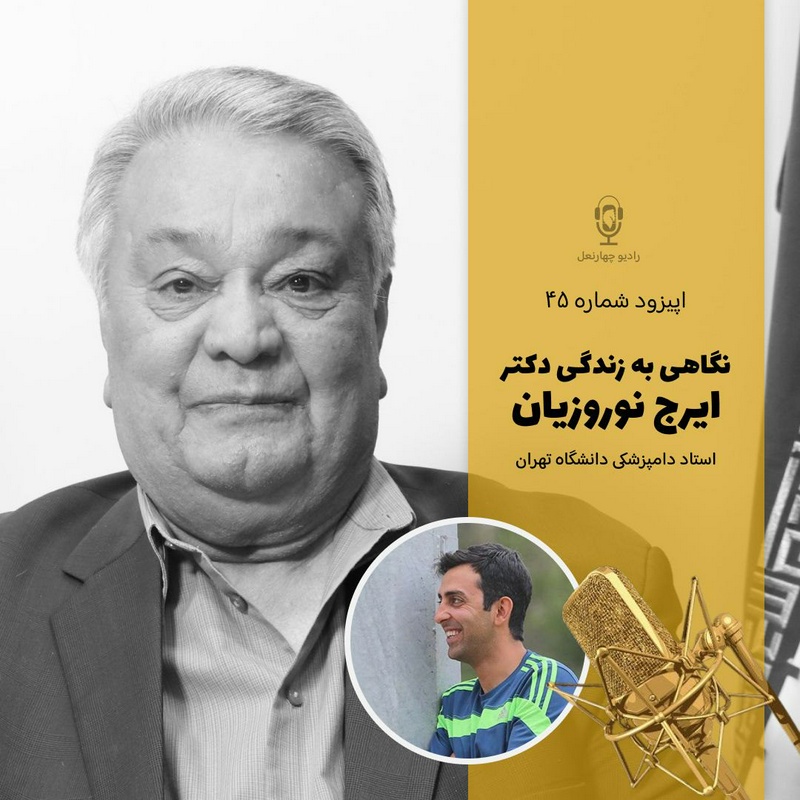
Professor Dr. Iraj Norouzian
خلاصه
In the forty-fifth episode of Radio Chahar Nal, Mohsen Pour Heidari talks with Dr. Iraj Norouzian, a prominent professor of veterinary medicine in Iran, about his impacts on veterinarians and the equestrian community. Dr. Norouzian discusses his experiences in high school and his choice of veterinary medicine, despite his family's inclination towards medicine, and mentions the influence of his teachers on this choice. He also addresses his studies at the Faculty of Veterinary Medicine at the University of Tehran, the challenges of that time, and the impact of prominent professors like Dr. Tajbakhsh and Dr. Hekmati. Dr. Norouzian speaks about his experiences at Shiraz University and teaching in the field of musculoskeletal diseases and equine surgery. He emphasizes the importance of ethics and the school of manliness in the education of veterinarians and stresses the scientific connections and their impact on his educational path. In the end, Radio 4 Nal is introduced as a free resource, and listeners are asked for financial support.
نکات کلیدی
- دکتر ایرج نوروزیان از اساتید بزرگ دامپزشکی در ایران هستند.
- علاقه به پژوهش و عدم پیشزمینه از رشته دامپزشکی دلیل انتخاب این رشته بود.
- اساتید دامپزشکی در کشورهای اروپای غربی تحصیل کرده بودند.
- آقای دکتر تاجبخش تأثیر عمیقی بر فضای دانشکده داشتند.
- دکتر حکمتی اصرار به ادامه تحصیل در دانمارک داشتند.
سرفصلها
- معرفی و تولد — دکتر ایرج نوروزیان در ۱۹ بهمن ۱۳۲۵ در تهران به دنیا آمدند.
- انتخاب رشته دامپزشکی — علاقه به پژوهش و عدم پیشزمینه از رشته دامپزشکی دلیل انتخاب این رشته بود.
- تجربیات تحصیلی — دوره تحصیل ۵ ساله بود و فارغالتحصیلی در سال ۱۳۴۹ انجام شد.
- تأثیر اساتید و پایاننامه — آقای دکتر تاجبخش و دکتر حکمتی تأثیرات مهمی بر تحصیلات و پایاننامه دکتر نوروزیان داشتند.
- ادامه تحصیل در دانمارک — برای ارتقا به استادیاری، دکتر نوروزیان به دانمارک رفتند تا مدرک جراحی بگیرند.
پرسشهای متداول
شما متولد چه سالی هستید آقای دکتر؟
من ۱۹ بهمن ۱۳۲۵ هستم.
چرا رشته دامپزشکی را انتخاب کردید؟
به خاطر علاقه به پژوهش و عدم پیشزمینه از این رشته.
چه دورهای را در دانشکده دامپزشکی گذراندید؟
دوره ما ۵ ساله بود و من در سال ۱۳۴۹ فارغالتحصیل شدم.
موضوع پایاننامه شما چه بود و با کدام استاد کار کردید؟
موضوع پایاننامهام سزارین در میش بود و با آقای دکتر حکمتی کار کردم.
چرا برای ارتقا به مدرک از خارج از کشور نیاز داشتید؟
اجباری بود که برای ارتقا به استادیاری، باید مدرک از خارج از کشور میگرفتیم.
متن کامل گفتگو
Greetings and respect to all of you dear and constant companions of Radio 4 with the forty-fifth episode of Radio 4, which is a conversation with the dear, lovable, and honorable Professor Dr. Iraj Nowrouzian.
Dr. Iraj Nowrouzian is one of the great veterinary professors in Iran, and many of the dear veterinarians who serve horses in various fields today have been either directly or indirectly students of Dr. Iraj Nowrouzian. Personally, I have learned a lot from him, and I am sure that having a conversation with the dear Dr. Nowrouzian has been one of the fortunes of my life. I hope that if there is a veterinarian around you, you will send this episode to them.
So that those dear ones can also benefit from the noble character of this honorable person like I did. Another point is that listening to Radio Chahar Naal and watching its videos is completely free everywhere, and there is no intention to charge for this content that is available to you dear ones. However, considering the high cost of producing this work, I ask you, if you feel you can support Radio 4 as a sponsor and companion, if you would like, from the link I will leave for you in the description of this episode.
You can enter a site and contribute any amount you like and are interested in to Radio Chahar Naal. Radio 4 Naal is always free, even if you do not contribute, I, Mohsen Pour Heidari, will still produce programs for you with all my heart and will still be at your service, and until the last day I breathe and Radio Chahar Naal exists, no one is supposed to pay any cost for listening to and watching the content of Radio 4. Thank you for being with me, forgive my audacity.
I won't take more of your time and invite you to listen to the forty-fifth episode of my conversation with Dr. Iraj Nowrouzian. In the name of God, the Compassionate, the Merciful, I am very happy today to be in the presence of a great person whose name is very big, whose position is very big, and who gave me the honor to be at his service and both directly and indirectly has a right over the community.
They have a right over the horse and equestrian community, and we are grateful to God for giving such a gift to Iranians. I am at the service of the honorable Professor Dr. Iraj Nowrouzian, one of the scientific prides of the country. Thank you very much for giving me the permission and time to be at your service and enjoy your presence. I am at your service. In the name of God, I am also very grateful that you gave me the opportunity to be at your service. Let's talk about the past and then.
About a past that always reminds me of valuable and very joyful memories. I mean, I feel that in this half-century that has passed since our presence in the country's veterinary field, I have tried to benefit as much as I can and also to benefit myself, and I am very happy to be at your service and for the opportunity you gave me to.
Before we leave this world, as they say, to record and document some points so that at least future generations and those who want to know something about the past in the future, have received it correctly, as they say, and it is more about memories and documents that if I had been told earlier, maybe I would have included documents as well.
But anyway, I am happy that if given the opportunity, I can say some points from the past and if I can suggest something for the future or have a contribution and have mentioned it to you. God bless you. It is impossible to talk about veterinary in equestrian without mentioning you. You are so honorable that at least from your students, I have heard that in addition to the specialized knowledge you filled these kids' cups with, you gifted them the school of manhood and ethics and.
There is no one who has been your student and has not spoken of your moral virtues. Again, thank you for giving me this permission. Well, if you agree, let's get to the questions. What year were you born, Dr.? I was born on February 8, 1947, two years after the end of World War II. God bless you. Where were you born? Well, the truth is I was born in Tehran.
But from a family where my father was from Yazd and my mother was from Kerman, and after my father's relocation from Yazd to Hamedan and Hamedan to Tehran, I was born in Tehran. Very well, but it can be said that I spent a lot of time in both Yazd and Kerman and got very close to the culture of the people of this land. God bless you, Dr. When did you feel that you were interested in.
Animals and entered academic studies in this field? The truth is that this question is a bit difficult to answer. The truth is that before entering the Faculty of Veterinary Medicine at the University of Tehran, I was not very close to the so-called animal population in various fields, and my world of thought was only about being present in.
My father's house in Yazd, where he had a cow or two, and at that time, they used the milk of this cow for consumption. There was an emotional connection between my grandfather, God bless him, and this animal, as they say. May their soul rest in peace. At the same time, he also had a cat, a very beautiful and very special cat that was not very wise with my mom. A kind of invention.
My grandfather had both a cat and two cows. We, as they say, had found some proximity in our very childhood, at the ages of 6 or 7, with these, and I did not have the proximity with animals that I should have had. But practically, you lived with them, you were with them, meaning you know even that life that is said today, emotional life and close connection and as they say, being a company was not.
It wasn't until I entered the Faculty of Veterinary Medicine that more and Dr. Veterinarian, meaning there were no veterinarians in the family, and most were doctors. Most of my grandfather's family and my mom's family were closer to the world of medicine, and the decision after getting the diploma was to enter the Faculty of Medicine, and this, as they say, was a kind of.
Transformation in life, now when I tell you the story, you will understand what events really happen in life and change a person's life path. Let me tell you that elementary school, kindergarten, kindergarten Roshdieh, elementary school Ibn Sina and Bu Ali Sina, and high school Jalveh and high school Firooz Bahram as the final year, and then the entrance exam, all of these.
Lead to the year 1965. In 1965, as they say, we took the entrance exam, and anyway, the faculty, meaning two fields, almost with the motivation of the Faculty of Medicine, we were ranked 160th in the national entrance exam and almost after Dr. Saber, I was the second student. Sasan was the first student, who is now one of the specialists.
Respiratory diseases are a doctor, and Borhan, the second student, when we came to the Faculty of Veterinary Medicine, University of Tehran, came to the Faculty of Veterinary Medicine, University of Tehran. As they say, it was almost a special incident, so much so that my chemistry lesson was very good, and I was very interested in two subjects: chemistry and mathematics. Mr. Dr. Alavian was my chemistry teacher in the sixth grade of high school.
May he be alive, and then Mr. Dr. Assaram was my mathematics teacher, and I always carry very good memories of these two dear ones with me. Now, other teachers, each of whom were the best of their time. Firouz Bahram High School in the sixth year was also one of the Zoroastrian religious minority high schools, and I was somehow linked to this issue, and I had very good moments in this high school with very good friends, and anyway, when I passed the national entrance exam.
I had the chance to go to the Faculty of Medicine at Ahvaz University, but well, my mom and dad wanted me to be in Tehran, and for my field of study choice, ultimately, all the family said that at that time, the veterinary field was not viewed as a health service or population service as it is today, nor was there much advertising for small animals. Now I will explain to you, but.
Regarding the field of medicine, chemistry, etc., they told me that the veterinary field has the advantage that if I continue my studies in it, I can have a great interest in research work in the world of research. That's why I chose veterinary medicine without any.
Background in this field, and it's interesting that our house was close to the Faculty of Veterinary Medicine where we are now.
At that time, they were still building the faculty here by Mr. Dr. Mimandinejad, may God have mercy on him, but we were kids from Eskandari Street, and during our playful times, we would come to this complex that was being built, running and playing in these different floors, playing various games like artist games and hide and seek, and it was close to our neighborhood, as they say, and we didn't know that this was the Faculty of Veterinary Medicine.
So when I chose the veterinary field, along with Mr. Dr. Horeshti, who was a professor of obstetrics and my mom's cousin, anyway, a professor of the obstetrics department who retired, like us, both family and classmates, we came to the veterinary field that was chosen, and we said let's see where the Faculty of Veterinary Medicine is. When it was finally chosen, from the university square, we saw an old friend who knew where the Faculty of Veterinary Medicine was.
I suddenly forgot his name, and then we used him to find out where this veterinary university is. The veterinary faculty is behind you. Wow, this is the faculty we played in for years, and we didn't know that this faculty was the Faculty of Veterinary Medicine. Let me tell you that we chose it, and we came to the university, let me tell you that on the first day we came to introduce ourselves to the faculty as students.
Events happened that I don't know if it's necessary to mention here now, well, we came into the faculty, on these steps, one of the people we later found out was a senior student was sitting on this platform, and we were new, and he said from here, turn back, why? We were surprised if the reception was from here, turn back, this field is useless, don't unnecessarily involve yourself in this field.
I found it very interesting to say welcome, and later one of our very own friends, one of the upperclassmen, and thus this was the first encounter, and then we took the course units, and the first course, which was anatomy, started, and everything was a bit heavy for me, so much so that before we took the national entrance exam.
One of our interests was that we would go to the street that is now 16 Azar, we would go from above into the dissection hall of the medical university. One of my interests was to go see the anatomy there, and now that we had come to the faculty, we went to the anatomy section, and the horse carcass and cow and these things were somewhat new to me, as they say. May God have mercy on the anatomy professors of that time, Ms. Dr. Ataei.
She was an anatomy professor, Mr. Dr. Zendeh Afshan, may God have mercy on him, Mr. Dr. Shahr Asbi, Mr. Dr. Naqavi, may God have mercy on him, these were the anatomy professors, and slowly our closeness to the veterinary profession, but this still did not take medicine out of my mind. A question arose for me, you said that the family are all doctors, and they were interested, they didn't practically question you, why like veterinary medicine still hasn't happened, I had just come to the beginning of the faculty, well.
Why, especially since my mom's cousin, Ayat Norouzian, who was a role model for all of us, our father or dad, who was one of the best obstetric specialists and is now in America, was a professor at the University of Tehran, and in the family, all were doctors. When they found out that we were accepted into veterinary medicine, well, there was some discussion, but there was no conversation, and only my cousin's wife's brother-in-law.
He had finished pharmacy university and expressed interest, saying that it's a very good field, especially at that time, more after veterinary medicine, it wasn't in therapeutic services, after veterinary medicine, it was more in its research parts, meaning when you talked, it was more about basic sciences than clinical sciences, you know, and therefore it wasn't very strange to us. I loved the world of research and these things very much, my first grade.
I, who was the top student in high school, we had our own comings and goings, and my grade was 8, I was very upset, I didn't expect at all, a grade of 8 was very heavy for Norouzian at that time, I went to Ms. Dr. Ataei Pourandokht Ataei, may God have mercy on her, I said, Ms. Dr., the person standing in front of you has his own special world of thought.
Top student and perhaps an excellent student of Firouz Bahram High School, entrance exam rank 160, and had his own comings and goings, and at that time, as they say, I was also becoming a television face, there was a competition at that time called the Competition of Ideas on television, a general knowledge competition that we started participating in interviews, and perhaps I am the first person to introduce myself through television, I said, first-year veterinary student at the University of Tehran.
Let me tell you that I said, Ms. Dr., I got an 8, don't consider this grade of mine, I promise you that my final grade will be 20, she was a great woman, a good teacher in life is like this, may God have mercy on her, may light shine on her grave because she changed my mental space, I said, Ms. Dr., I promise you my final grade will be twenty, and it happened, I came to her and she said Norouzian has become so disheartened.
You even promised me. I am very grateful and hope that this is a great opportunity for you to continue veterinary medicine and you encouraged me a lot. After this, at that time, the anatomy course here was taught by Professor Mir Babayi, Professor Naqvi, Professor Zand Afshar, who were really renowned professors of our veterinary medicine. Because there was only one faculty, the University of Tehran's veterinary university, and these were among the great personalities, and the clinical fields had not yet been formed by the great ones who joined later, so it was very important that, as you say, you could pass these courses. Mashallah to your memory, knock on wood, you remember the names completely. The professors and the question that came to my mind was that you said you were among the first people who started at the University of Tehran's Faculty of Veterinary Medicine. Where did your professors study? Because this conversation goes back to the time when I was hired in 1351.
That is, take seven years and 5 years and two years, 7 years, 7 years after I entered the Faculty of Veterinary Medicine. Because at that time our course was 5 years. I graduated in 1349. We continued the system during the study. Then I came, we went for a year for the promotion corps course. I chose Kerman province. There they informed me that my professor, Mr. Dr. Hekmati, nominated me for an instructor in the department.
But before this, most of the professors were in Western European countries, especially France and higher, Denmark and Sweden, mostly in these three countries, they were getting scholarships and graduating and attending courses there. It was on behalf of the Iranian government. Yes, on behalf of the Iranian government, before the revolution, yes. That is, during our first surgery professor, the late Mr. Dr. Akhza, whom I will now tell you about, in our third year.
We reached the second year, the first year was all basic sciences. It was physiology and pharmacology and histology and these courses. Biochemistry and then we would come up. In the third year, clinical sciences would almost start, which means in the second year and now let's say almost the third year in the basic clinical sciences courses, the focus was more on principles, which the surgery professor, Mr. Dr.
Aqshar Seyed Mostafa, may God have mercy on him. He was our professor, who I think if I remember correctly, came from Denmark, and it was on this basis that after him, Mr. Dr. Hekmati, my dear professor, may God give him a long life, who also later came from Denmark, and this group always liked that their successors, as they say, would also study in Europe, which we were slowly.
The connections were a bit different, and now I will tell you. These were essentially the events that happened to us in the basic sciences. We had good professors. In physiology, Ms. Dr. Kashani, Mr. Dr. Salimi in pharmacology, in biochemistry Mr. Dr. Taslimi, and so on, I think in histology my mind doesn't allow me right now.
Anyway, there were professors, and we came until we reached the so-called clinical period. The first clinical professor we encountered in surgery was Mr. Dr. Seyed Mostafa, Mr. Dr. Aqsam, may God have mercy on them. I liked them very much. Mr. Dr. Aqsat was a very noble and influential personality, meaning if we want to.
If I speak honestly, he had a strong character, as they say, and this strong character was inevitably influential. They were very charismatic, to the extent that they could make surgery very understandable for us at that time, not with these video projector systems, I don't know, these things didn't exist at all, meaning it was different from an actor, which professor should also play a role.
That is, all the movements they made that they had to convey to us, so that tomorrow if a horse, cow, or whatever disease was in front of us, we had to feel exactly how to have the right clinical approach. It was very interesting for us. Now sometimes, as they say, almost funny scenes would also occur, and surprise that Mr. Dr. how he is maneuvering on the table to make us understand that you should be bound like this and be at your disposal and these things.
At that time, there were no modern facilities. The drugs were limited, and I should tell you that we learned the basics of surgery in his class, and at that time we also had a hospital. There were two hospitals. There was a small animal hospital here, which is where it is now, and there was also a large animal hospital at the beginning of Saveh Road, and the hospital was in that area, which was not developed like today.
Most of the surroundings were traditional dairies. We would go a little further to a place called Nowruzabad, where they had just started the stables, and then the traditional dairy space, everything had a traditional shape. That is, the space in front of Imam College, which has these facilities today, was not there, it was all with Mr. Anar, and we usually came from the hospital during our breaks to the pomegranate trees, and anyway, we had the mischiefs of our time around.
The hospital and the limited dairies were there, and usually, the visitors to the hospital were these carriage drivers. Carriage horses and these things. There were no aspects of, as they say, racing and I don't know, jumping horses and polo and these things at all. Absolutely very.
The initial course was also practically not yet established with the Turkmen system. That is, everything was very simple, and how to serve only the small animal hospital above.
May God have mercy on Dr. Sanjar, they were responsible, and Mr. Dr. Asghari Irkhani and Ms. Daee Moayena Aghajians, who are still alive, are in America, and if there is an opportunity, they had a small animal clinic above, and Dr. Sanjar was also responsible for the animal support clinic on Farvardin Street, and at that time, I mean to say that everything was moving in its very simple and primitive form, and everything was growing, you know.
And you had hope for the future. You had hope for the future. We were being trained well, we still didn't know what our work environment would be in the future, you know, and until exactly when we reached year 4, I should tell you that new faces returned to the faculty from abroad, until then we didn't know that a series of universities that got scholarships went abroad.
For example, suppose in the anatomy department, Mr. Dr. Shahrazbi had returned, may God have mercy on him, or in other fields the same way, but most importantly, Mr. Dr. Hosseinion, may God keep him in complete health, he came from England, and in the internal department, Mr. Dr. God bless him, Mr. Dr. Ansari had taken the midwifery field from Sweden's Uppsala University, and most importantly, Mr. Dr. Parviz Hekmati from.
I returned to Denmark. This honorable character, Dr. Tajbakhsh, may he be healthy, came from the University of Lyon, France, and then Dr. Farkhondeh came again from France in the field of food inspection, and then Dr. came from Paris. Other students came from Lyon, Dr. Afshar came from England in the field of virology, who later left. This new group that came completely changed the face of the faculty and hope was revived. Yes, they created a completely new atmosphere. Although Dr. Afshar went on to form Shiraz University and took responsibility for it, he had less opportunity, but Dr. Keyvanfar and Dr. Keyvanfar were in virology and microbiology.
Dr. Tajbakhsh, with power and ability, in addition to the scientific information he provided to the university, had a meaningful connection with knowledge because he was a world of mysticism, literature, and poetry, and gave very interesting opportunities to students. Especially to groups like us who were a student group and had extracurricular activities, and our advisor was Mr. Tajbakhsh. I remember we arranged a lecture for him to review Persian poetry and literature, and that afternoon was unparalleled. The faculty exploded with literary and poetic information. He started with Hanzala Bad Gheichi and reached Nima Youshij and modern poetry. These programs changed a world for us, meaning that in addition to the scientific world, they also gave a mystical world life in our faculty, and we, who were fourth and fifth-year students, brought Bahram Beyzai to the faculty. We brought theater to the faculty, and I don't care that at that time we brought two or three plays, and we were among the students who served Dr. Khamami Asadi, who is now a professor at the University of Chicago, and we still visit him when we go to America, serving Mr. Beyzai at Stanford University, and they still have their artistic atmosphere there.
But I want to say that the atmosphere of the faculty from our presence in year 4, which is 1654 between 1354 and 1348, meaning I came in the fourth year 49, when my inclination was more towards Dr. Hekmati, who taught us surgery very artistically and up-to-date, and an emotional connection was formed between me and Dr. Hekmati to the extent that I asked him if he would allow me to take my thesis topic with him. Although due to my interest in research work, I went to Dr. Sheibi, the dear professor of the microbiology department, to get a thesis, and he sent me to Dr. Tajbakhsh. Dr. Tajbakhsh had many students at that time.
Then I decided to get closer to Dr. Hekmati. He gave me the topic of cesarean section in sheep for my thesis. At that time, Darvish was a topic in itself. Although today this topic really can't have any appeal, we took this thesis topic and completed it in his service, and I had a very good defense, and an emotional connection was formed between me and Dr. Hekmati to the extent that when I went to military service, he expressed interest that I come as an instructor after my military service to join him in the surgery department of the faculty. This conversation I'm having goes back to 1350. We went to military service in the year 50 because we had a system during education, this military service was considered part of the promotion corps, and I came in fifty and.
50 I almost came. 5051 we came and became a faculty member as an instructor in the surgery department in the service of Dr. Hekmati, and we started practicing academic spaces and, in any case, studying and helping in research work until we came forward to 1351 and fifty-two, and in this interval, some of the students had returned from abroad.
Like Dr. Bozorgmehri, like Dr. Sohrabi Aghdoos, and a few Dr. Radmehr for the anatomy department, and no one from the internal department had gone abroad yet, only Dr. Maqsoudlou had returned from abroad. Dr. Hekmati, whom we were serving, in the internal department, Dr. Hosseinioon, who came from England at that time and created a great transformation, meaning in essence.
Towards English-speaking countries, Dr. Tajbakhsh had come from France, some from France, and some from Denmark and Sweden. Their language was mostly French, meaning the first person who returned with the English language was Dr. Mohammad Hosseinioon, who activated the internal department in the faculty, and we were alongside him in the surgery department, and until now, opportunities arose that.
At that time, dear Dr. Rafiei, Rafiei was the director of the faculty, and when we had become instructors, they still didn't give us a salary and benefits program. We had just gotten married, and God had given us a child. Naghmeh was born, and we had no salary. Then they told me that we should go to Dr. Rafiei and tell him to help or it could be.
Dr. Ghodsian and I were the two who had just been hired. He went for clinical pathology, and I went for surgery to Dr. Rafiei and said that Dr. anyway, they say that if you retire, they can give your salary to the two of us.
I said this very simply. God bless Dr., don't worry. I'm supposed to retire in two weeks, so rest assured that from my salary, you and Dr. Ghodsian can, in any case, become disgusted and these words.
Did you get married, Dr.? I got married in 1350, and the result of the marriage is a daughter and seven grandchildren, God bless them. Yes, Naghmeh, who is now 50 years old, Mashallah, and Pooneh, who is 45 years old. Naghmeh has four children, and Pooneh has three children. They have grown up, and we have, as they say, defined life here, and let me tell you that affected by our employment, now the conversation turned to.
Well, now we have to get promoted. For promotion, when it came to us, they said we definitely have to go and get a degree from abroad. They made it mandatory. It was a good obligation. Before us, the students would become assistant professors right here, and after becoming assistant professors, they would go abroad, like Dr. Sohrabi, like Dr. Bozorgmehri. In other words, they had said that you definitely have to go abroad and return to be able to become an assistant professor. At that time, it wasn't like we.
We were looking for such an environment where Dr. Hekmati was very eager for me to go to Denmark. Dr. Hekmati said that I should go. In these two years that I became a faculty member, from 51 to 53, Shiraz University took shape, and most of its professors came from abroad, especially from Europe. That is, the resident professors taught there. One of the professors suggested by Dr. Hekmati was Professor Espersen, and after him, Professor Olsen. They were from the surgical departments. Since they came to Tehran, I essentially accompanied them, as they say, when they were in Tehran, I took them on tours to create an atmosphere so they wouldn't get tired, and then we put them on a plane to go to Shiraz and return from Shiraz. We helped them return to Denmark. An emotional connection was established between me and especially Professor Daneshin, Professor Esp, which I should tell you about.
This led Dr. Hekmati to insist that I go and continue my program there and then return. I should tell you that this coincided with the arrival of Dr. Eslami from the Razi Institute to the faculty, and he took on the responsibility of our international relations, and Dr. Hesabi also had very high goodwill. At that time, I was also serving Dr. Hekmati.
I was given the responsibility of teaching the course on diseases of the locomotor system, and I was more interested in going and working on horse surgery because they were, after all, a master in the field of ruminant animals. Our small animals were still not very numerous. Dr. Aghajians and Dr. Ilkhani were there. Dr. Bahar, may God bless him, had recently been added to radiology, and small animals were not active in that form.
But large ruminant animals were very interested in me going there, now with ruminant animals along with single-hoofed animals. I also had the opportunity to develop myself in the locomotor system. They had given me the so-called small animal classes. At that time, as they say, our surgery model was from surgery on dead animals. We would take animals, for example, a donkey, a horse.
We would anesthetize them in the clinic and then perform surgical procedures on them, as they say, and then let them go. Because the horse was not yet seriously active, and its surgery, considering that we did not have today's anesthesia facilities, neither medicine nor with the same clotte, as they say, we would anesthetize them. We almost used deep sedatives. These were the troubles we had and.
I was more interested in horses than ruminants. While Dr. himself had responsibilities, I was also alongside him. Now, if I want to explain each of the many stories, it is, after all, a long membrane, as they say. Until this promotion talk came up, I went to serve. One day I was going to my class for the locomotor system lesson in the afternoon.
I went into Dr. Eslami's room again. Dr., don't you have a scholarship we can use? Because for our assistant professor, it is necessary that I definitely go and get a degree from abroad. He said, Norouzian, come in. I went in. He said, how is your English? He said, how is your mathematics? I said it is excellent, and I have a lot for it. He said, are you going to America? I said, where is America?
We are going, how? He said, well, Dr. Neshat, may God bless him, is in America now. They are signing a contract with the University of California, Davis, to establish a student and professor connection, and a team is also supposed to come from there after Dr. Shad's trip to Iran and establish this connection. I said, Dr., what field? He said epidemiology. But at that time, we still didn't know. I only, may God bless him, light his grave, my dear professor, I loved him.
And Dr. Houshang Khavari, my statistics professor, may God bless him, was something strange. He taught statistics, taught genetics, and was very influential, a very understanding person in terms of social issues, top-notch, and I fell in love with him to the point that I was the best in Dr.'s classes. And you know that in the epidemiology course, its basis is statistics, vital statistics, and based on this, when I went now that.
Choose and bring. I came and went to ask two Ghodsians. Dr., who was studying midwifery at that time. I said, are you coming with me to America? He said, what field? I said epidemiology. What's up, man, leave us alone. I want to go to midwifery. It became this part. Then they went to North America, and then there they returned with an MF degree. These are not my business now. I went to Dr. Ghodsian. I said, we are coming to go. Iraj, may God bless him, said that mathematics is not good either. I said, I play billiards, don't worry.
These talks happened, and we came to Dr. and said we were selected five people so easily. He said five people, five people. Two from the veterinary school, one from the economics faculty, two from the agriculture faculty. Because you know, at that time, UC Davis University was famous for its agriculture and veterinary faculty in the entire western United States, and it was the only university in the western United States whose horse clinic was famous, and only Dr. Hekmati came to them and said that I want to go. He said no.
You must go to Denmark and return with a surgery degree. I said, Dr., they are giving this opportunity here now, and we are also on a scholarship, and we have the system's support in a way. They returned with a lot of complaints, but on the condition that you go there and have innovation for me in the field of horses. I said, sure, Dr., and what trouble should I give you two months later, we got the US visa. Dr., we went to Washington. We got off the plane.
Thank you very much for being with me until the end of this episode, and I hope you enjoyed listening to the talks of dear Dr. Norouzian as much as I did. Another important point is that the Radio Chahar Naal YouTube channel has been created, a roundtable with dear Mahmoud Poulheidari and Maziar Jamshidkhani.
It is recorded on the YouTube channel. You can go and watch it. I have put two parts of the conversation with Professor Babak Shaki, in which I have included attractive photos from the old days that were available to me among the videos, and I hope you enjoy watching them. The only request I have is that if you enter the YouTube channel, be sure to press the subscribe button and also press the bell button so that if I upload a new video, it will be announced on your phone, and you can enjoy watching it. The link to the Radio YouTube channel is in the description of this episode for you.
See it and enjoy it. Until the next episode, I entrust everyone to the great God and wish everyone health and a long life with dignity, and finally, as always, take care of your horses.