Ali Rashidian's comments on a horse owner's perspective
خلاصه
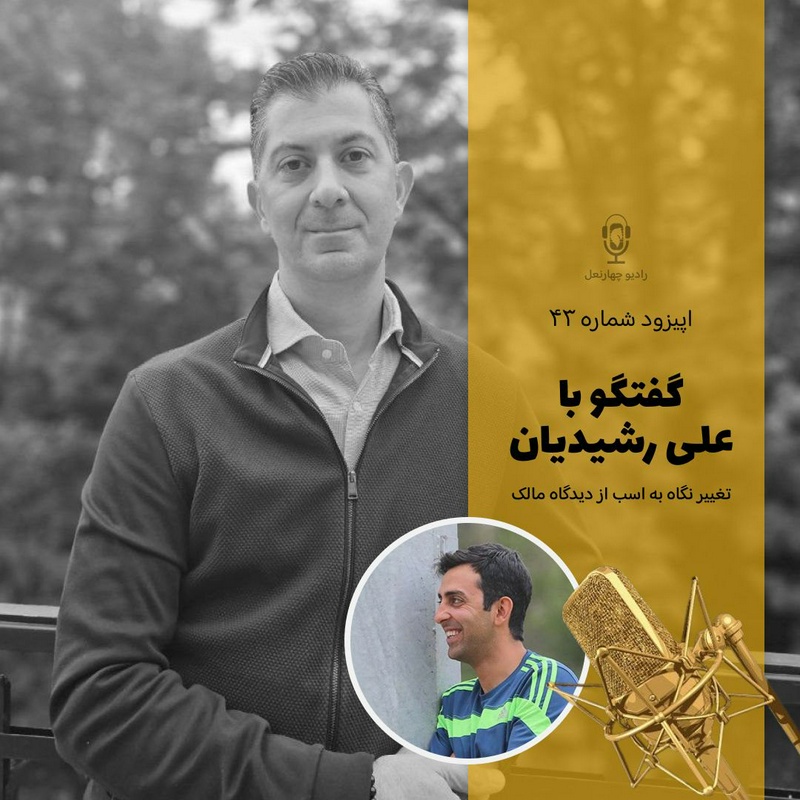
In episode forty-three of Radio Chaharnal, Ali Rashidian, an experienced horse owner from Iran and Europe, examines the cultural differences and his experiences in the world of horsemanship. He emphasizes that a horse should transform from a mere tool into a companion and teammate, and that true love for these creatures goes beyond their performance. Rashidian highlights the importance of establishing a deep connection and understanding the needs of horses, stating that success in horseback riding requires a precise understanding of the behavior and needs of these beings. He also points to the necessity of changing the mindset in the equestrian community and respecting horses, emphasizing the importance of media in conveying knowledge and communication in this sport. This interview offers a deep insight into the human and ethical values in horseback riding and urges riders to view horses as valuable companions.
نکات کلیدی
- اپیزود چهل و سوم درباره تجربیات یک مالک اسب است.
- علی رشیدیان تغییرات عمیقی در نگاهش به اسبداری داشته است.
- رسانهها نقش مهمی در ارتباط افراد و انتقال اطلاعات دارند.
- عشق به اسب و رفاقت با او برای موفقیت در اسبسواری ضروری است.
- استفاده از شلاق به صورت تنبیهی به دلیل درک بهتر از اسبداری کمتر شده است.
سرفصلها
- تجربیات یک مالک اسب — علی رشیدیان از تجربیات و چالشهای خود در اسبداری میگوید.
- تغییر نگاه به اسبداری — تغییرات عمیق در مدل ذهنی علی رشیدیان نسبت به اسبداری و عشق به اسب.
- نقش رسانهها در اسبسواری — اهمیت رسانهها در ارتباط و انتقال اطلاعات در دنیای اسبسواری.
- اهمیت عشق و رفاقت با اسب — چگونه عشق به اسب و ایجاد ارتباط صحیح میتواند به موفقیت در اسبسواری کمک کند.
پرسشهای متداول
موضوع اپیزود چهل و سوم رادیو چهارنعل چیست؟
درد و دلهای یک مالک اسب که سالها در ایران اسبداری کرده و به طور حرفهای سواری کرده است.
علی رشیدیان چه تغییراتی در نگاهش به اسبداری داشته است؟
او با تناقضی مواجه شده که باعث یادگیری عمیقتر و تغییر مدل ذهنیاش نسبت به اسبداری و عشق به اسب شده است.
چرا رسانهها در ورزش اسبسواری مهم هستند؟
رسانهها برترین روش ارتباطی افراد با یکدیگر هستند و اخبار را به صورت اصلاحشده و تصفیهشده منتقل نمیکنند.
چگونه میتوانیم شناخت بهتری از اسبها داشته باشیم؟
با تغییر ذهنیت و احترام به نیازهای اسبها و ایجاد ارتباطی پر از فهم.
چرا برخی سوارکاران به درجات بالاتر نمیرسند؟
چون ممکن است نتوانند ارتباط صحیحی با اسب خود برقرار کنند و نیازهای آن را درک کنند.
متن کامل گفتگو
Greetings and respect to all you dear listeners of the radio. First of all, I want to congratulate all of you for being part of Radio Four and for the radio family reaching 10,000 followers on Instagram. These 10,000 people are not just followers for me, but they are considered an investment and support, and this number and these people make my responsibility towards the content I produce for you dear ones even heavier. I wish you all health, longevity, and increasing success. I want to now introduce the forty-third episode of Radio Four Naal and explain it. The forty-third episode is about the thoughts and feelings of a horse owner who has been involved in horse breeding in Iran for years, has ridden professionally, and has been living in a European country for nearly four years.
He has faced a contradiction that has led to deeper learning, more precision, and a change in his mindset towards horse breeding and love for horses. Ali Rashidian sent me a voice message for Radio Four Naal, sharing his perspective, and I enjoyed his words so much that I decided to present Ali Rashidian's talks in the forty-third episode for you. I'm sure you will enjoy listening to these talks and will reflect and reconsider, and I hope all of you dear listeners of this podcast, like Ali Rashidian, will share your thoughts and help others benefit from these talks and experiences. I won't take more of your time and invite you to listen to the forty-third episode.
Let's listen to the thoughts and feelings of Ali Rashidian. Hello dear Mohsen, I hope you are well and not tired from the great programs you prepare. It's a very good path, and I think you have a very bright horizon ahead and will be a source of improvement and health for this exceptional sport in Iran.
I say this because everywhere in the world, media, whether online, social networks, or television, is the best method of communication among people. Otherwise, news reaches others in a modified, filtered, or biased manner and distances itself from its true mission, which is honesty. You've invited some very amazing guests, but I specifically want to mention the roundtable we had with Mr. Mahmoud and Mr. Maziar.
Both are unique in their own modeling style and are distinguished in some of the finest details from others. I think it was a very smart choice. They are not like anyone else; they are like themselves. Like you, I have a concern for horse breeding. Regardless of not having a main family, I had a horse from childhood due to the interest that existed and moved around in the riding community. I don't want to call it an achievement; I want to say it's part of the experience I have today after about 4 years of having a horse in Europe from the perspective of someone known as an owner in Iran. This difference doesn't exist here, which we will get to and discuss, and with what perspective I came and what I learned, and truly, I look at this sport with a different ideology. I thought it was useful to leave this message for you. Surely you will accept my words because you have worked outside this country and know that all friends in the coaching profession know technical issues much better than I do. Certainly, my goal in this matter is not to convey knowledge; I just want to share my experiences as someone who is not professional, is an amateur, loves riding, loves horses very much, and has tried to learn something from his surroundings as much as he could. Given the time constraints that everyone has due to work commitments and such matters, well, beyond a certain limit, it's not possible for me to spend time in this sport, and naturally.
Success, as they say, is acquired, requiring you to have more horses, more time, which naturally is not very easy for me. In 2021, specifically when I decided to definitely buy a new horse, apart from the four years I mentioned to you from the start when I came and used other people's horses. The first day the horse arrived, and I, with all the equipment, after a day or two, well, saw the environment and lunged it to know its temperament, and then we said, well now.
Kinozin looked at me and said, well, do you saddle yourself? He said yes, here everyone does their own work. Our aunt's superiority was with every mouthful to fit this headpiece, I don't know, to put the saddle on the sweat, our face and head would spill, and finally, however it was, we saddled it from the farrier. This was the first experience of how much a person knows nothing, meaning this wrong method and perspective that in.
The riding community in Iran, I'm talking about my own spectrum, meaning those who are non-professional and known as horse owners in Iran. Now here, this matter is different, which I will also talk about. Finally, we started working, started, and after one or two sessions, we saw we ask everyone something, they say I don't know. Well, for example, you know it's like this. For example, people have no interest in participating in a subject. Well, it's strange for you because we come from a very crowded culture, we are people who love to talk to each other, we are passionate.
We become acquainted very quickly. Now in the European space, people approach each other with more caution and then, most importantly, are very cautious in expressing opinions. Not everything is bad. The story started, and then we saw, well, it seems this is the story. We have to come ourselves, saddle ourselves, and it ends. Again, we go, take the saddle, do its work. So step by step, you get closer and closer, and gradually you understand the flaws, gradually you recognize your horse's problems, gradually you pay attention to your horse's body, recognize the muscle, and piece by piece, you come forward.
It turns you into a different person, meaning into someone who previously had a tool called a horse that if they saw that tool didn't work like before, they would go and buy a better tool. Now everyone makes decisions according to their financial capacity regarding these diverse dreams. But now, generally speaking, from that state where the horse was your tool, it turns into a horse that is a companion for you, a teammate, as Mr. Mahmoud and dear Maziar also said in their roundtable.
When you see that if success is to be achieved, it is only from his side. Gradually, the instrumental view changes and becomes a collaborative and cooperative view, which then starts a chapter that is somehow endless. Because understanding it takes so much time, and the different nature of horses is what makes it beautiful. The cycle is not simple. Ultimately, you learn to manage horses, and this horse management.
Taught me a lot as a non-professional. I learned what a bad saddle is and what factors I should consider. How they choose this factor here. How far a bad saddle can limit me in a ground work that we always do in Iran. Again, I say that I do not mean the professional riding community. I am talking about the range of people who ride non-professionally and then look to see, for example.
This problem that the horse has or this problem we see in the bit or many other things are not at all originating from there, it is not the bit, it comes from somewhere else. Now you have to gradually recognize these, and then the good thing about the story is that no one puts the solution in front of you. You have to suffer a little, learn a little, be patient a little, and then gradually move forward slowly until you say, well, now I understand the basic principles of riding. That too, what is the body, what is competition, as they say, care, it teaches a person, it teaches many things.
The most important thing it teaches you is the love for horses, and I always thought I loved horses, and then I came here and realized it wasn't like that at all. It wasn't like that at all. I loved the performance of the horse, I wasn't in love with a companion. Until this happens, it is impossible for a companion to reach a point with you. I don't know what techniques they use in very modern clubs, but anyway, I live in Austria. There are a million people here, and there are a lot of horses, and I jump at very good levels. Big competitions are also held here. Advantages like.
The Netherlands or like the Swedish Champ, like Germany, and these are not that well, it has a much smaller population, it is a small country. But I can tell you without exaggeration that after several years, maybe once or twice I have seen someone use a whip as a punishment. Now why is this not used? This is not because those people are kinder and we are more violent people. No, the main reason is just that they have realized that if we fight now, we will always have to fight with him until the end. This is a problem at that point.
This horse management helps you to sit quietly, come back, start seeing your companion, see your friend where the problem is. If you are not jumping, there is another problem, or it is not suitable for that height, or it is in pain, or there are many other factors that professionals know better than me. The things I am saying are because I say how much you can learn from it and how much being involved in this process is firstly enjoyable and then how much this non-technical level of expectation that arises that I.
I am strongly opposed to this model that now there is no class as something in Europe, and sir, my owner says well, everyone is an owner, everyone rides their horse, they are owners, so there is no difference. Now here they call the owner someone who is going from another category, has a rider and exclusively that rider is jumping that horse, and this is also mentioned as the owner in many competitions, it is subtitled.
Now the groom is the same way that subtitles his name, so it is a completely different definition.
Now that friends came, Mehrdad Jan Kazemian also well, I love his superiority very much and I have respect for him, but he raised a discussion about that they came here to have fun. Owners are not supposed to. We come riding during the week and we have fun and we separate from our work concerns, we come, we jump, we enjoy, we exercise, and when we want to go to a competition, we go to another competition.
It is not supposed to set a special competition for us with completely tidy foals, a simple parkour, everyone comes with a thousand twists and turns and goes, and the horses up to the height of 11, 120, 120 that they set for them. Anyway, you know your style better than me, it comes and twists and the horse now well, the owner of exclusive ability comes and comes out clean. Well, what did we do now? Now I want to reach somewhere else. This view that existed said why these are effective in turning the industry and generating income. I tell you this is exactly a big hat that we put on ourselves.
And no one else but ourselves puts this hat on us. Instead of making a rider interested, which even makes us say the owner came here away from his job concerns to ride, first of all, let's make him interested in the essence. Then let's see how many years this person stays with us. This happens with Ali and we go jump, it doesn't happen. As it didn't happen for me either. Then when I came and diagnosed and understood that.
I always thought I liked him. No, it's not like that. To love children, you have to be very careful, very, very careful and understand. Maziar had a horse owner, Elita, the owner of Elita, with whom I also had the chance to talk during the Baku trip. He stood by this for many years and Elita came from a foal and finally achieved the greatest possible honors that a horse could achieve in Iran. Now with Maziar's effort and this companionship of his owner was the greatest asset for him.
A person you never saw in a competition with Elita. So creating this motivation and making a person we call an owner interested is much more important for the industry, even horse trade. You make a person interested who understands the essence of this story. In the end, let's say it's not like that. He comes, takes two or three horses, and goes to bite the gas. Where do all these events happen? He goes, he doesn't even become the champion of the country, he jumps, he comes out, he becomes the first owner, then he says no, I want to jump higher. This person is done, he left this sport.
He goes twice, falls on his back, says sir, my work and life stop. It's over, he goes out. So we had a fleeting view of him, we also created an income. Now four transactions have happened. So I, as someone who is also part of this group, am saying this will have no other benefit than quickly passing a single owner. Now we come back to that process I mentioned in relation to care. Now alongside it, the responsibility from the perspective of medical diagnosis of injury.
That your horse, for example, needs some work and practice, to come and do some physiotherapy, find the right person, stand by it, and see what you need to do. As I am telling you this, I am a very time-constrained person here over the past few years, given my background, I could quickly recognize the flaws or advantages of the situation. I didn't intend to say something that no one knows. No, my only goal was for my words to be directed towards you, Mohsen dear, as someone who is pursuing this story very, very well and purposefully.
You are pursuing this story beautifully and, in my opinion, intelligently. I am sure that in the future, everyone will remember that one day someone came and tried to document all these events, and this is very good. When people speak from a large platform, they must adhere more to their mission. The fact that different people come and express opinions is exceptional. I found it necessary for myself because part of this superiority was the ownership group, to have this wisdom and opinion from my side before. I referred to Meta Jan Kazemian in connection with that.
The meeting you had together and a comment was made about the owners that no, they are supposed to win here. No, not at all, these types of advantages are neither suitable for a rider nor for a horse. In my opinion, there is disrespect in its depth because we want to give a gift to people who are struggling. Everyone is busy with their livelihood from morning till night, some a little more, some a little less. Coming to the competition is not at all meant to secrete exceptional adrenaline in a minute and then become a different person. This becomes the same base where you create a strange illusion for the person, and as soon as they want to come out of that cliché, they say no, I came and jumped and all that. Then they come out and go, for example, to jump a 125 standard parkour that all riders jump, wanting to go and jump. They came once or twice, and if they don't know what to do by the third time, they get stuck.
As we look now, many of these riders got stuck and didn't come higher. Let's move on, there were exceptions like Sohrab Masoumi, who is a close friend of mine, Mrs. Gharbi, and other friends whose superiority in number, in my opinion, is less than the fingers of one hand, came and stayed in the community, were interested, invested a lot in superiority, and made themselves enduring and reached higher levels. I say, Hossein dear, we should help a little to create this correct understanding of the horse.
And create a relationship full of understanding between me, who is called the owner in Iran, but everywhere in the world, I am called the rider, with that horse that is supposed to be a winning tool for me. But let's change it and turn it into a good companion that must be well so that your result is good. If we change this mindset, we can think that we are doing a better job in our sport. We complain about the volume of competitions, we complain about many other things. All of this comes from here.
That we don't say to this dear creature, don't misunderstand, the community that maybe I knew, we don't give the respect we should to that animal. We think we love it, no, we don't love it. We think we care, no, we just give orders without even knowing what order we are giving. Then we have strange expectations from our coach, strange expectations from our horse. It requires a series of prerequisites that you don't even know where you are. I say hiding.
Knowledge from some people who don't know it, transferring it is another discussion. But the one who knows and doesn't say, well, in my opinion, it's a bit of betrayal. Beyond this explanation I gave, we are putting a big hat on ourselves. Much faster than we think, these people who came and invested will leave this community instead of staying as long as they want to ride with love and then keep the good principle and give it to a professional rider to jump with and enjoy its jump. This love is scarce, Mohsen dear. I found it necessary for myself to at least convey my point of view. Certainly.
My words may be cliché to you and very general, but I felt that what you are doing is a very good job. I wanted to convey my thoughts to you. I wish you health. Sorry for taking your time. I hope you succeed. Yours truly, goodbye.
As always, I thank all of you for being with me and Radio Chahar Nal until the end of this episode, and I am sure that in many of you dear ones, it has created thought production, mental challenge production, and also pressure for change in your mind. I wish health for all of you. Again, I am infinitely grateful for your presence alongside Radio Chahar and hope that together we can make the future of equestrianism.
Brighter and let's not forget that we are all together because of the existence of the horse. Also, the designer of the podcast cover poster and the Instagram post is my dear friend and colleague Farshid Jahanbazi.
Who has always had my back from afar. Let's be more careful with our horses, take better care of them. Until the next episode, I entrust all of you to the great God and, as always, take care of your horses.