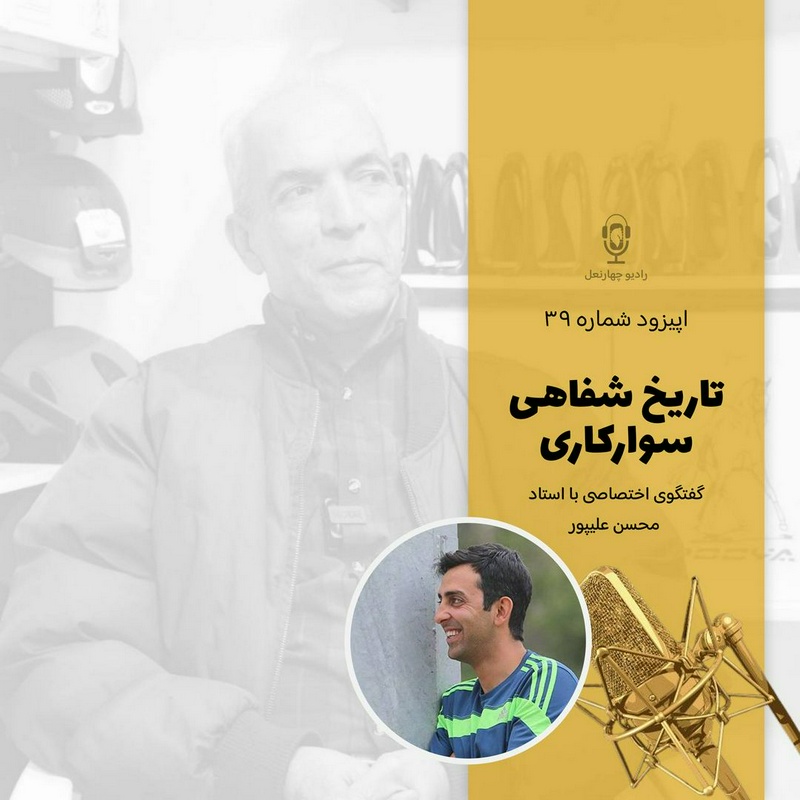
Ostad Mohsen Alipour
خلاصه
In the forty-first episode of Radio Chaharnal, the second part of the conversation with استاد محسن علیپور delves into the depth of equestrianism and the importance of time and practice in this field. استاد علیپور, recalling his experiences in horse racing competitions, especially youth competitions and championships, highlights the support of families and teamwork in his successes. He mentions memories from his military service and his connections with important figures, speaking of his love for great riders and legends in this area. He also shares a painful experience of an injury during a competition and reflects on the order and discipline prevailing in the equestrian environment. His narratives of riding with famous horses and past accidents vividly reveal his love and respect for this field and its pioneers. The podcast host thanks the listeners and invites their feedback for improving the programs.
نکات کلیدی
- ورزش سوارکاری نیازمند وقت، صبر و حوصله است.
- سوارکاری نوین توسط استاد نشاطی به ایران معرفی شد.
- مهمترین جوایز و قهرمانیها در مسابقات سوارکاری.
- تجربیات و خاطرات از مسابقات و همکاری با اساتید بزرگ سوارکاری.
- علاقه و عشق به کار اسبسواری از جمله عوامل موفقیت در این حرفه است.
سرفصلها
- معرفی سوارکاری نوین — استاد نشاطی سوارکاری نوین را از فرانسه به ایران معرفی کرد و شاگردان زیادی تربیت نمود.
- تجربیات قهرمانی — مهمترین جوایز و قهرمانیها در مسابقات سوارکاری و تاثیر آنها بر زندگی حرفهای.
- خاطرات و چالشها — تجربیات و خاطرات از مسابقات و همکاری با اساتید بزرگ سوارکاری و چالشهای پیشرو.
پرسشهای متداول
چه کسانی به عنوان خبره دامپزشک در انتخاب اسبها شرکت میکردند؟
افرادی مانند آقای علی رضایی، آقای داوود برنامه، آقای داوود کریمی و دامپزشکان مانند آقای مجید آریا زند و آقای دکتر ویلیامسون.
بیشترین خرید اسبها از کدام کشورها بوده است؟
بیشترین خریدها از ایرلند و مزرعه استیل بوده است.
مهمترین جایزهای که در این همه سال گرفتید کدام مسابقه بوده؟
مهمترین جایزهام قهرمانی کشور و قهرمانی سال ۷۰ در استادیوم پاتیناژ ریاست جمهوری بود.
شما قبل از انقلاب عضو کدام تیم بودید؟
قبل از انقلاب عضو تیم الف تهران بودم.
چه کسانی اسطورههای سواری شما بودند؟
من خیلی دوست داشتم آقای پول وایر، خانم گیلدرز و آقای داوود بهرامی را.
متن کامل گفتگو
Greetings and respect to all you dear listeners of Radio Charl. We are here with episode forty-one and the second part of the conversation with Professor Mohsen Alipour. If you haven't listened to episode thirty-nine of the radio, the first part of the conversation with Professor Mohsen Alipour, I suggest you listen to that first.
And then this episode, because the issues are completely related historically. Also, the financial sponsor of this episode is the Nikos Equestrian Equipment Store located at the Ghazali Club, managed by dear Ali Nikbakht. The Nik Horse store's slogan is that it offers economical products to the equestrian community, and a very big advantage is that wherever you are in Iran, the equipment you order will be easily sent to you.
I will put their Instagram page address and contact number in the description of this episode for you. My request from you is to help, as always, with your suggestions, criticisms, and opinions so that I can follow up on the issues better and more deeply. I want to remind you of some issues about horses and equestrianism that you are also aware of. Equestrian sports, racing, and anything related to the core are not easy sports that you can master and reach high levels with just a few short riding lessons, whether 50 sessions, 100 sessions, or any number. Equestrianism and horses require depth and the need for you to live alongside the horse for long hours, to know its temperament. With a few books and a few riding sessions, you really can't achieve the desired results because this sport entirely requires time, patience, and perseverance.
And also remember, a student or apprentice progresses when, after their coach teaches them a series of issues, they independently follow up, see what those talks were about, and even make their coach discuss them with them. Remember, a good student pushes their coach and teacher to strive more for further learning. I hope this talk is useful for you. I won't take up more of your time and invite you to listen.
Listen to episode forty-one, part two of the conversation with Professor Mohsen Alipour. Mostafa, you mentioned in your talks that you used to go there to buy horses. Who were the people in that group who went there to select horses? Who were the experts as veterinarians? Now, I don't know, whatever position they had, who were they? For example, Mr. Ali Rezaei was there, Mr. Davood Barnameh was there, for example, Javan was there or Mr. Davood Karimi was there, Ezzatollah Khan was there. Our veterinarian too.
Mr. Majid Arya Zand would go or Dr. Williamson would go. They would completely check and extremely good horses came. From which countries did they make most of their purchases? Ireland, the Steel Farm. I was there too, it seems they bought later. The Royal Association, yes yes, it wasn't clear what happened. Ezzat Khan and I don't know these people would go there as experts with Kambiz Atabay, they would ride, select, and it would be paid from the foot. Very excellent.
You mentioned you spent most of your time in the lower stable or the same Pony Club stable and now I personally know that you and Davood Khan Bahrami were the apple of Neshati's eye. May his soul rest in peace. I want you to describe Neshati's character to the Radio Charl audience, what this person did in that position as a professor. If you want to describe him, how would you describe him? Neshati, do you want to first.
Explain how the acquaintance with Neshati was? Through what process did you get to know him? He knew I was riding because he had seen me ride. To Mr. Afshar, Mr. Afshar was there for a while, then they left from there. When they came, he left. Then he had no jokes with anyone in work. Outside the manege, he was friends with everyone and brought modern riding from France.
He was among the top students of the Istanbul French school. Yes, I present to you, he brought modern riding into our country and took it out of that state. Then it was very good, it responded very well and had a lot of students. I think something about besides Iranian members.
Besides Iranian members, we had over a thousand foreign students. Over a thousand like Australians, Americans, I don't know Canadians, who who, there were a lot. We couldn't have a day without a class. Every day a class, every Friday morning and afternoon, I don't know midweek, Eid, we had one day off, one day Tasua, just like that.
I think one half day if there but we had no holidays at all. Without our horses getting hurt, like saddle sores, girth sores, losing a shoe, I don't know getting injured, colic, we didn't have these things, we didn't see such things. Then where were your horses supplied from? The court itself, meaning the royal, would give the horses because you see the gendarmerie would bring them from Jalilabad. Yes well, a series also from.
We would take from the royal Islam. The lower subset was the gendarmerie. The Vanak Square club was a separate gendarmerie club. The entire army gendarmerie of the whole country. Then we would take from there and also from Farabad, meaning the royal stable. Practically, you had no problem supplying horses. Absolutely not, and we also had a few private ones like.
Our own Professor Khosrow Samiei family who were a very respectable family and Dr. Eghbal's family who at that time had the Ministry of Oil. Yes, their daughters would come here to ride. I said Miss Katavoy's daughter whose horse was in my hands, was from Italy. In Iran, they would come to ride, and her horse too.
Mostly was in my hands. On some days when they came, I would ride first, calm it down, then she would ride. It wasn't like she would go to a competition or anything. You rode Neshati for a long time. Besides you, which other professors and your contemporaries participated in Mr. class and practically had the honor to benefit from that great and lovable presence? Look, now Mr. Sang was for a while the president of the club.
He was also the president of the royal club, Mr. Ali, the late Mr. Ali Rezaei, Mr. Ezzatollah Vojdani, Mr. Davood Karimi Majdour, Mr. Kalan Alaman, yes, Mr. Davood Bahrami, I don't know if God accepts, I myself was in their class. Their daughter was there, Mrs. Nasrin Nejadi, their two sons were there, one of them was younger, a little earlier left in America and Nader Khan. Then Mr. Kourosh Farzandeh was there who now.
Is an artillery officer in the US Army. Yes, then Mr. Amir Hossein Sanei Farzin Kimdar and many others, but now I don't have them in mind. But they were good riders. There were also those who found from the gendarmerie club to this side and came here.
Who were they? Mostafa, you definitely participated in many events. Which was the most important for you? What year was the International? Where? The same royal stable, plenty.
Yes, do you remember the year? The exact year, no, but what category was it? It was category 30, were you young at that time? Yes, then it was the Crown Prince Cup which was also for the youth. No, the most important and exciting for you that created a very good feeling in you? Look, because the organizer of the competitions was first the association itself and those who were present in it, meaning they cooperated, were individuals who had expertise in this work.
Everything was in its place. In the competition, what place did you get? I didn't get a prize but I participated and I was very satisfied, it was very good. That was the most exciting event you participated in for you. Now, what was the most important prize you received in all these years? Which competition was it? How many national championships and which was the most important for you? Both the Safavid year hall.
Ariamehr Skating Hall. My community was supposed to have a horse that General Khosrowdad, the late Khosrowdad, had named Olympic, a very good hand-to-hand. Then I worked with this horse and it was also supposed to jump in the Ariamehr Cup that year in the youth and this friend of ours played a little and this and his father supported well. His father was the deputy of the Ministry of War, General Farzaneh.
He was the deputy of the Ministry of War who bought this horse from General Khosrowdad for 40,000 tomans that year and Neshati was very insistent that Kourosh let this competition finish because Mohsen has worked a lot and I am sure he will definitely come in the prize and this but he said I bought this horse just for this competition. He said you won't be anything in this competition, you knew anyway before.
In the competition, you won't be anything, let Mohsen because he worked and this is his work finished after the competition that he didn't allow anymore that the time went. In the competition, nothing happened of course I didn't jump and with Mrs. Nasrin Nejadi we were spectators. Oh, she didn't jump. Then what was the most important prize you received for you? These championships? No well which one? Let me see one of them finally was different from the others, we.
Year 70 the same Ariamehr Skating Hall Stadium presidency the first night I became second, the first night I became first, the second night the horses were drawn. 5 of us came up, 5 horses, 5 riders. I was without fault with 4 of them, with one horse, with one of Mr. Pezeshk Niyam's horses. Which horse was it? It was a pole horse I don't have its name I don't know that I dropped one, I dropped one then I became second.
Then in the 68 championship I was selected as a member of the Tehran A team. I was, Mr. Ezzat Khan Vojdani was, Mr. Reza Ghadiri was and Mr. Timur Rezakhanlou. We four were members of the Tehran A team that went to Mashhad. There I say team, I mean we became team one with the famous Tosun horse.
I became individual 2, meaning we became both first and I took the individual second and I was very happy and this. Before the revolution in the system now competitions before the revolution and the royal association team competitions were also between clubs. Which team were you a member of and with whom? Then well the Farhad team well you had a lot of numbers, how many teams did you have at that time? At that time sometimes we would see two teams. Then a rule that was there then each team had a young member. Then you and Davood Khan Bahrami were.
Homayoun Vojdani and who else was a few years younger than us but was, he was also there. Who were your teammates? You were in those teams, you weren't part of the team. Your teammates were Mr. Davood Bahrami. In the youth we I was, Mr. Kourosh Farzandeh was. You all jumped youth? Yes, I present to you I say were you also team with adults? You as a young member once oh once with a horse.
Fars in short I jumped with them named Khoshrouy Madineh Kahri, it jumped very well and there we with the kids I jumped and this I think we became team third. I think we became team third. Then I was very happy that then another year 5 or 4 or 5 they came adults. You came early adults. I came a year early, then in 56 I became a soldier and.
Where were you in the military? I was in Bandar Bushehr. Did you go there for an exception to be there or be in Tehran and this? I was a little mischievous, not a troublemaker, I was mischievous. Then I still say military uniform, I still didn't have a military uniform on, something about 4 days there with civilian clothes in the garrison, in the base we weren't in the garrison, the base was a bomber fighter base, it was a fighter base.
In that base four days we roamed with civilian clothes. I in those four days my order from the Ministry of Court had come there that the colonel commander of the base one day pulled me aside, laughed a lot, said do you know Mr. Atabay? I said Mr. Kambiz Khan, he said yes, he said what relationship do you have with each other? I said we are colleagues. Suddenly he laughed said colleagues? You're still 18 years old, 19 what colleagues? He is all the Ministry of Court of the Shah. I said no colleague doesn't mean I sit next to his desk.
In sports we are colleagues, with General Jahanbani we are colleagues, with Mr. General Khosrowdad the same way, Khalvati father-in-law of General SAVAK chief Moqaddam Nasiri, Nasiri father-in-law of General Nasiri. Anyway we rode in the same manege together, always with a cigar in the same.
I present to you suddenly he said oh you said colleague, I said I am a colleague, colleague of them. He said no, what is your job? I said I am riding. Bravo, these he said what did you do? I said what did you do? He was the commander of our base.
I said what do you mean what did you do? He said Mr. Atabay wrote two lines that after the fourth training which should be there after 4 months of training after 4 versions that are finished, another three four months keep him better. He had ordered that way, reverse. Yeah in short this three four months after our training was finished and this we came to the palace.
To thank them, he didn't recognize me because I was very dark, Bushehr is very hot. Then he passed by me, I said what do you mean he didn't recognize me? He doesn't believe it. At the door of the same manege fences he went with his white Benz, suddenly he came back in reverse that Mohsen is it you? I also a military salute, how dark you have become? I said sir it was very hot there and this. Suddenly the first thing he said to me do you know what it was? He said.
Did you get better or not? I said the word he used, did you get better or not? He also did this and this. I said yes sir, bravo go now, from tomorrow you don't need to go to the garrison, once a week he had introduced me to the central support street now it has become victory, yes, at that time the office because General Jahanbani was the deputy of the Air Force of the army, yes and the commander of the Golden Crown team of Iran, yes.
He said once a week you go there introduce yourself and come enjoy now. Eight months there your skin 56 I went into the revolution what did you do? Did you remain a soldier after the revolution or not? No more, then they said sir soldiers forgiveness to them and this. I served 15 months. Mr. Hossein you rode next to very great professors. Big names and I want to see which of these.
Gentlemen, now whether Iranian or foreign, who were the legends of your riding? Meaning you wished you were in their place or one day reach their place? Which name was bigger for you or was there anyone at all or not? Yes, I really liked. From where was he? From which country was he? Now I mention a name, you might remember. I say I didn't follow much because I was young, I wasn't looking for anything, just looking for work, to learn work and grow and come up. Was he foreign? Yes, the same people who came and jumped in the court.
No, the royal association paid them, they would come for a year, two years, three years. Now like for example Mr. Paul Weir, like Mrs. Gilders, like worked at that time who came as a rider. Because a competition was held Farabad named the armies of the world. Well, that he was also part of those riders who came to Iran, Colonel.
Pirodenso and he was a very top rider. I really liked him. He didn't go to the hotel, I really liked him. Now but well, yeah. Then the riding of my dear friend Mr. Davood Bahrami I really liked. Mr. Ezzat Khan Vojdani I really liked. My dear friend Mr. Davood Karimi I really liked and although I was a kid, younger than Davood who was younger than the other kids.
I really wanted to grow up quickly so that I could handle these horses that they ride. Fortunately now, now more or less, in a way we have now reached ourselves. Now yes, certainly that's the way it is, it can't be otherwise. Mohsen, the most exciting memory you can tell from those days when you worked there for the Radio audience, what is it? In your mind. We had a competition ahead, it was a good competition. On Tuesday we set up the parkour and then we went riding, we went riding.
We came while working and this it was our turn. Jumping and parkour and this. The horse froze, from froze. I went like this with this part of my tooth, now the place is still there. I went into these nails, the nails of the old obstacle and out of fear I sat down, I didn't say anything that my breath is stopping. I don't know, they didn't look at what happened at all. I'm serious about this immediately.
I got up and they caught the horse. Well there we had soldiers, we would bring them from prison. There was nothing like a groom who would be paid and this talk. Then they would do their military service, also the horse work. I got on right here where I was galloping to start again. Suddenly for example he called me, said come here let me see. I said what? He said come here. I came forward, he said what is this blood? Here the nail had gone into my gum, the gum was broken but out of fear.
Why did you sit loose? From those words that now well now not much is interesting. Now in short but everyone knows blood had spilled on the shirt then on the pants. He said you don't need to continue. I said I will continue, you won't believe it. Now he said hold you there and I continued and continued. It would pull to the side, I had to gather it. In short we jumped, the parkour was finished and this and.
He said sir don't answer me, don't talk. They quickly called the royal ministry hospital which was on Pasteur Street. From there an ambulance came here and in short they took us and I don't know what they did with it. Now, now it was really fear, it was interest. It was more interest. I liked to work, you know? I liked to work. It was very competitive there, competitive.
And the kids who and I'm very happy about this and the kids who rode at the gendarmerie there,