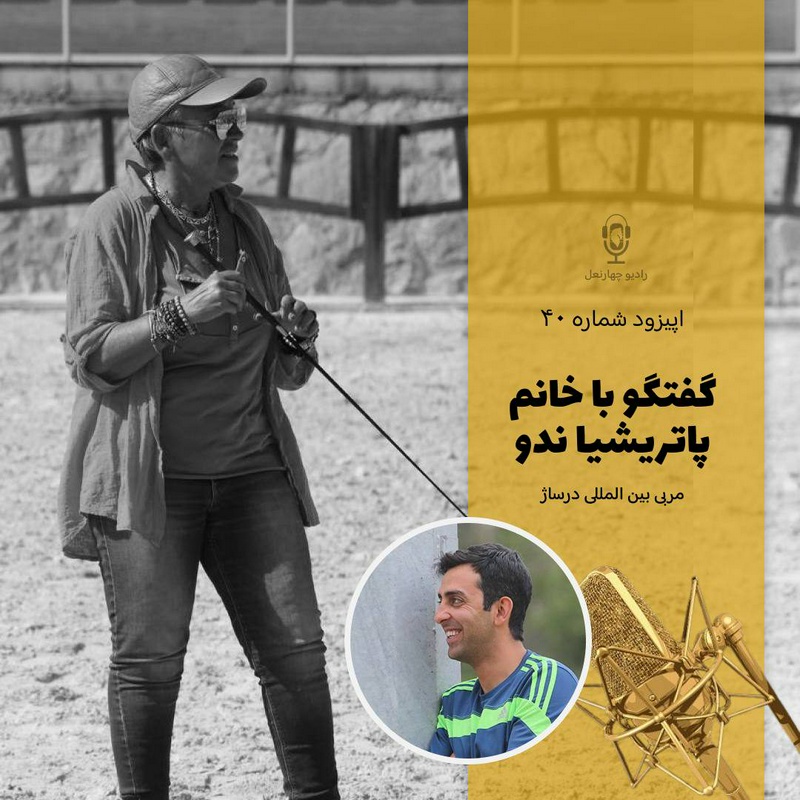
Patricia Nadeau, a dressage master from France
خلاصه
In the fortieth episode of Radio Chaharnal, Mohsen Pourheidari discusses the advancements in para equestrianism in Iran over the past decade with Ms. Patricia Nado, an international equestrian coach from France. Ms. Nado expresses concern about the current state of equestrianism in the country and emphasizes the need for changes in approaches and coach training. She highlights the importance of creating training groups and innovative projects to elevate the level of equestrianism. Additionally, the conversation addresses the significance of training coaches, especially for riders with disabilities, and suggests that collaboration between riders and coaches from other branches of equestrianism can help improve performance. The impact of riders' disabilities on horse training is also mentioned, and it is recommended that individuals interested in equestrianism should engage in continuous practice. This discussion serves as motivation for progress in the field of equestrianism.
نکات کلیدی
- پیشرفت سوارکاری در ایران به طور کلی رضایتبخش نیست.
- کرونا و مشکلات مدیریتی در فدراسیون باعث توقف پروژههای سوارکاری شده است.
- توسعه سطح مربیها برای پیشرفت سوارکاری در ایران ضروری است.
- مربیان خارجی برای آموزش سوارکاران ایرانی ضروری هستند.
- حفظ سطح اسبهای خریداری شده نیاز به آموزش و یادگیری دارد.
سرفصلها
- چالشهای سوارکاری در ایران — بررسی وضعیت پیشرفت سوارکاری و مشکلات موجود در ایران.
- نقش فدراسیون و تاثیرات آن — تاثیر کرونا و عدم ثبات مدیریتی بر پروژههای سوارکاری.
- اهمیت مربیان خارجی — ضرورت استفاده از مربیان خارجی برای بهبود سطح سوارکاری در ایران.
- حفظ و نگهداری اسبهای خوب — راهکارهایی برای نگهداشتن اسبهای با کیفیت در ایران.
پرسشهای متداول
آیا در ۱۰ سال گذشته سوارکاری در ایران پیشرفت کرده است؟
وضعیت بد است و به نظر میرسد که برگشتیم عقب.
چرا پروژه پارا سوارکاری در ایران متوقف شد؟
کرونا و عدم ثبات در فدراسیون باعث توقف پروژه شد.
بزرگترین دغدغه در سوارکاری ایران چیست؟
سطح مربیهای ما بزرگترین دغدغه است.
چگونه میتوان اسبهای خوب را در ایران نگه داشت؟
باید یاد بگیرند تا بتوانند اسبهایی که خریداری میشود را در سطح نگه دارند.
چرا مربی خوب از خارج از ایران باید انتخاب شود؟
در ایران هیچکس نمیتواند صحبت کند و سوارکار درساژی وجود ندارد.
چه توصیهای به کسانی که میخواهند سوارکار شوند دارید؟
باید سواری کنند و تمرین سواری داشته باشند.
متن کامل گفتگو
Greetings and respect to all you dear listeners of the radio. By the grace of God and with your support.
I have released the fortieth episode of Radio Chahar Naal for you. I am very happy that I have been able to continue this far with your support and encouragement. Considering that producing such content is costly and time-consuming, thank God I continued with the energy you gave me. The fortieth episode of Radio Chahar Naal is an interview with Ms. Patricia Nedo from France, one of the great and skilled trainers at the international level. I can confidently say that the fortieth episode and this interview is one of the most informative episodes I have produced so far. Very technical and important points were discussed, which I believe can be a life lesson in the system of equestrianism. The point I want to make about the topic of learning and teaching equestrianism is that we need to behave a bit more deeply and professionally in this sport, especially at the level of coaching and education. Equestrianism will not progress easily.
If we do not want to start the change from ourselves. Change means changing the mindset, changing the work procedure, changing the behavior with our horses, changing the behavior with students and trainees, and many other items. If we want to have something to say in the future, at least in the Persian Gulf region or neighboring countries or countries at our level, we must work much harder and learn more. If we are to progress in this sport, there is no way but to learn the principles accurately and deeply. Equestrianism is not an easy sport and requires the right path, the right method, and most importantly, time investment. I am Mohsen Pourheidari and I invite you to listen to the fortieth episode of Radio Chahar Naal, an interview with Ms. Patricia Nedo from France. Well, I am very happy to be in this program with one of the world's greats in the field of equestrianism and para-equestrianism, who is our guest from France, Ms. Patricia.
From the respected instructors worldwide and among the big names, we had the honor of having her in our country and making the best use of her presence. I am very happy that you came to Iran, and personally, it is a great honor for me to talk to you about the para program and other programs you have seen up close in recent years. Now, if you want to say hello, you can greet so that I can ask the rest of the questions.
Okay, Ms. Nedo, you came to Iran about 10 years ago and started the para-equestrian work with the help of Ms. Montazer. You have come and gone a few times over these years. If you want to compare today, being here now, with 10 years ago, have we made progress, remained the same, or moved forward?
It is about ten years that you are coming regularly to Iran. If you want to compare the first day of your coming and your work in Iran with today, is it improvement or we just stopped? Ok hello my what in و سلام میکنم و میگویم که از سال ۲۰۱۵ اولین سفرشان به ایران بوده. در ایران باتی.
Through the Solidarity project of the World Federation to Iran, the goal of this project was to develop para-equestrianism in Iran. Because at that time, there was nothing about para-equestrianism except for Ghazaleh Montazer and her club, which welcomed people with disabilities, and there was no federation or committee.
I often came in the first year, the second year, the third year regularly several times a year, and we had a lot of equestrianism, and gradually they increased.
Androydos to Samtik in 2019, we reached the point where we had many riders, and even she, with a classifier, meaning a person responsible for classifying riders with disabilities based on disability, not based on riding skill.
They came to Iran, and at that time, they were able to classify about 20 riders, meaning we went from zero to about 20. During this time, I saw important people.
From the federation, from the National Paralympic Committee, and various projects were put on their table. Various packages of the para-equestrian project until in 2020, they were able to hold the first para-equestrian championship in Iran, and unfortunately, that 2020 was her last trip to Iran.
Corona was the first thing that caused the project to stop, well, Corona, because Corona caused many to stay at home, they could not travel, they could not drive, and the practices stopped. This site.
The site even another issue that caused this project to stop was that the conditions in Iran regarding the federation were unstable, and events occurred that forced them to change the head of the federation. I am not here to judge or say it was someone's fault, and that is not my job at all.
And when you stop something for any reason, it is difficult to continue and work on it. Unfortunately, like many other countries, para-equestrianism is not a priority for the federation in Iran.
Practice, I understand why because few riders can practice in this field, and now it has been two or three months that Mr. Kazemian has been elected to be the head of the federation.
Samsung and it seems that he has the motivation and goal to redevelop para-equestrianism.
And this is also the reason for my return to Iran. Yuhash me what is my freing what is my opinion about the new situation.
I have two choices. I can say everything is fine, and maybe I can be very blunt and honest. Honestly, the situation is bad. We seem to have gone back. The level is very low. Except for one or two riders who can compete and race in Iran.
Country discipline, now equestrianism, we have to work a lot if we want to have dispatches and riders to compete outside. We have a very important concern, the level of equestrianism.
And our biggest and most important concern is the level of our coaches. If we want, not if the federation wants.
This happens and develops, well, I am available. Yes, I love Iran, I have many friends, and this is my job. I will come and do it if they ask me. But the road and path are long. They mean the path and route of para dressage, and I have to build a new project from scratch again. Project, I even wrote this new project and sent it to the federation.
Zuwalt, they seem eager to pursue this project, but wanting is not enough. We must act. To create a group of coaches, we must create a group of coaches who can really teach dressage.
Exactly, they are a discipline, a sport of equestrianism. The only difference is the rider's disability. The fiction is that the horses do not have disabilities, our coach is the one who must train the horse.
Teach it the special codes and take those codes from it in work, and after doing these tasks, prepare the horse and provide it to the rider with a disability. If you look exactly in the world, the country that is the best in dressage is the best, and that country is Germany.
France and England, and today, well, if we want to advance what you have in mind as a professional in this field, which part needs more training and attention.
They must work with a good coach, and that too from abroad, not Iran. Sorry to say this, but in Iran, no one can speak. In Iran, there is no dressage rider, no dressage judge. They say, well, I, for example, accepted Semina as a student in my club in France. It is said that she is one of the best in dressage in Iran.
But well, in my club, she seems like an ordinary rider. So they believe that we must focus on the system and advance it. First the coach, then his horse.
I am not the only person who can help Iran, but now I know Iran completely. I know Iranian.
They say, well, there is a bad atmosphere on the other side regarding Iran, and well, there are cultures here that are different from ours. I did not come to bring my culture here and force everyone to take that culture, but I came to help add my culture to the Iranian culture. They mean sports culture.
Iran is interesting. They say my duty is to bring the knowledge from that side and put it on the culture of this country. Now why do they say the culture of this country? Because they believe that our ancestors in Iran had a very rich culture of horses and equestrianism, and now that Western knowledge should come and ride on this Iranian culture.
What they have seen is that there are many riders in Iran who, in any case, love horses and equestrianism. Now it is true that many of them also ride horses and do not have the style of equestrianism that is of interest to Western culture, but they believe that well, they are also interested and can even work together and progress.
So their work and mission, they believe, is to bring knowledge and technique from the West and mount it on the rich Iranian horse and equestrian culture.
It is not that they can say, no, this culture should go aside, now whatever we say, and you must copy and accept it. No, I say I must bring it and mount it on this. This requires an art. In any case, what exists in the West regarding horses and equestrianism, perhaps they do not see it here, is severe work discipline.
And their work motivation, they stop working when they have achieved that goal, otherwise, they do not leave it. We are not lazy people. We work very hard.
And when we stop working, we believe everything is right.
Another point that exists in the West.
All branches of equestrian sports work together.
For example, in clubs that specialize in show jumping, there are many riders and coaches who do ground work and actually help the jumpers to be more successful and better in their jumping, and it is interesting to know that all successful jumpers definitely collaborate with dressage riders. The same is true for three-day eventing competitions.
And we respect each other and all work together to achieve synergy.
In these 15 years, we work very hard, and we do not like to say ground work with horses, we work hard to reach that goal we should.
Lay the foundation stone because what they have seen is that in Iran, everyone talks about jumping. That foundation stone, that strong foundation, does not exist.
That is why now many owners of good horses come to Europe and make good purchases. Good horses have also come to Iran, but what happens is that one or two years later, when you look, those horses have disappeared, and that horse owner comes again and buys again, meaning they cannot maintain that level of the horse because of work.
They must learn, then they can maintain these horses that are purchased with this investment in Iran at the level they were purchased and even cause their progress.
This is how the project becomes a win-win. Everyone benefits from it, and no one loses, and that is why I keep emphasizing that the coach issue must be sorted out. Coaches must progress, learn things. We must give good training to the coaches.
How do they see dressage and para-dressage, especially para-dressage?
This issue is very connected for other reasons, but if Mr. Kazemian remains in his position for a longer period and follows this project, we can also have rider dispatches. Well, they say, but my concern is that we have another change in the federation.
This change means that we have to go back and build from scratch. Unfortunately, para-equestrianism and dressage, in particular, are very dependent on the future of the federation, on stability, in particular, and one of the other major concerns is the financial issue.
To be able to compete on the day that dispatch arrives, we need a good horse for the competition, and the horse in para-dressage is very expensive, and if there is to be a dispatch and a horse, this team must keep the horse in Europe because of quarantine issues and costs and proximity to the competition probably.
So it is natural that riders in Iran must have a series of horses to train here and have a competition horse when it is in Europe, the Iranian team competition, so a coach must work with these horses.
To give them the coding they mentioned. Well, now they say it is not necessary for me to be there, but any coach can be there who works in this field. Well, this is another cost, and then the riders, now I want to say in this discipline, in this para-equestrianism, the rider does not necessarily train the main coach. They give coding and then put it under the feet of that rider with a disability.
As much as possible, only once a week, this horse is placed under the feet of that rider with a disability. The rest of the week, the coach works with it. This is the routine of successful countries in para-equestrianism. The horse is under the feet of those riders from the other side they train with.
Because well, the disabilities of that rider certainly affect the training of that horse. So we put the competition horse under its feet less. For that, we actually keep it tuned, keep it ready, and give it to it before the competition. It has a weekly practice, knows its horse, but the horse is not ruined, and that is why most countries now succeed in keeping their horses in Europe, for example.
Brazil keeps its horses in France, Singapore in Germany, and Hong Kong in England. They do not have very high-level coaches either. Therefore, they keep their horses in Europe, in countries that are more advanced and have access to many coaches, and prepare them. When the competition arrives, the team comes to that country, practices, and goes. Many may see your voice and image in Iran.
What is your final word for this section? What advice do you give to those who see this voice and image? If they want to become riders, they must ride. You cannot be a rider without practicing riding. I hope these talks create changes in individuals that lead them to pursue better and more professional work.
This can be a motivation to engage in riding. Thank you very much for taking the time, and I wish you health and success. I was with you and saw the effort you put in here and had good planning. I wish you health and hope that our next interviews will be when you.
Prepare a number of professional riders for international competitions. Thank you.
I am glad you were with me and Radio Chahar Naal until the end of this episode. I hope this conversation has made you think and motivated you to change your approach for the better. I wish everyone health and happiness, and as always, take care of your horses.