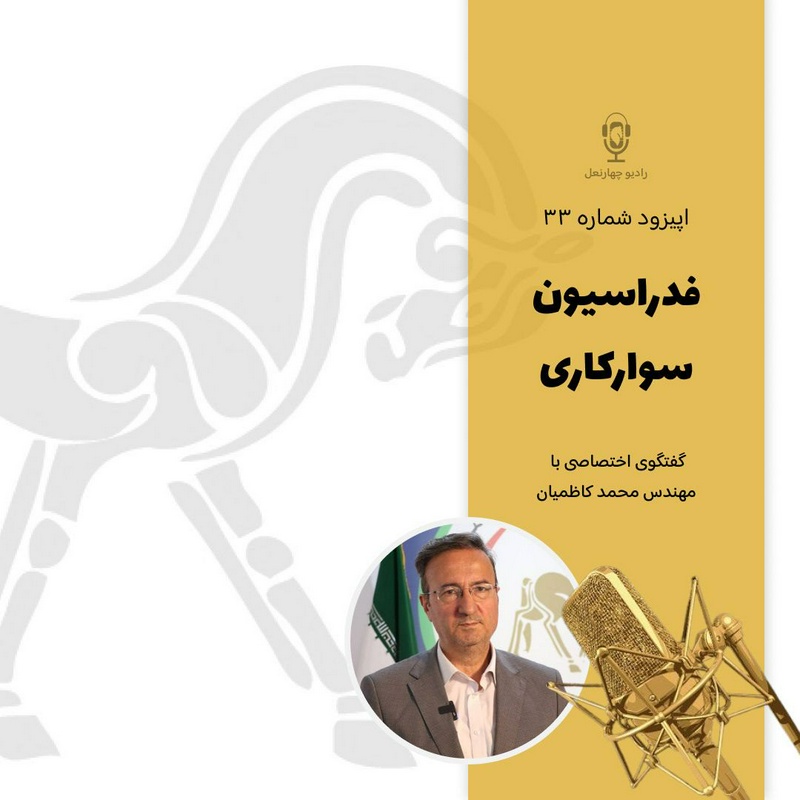
Mohammad Kazemian, President of the Equestrian Federation
خلاصه
In the thirty-third episode of Radio Chaharnal, an engaging conversation took place with Mr. Mohammad Kazemian, the president of the equestrian federation. He addressed the challenges in the equestrian industry, including doping and the need to improve processes, and emphasized the importance of media cooperation in information dissemination. Additionally, the challenges of identifying and registering horses, the issues with the entry of sport horses, and the necessity of establishing specialized commissions to oversee imports and breed improvement were discussed. Mr. Kazemian stressed the need for online and systematic training, ranking of coaches and clubs, and support for riders and trainers. Furthermore, planning for participation in Eurasia competitions and the development of para-equestrianism was also mentioned in this interview. The main goal of the federation is to win international medals and enhance equestrian conditions in Iran.
نکات کلیدی
- فروشگاه بنیامین بزرگترین فروشگاه لوازم سوارکاری ایران است.
- مشکل دوپینگ اولین چالش فدراسیون است.
- میکروچیپگذاری اسبها با مشکلاتی مواجه است، اما راهکارهای موقتی در دست اجراست.
- آموزش صحیح در صنعت اسبسواری ضروری است.
- تشویق مربیان و برگزاری دورههای آموزشی برای ارتقا ضروری است.
سرفصلها
- معرفی فروشگاه بنیامین — بررسی تاریخچه و محصولات ارائهشده توسط فروشگاه بنیامین.
- چالشهای فدراسیون سوارکاری — بحث در مورد مشکلات دوپینگ و اقدامات انجامشده برای حل آن.
- حمایت از تولیدکنندگان اسب اصیل — راهکارها و برنامههای پیشنهادی برای حمایت از تولیدکنندگان اسب.
- اهمیت آموزش در سوارکاری — نقش آموزش صحیح و آنلاین در بهبود صنعت اسبسواری.
- برنامهریزی برای مسابقات بینالمللی — اقدامات لازم برای تشکیل تیمهای ملی و شرکت در مسابقات برونمرزی.
پرسشهای متداول
فروشگاه بنیامین از چه سالی فعالیت خود را آغاز کرده است؟
فروشگاه بنیامین از سال ۱۳۹۴ فعالیت خود را به صورت حرفهای آغاز کرد.
فروشگاه بنیامین چه نوع محصولاتی را ارائه میدهد؟
فروشگاه بنیامین تمام نیازهای اصلی سوارکار را با هر بودجهای تأمین میکند.
چگونه میتوان محصولات فروشگاه بنیامین را خریداری کرد؟
میتوانید از طریق آدرس سایت یا اینستاگرام و شماره تماسهای موجود تماس بگیرید و اجناس خود را تحویل بگیرید.
اولین مشکل فدراسیون چه بود؟
اولین مشکل، بحث دوپینگ بود.
برای حل مشکل دوپینگ چه اقداماتی انجام شده است؟
اقدامات شامل خرید کیتهای استاندارد و همکاری با آزمایشگاههای معتبر است.
چگونه میتوانیم از تولیدکنندگان اسب اصیل حمایت کنیم؟
با تعریف فعالیتهای ورزشی، جذب اسپانسر و برگزاری جشنوارهها میتوانیم از تولیدکنندگان حمایت کنیم.
متن کامل گفتگو
The sponsor of this episode is Iran's largest equestrian equipment store with four active branches, Benjamin Equestrian Equipment Store. Benjamin Store started its professional activities in 2015 and by importing the latest global products, it created a new chapter in the horse and equestrian industry in Iran.
When you enter any of Benjamin's branches, it's impossible not to find your desired product at a reasonable price. Benjamin Store easily meets all the main needs of the rider with any budget. The interesting thing about Benjamin is that you won't worry about their products running out, and the latest global goods are always available to you. Big brands like Pilot, Flexcel, Kerbl, and many other global brands are constantly available at Benjamin Store and also.
Many high-quality domestic brands always have their own shelf at Benjamin Store. Just contact them via the website address, Instagram, or the phone numbers provided in the description of this episode, and receive your goods wherever you give an address. It doesn't matter if you're a beginner rider or a top-level rider.
Benjamin Store has equipment for all rider and horse categories.
Greetings and respect to all you good listeners of the radio. I'm happy to be with you with another episode. Episode thirty-three of Radio Chahar Naal is a conversation with the President of the Equestrian Federation, Mr. Engineer Mohammad Kazemian, and I'm happy that for the first time.
I had the chance to have a casual conversation with Mr. Kazemian as a private media, and I hope these talks will be encouraging for all of us and make the future clearer for us. I am immensely grateful for your comments on the discussions and episodes and for being alongside Radio Chahar Naal. Additionally, because the conversation with Mr. Kazemian lasted nearly three hours.
And I know it's hard for many to spend three hours listening to this episode continuously, this episode will be divided into three parts, and I will broadcast one part for you each week. I hope we have good times and that future brings us all goodness and blessings. I am Mohsen Pourheidari, and this is episode thirty-three of Radio Chahar Naal.
In the name of the One who gave existence its name, the heavens gained movement, the earth gained tranquility from Him. I'm happy to be in the service of Mr. Engineer Mohammad Kazemian, the President of the Equestrian Federation, and even happier that I had the honor to take this time from him as a relatively private media, because before this.
I don't recall any federation president sitting in front of the camera and being accountable to the people. Thank you very much, Mr. Kazemian, for the time you gave me and Radio Chahar Naal. It's an honor for me, and I'm sure the audience of Radio Chahar Naal will certainly enjoy this interview a lot. We are at your service. Thank you very much. In the name of God, I'm very happy, Mohsen dear, that you gave me this opportunity to be able to talk face to face with the equestrian community and those dear ones who have dedicated their lives and efforts to equestrianism, maintenance, breeding, and the values of equestrianism, and I'm grateful that.
This opportunity was provided for me. I really wanted to talk sooner than this. Fortunately, you were persistent. Thank God you have a lot of audience. I myself am a follower and one of your audience. Be healthy, and I follow the opinions and talks of the elders, and thank you for providing this opportunity for me to be able to talk to those dear ones who are trying to hopefully solve their problems and reduce the community's difficulties. Now, the things I know, I know a little about horse riding, and those I don't know, I hope to learn from dear friends.
I am at your service if you have any specific questions and want to move this conversation forward in any way you have planned. I am at your service. Thank you again for your time and kindness, Mr. Kazemian. Well, anyway, you are part of the equestrian body. Regardless of your governmental positions, it can be said that you are a horse family. I mean, the whole family from many years ago, at least where my father remembers, you are among the old families in this field. We are really happy about this, that someone who has experienced the pain has come into this sport, and a value has been placed behind you that you have a listening ear and your phone is on-call, which I really didn't see in previous presidents.
Now, let's not gossip. I don't care about the past. I really personally moved on from the past. My first question is, what made you want to take on such a heavy responsibility with this mess we all witnessed, and as many elders say, this ship has run aground, with this mess? First, let me thank you. You mentioned the previous managers of the Equestrian Federation, whether those who worked permanently or those who acted as caretakers, whether for a short or long time. I am truly grateful to each and every one of them. I appreciate.
All the efforts of those dear ones who have taken even a small step for the horse. Many of these elders have done great and good things, which we will try to follow the good works and learn from their mistakes so that we do not make those mistakes.
But why did I come into this field, and well, you said it beautifully, see, we all care. Now maybe someone like yourself has come with this mission to try to inform, try to do media work. Another one in another way. What I know how to do, I always saw myself as an official or a federation person, and I know and will know. I mean, for the rest of my life.
I see myself as a federation person, and I think I've done a lot of administrative and federation work. I learned a lot from the managers who worked here before. Now, both positively and from their mistakes, I learned not to make those mistakes. I felt that I could do something, and because as time went on, I saw that the problems were increasing and the people's problems, especially in these economic conditions, were becoming more difficult, I felt that I should come into the field.
I don't want to give slogans that I felt responsible to come and serve. I don't want to say these clichés. But the reality is that I felt I could untie a few knots, make a few moves. That's why we came. Well, the election process, as you yourself know and dear friends know, took a long time. But anyway, it was God's will and God's grace and the support of the assembly members and now the heads of the boards, friends who kindly voted, and I came into the field. But coming in wasn't enough. I mean, for me to sit today and keep saying the past was bad, you yourself are aware. Even in the early days when I came, I prefer to keep this connection with the people.
I invite other friends who work in the specialized equestrian media field to be our bridge to the people. Maybe I don't have the opportunity to talk to everyone every day, but through you, I can tell people what we are doing, and if we have any mistakes, let us know. There were many problems. Now I say I don't want to constantly refer to the past. From here on, it's a new page. That is, from the 24th of Esfand 142, I opened a new page and tried to solve the problems. The first problem I encountered in the federation, which many others also faced, was the issue of doping.
Friends had worked hard on doping. Now, those who were in the committee, I don't intend to criticize, but in any case, this is a matter of preference. Since I have worked with the kids for years, doping was very sensitive to me. That is, my red line was the use of banned substances to, for example, achieve results in competitions. It doesn't matter what discipline it is; racing, jumping, endurance, or even beauty shows. I was looking to solve the first problem, which was doping. Well, in the federation, I saw we have three or four refrigerators where the B samples are kept.
The horses are kept in these. The B samples, the samples we took, we have sample A and B. Sample A was sent to a laboratory in Turkey, and sample B was kept in the refrigerator. If someone objected, it would go to another laboratory again. After consulting with major doping specialists, this practice was wrong. For this reason, I was looking to get help from people who are experts. Now you are aware that during the Nowruz holidays, except for the first day, we were in the federation the rest of the days and had meetings. Many of the kids kindly left their holidays halfway and came to the federation, and we held specialized meetings.
Not for show, but to be able to untie the knots. My belief is that we can untie the knots with the help of the people themselves, and our first discussion was doping. I consulted and reached the statute. We saw that the statute states we are obliged to pursue the issue of doping with the Anti-Doping Agency and the Sports Medicine Federation. Dr. Norouzi, the head of the Sports Medicine Federation, is an old friend of ours and very kind. I immediately bothered him during the holidays.
And consulted with him. He cooperated to the fullest. NADO itself cooperated a lot, and we reached the conclusion that we should make changes in the committee, the sampling process, the laboratory, and even the kits. Look, the kits we used for doping were Iranian kits. All the labels were printed in Iran, and our packaging was not at all up to the standard approved by the laboratory that has the approval of the international federation. So our first task should be to purchase kits.
To purchase kits, we need to sign a contract and send money out of the country. You know the conditions of the sanctions. These have to come from a country like Switzerland. Well, this was a time-consuming and very difficult process. The second issue was the laboratory. Which laboratory? The laboratory that was in Turkey. The kids hadn't signed a contract with it, but they were working with it. Its quality was not very high. That is, unfortunately, most of the samples taken were blood samples. More in anger. Now maybe friends are aware. We are looking for urine samples because many drugs are more accurately and better revealed in urine. For this reason, the laboratory was another issue. We reviewed various laboratories again. We held a meeting with NADO. NADO sent the samples to Germany. But well, NADO is dealing with human samples. We want animal samples. In any case, with the managerial changes that occurred in the committee and we invited Dr. Hosseini, who is a reputable person in doping.
He also kindly accepted. That is, our doping conditions are so difficult and challenging, but he kindly accepted and agreed to step in, and from the day he accepted responsibility, he has been advancing all the work. We corresponded. Today, as I speak to you, with the kits we currently receive from the Anti-Doping Agency, we take our samples in the ongoing races and send them to a very reputable laboratory. But for the future, this is not enough. We have taken action to purchase and order more than a thousand standard kits in Switzerland.
We are doing valuable work to, for example, deposit this money into their account, and hopefully, with the help of friends in customs, we can bring it into the country without any problems. And we are also pursuing to hopefully sign contracts with reputable laboratories like those in France or laboratories that have approval. Now I say we also have the issue of sanctions, but hopefully, we will find solutions to carry out this discussion. So the first issue I really wanted to solve was doping, which is almost.
At this stage, with the process you went through, the test results come in after a while. From the time of sending, we have two discussions. The tests have a sending issue, which if we want to send to Europe for now, we have a series of problems. The process is longer, but again, a reputable laboratory that is very equipped and recently has very high quality and is closer, these facilities have been created so that we can send to them. From the time they receive the samples, there is a protocol. That protocol is that when they do it, it becomes clear. They send us an invoice. We give you the invoice for its payments to be made. As soon as the payment is made, they answer.
The chain process is connected. That is, if we send the samples late, if we can't, for example, send them for a long time, this itself becomes time-consuming. And if they give us the invoice on time and we pay late, again, this will be time-consuming. If all these are done on time, we will receive a response within a maximum of two weeks, and hopefully, we can respond. And after that, our problem is our anti-doping regulations. Now some of the penalties we have are not that much, and now maybe in jumping, it's less, but in anger sometimes.
People even do the tests because the penalties compared to the exploitation they can make from those banned substances are nothing at all. And for this reason, the regulations, the disciplinary regulations, must also be hopefully revised, which in any case, we had a problem with from day one and we did. Question.
The second point that was very important to me is that we have not yet reached our sports duties. When we came to the federation, we had more than 5,000 samples of horses for identification and genomics. Most of these samples are related to Turkmen and Arabian horses, which need to be processed. These samples should have been sent to the laboratory, and the laboratory must have a valid certificate.
This has not been done so far due to existing reasons. When I arrived here, these samples needed to be reviewed. The first thing that came to my mind was that we must work within the framework of the law. Apparently, a laboratory in Iran used to do this work, but now for various reasons, it is not advisable to work with that laboratory. Supervisory discussions and events that have happened in the equestrian federation in the past are being considered.
So the first thing we wanted to do legally was to see which laboratory could do this work. Until today, as I speak with you, the deadline we had set for ourselves from the legal authorities in the country, we sat down with the Animal Science Research Institute, the Ministry of Jihad, and various places to review which laboratory is approved by the country. We have a discussion aimed at protecting genetics and preventing the exit of animal genes from the country, which the Ministry of Jihad was also facing. So the authorities had to give us permission. We held several meetings, and unfortunately, until today, we have not been able to obtain this permission to send these samples to a certified laboratory. Internally, we can do parentage testing to say whether this foal is the father of this horse or not, but for genomics, it is not possible. Now, in the meantime, we are conducting reviews, and we have a contract with a laboratory in Spain that has a valid certificate. A contract that was previously arranged, and we also spoke with the legal officials of the Ministry of Sports. We are sending it through an official letter, and hopefully, if we can get permission from the Ministry of Sports, the samples that are currently pending and people are waiting to receive their answers will be sent to that laboratory to clear this backlog. Or with another agreement we have with other friends, if we agree with another laboratory that Jihad itself sends, we can do this work. This is one of the important issues, but besides this...
Things that have not been in the hands of the federation for a long time, meaning that laboratory and the previous process were not there. Another issue is the microchips. We always received codes from the Ministry of Jihad, the Deputy of Animal Affairs, and then ordered microchips from other countries outside of Iran. Then we imported the microchips and legally cleared their customs bases and they were imported. Then we would go and microchip. It was a plaque that was installed on the horse's neck, the registration number was recorded, and then it was identified. Well, in the federation, for reasons that...
The specifications of the horses that were microchipped were not given to the Deputy of Animal Affairs, and people have encountered problems and they want to register them in their system. For this purpose, what did they do? On the other hand, we have a discussion because the horse issue is a concern of the equestrian federation and for over 50 years this work has been done by the federation. Well, it was one of our main duties. Although it is not written in the statute, inherently, since it was also one of our main duties in the past to consider the lineage of horses in studbooks in international forums...
For this purpose, what did we do? We said that...
We still couldn't coordinate with the Deputy of Animal Affairs of the Ministry of Jihad. I say since March 18th, I have been trying, but due to the commitments that friends had, we couldn't hold this meeting, but we talked on the phone several times, and it was decided to solve the problems and give us those codes again so that we can import the microchips. Like in the past, the equestrian federation will carry out the microchipping, and hopefully, we can resolve the issues that have been between us and Jihad so that people's troubles are reduced. That is, the feeling is that the more stubbornness there is between organizations and the administrative resistances that sometimes arise...
People suffer. Therefore, to solve these troubles, the first thing we saw was friendly interaction, and we are moving forward with this indicator. Today, when horse racing competitions are held, we have several foals that were ready for the field, and the owners have spent money. I had two solutions: either say no until the federation's microchips arrive, I will not allow these foals to run. Well, this is an unprofessional and irrational decision. Because a foal that has turned two years old or is three years old, if it does not go to the field and cannot compete, it loses the season, and the expenses that the owner has incurred all go to waste. The foal's age increases, and well, a loss...
For the owner. The owner of a horse whose life is the horse and this foal...
I saw that the best way is that we talked with the institute and provided a series of loaned microchips so that the foals that are currently in the field are microchipped. Only other issues like sampling and such are done by the federation itself. Those microchips are temporarily placed for these foals to solve the immediate problem of the horses that are in the field. This issue is also one of the concerns of the people, and now I will explain what we should do in the future to reduce people's troubles. Until today, as Mohsen Jan has been sitting in the federation, now you have seen your working hours until we can have people and...
If they have come from the county, I can open the door for them, we try to be there. We invite my other colleagues to all come so that we can hopefully solve their problems. A question that has always arisen for me is whether the equestrian federation, whose main specialty is horses, and Jihad, whose main specialty is livestock, cannot form a joint committee that...
Be the final word on all these problems? In your opinion, this happened many years ago. Even for imports, the Ministry of Jihad would give the import permits. That is, it had a system, and the kids would go to import the horses and upload the specifications and documents in the system. Then we had prepared a joint regulation with the experts of the Deputy of Affairs. Based on that regulation, the file would come to our federation, and we would review the sports eligibility for installation. Sometimes, for example, the policy was that...
Some horses were not allowed to enter, while some sport horses were allowed, and this was what was happening. There, when the sports qualification was signed by everyone in that commission, the head of the federation would write a letter to the deputy of affairs, providing a list of horses based on microchips and stating that we approve their entry in terms of sports qualification. This would go to Jihad, and they would issue a permit for entry. Jihad itself would control that the same horses were at customs and would allow entry. Quarantine and this would happen. Unfortunately, today this has disappeared for reasons I do not know.
During this time, these permits were not being issued, and people were experiencing delays. You know that maintaining from abroad with this currency is very expensive and sometimes it would take a long time. Now, those who had responsibilities might not have been informed, might not have been willing to take responsibility, and in any case, there were resistances, and imports today are by a group from the equestrian community, which we do not know how specialized they are, but we were very careful that in the federation, that commission, be a specialized and impartial commission.
It should not seek to support a particular faction. But now today, I saw some friends have set up a commission and are issuing permits in places. These were actually powers that the federation lost. Now we are trying to return again. I also talked to Dr. Sharif, and it was decided to return this commission to its previous form. I want people not to worry about their horses being left outside. I know now the cost is very high with this currency. We keep wanting them to give proportion there. One thing that happens abroad is that when you buy a horse, that person, that club takes care of that horse until that day and releases it. That is, you buy a horse with good physical quality.
A thin horse, a horse that no longer has that quality. Because precisely to solve people's problems, we must reach an interaction with other institutions as soon as possible. Now these institutions are customs itself, the deputy of animal affairs itself, the research institute.
We can do a lot of work. In my opinion, we must quickly pass over these things, these wasted times. From identification, we are still stuck in the problem of identification. We can do a lot of work for breed improvement. Maybe people do not take us very seriously, and these records that we have in competitions give us a lot of advisory states, guide us on what breeds we should produce inside, what bloodlines we should use more, what horses we should import, what horses we should not import, what bloodlines should be in our herds, what bloodlines should not enter. We are oblivious to all these.
We have set them aside. See, we have excellent purebred Iranian horses, but today I want to boldly say that maybe these purebred horses of ours are not suitable for the Olympics. Well, nowhere in the world is it like this that they take their purebred horse to the Olympics. But if we preserve these purebred horses well, if we support our purebred horse producers, you might say it is not part of the federation's duties, but I can still somehow.
Because I say I understand, I know, for example, we define sports activities, get sponsors for them, and do many things, hold festivals, do a series of things so that our purebred horse producer does not become discouraged and hopeless. Now they are very tired, our producers are really tired. Those who are working with purebred horses sometimes have no justification, sometimes the costs have bent their backs. For us to support them, we must do some things, the Ministry of Agriculture, that deputy of affairs, and they must do some things, and the people themselves must do some things. Now you say how the people themselves.
See, today we are in the federation, for example, 10 producers of a horse breed call us, have a request, 15 people in one way, five people in another way, 20 people in another way. Some of them have also formed an association, for example, the association of such and such a horse breed, they have requests.
This way is not beneficial. That is, whoever is the manager, whether in the Ministry of Jihad or in the federation, becomes confused and ambiguous. Sir, whose word should be listened to, who is telling the truth, who is saying the right thing. The best way is for the people themselves to form a breed association.
And we have it now. We have many associations. Even today, a very good thing happened. We were able to sign a memorandum of understanding with the Caspian Horse Association. Because this association has a structured and very organized board of directors, they have more than 100 members, they have elections, their producers, well, in the memorandum of understanding, what they themselves thought the federation could help with and I also added some duties to this that we in the federation are obliged to help them, for example, for training coaching courses, for example, training children to work with Caspian horses and many other things.
We signed in this memorandum. Do you know what advantage this has for me? Whatever I want to consult about the Caspian horse, I consult with the association.
It happens instead of us coming and forming a committee, instead of selecting people based on taste, for example, it may be from a faction, I do not know, but the associations themselves write this bylaw, say sir, our members, for example, depend on that breed, on that population, on those audiences that have to draft a bylaw for it. Whether people who keep 10 to 20 to 50 to 100 horses, have farms, have clubs, do not have, they can specify these, they become their members, recruit members. When they recruit members, they can hold their elections. After the elections, we are dealing with a CEO and a board of directors and hold most of our meetings with them. They bring their members' opinions and.
Suggestions to the federation, bring them to the Ministry of Jihad. We, the federation and Jihad, will perform supervisory work. We do not come to involve ourselves, for example, in execution, involve ourselves, for example, in many tasks, assuming our various committees are now active, they can be alongside these associations, be breed associations, work. In many places, people's problems are solved if these associations are formed in the right way.
Thank God, I say, because in many of these breeds we have associations but the associations are not active. I am willing to help with this in any way we can. All the people gather for production. No one, no federation president, no technical deputy will be more caring than the people themselves for their productions. So the best form is for us to come and do this work, we strengthen the associations, support them, the associations come.
I'm not saying the work of execution, but we can outsource many tasks. We can consult others on many tasks. They can transfer many problems to us, and we can find solutions for them. This is solving people's problems by the people themselves, and it helps a lot. You explained this topic very well, which raised two or three questions for me. Well, Mr. Kazemian, since I conducted a survey, one of the most challenging issues for people currently in the horse industry, whether riding or horse breeding, is the cost of horses and club boarding. Many people have talked about this issue, saying that we really can't keep horses under these conditions anymore. I want to see how much room there is for maneuver in the federation's jurisdiction, help, I don't know, support, if there's a committee, I don't know, subsidies, or whatever the term is.
How can we reduce the costs a bit? For example, someone who had five horses now has one and has sold that one too. This has become like urbanization in Tehran, meaning those who were in the middle of Tehran have become the middle class and marginalized. Unfortunately, we are seeing this happen with horses. What can we do to prevent this from happening? I want to tell those who are watching our images and hearing our voice that monitoring clubs is not our job because where do they get the license when they want to establish a club? From the General Directorate of Sports and Youth Affairs of the province's club affairs. We have a General Directorate in the Ministry of Sports, the General Directorate of Club Affairs.
But this doesn't mean we should say it's not our job and shirk responsibility and step aside. No, something that came to my mind a few years ago, because I worked in the Tehran board and the Tehran board itself had many issues, I learned something. We can help in ranking the clubs. See, it's not at all logical for the east of Tehran to charge half the boarding fee of the west of Tehran. What is happening? Is this a five-star hotel? Is the hay more expensive here? Is it cheaper there? It's not about this.
In my opinion, a bit of subjectivity is happening. We don't want to interfere in the clubs' work, but if we rank our clubs, we identified 230 items with the help of experts and specialists. Maybe these need to be more. If these items are evaluated by an inspector from the General Directorate along with a few people from the equestrian community and rank the clubs, then we can define the ranks. A club with an A class, a five-star club, an excellent club, whatever the highest name is, and the lowest.
And the rest can be calculated. Nowadays, the reality is that I have to say some things, the clubs themselves have a lot of problems. Workers have become expensive, insurance has become expensive, fodder has become expensive, ancillary costs are high, depreciation, taxes, and things that come to them are very high. But it's also unacceptable to be so undisciplined. Even in the west of Tehran, in some places now, for example, you look, their prices are very different from some clubs. This can be managed, this can be organized. This is even to the benefit of the clubs.
Sometimes we have this opportunity in the classes we have with friends. We set up some courses for club management, and we will continue those courses, God willing. In the continuation of the talks, I will say what we will do for education. When we were teaching in class, we told friends, everyone said horse breeding is a loss, horse breeding without accounting is completely a loss, it's problematic. When in the club, the club manager himself keeps several horses without accounting for their boarding and other events, well, these are very detrimental to him.
The best thing that can be done is order, discipline, management, financial discipline, economic discipline so that we can support the clubs, and also support the consumers, owners, and those who board and even those who come to the club to learn. These all have ways. We shouldn't go one-sidedly towards saying, for example, reduce the boarding, the club goes bankrupt and closes. On the other hand, if the boarding is too high, people will go bankrupt and abandon it. We can go towards that balance, it's an expert work.
I invite friends who have ideas, thoughts, can help us to come. We in the federation are open to everyone. The federation is called the house of equestrian, the house of the rider.
Let's gather here, find a solution that benefits both the consumer and our club owner and can use these facilities. Regarding education, let me say something, this education question is very important, maybe in many places.
It has become a slogan, a cliché, very instrumental that everyone talks about education, but just talking is not enough. What do we want to do in education? What do we want to teach? Who should teach? In which part? Today we see everyone in cyberspace has set up an educational course for themselves, doing some things, and it's very strange. Sometimes we look and see what really harmful things they are saying, and these are damaging and now.
Fighting, for example, closing this page is a very difficult and costly task. Maybe the federation doesn't have the facilities to do this. But what do we do alongside this to make them fade away? And for this work, we need to set up a proper educational system. The first thing that can be done for education and for all the surrounding work that we need is an intelligent IT system. From the day we started the federation, this weakness and gap were in our system, a part of it is fresh education.
We set up an IT team, established an IT committee, a team of equestrian kids, and we still invite them. This team can be so big and strong. Anyone in this field, sometimes I get to know friends who have expertise in IT and informatics at competitions, I can invite them, come.
Many do not want their name to be mentioned, many say it should be, and we are building this team to be able to do this work. How? The first thing that needs to happen is that education must be very accessible. Nowadays, it's not like the old days when people would come to the federation, for example, a club somewhere, a teacher coming late or early. People's time is very valuable, and commuting is difficult. So, we need to provide systems for online education. We have many of our kids who are specialists but do not have time. Well, we can record a series of videos. You can help yourself. Kids who are very skilled in this discussion can do this work. Let's start education with our system.
From top coaches around the world and people who have worked in stables, it's not just about coaching and judging education, but we need detailed horse management education. One day we invited one of the world's very good coaches for training and tried to invite our groups to learn there. Many friends were upset that the price of groups might go up, but today we really need this. When we have multi-billion horses, the person working with this horse must be trained. Some time ago...
You yourself worked hard and held a meeting with the riders. Many were upset about why, for example, the federation has a lot of work with the riders. We have people who are directly connected with these horses, which are the investments of the people and the country. We have not trained these people and have left them. Anyone with any degree has come, loved horses, and has become a rider or veterinarian or other jobs. Therefore, we need a very intelligent and strong system for education.
Today, we can no longer have Mr. or Mrs. Federation sit and hold a competition and organize colors, etc. The best thing is to have robotic planning. Like the FBI, we participate in a course, and until we reach the plane and return to the country, we receive a digital certificate. If we pass, the digital certificate comes, and if we want, we print it. We must do these things at this speed. The list of instructors should be specified, the places where they can hold classes, and people can take courses. The instructors upload, and those who pass are forced. The robot programmed for this work determines pass and fail and issues the digital certificate. You in...
We have a certificate, but this is not enough. We have something in equestrian sports, and that is a profession, a specialty, but we have been neglecting it until now. I searched a lot and thought about what to do about this. Now many of our coaches are not insured and cannot have social security insurance. This is my main concern. From the day I came, I asked Sardar Razaghian, the deputy angrily called immediately to see if our riders are insured or not. Well, this is very important. One of the riders had sent a message that his hand was broken with a master's degree.
You wouldn't believe it; one of my past concerns has been the insurance of the kids. We even held meetings in the past, even the then-president of the federation supported that coaches sign contracts with clubs and the club insures the coach. That day we thought that now many clubs preferred not to because of high costs, but this must be done. Now what came to my mind and I studied is the technical and vocational discussions. We have technical and vocational centers that get licenses from the Ministry of Labor.
The certificate that the technical and vocational center gives is like a business license and has credibility.
To be able to regulate it, because the technical and vocational work outside is illegal, and we must stop it, I came to use the benefits of technical and vocational. We are setting up the technical and vocational center of the Equestrian Federation. That is, we hold coaching classes, and at the same time, we give a technical and vocational certificate to individuals. This is like a business license, and they can get loans. It's not just coaching; for example, it can be for farriery, for a group, and many other activities that have club management, management. Whatever is done, they get a certificate here and can use it. In addition, they can have social security insurance.
This is very valuable. One of the goals I was pursuing is that the individual can introduce it as a workshop in any case as a business. Now, for example, they do farriery activities, group activities, riding, or anything else, and this can at least be a retirement salary and use of social security services for them. One of the things that came to my mind, again if other friends have ideas for us to help, I have repeatedly said this federation is the federation of the equestrian community itself. The main federation. Any idea and anything that can improve the lives of the kids, we can do. Let's pursue this work.
How is this coach ranking discussion? Because many of those who are now especially in the counties, you see less in Tehran that our coach does not know and does not allow us to progress. No one, for example, from Tehran or the federation comes to help us. How is it that now, for example, someone comes to the club and wants to start riding? How do we know that the person who is their teacher is mentally healthy, technically skilled, supportive, or not? Because one thing Mahmoud Amiri said in one of the interviews was that we...
The main education is based on frustration until learning, and I have personally seen this many times, maybe I have done it myself, I really don't know. But this lack of ranking and this lack of recognition may cost a person's life and many other issues. Surely you are also better informed about it. What move can you make for this as two different discussions? One is that we say a coach with a certificate or without a certificate and one ranking. Look, if I want to go, for example, I need a medical case, the first thing that is posted is Dr. So-and-so or Dr. So-and-so, I do not enter. I study, I ask from the same.
For example, toothache, stomachache, something I ask which doctor did you go to? Four ask, sir, this doctor is better, like this, like this, this hospital is better or these conditions are better. So first my review. Sometimes I am very surprised. We had many cases where people complained. Then I said what happened? They said we went to the club, well, that coach did not have a certificate.
On the wall, it was written under the supervision of specialists and so on. We also went and entrusted our child. Tomorrow, trust was broken, leading to a court complaint. So the first thing people should do is to investigate, and then when they enter the club, in my opinion, clubs should have a list and names of their main coaches with their credentials on the wall so that people know, for example, Mr. So-and-so has a certificate, and it might be that 100 people walk around the club and all say we are coaches, which unfortunately is the case.
So this is not enough. People themselves must first supervise. But after this, now who is a good coach, who is worse? In our opinion, the federation should be ranked. Not only the coaches, but I think the referees, the clubs, and all of us should, at the end of the year, although it is a difficult task, we want to leave the judgment to the people.
This idea I have because you yourself started this beautiful work, when you started polling and asked which club do you think is the best, I said instead of us coming to judge, let's say, for example, this coach we have a grade, for example, we put retraining so that the coach gets updated and their level goes higher, level three, two, one. Now the things we have here are international courses, for example, we are looking for this AF Coaching System, now we are applying to return with the FBI. Now I must also say that we were suspended by the FBI for a long time, we had left some of our courses unresolved, the AF suspended us, and we were, meaning we were in a state of limbo.
Some of our activities are frozen, and we cannot continue. Now this online meeting we had with the FBI last week helped a lot, now the reports we are giving them, these reports are being opened and it helps. So we will have some international courses to upgrade the ranks of our people. The AF Coaching System also helps a lot in training coaches with specialists who come to the class, but again this is not enough. In my opinion, the way is to encourage instead of punishing, instead of closing, the one who has a certificate should work with you. So the club must see who has certificates.
The club can choose higher grades. For example, one of our rankings is that a club that is, for example, 5-star or a club that is, for example, excellent should have coaches whose level is not less than this. These are the minimum and maximum that we have in club ranking, but after that, people come to judge. For example, we say the same poll you put up, and I have seen a lot of things in the past couple of years when I look at the programs, I even gave a suggestion that you did for the friends who said what were you doing before the elections, this request of mine in one sentence if you write if I am the president of the federation I have noted.
I will do it like the same opinions that friends gave for, for example, the kids and so on, but for the coaches and for those who work, the best way is that at the end of each year we have a series in the FBI itself, we also hold a party, they hold a gala, we cannot call it a gathering party, the best ones that people voted for because in my opinion, the best judge is themselves, those who are using it. If someone has gone to the club and received the best services, they give a good score to that club, many people change clubs, change coaches, and even the groups that are working.
They see that they are being seen, the referees who are judging when they see they are being seen instead of punishing, banning, and so on, we encourage them, and that can be very impactful. Well, Mr. Kazemian, we have witnessed in the past two years the involvement in overseas competitions and quarantine and these stories, and well, many of the kids really long for international competitions, and given the quarantine and political issues we have, entry and exit are really difficult for us, now we have more entry than exit.
What is your plan for the national team's overseas competitions and horse exit? Thank you very much for pointing this out, it is a very fundamental point. I mean, just looking at it scattered, if you look at equestrian sports, the disciplines we currently have about 30 team and individual medals. We have been oblivious to these until today, easily so involved in the sidelines, whoever has become the federation manager, I don't want to say bad or good, whoever has become very involved in secondary issues, meaning we have remained from the essence of the sport. What should we do? Now one of the points I mentioned is focusing on the foundational ages, the foundational groups.
Meaning the children, teenagers, and even before childhood, the games we can launch with horses, with this Caspian, we can attract children to equestrianism and then have a program. We must start riding with the Caspian horse with small horses from the foundation, have dressage, be able to do some groundwork, and many other things, but these are also preliminary, these may not be responsive in four or five years today.
We have no choice but to try not to sit again right before the Asian Games, the Olympics, the Para-Asian Games and say what should we do now, we are stuck again who has a horse abroad, who has money, who has this and that, again we want to select the top 15 national team ranking like this. In my opinion, it is a repetition of past mistakes. From today we must and must start activating national teams in various disciplines, not just saying this is the national team.
For this, as soon as we entered, we had the Uzbekistan competitions ahead, with two weeks left to the Uzbekistan competitions, we immediately said we want to send a team to Uzbekistan, then it was Kyrgyzstan, then Kazakhstan, and then we said we are going to Moscow to join the Eurasia League.
And we started corresponding with the Veterinary Organization, even during the Nowruz holidays, I am very grateful to them, they came and provided information, but our Uzbek counterpart who was supposed to give the protocols because it was new for them too, suddenly, for example, from Iran we had to pass through Turkmenistan to go to Uzbekistan, so they suddenly were stuck, the chef was stuck, and until today they have not given us any answer on the protocols that what we should do.
So we saw that we didn't get an answer from this path, we formed a team, not a sports team, a work team, a team that can solve our problems in this process, meaning with the help of the Russians themselves, we are closing this, we are getting facilities from within themselves for this competition so that we can go to the Eurasia League. We are preparing two teams now and will soon announce their programs so the kids can start working, practicing for participation in Eurasia. So now we are gearing up to participate in the Eurasia competitions to win medals in two disciplines, and we are currently planning.
Soon people will see, those who are ready can go by land because air travel is very expensive, and we have the opportunity, we have had connections with some centers in Moscow before, the horses will be stationed there, there will be three or four competitions with high prizes, when the kids take the horses, it will also have economic justification for them, and from there we can participate in Eurasia and have a strong presence in this section. This is for this part of the country, but what about the other side? For going to Europe, we now know in the UAE and Qatar, and Iranian kids are also there, they have horses and are active. So we also talked to the kids who are working in the UAE.
Some of the people there determine the level of competitions for us. We call them as a group, Team B and Team A. We have no problem, we can have 10 national teams, and they can also work in that field. We have established connections with some Iranians who work in Europe. Therefore, we can also have one or two teams in Europe. But how is the issue of commuting resolved? Whether we have horses in the country or not, experts must say. But as a federation, I have to solve the commuting problem. Today, I can confidently tell you.
We are trying to remove the third quarantine for going to Europe, meaning from a clean zone in Tehran, not anywhere else for now, which we have seen the location and are negotiating with people who have control over that area. We want to introduce this zone to the world as a clean zone. This zone must be near the airport, it must be in the desert, and there should be no club around it so that we can declare that area as a clean zone and the movement of horses can be controlled there.
If this happens, which we have started working on, and another good thing that happened with the veterinary department, the veterinarian has a series of data that controls the entry and exit of horses and says where they came from and what vaccines they have received. The same IT system that I mentioned to friends, meaning soon the kids who want to register will no longer need a paper certificate from the veterinary organization stating whether it is healthy or not. As soon as you insert the horse's microchip, it is checked in the veterinary system, for example, that these vaccines have been received. So it can be there. It is checked by our technical department to see if it is registered and the ownership is correct. We will soon announce that people should go to this new site.
We will unveil it in the next day or two. The phone numbers that are registered in their name and their national number should be registered again, which will be checked and sent to the national registry system and checked. If approved, then they can register the horses that are in their name with the documents they have there. In this way, if we solve the movement of horses in the country, people will no longer have the excuse of quarantine. Look, I always say forever.
We will have quarantine issues in the country because we have vast land borders, and if we want to close and control these borders, it is very costly and not feasible at all. But we can create clean zones in the country. Horses from this clean zone, following the protocols of the destination country, go to that country, participate in competitions, and can return to the country again. Now that the cost of commuting is very high, airplanes are expensive, all of this is true, and we know. Some competitions may be justified for our riders, but we will no longer have the excuse of quarantine. So the one who buys a foreign horse and wants to bring it into the country for competitions.
Choose well. The owner who wants to buy a horse, instead of buying many horses, can limit it to one or two, but more expensive and better horses that can win medals with them. So one of our main goals in the equestrian federation will be to win medals, not just for jumping, but for various disciplines that have this potential. Our endurance friends say they can do this with confidence. We talked to the Qataris, we have a field in beauty shows for Qatar, we can have space in horse riding in Qatar, we can have it in show jumping, and we can do this endurance and these tasks.
So our focus is special on winning medals and presence and again in para, meaning one of the very important disciplines that can be a chance for us. We can even win an Asian medal because we have classified. Our disabled and able-bodied kids, a lady from France came, Ms. Patousia, we are still in contact with her. For a few days that it is possible in the country, I can confidently say that the kids who are active in para should be hopeful. I will find a sponsor somehow, don't worry about money at all because you know our dispatches for para are very costly because it is.
Disabled or able-bodied and should have a few companions, commuting is very costly, but we will do this, and we have a lot of chances. Thank God, from the day we started, we met people who have good facilities, and they are also willing to support. We talked to many people who want to invest, we said even in clubs, you provide a space so that para kids can do horse riding. We talked extensively with Ms. Montazem on Radio Javan about it and its challenges, and many heard, and many really announced their readiness right there that we.
We need help from welfare, we have exceptional schools, there are centers there that are extraordinary, and let me tell you something interesting, we reflected this to the Asian Confederation, it was so well received that Iran is working for para, and even because Ms. Montazemi, who is a valuable person herself and her team, now I say Ms. Montazem, all the kids who are working in the committee, dear friends who are in welfare and elsewhere, have sacrificed, they have done a very valuable job for years. I appreciate their efforts and thank them, and we even suggested to the Asian Confederation that God willing.
We can secure the Para seat for Ms. Montazam and for Iran, and we hope that this proposal, which we certainly sent, will happen. Our kids should be hopeful that we can provide this space for them and that this work continues. There is no obligation; they can bring pride to the country. Yesterday, at the ceremony we had for honoring and such, many of the Para kids shone brightly. Out of the over a thousand medals that Iran has been able to win in the Asian and Para-Asian Games, Para has had a significant share. We were unaware of this in equestrianism; from today, I tell them with confidence that they will do this, they just need to have a plan and a project, which thankfully Ms. Montazam is working on.
If there are other provinces that want to be active in this field, they should contact our committee so they can do this work. The point I wanted to make, Mr. Kazem, is that you have definitely seen, for example, a country like Norway has an equestrian who has 10 horses and takes them to Spain, where they jump, and I think if there is really support from the federation, our private sector should have such a trailer that has the capacity for at least 10 horses.
I don't think exporting horses has become very difficult for us and those terrifying costs, because, for example, someone from Norway doesn't take a plane to Spain to jump. I don't think the difference in distance is much more than ours. If the private sector really helps the federation, we can buy that cabin, well, there are many cars here, many drivers, and I think it would help a lot with the federation's and kids' expenses.
I hope we can do it. We can use Turkey's facilities. We can take our horses with the same trailer to Turkey and participate in a series of competitions, take them to other countries, and we can make this happen. One of our goals is this, because flying back and forth is very costly and almost impractical unless you say I have a medal chance.
But we can do the same thing by land that we are doing towards Russia. If we can go by land and watch the competitions, now it can be horse racing, it can be jumping, endurance. We should see the calendars of these and move in competitions that can be justified and plan and go to other countries.
This goes back to us being able to move with cohesion and planning, and hopefully, we can reduce the problems and margins that exist so we can focus on the main work and our sports discussion. We will soon form national teams, coaches, and assistant coaches. But I say they shouldn't just think about holding four classes in Iran. They should think beyond this. They should think about how to take their team to a certain competition. How now we have the Youth Olympics in two days. Well, we still haven't got the FEI Challenge competitions for the federation. We are not in the global federation calendar.
And we haven't got CSI for this year. Anyway, now we are submitting its requests, we have talked, and because we are doing the reports earlier than the dates they specified for us, they had some requests, we are fulfilling the requests much earlier. I feel that we can have this opening, and if it doesn't happen this year, it will definitely happen next year. But our effort is to provide this space this year. But all the people who are in the horse community and equestrianism.
Think beyond buying a horse, being able to sell it at a higher price, and this becomes the whole work of the horse industry. We have to think about medals and competitions because if we can take our horses out and be successful in winning medals and have a chance, rank them, maybe we can bring a lot of currency into the country. It would be a very good event for the horse community and producers. I just think that until our kids, in any part, don't go out and get familiar with more challenging environments, they practically won't progress. Well, there are many kids here, they compete, they win prizes. But I say now maybe an old example in this podcast.
We should be in a quiet alley, open the door and go out, and as we have seen, the kids in Iran are amazing, they jump 140-150, but in international environments, they practically lose maybe 50% of their ability because they haven't been in those conditions, and this is completely natural in this sport.
Thank you so much for being with Radio Chahar Naal in this episode, and remember this was the first part of Mr. Kazemian's talks that I broadcasted for you. Next week, the second part of Mr. Kazemian's talks will be broadcast again on Radio Chahar Naal, and I hope these talks will be repeated frequently, and we witness this constant chat with all the dear ones active in the horse and equestrian industry.
Be done. Thank you for being with me. I entrust all of you to the great God and take care of your horses.