Master Mohsen Amiri
خلاصه
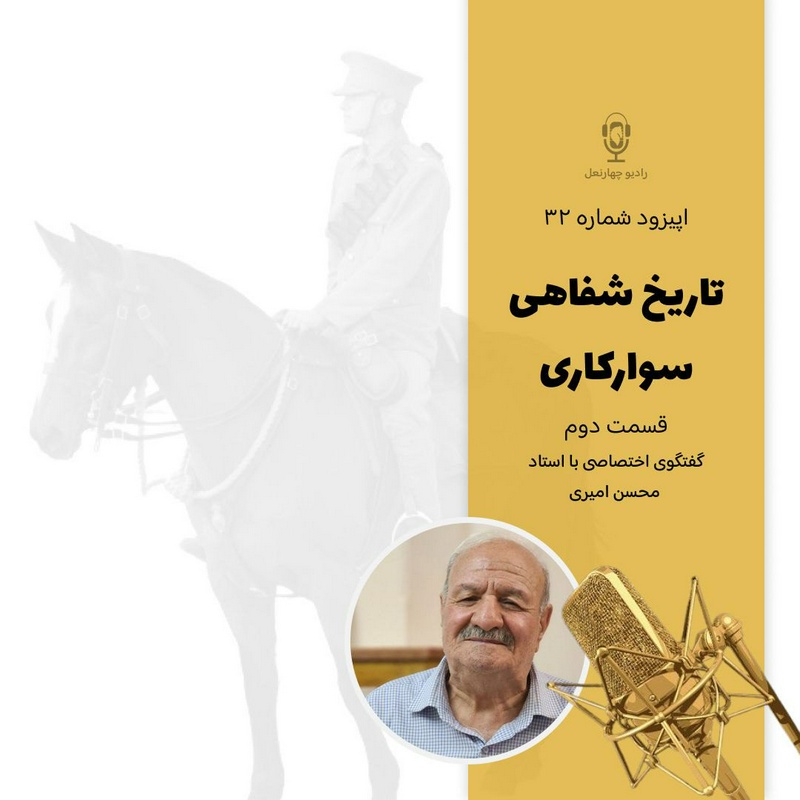
In the thirty-second episode of Radio Chahar Nal, the second part of the conversation with استاد محسن امیری discusses the challenges of coaching and the costs of horse maintenance in clubs. The host emphasizes the necessity of improving the quality of training and reducing costs, calling for closer collaboration with the سوارکاری federation to ensure the future of this sport. In this interview, the memories of an individual rider from the 2500-year celebrations and the challenges of learning to ride, as well as the impact of coaches on his journey, are narrated. عرب شیبانی, after resigning from the army, engaged in horseback riding and worked with other skilled military personnel to train horses and educate riders. These individuals achieved remarkable successes in horseback riding competitions despite the limitations. The interviewee references his experiences in the national championship competitions and the impact of نلبندی on his horse's performance, asking listeners to share these memories with their friends.
نکات کلیدی
- بهبود کیفیت مربیگری با افزایش علم مربیها و همکاری با فدراسیون ضروری است.
- هزینههای نگهداری اسبها تهدیدی برای آینده ورزش سوارکاری محسوب میشود.
- جذب و حفظ افراد در ورزش سوارکاری نیازمند رواداری و حمایت از مالکان است.
- نامهای برای جشنهای ۲۵۰۰ ساله از مجلس به شاه ارسال شد.
- تربیت اسبها نیاز به زمان و تمرین مداوم دارد.
سرفصلها
- بهبود کیفیت مربیگری — راهکارهایی برای افزایش علم مربیها و همکاری با فدراسیون.
- چالشهای نگهداری اسب — بررسی هزینههای نگهداری و تأثیر آن بر مالکیت اسبها.
- جذب افراد به سوارکاری — نقش رواداری و حمایت در جذب و حفظ افراد در این ورزش.
- نامه جشنهای ۲۵۰۰ ساله — شرح مأموریت انتقال نامه از مجلس به شاه در جشنهای ۲۵۰۰ ساله.
- تربیت و تمرین اسبها — اهمیت تمرین مداوم و روشهای تربیت اسبهای جوان.
پرسشهای متداول
چگونه میتوانیم کیفیت مربیگری در باشگاهها را بهبود دهیم؟
تلاش کنید که علم مربیهایتان بیشتر شود و از مربی خبرهتر کمک بگیرید.
چرا هزینههای نگهداری اسبها نگرانکننده است؟
بسیاری از مالکان به دلیل هزینههای نگهداری مجبور به فروش اسبهایشان و خداحافظی با ورزش میشوند.
چگونه میتوانیم افراد بیشتری را به ورزش سوارکاری جذب کنیم؟
به عنوان باشگاهدار و مالک، باید رواداری نشان دهیم و شرایط را برای جذب و حفظ افراد بهتر کنیم.
داستان نامهای که برای جشنهای ۲۵۰۰ ساله بردید چه بود؟
در جشنهای ۲۵۰۰ ساله در شیراز، نامهای از مجلس به شاه ارسال شد که وضعیت پیشرفت کشور را نشان دهد.
چگونه اسبها را تربیت میکردید؟
ما صبحانه را که میخوردیم، روی اسب بودیم و روزانه ۵ تا ۶ ساعت سوار میشدیم و اسبهای جوان را تربیت میکردیم.
متن کامل گفتگو
Hello. I'm glad to be with you for another episode of Radio Chahar Naal. I thank God that I have been able to continue this far with your support.
I have heard positive comments and very good talks from you. Before I explain the thirty-second episode to you, I want to talk for a few minutes about the many messages I have received in the support of the Radio Chahar Naal Telegram channel or Instagram in recent days, and many have complained about two very big issues. The first was about coaching and training in clubs, where many have messaged that our coach has a series of issues and problems and.
We do not have a proper perception or a good feeling for the cost we incur. The next issue is about the maintenance costs of horses both in Tehran and in other cities, which many are worried about, and it practically threatens the future of our sport. Regarding the first issue, I would like to ask you, as a club manager, club president, club owner, whatever title you have, to try to increase the knowledge of your coaches. If you feel that the person working there.
Has an error or a mistake, talk to them. Get help from a more experienced coach to train your children, and if you see that there is no way to progress and change, you can easily write to the Equestrian Federation and request or even introduce that coach and whoever it is to the Federation and write in the explanation that for this reason and these problems, we need more cooperation with the Federation. Now the Federation will certainly follow up, and since I am sure Mr. Kazemian, when he came, he was very.
He listens, hears a lot of words, and tries to improve the conditions. So don't worry that your coach is not good now or hasn't been trained. A part of the talk is also with my colleagues and those who work as coaches in these collections. Anyway, anyone may come to any of us who wants to be a coach tomorrow and wants to work in this field. It is our moral duty to help future coaches be more educated and understanding.
And more technical and professional than us. The principle of coaching and teaching is to help the student become better than himself, and it is very beautiful to leave a legacy of ourselves in this world and practically leave someone from ourselves as a legacy who keeps our name alive. The next issue is about the costs of maintaining horses and club boarding. Many have messaged and many are upset about this issue, and they are right. The upsets.
In reality, we are in a situation where economic problems are around us. Naturally, in economic problems, those who deal with horses are much less than the general public. If we, as club owners, as owners of a collection, and in any position we have, do not show that tolerance from ourselves, we have practically taken the ax and are hitting the root of this sport very hard. Many have the money to buy an initial horse up to certain amounts.
But what worries them is the cost of maintaining horses and boarding. We, as club owners, as owners of a club, as a system manager, have a human duty to be able to attract more people to this system and to be able to keep those who are there. Because in recent years, at least in the last three years, I have personally witnessed a very sharp decline in the maintenance of horses.
And I have seen many owners who, because they cannot pay their horse's expenses, are forced to sell that horse and are forced to say goodbye to this sport with a world of regret. Ultimately, it is the duty of all of us to help attract more people to this sport, and if we do not have this view that equestrian sports should become more public, our community will remain small, and a small community certainly will not have a big market.
Well, the thirty-second episode is the second part of the conversation with Master Mohsen Amiri, which I suggest if you want to hear this part completely, you should first listen to the thirtieth episode because this part continues the talks and the same discussions of the thirtieth episode. I hope you enjoy listening to these fascinating memories, which have become more beautiful thanks to Master Amiri's beautiful and kind tone, and thank you for introducing the episodes to your friends and supporting us. I talked a lot.
I hope to see a better and brighter future for all the people who deal with horses. I am Mohsen Pourheidari, and you are listening to the thirty-second episode of Radio Chahar Naal. Yes, they didn't do it themselves.
Someone would see, and we didn't have work in our course. Correct, our course was almost in 1355, a Timsar Qarabaghi. He was a Turkmen gentleman who had donated a horse. We kept it ourselves, I prepared it, I prepared it, I prepared it, in short, we prepared it so that.
The jumping horses would go around, they would throw it next to these jumping horses. I would go 3 hours, 4 hours, 2 and a half hours every day. Ultimately, I wouldn't go one day a week. That was the thing. The jumping horses were a bit bigger than today. In short, we prepared it, we prepared it, and suddenly they told me that this horse should be taken to Kamand or Gonbad. At that time, Gonbad also.
They had very good fields. Or a foreigner had prepared it, very neatly. Gonbad, which I think you better than the late Farzin Masharraf, a French assistant named Qarqi. His name was Qarqi. I prepared it, I took it to the Gonbad championship, we didn't reach the Gonbad championship. I had prepared a soldier. This soldier wasn't bad, but they took him there.
I saw that these Turkmen kids, this Mamad Tomajo, I don't know, had a son from him, so whenever he rode around this Bandar Turkmen field, this boy would pass by and hit the poor soldier with three or four whips. Yes, one day he told me that this uncle's brother was a colonel, a colonel, the commander of the Gonbad police, Gonbad or Gorga.
This kid wasn't afraid of them because of that. In short, one day I said to Mamad, tell this boy that if this soldier gets whipped, at that time their whips, for example, had a wooden handle, then they would sew the rest of it with leather. If this whip hits this soldier's eye, be careful. Then Mamad laughed a little, and we did this first course with this horse. At that time, Mr. Babak Shaki also came. We were sweating it, he saw.
It had become heavy, he really wanted to ride. We took it to the first race, and it jumped up and down so much that the saddle came on its croup. Considering that with this soldier, it still came fourth. Well done. Yes, next time.
Rahim was there, I said this Rahim who will get on the number later, whatever it is, I'll pay. I was teasing, at that time when they came to Tehran, we used to tease. He said no, I don't know Rahim. I said let him ride, once he rides, he will fall in love with it. Now we only have two more races.
One race, a bad championship in the second race, when he rode, it was 40 meters apart. Later, in the next race, the horse had the first flower of the whole world, it had one flower, it had won the Gonbad championship twice. Later, ready to fall in the championship in Turkmen, fall next to this, fall next to this, I say this horse negatively that it was a hundred and something meters apart from these.
I also went and hit, meaning I hit with a whip, hit with a whip, stuck to the railing so it wouldn't hit, but this damn thing, I had gotten used to it. I always told the soldiers to move a head and neck ahead, so this habit doesn't stay, always go forward. Later this got ready first and this Rah said that my son also went on the championship day, I took this son on the championship day.
You beat him, Muslim, why are you hitting? These went, the same colonel went, they brought the colonel. In short, I said, Mr. Saadi, this nephew of yours is for the sake of the children, don't think that I have from you. Don't make a scandal here. In short, he left and didn't come back, and we reduced the same deduction.
I really reduced it. I heard a memory from you about taking a letter for the 2500-year celebrations and I was very eager to ask you this question. What was the story of this letter in 1350, the 2500-year celebrations in Shiraz? Yes, in Shiraz, Jamshid was set up through the Shah himself.
Everyone participated there. The cavalry with horses, with elephants, with camels, and the letters that had to reach the Shah from Tehran to see how much progress had been made since the Shah came to power and how history had become. They took the letter from the parliament. Now those who were with horses like the former couriers.
Horse letters to Shahram County, let me add something for the Radio Charl audience. During the Achaemenid era, the largest postal system started from there, and the Iranians had the largest letter transfer system that they implemented almost all over, you could say, near China with the same courier system. Yes, you were saying, they gave us a mission to practice the route in three stages. Major General Hossein Zamani was there, Colonel Soratpour was there, Soratpour yes.
Then I was there. We went to the Senate opposite the Military Academy. We took the letter there. There was one letter, and they gave me the letter. Who did you take the letter from? From Prime Minister Sharif Emami. During Sharif Emami, yes. Later, from Tehran to Persepolis itself, they had placed two riders every 12 kilometers so that the horses and riders would change every 12 kilometers. Give this letter to that one, give that letter to that one, give that letter to that one.
Just like that, where to? Persepolis. Later, some of these kids who were designated couldn't do their job. How many people were assigned for this line? Meaning during this period, from this route, a thousand kilometers, every 12 kilometers, two people were designated from the ranks of the army and gendarmerie and so on. They were all military from Isfahan, from Tehran, from Shiraz. But a few of them did this work, they gave up, they said beside the road.
Cars, buses, trucks, etc., will throw us out. I was scared. No, it was really like that. They didn't accept. Mr. Zamani told me, Amir, I said what? He said, as much as you can ride, I can ride 10 people at night instead of 20 people. From here, he said, I don't know. Meaning every 12 kilometers from those who were placed there with a horse, I would ride them. From Tehran, meaning right from Shah Abdol-Azim, from Qom, from Qom.
We went to Isfahan, from Isfahan we went to Persepolis. 47 hours, meaning I was just dancing there from this horse. Meaning maybe 18 to 19 to 18 19 injections, did you inject yourself? Yes, so I wouldn't sleep, wouldn't reduce the route. 47 hours, meaning you reached Persepolis from Shah Abdol-Azim in 47 hours? Yes, Mashallah Mashallah Mashallah.
Later, we gave it to Hossein Zamani and he took the last line forward, Hossein Zamani went up, and in short, some people laughed there. The wife of the same Neshati, they laughed and said they worked hard and ate a mule. That poor guy rode a horse for a thousand kilometers, they took me to Namazi Hotel in Shiraz, I slept for five days, I wouldn't wake up at all. Yes, later.
This is the same way. We did this stage three times. Did you have it before? Yes, once in June, once at the beginning of September, the last one was at the beginning of October when we did this work and the same Persepolis Achaemenid, why was it there. Bravo, well done.
Mr. Salman, did you have any encounters with the late General Mobasheri or not? Yes, for a while, Jalalieh, the product of Shapour Shapour Gholamreza, was in Kalarieh Square. When he wanted to work with the horses, he would get tired, or he couldn't work, he would inform me, I would go and work with him, work with the horses. Hijab means with.
Of course, his sons were also there, Mohammadreza was there, Alireza was there, but they were kids, Gholamreza, Gholamreza, Mohammadreza, they were kids, I would go and work, just like I worked with Mohammad with his horses. He also taught me good riding and his fears. In a way, they were your coach, General Mobasheri, and Vanak was also our coach. What an honor, Vanak was also our coach. While I should say.
We taught students from the gendarmerie to Shiraz University, we played polo. Some days when we found time, the general himself would stand over us. This guy was there for 6 or 7 years. Any problem we had, anything we had, we would go to him in the nervous system. Yes, General Mobasheri, let me say, he had seen several stages of training in France, he was an unparalleled rider, Mr. Mobasheri.
He was also an unparalleled jumper in France. Meaning in front of the Shah, the first Aryamehr Cup in front of the Shah with the horse Heydar Baba. At that time, I think he was 75 or 80 years old. As a thing, the Shah was sitting there in the place. The first person who jumped was this General Mobasheri. An excellent jumper, the best, the best, meaning even in France, he came first several times.
He taught both riding and jumping. Meaning wherever we had a close deficiency, he would guide us. He would say, set the distances like this, set the parkour like this, he was the first coach who worked very professionally with us, he was the one who guided us. Later in 1394, 78, Colonel Neshati came there, Oveysi brought Colonel there.
Of course, after that, he would ride, but still, if we had any work, we would ask him. He was really above all these, really the title of master suits him. Yes, these were a few military people, the same Mr. Mobasheri was there, Mr. was there, Mr. Khalvati was there, Asafi was there, let me tell you.
Arab Sheibani was in the military for a while and then left it. He was in the military until he reached the rank of captain and then resigned and left. Yes, these were Pasha Islam and they were exceptional riders. You have been in Isfahan all these years and it has stayed well in your mind. Now the question I have for you is that since we practically know nothing about Timsar Mobasheri, what is your assessment of this person? That is, if you want to describe this person in terms of personality and as a human model, how would you describe him? Of course, they were military, meaning they had pleasant military behavior or not? Yes, those military regulations did not allow them to deviate from their system in military barracks. They would give orders and any guidance you wanted from them, they would do it without hesitation.
Even if they were at home and someone wanted guidance from them, they would come for coaching with interest. Yes, yes, Mobasheri was truly exceptional. Mobasheri, Colonel Neshati, and Colonel Shaki were truly exceptional in their work. They lacked nothing compared to the trainers in England, France, Germany, and Italy. For example, there was a colonel who had been first in several world army competitions in Italy. They even asked Colonel Neshati questions regarding horses and jumping.
Timsar Mobasheri, Colonel Shaki, Mr. Neshati, and even Khalvati were there. Yes, Khalvati was a bit weaker in this field, but they were truly exceptional in working with horses and training horses and students. Mobasheri was at the top of all of them. Mr. Salman, did you have any shared memories with the late Colonel Shaki or not? Did you have any encounters with him at all? Whenever we had work or needed guidance, we would go to his service. The colonel would come to our club and we would talk, but we didn't have any long-term memories of working together. No, I mean they were close to you. It was close, from Evin to there wasn't a long way. Whenever we wanted, we would go to Colonel Shaki. At that time, Babak, Piran, and Ramin were there and we would go there. You would ride and correct our jumping errors. The Derakeh Hills Club and others, we would go there and pass by Colonel Shaki's club every day. This way, you practically spent a lot of time with horses. Yes, yes, we would have breakfast and be on horseback until lunch. We trained young horses and worked with them to prepare them for the next stage.
We trained students daily and practically rode 5 to 6 hours a day. Very good. Yes, sir, I heard a memory from dear Mahmoud. Mahmoud Khan Amiri Aghazadeh, when your first child was born, I think the family was looking for you. That is, a few days after... do you want to tell it yourself? It seems better this way. Yes, of course, when we were busy working, at that time we were at the 2500-year celebrations. In Mehr, we went from the first of Mehr to deliver a letter and for Persepolis. Our first child was born on the sixth of Mehr at that time. Ahmad Agha, yes, was born on the sixth. It took us about 10 days to return from there, go to our service place, do our work, and deliver them.
We were there day and night. We had to spend 10 days comfortably. Later, one day one of our colleagues came and said where are we? I asked how? He said your wife has given birth and you haven't come for a few days. I didn't know. In short, I came and right at the square they told me Kharghosh-Tareh. Yes, they told me your child is born and your wife is in the hospital. I realized from there and went to her, congratulated her, and brought a bouquet. To you, all those who are the wives of a rider, the reality is that in my opinion, they do not enjoy marital life. That is, the mothers who were our mothers, your mothers, your wives, truly these poor souls do not enjoy their lives. That is, there was no enjoyment from a husband named husband. That is, we are never there. It was really like that. Please.
Life.
I wish I could tell you how much I love your voice, how much I love your lullabies like my childhood, I love your simplicity, I love your tiredness, I love your prayer veil and your whispered prayers.
I wish I could become a mirror and candlestick on the shelf of your heart, become a raindrop in the cloudy field of your eyes, I wish I could sing a lullaby for you in a field of flowers, plant a sky of narcissus and jasmine in the garden of your hands. Sleep so I can count my stars in your eyes.
Stay with me because I love the world with you forever. I leave this voice as a memento because what I said is certainly the shared pain of all those who are somehow connected to the origin. Yes, of course, ours, especially mine, was very sweet. I would get up at five o'clock, go.
To the barracks, believe me, I would come home very early. Where was home at 10 at night, sir? At that time, we went to Vanco every day and came back. With this work schedule and these, it was really hard. I think you had a memory of an Aryamehr Cup regarding the horses that were in the gendarmerie system and you somehow managed to reach these competitions despite the lack of facilities and horses. What was it? Let me hear the rest of this story from your own words.
One day a letter came that they wanted to hold an Aryamehr competition. Later, we were aware of the horses that had been imported from abroad. Alghaniyan had imported some, Alireza Soudavar had imported some, Timsabani had imported horses. About 25 had been imported from France, Italy, or England for this competition. We received a letter that was blocked that you must participate in this competition. At that time, Major General Oveisi was the commander from which organization did they contact you? From the same Farahabad Equestrian Directorate. We replied to this letter and said that our horses with those horses, the horse we have, is at most 1.45, 1.50 in height. It cannot come to the grammar level that those horses jump, to participate.
We asked to be exempted from their team. I was there, Gharib was there, Yousefi was there, Golshani was there, Oveisi. This letter was made and said how do they always come to competitions, they come first, second, third. Now in front of the Shah, a competition is going to be held, Timsar wants to participate, why not participate? In short, Oveisi replied to our letter saying that if you ride a wall, you must go to the competitions from nothing.
If you ride a wall, you must participate. It really became obligatory for us and the issue became an order. The only force from the military participating in that competition was the gendarmerie; that is, no army force participated in that competition. Because when we participated, we were really in need of horses, now it may be foreign.
However, a complete Varamin army group was under the command of Esfarayen Javidan. There were horses that in ancient Baba Frank were horses that were not inferior in height and build to their horses. We were four people who came and participated in the competition. We had a captain named Golsharif Dariush who came and jumped three or four of the obstacles and then changed to go over the obstacle.
There was a small door that came out of it. Because it was the beginning of the competition and everyone was jumping everything for the Shah. Maria was placed and those chubby horses were arranged. Yes, those horses that were bought from abroad and brought were really good horses. Later, this one went over it.
In Paris, it went out. Shahab Oveisi was sitting with the Shah in the stand and they were close to each other. The Shah turned his head like this and said the gendarme went. Later, we were left with three people, Rousfio, Gharib, and me. Three or four people went and jumped. It was my turn. In short, I went and we went through these in the first round without error. All three of you, no, no, Gharib was thrown, Lucif was thrown.
Gharib and I went without error. They were riding the famous Simorgh, no it was Simorgh, Simorgh yes. Then it was Gharib's turn, he hit three obstacles and I also went and jumped. I jumped right in front of the special stand where a wide oxer was placed. My horse couldn't pull over from the other side.
We were beautifully spaced like this in front of the special stand. That is, two finishers, two I do 40 violet one and.
48 or 50 was its height. I went and it stayed hanging up there and I sat and laughed. He said he turned to Atabay and said Kambiz Abolfazl's father said that you gave those expensive horses that height, they rode them, Abolfazl lifted these goats.
The Shah himself to Abolfazl Khan Atabay, not to Kambiz, not to his father. In short, this gentleman got up and went towards the helicopter and they followed this now Ahmad stayed there happily. That is, there was no one from that crowd to breathe. I was also left up there. Now, whatever he does like this, I kick so that it moves. Let me tell you this obstacle falls and I come down with a nice grip, it stayed right there.
He pulled one of the bases and this oxer in short fell apart and at the same time the Shah said to Atabay from those horses you bought and brought, give 4 to the riders of the same horse. Our horses were smaller horses. Yes, he said pour those horses into the gendarmerie forces for 4 hours. In short, my father came and said dear, I said yes sir, he said well, you can't do anything.
Your horse Imaniyeh and such, they jump, you should have apologized from the beginning, everyone was ready in the middle of the manege, you should have apologized and respected His Majesty and went out. We had taken our work a month ago that we had written a letter that now Oveisi had just risen right at the fence, Oveisi was standing there at the fence to see what you were saying. I said that we had taken off our hats a month ago, they can't take those obstacles.
We might be able to jump ourselves, but my horses have the power of a chance. His Majesty said that from these horses, 4 should go to you. Now we are the happiest of all, and tomorrow morning Gharib and I were assigned to go and bring the horses, brother. You and Mr. Gharib were responsible for going and bringing four from the court. Yes, let's go and bring from Faraabad. Yes, we arrived there, Gharib said that I have to ride all of them.
Choose four. Later, at that time, there was a gentleman named Masoud Farhad who was exactly in place of Kambiz Khan, what was it, I think I forgot his name. We went to Preyon, that gentleman said that what the Shah has given, he does not give to his eye, tooth, or body. He said you go from there, 17 of them, whichever you want, well done, Mr. Gharib in short did something.
What Shabrang three-star world, meaning a horse that was in Ezzat's hand, became first three times in the world competitions. Yes, for example, we would take it, no one could say why you are taking this. It was the Shah's own order. But I said Gharib, come on, let's ride, let's go, pick up four hands and take them. Let's go, take the car, don't do anything. He said he was from the north, how did he say, he said ride them all.
We rode and in short, on the third day, we were going there, Mohsen Alipour's father had come there, the guard in Farhad was always saying that he was taken to Vali Asr. He said that no, they rode for two days and went to ride to test from above. Now, whatever saddle they do, he said that he stands at the door, if they say return, if they say no, we will shoot them in the head. Whose order was it, Captain Ayeb, Mohsen Alipour's father, yes.
He said return, return outside, a group was doing what you did, we lost 4 horses. In short, we returned, we came to Vanak, and whatever was planned with Gharib, we did. Three or four people said that.
If the Shah comes here now, standing here, he says I don't know anymore, two people came for three days, they rode every day, our workers, our leaders saddled them, they rode, meaning from 17 to 14, I choose. In short, we stayed there again, you couldn't make any choice, no, Ezzat Shabrang's choice was Rezaei's horse, yes, later it was.
From here we want to take it, no one was there to say no, it was ordered. In short, for a while, we did this and then wrote a letter, it was Oveisi, he had a little courage, for example, he wanted to do something.
Because he was in the same class as the Shah during his student days, we respect Oveisi for a while, but after that Qarabaghi came, the same Qarabaghi who later became the Chief of Staff of the Army, yes, Qarabaghi became. In short, he said what do you want to do, the Shah gave you a horse, you didn't accept it.
We wrote, wrote, wrote, and later, several years later, this was a Shabrang that was ridden, it was German, a very large, rebellious horse, everyone also rode, but this Reza Erdogan was riding, God bless him, yes, whose brother is this, later it was one, these were riding Jahanbani's.
I don't know if you heard or not, there were trainers who came and did something, brought 6 horses here in the competition, all 6 became first, second, third, fourth, and fifth, later it fell into Jamali's hands, they became copies, they gave it to Khosrowdad, and the ground could no longer rise, he let go of these two horses, he let go, he calls to sell them to you, we give it very cheaply because at that time.
The Shah gave you a horse, you didn't get it, these two horses from those 17, in short, I will give you, come and bring two photos of your brother, we went to the competition, you pay money or at that time unless you paid money, you ride, they want to take 60,000 tomans from you for each horse, I will deposit 120,000 tomans into the account.
Farhad Mobarakeh, we went and now at that time the colonel was sitting, he came to work with us. He came to work with us two days a week, Thursdays and Tuesdays. He said, Amir, you get on and ride, maybe these will be fixed. They were not fixed. I say we bought a horse, you know what trouble we are going through now.
It was mine to take these to the Pony Club down here under the supervision of Colonel. After the Javidan gas, he was teaching there. He saw what he wanted to do with them there. We went and rode for a while; in short, this Shabahang belonged to the same.
I gave it to Maniksam, I gave it to a captain named Hossein Davari. We were working. The Colonel was very fond of him. I gave it to him. Suddenly they said that the national champion competition is in Farahabad. Extensive tracking jumping. Take it there. I want to have a horse. We went there, and it was my turn, and I went with a tall Bani.
The height was high from 1 and 35, 40 upwards. I jumped the first obstacle. I said it pulled with interest, did the second. I turned again and jumped the second obstacle. On the third, it collapsed. At that time, it was now two collapses, yes. At that time, I went out and was expelled. Expelled.
During this time, you didn't bring these to the competition once. Now the competitions have become stone arenas, you took them and brought them. At least a couple of times, you could have brought short arena category D, category C, and jumped. Then we wanted to go up, we said okay, we went.
We went, and the Colonel said Amir, I said what because he liked this referee very much, he said come, this Shabahang to Davari, well, it was Thursday, and he hadn't bought it from the number, he said come install Shabahang, give this verse to Davari, I said okay, after all, it's your order. I rode and saw, wow, it's very good, but it didn't have the equipment, we didn't have this heel to come up, we didn't have that much.
Later, we went to a competition, it was category D or C, the same Farahabad, I became first, I became first, second, he said Amir, did you see, I said no, we don't have these, they can't shoe this heel, it doesn't let it walk. The next morning, there was a competition, it was Farahabad.
A foreign guard, two people came, one was Iranian, one was something. I went and saw yes, that God bless him, his son was soft, soft Farahabad yes, we said with Williamson, Amir, I said what, he said that Williamson said to come and shoe your horse together, if there is a problem, the office has it, pass it, bravo, God bless his father.
In short, they shoed it, the next time we went to the competition, how easily it rises, it made a big difference, thank you very much.
Thank you for being with me until the end of this episode, and I hope you enjoyed listening to these beautiful memories. I ask you to send these episodes to your friends and those interested in the essence and equestrianism so that they can also enjoy these talks. Among these talks, there are many instructive words to learn so that they do not remain deprived. I wish you all health and increasing success and hope for better days ahead. I entrust you all to the great God and, as always, take care of your horses.