Ostad Mohsen Amiri
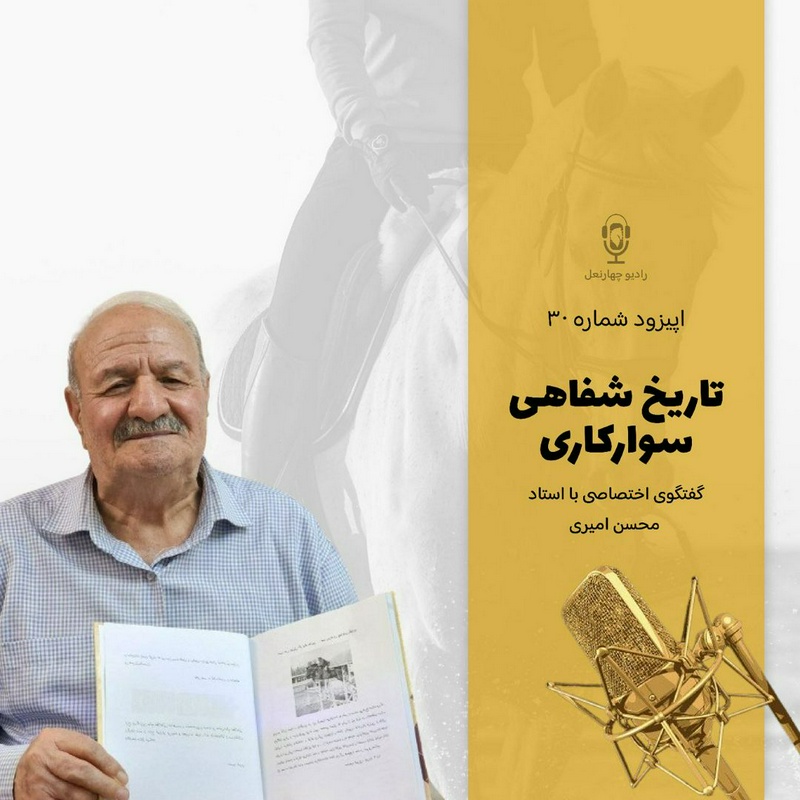
خلاصه
In the thirty-first episode of Radio Charanall, Mohsen Pourheidari talks with Professor Mohsen Amiri, a veteran of equestrianism in Iran. Professor Amiri, referring to his rich experiences in horseback riding, examines the positive and negative impacts of recent discussions in the sports community and emphasizes the importance of focusing on cultural advancement. He mentions the training of riders at the military academy and gendarmerie and discusses the challenges and specific methods of selecting and training horses. He also recalls memories of practices and polo competitions with skilled riders like Mr. Yousefi and Mr. Gharib. Professor Amiri addresses changes in the organization of equestrianism and the preparation of horses for competitions and speaks about the influence of great personalities in this field on his passion for horseback riding. This interview depicts the fascinating world of equestrianism and the valuable experiences of a veteran.
نکات کلیدی
- استاد محسن امیری یکی از بزرگان ورزش سوارکاری در ایران است.
- آغاز فعالیت حرفهای ایشان در سوارکاری از دانشگاه افسری بوده است.
- اسبهای ارتش در سال ۴۶ به ژاندارمری واگذار شدند.
- خاطرات از سوارکاری و مسابقات چوگان در ایران.
- علاقه به سوارکاری هرچند ادامه پیدا نکرد، اما همیشه در خاطر بود.
سرفصلها
- زندگی و خانواده — محسن امیری متولد ۱۳۲۲ و دارای چهار فرزند است.
- آغاز حرفهای سوارکاری — فعالیت حرفهای در سوارکاری از دانشگاه افسری آغاز شد.
- واگذاری اسبهای ارتش — در سال ۴۶، اسبهای ارتش به ژاندارمری منتقل شدند.
- خاطرات و تجربیات سوارکاری — تجربیات و خاطرات از مسابقات سوارکاری و چوگان در ایران.
پرسشهای متداول
شما متولد چه سالی هستید؟
بنده متولد ۱۳۲۲ شهرستان ساوه، شهرستان نوبران به دنیا آمدم.
شما چه سالی ازدواج کردید و چند فرزند دارید؟
۱۳۴۸ ازدواج کردم و دارای چهار فرزند هستم؛ دو پسر و دو دختر.
اولین مواجههتان با اسب چگونه بود؟
بهصورت حرفهای ما همان دانشگاه افسری شروع کردیم و دو ساله که آنجا انجام وظیفه میکردیم.
اولین استادی که به شما سواری آموزش داد چه کسی بود؟
مرحوم شاتری استاد من بودند.
چگونه اسبها را از ارتش به ژاندارمری واگذار کردند؟
در سال ۴۶، همه اسبهای ارتش به ژاندارمری واگذار شدند.
متن کامل گفتگو
Greetings and respect to all you dear listeners of Radio Chaharnal. I am Mohsen Pourheidari, and you are listening to the thirty-first episode of the first season of Radio Chaharnal. The guest of this episode is Professor Mohsen Amiri, or as we know him, Captain Amiri.
He is one of the rightful pioneers and veterans of equestrian sports in Iran and has honored us by being a guest on my program, where you will hear very interesting and pleasant conversations. The thirty-first episode of Radio Chaharnal has undergone some good changes, thanks to the dear Farshid Jahanbazi, who is one of the enthusiastic listeners of the program. Farshid Jahanbazi is originally from Isfahan and currently resides in Australia, and he designed the podcast poster for the thirty-first episode. I wish him health and success.
In recent days, we have once again heard voices and words that unfortunately do not smell good. These talks have never led to progress in the history of this country and have unfortunately caused conflicts, wasted energy, and other marginal issues. Let's help this culture together. Instead of invading people's privacy and personal lives, let's think about how we can define and design a better and more prosperous future for ourselves and our horses. I have a request from you dear listeners of Radio Chaharnal; wherever you hear such news and talks, do not follow those pages, block them, and report them, because if someone has constructive words, they can speak officially with their identity. I won't talk more and invite you to listen to episode 31 of the first season of the radio. In the name of the Creator.
I am very happy to have had the chance again to be in the presence of one of the greatest masters of horses and equestrian in Iran, Captain Mohsen Amiri. Someone whose name you have heard a lot and many of the current great riders of Iran were once his students, and I am lucky to have this chance to sit in front of him and chat with him. Thank you very much for allowing me to disturb you in your home and arrange this program. Many thanks to Mr. Mahmoud. We are at your service. In the name of God, I...
Thank you to Mr. Mohsen Pourheidari for taking the trouble to come to the house, and of course, we are grateful and also send greetings and respect to the viewers and listeners of Radio Chaharnal who hear my voice, thank you, and we are at your service. Please, the service is from us. I thank you again for your kindness and affection. Professor, if you allow me, during the interview, I will call you Captain, as most people know you by the name Captain Amiri. Please tell us what year you were born? I was born in 1322 in the city of Saveh, Nobaran. Can you tell us the day and month? November 1322. May God protect you. Yes, then you said you were born in 1322, where are you from? Saveh, Nobaran.
The Habibi family are also fellow townsmen. They are also from Saveh, Nobaran. Yes, they are from another place. Mr. Davood Bahrami, Baba Davood Bahrami, later Mr. Nour Mohammad Habibi, and a little distance with the Rezakhans, Reza Khan, Reza Ghadiri. Reza Ghadiri and these were almost born in the same area. Of course, Mr. Nour Mohammad Habibi.
They were born in Tehran. They were born in Tehran. I think they were born in the Sar-e Sabz, Akbarabad area because their father worked at the military academy. The closest place to there was the Sar-e Sabz and Akbarabad area. Correct, ma'am. We talked extensively, and I heard a lot from the radio audience. Professor, what year did you get married? I got married in 1348 and have four children; two sons and two daughters. Can you name them?
Yes, my son Ahmad, my daughter Azam, again my younger son Mahmoud, my younger daughter Haghighi. May God protect them. How many children were there in your family? Our family was populous. We were three brothers and had other sisters. Yes, there were many. In a farming family. My father was a farmer. As a result, we followed until the age of 18 there. After 18, we came to Tehran for...
Military service. They accepted us at the military academy to perform our military service duty at that academy. Sir, how was your first encounter with a horse? That is, how did you get to know the horse and feel that you wanted to enter this fascinating and lovely world? Of course, professionally, we started at the same military academy, and for two years we were serving there. After that, they saw that we were interested.
And in this work, we could have progress. They employed us there, registered us, and sent us to the gendarmerie. The former gendarmerie. Did you get divided from the army and enter the cavalry system? Then they divided you and registered you in the gendarmerie. In the year 43, yes, early 43, I registered. We were engaged in the same university. The military academy because...
At that time in Tehran, the gendarmerie did not have a cavalry unit called a rider. We were engaged in the same academy. You were the first people through whom they opened the gendarmerie cavalry unit with you. That same year they opened it, and we were engaged there with about 30 horses given to you from the army. The armored center army.
Because it was being collected, the armored cavalry center was being collected and was going to Shiraz. Some of these horses were given to the Polo Federation in the same academy, and some were given to the gendarmerie where we settled and stayed. We were engaged in work there until the year 44 themselves in Vanak, Vanak barracks. Yes, in the barracks, they made one or two stables, about 40.
One 40 and one 30, about 50 horses were made, and a manege and these were made. The current headquarters of the police command is there. Yes, it still is. Yes, yes. We were engaged in work there and started training horses and started working with horses and from the horses we had taken. Of course, they were horses that were almost aged.
8 years old, 9 years old, which could not be specially trained for jumping, but they were ready for polo. Because the armored cavalry itself had a strong team from the military academy. Yes, Jalalieh. Of course, both the military academy itself had a team, and the armored cavalry team had a strong team such as Mr. Gharib, Yousefi, Golshani, Mohammad Agha Yousefi.
Yousefi, Masihollah Yousefi, then Golshani were in the armored polo center. The military academy team was led by Major Teymourian, Captain Tabatabai, Rafiei, Sergeant, and Mr. Shakeri, the late Shakeri. Yes, yes. They were the armored team. Later, we would take the horses from the academy to Jalalieh, where they would practice.
Again, after the polo practice, we returned to the college. But after that, we went to Vanak and parted ways. Vanak, of course, did not have Persepolis, which was skilled in this work. We hired a few people ourselves, trained them. After that, this armored polo team, because there was no polo field in Shiraz.
They came and requested to join the gendarmerie and serve there. Mr. Dariush Golshani, Mahmoud Soltani, Nasrollah Yousefi, and Fereydoun Gharib separated from the Shiraz armored center and came to the gendarmerie.
Who was the first instructor you had who taught you riding? Whether it was a superior commander or your instructor. I think we started from the same military college. Was the late Shateri your instructor? Yes, he was. Of course, at the same time that the armored unit went to Shiraz, a cavalry from the military college also went to Aghdasieh permanently. Yes, but Dariush quickly.
For example, in the summer their horses went to Aghdasieh and returned in the winter. At that time, they separated and went to Aghdasieh permanently. They made strong horses for a cavalry. They stayed there. While we were at the military university, Mr. Shateri was our instructor. I learned some from him and some, let me tell you, a bit more from Mr. Yousefi and Mr. Gharib. They were ready, but the things we needed.
They taught us; both riding, jumping, and polo. I went for you to get the army horses that they wanted to transfer from the army to the gendarmerie. All the army horses were transferred in 1967. Where? Crime 5, for example, emptying from the university's horses. Yes.
It was emptied. What is its logic? It stayed in Aghdasieh. A cavalry remained for training their students and for their own riding. Of course, the college kept most of the horses there for student training. Later, when they gave the army horses to the gendarmerie, there was hardly any garrison with horses. For example, there was the Wireless Palace, which was called the Palace Garrison, the largest cavalry.
The army was there. Its location was the joint army garrison, now the Zareh-Savar street garrison in Mehrabad. They gave all of these to the gendarmerie. Where were the horses, for example? Imam Qoli, 180 kilometers beyond Mashhad, Birjand. Yes, they gave their horses. We transferred them from there.
We transferred them to Jaldin. Where did we transfer them? West Azerbaijan, Urmia. Yes, later we took them from Manchel to where? Sanandaj. We rode all of them. Yes, yes, West Azerbaijan was given to the same Jackians, meaning a mounted battalion of Jaldin because it was a border strip, it was given completely in the table. Of course, Kermanshah and Sanandaj, because they were border strips themselves, the army.
Kept some for themselves, but the rest of the cavalry had to be given to the gendarmerie. There were only two, one in Varamin and one in Maragheh, East Azerbaijan, for the army to produce horses and mules and, let me tell you, sheep and these in Varamin. Mr. Dr. Ebrahimpour at that time was given to the regional command.
Yes, he was the commander there. Later, whenever we needed horses, we would go and get them from Iran. We would go and get them brand new. When these horses were born, their foals stayed until the age of 4. They were in the desert, free. We would go there, Jalilabad, where there were a few people with very good sizes, meaning any foal they wanted, they would get in exchange for a minute.
We would ride them from Varamin to where? Tehran. You would go to this Jalilabad Varamin. Then they would give you the choice of which horses you wanted or not, they had to give them themselves. Of course, they kept the good horses separate, meaning their pasture or their feet were different. Yes, yes, those they wanted to give us.
For example, they kept them in another paddock and said you choose from these. For example, among 100 foals, we had requested to take 10. What would we do with these? Now some of them we could take, some of them, for example, we would choose, some of them we couldn't take. But those we could take, what would we do with them right there? We would bring them out of that paddock because we couldn't saddle or bridle those foals there.
How did you saddle and bridle them at that speed? Maybe in two hours. No, sir, we would go from Vanak to Jalilabad in the morning. Then we would waste an hour or two there until they would agree to give us horses or not. We would plead there. Then they would agree and say go ahead. Dr. would say to two or three of those in uniform to go and see which horses they choose. Take these and bring them to ride 43 and give them to take.
During the time I was recording the minutes, what would we do? With the help of our soldiers, what would we do? We would make them 10, not 10. Some of them wouldn't even let us ride. We would get on another horse. Then they would bring that horse close to this horse, we would jump from this horse to the one we wouldn't give to the killed. Then at one stage, we moved because it was late, we had to stay between Varamin and Shah-Abdol-Azim at a place called Qal'eh Now.
We stayed there for one night. We stayed there for one night. We couldn't take one of these horses, the foals, out of its mouth and head. We left it there with the same saddle and bridle to rest until 2 a.m. Then we went and took them and rode. Of course, I would help with its riding because it wasn't between. No sir, certainly your imagination of how from the paddock.
You caught the foal, I don't know, I threw a lasso. You saddled and bridled all of this in two hours and set off and took it to Vanak. Yes, then we moved from there and came. The same one horse that wouldn't let us ride there, it wouldn't let us ride here either. The one we rode, one of them, we rode two people. The one that had calmed down a bit. Then one of the kids, the same Rash next to that foal from between the evening and the two people who had ridden, this one stood up.
From here, for example, from here there were two horses. It jumped from these horses onto those horses. What was the name of that person who did this, do you remember? Mr. Ahmadi was a soldier. He was a soldier. He jumped on us and we rode and came to Vanak. Let me tell you, we started working with these for polo and jumping in Vanak. For example, those that were very small for those that had a bit of height.
It was very tall. At most, it was 150. Then how many days did it take, sir, to go from Varamin to Vanak? Some days we went and brought them several times. We had learned some shortcuts. We had learned shortcuts. If we took the stick early that day, we would do it before noon, we would arrive at 12 at night. We would go in the morning and arrive before night. Yes, we would arrive at Vanak by 12 at night.
If it was late, for example, if we finished work at 3 o'clock, or at 4 o'clock, we would stay at Qaleh Now. The animals would eat for about seven or eight hours, and we would rest a bit.
What did you do afterward? Who was the commander of the gendarmerie when we were serving there? The commander was Malek. Lieutenant General Malek. Malek. Yes, yes.
After that year, when we served for a year and a half, first, service came to Vanak. The commander of the gendarmerie became Major General Oveisi. Major General Oveisi became the commander of the gendarmerie. Later, all the sons of the Major General were skilled show jumpers. What was his name? The first name at that time when they went to Colonel Khoda Bi Amorz Neshati to ride. It was very good there.
Mr. Shateri's level at that time when we were weak was at the level of Mr. Shateri and Mr. Alirezaei. Later, the Javidan Guard had very strong ranks, and we competed with them. We were the same boys at that time who trained several horses for polo and jumping. In a year that we had trained, we slowly prepared these horses for jumping and polo.
Yousefi worked, Gharib and Yousefi were very skilled riders and truly masters. In terms of show jumping in Iran, when they were alive, they were truly renowned riders. The same Mr. Gharib and Yousefi perhaps went to 10 countries for polo competitions. Polo was very strong and was part of the national team. Mr. Yousefi was with Mr. Zolfaghari, Amir Hossein Zolfaghari, and Reza Zolfaghari.
Mehdi Zolfaghari was also there. For several years, the national team consisted of these five people. They went to America, Argentina, Pakistan, Morocco, and Jordan. They were present in Pakistan, and later they might have encountered problems with their national team, otherwise, they competed with all countries. Gharib was unparalleled in both jumping and other disciplines.
Do you remember those years when, besides the army, there were private clubs for polo? All were subsidiaries of an organization, meaning the polo competitions were under an organization. At that time, the competitions were held there. The Jalalieh Polo Field was there. Yes, wherever anyone was, all the horses prepared for polo were at the same college. After the military academy, they came to Khargush Dareh.
Then all the polo horses, both private and military, were taken to Khargush Dareh. We were the only ones who rode from Vanak to Khargush Dareh to practice. For example, with the same horse, we played four, then three, then two. We rode again and went. After the horses, you took them from Vanak to the western entrance of Azadi Stadium. How many horses did you take? There were five of us, and each was given two horses.
How many hours were you on the road? Two and a half hours from Vanak to Azadi Stadium. Let me tell you, there was a brigadier named Hossein Zamani who asked why you were doing this? We will give ten horses here and keep them here.
Give the soldiers and others yourself. There is polo three days a week, come here to ride, and sometimes when we had training and students, we would use your horses. They accepted this, and there was a gentleman named Major General Vaziri who was responsible for riding. Of course, his job was something else in terms of management.
And on Fridays, we practiced and went. It was easier. Do you remember the first official competition you participated in, in which discipline? Was it polo or racing? I don't know. Of course, I...
At the same time that we were in the military academy, Mr. Vahid Malekian, maybe your father knows his name very well. Yes, the university was good. Eghbal was there, Takht-e Jamshid was there, Takht-e Soleiman was there, Takht-e Zomorod Rostam was there. These were the names of the horses. We would stretch them. We would ride at night and go behind Yousef Abad. It was a desert there.
A picture of Keshavarz Boulevard upwards, there were two alleys in North Amirabad with housing. Some people were higher up there. A little higher from there was the Ghezel Ghaleh prison. We would ride these horses from there to Jalalieh. From Jalalieh, we would come to Vanak and then return the same way. At 9 o'clock at night, when we were at the college, we would return and come again before morning. I prepared the horses for racing. My riding on these horses had become very good. Once we brought them to Jalalieh for racing. The race was also in Jalalieh. Polo and Jalalieh were there. We held races there. God bless Haj Khoda Gholi, yes, Khoda Gholi Agh, yes, Khoda Gholi Agh would ride. This Takht-e Jamshid was very strong-necked. Initially, its name was Iran, and they said Iran couldn't be, so they changed its name to Jamshid.
It came from the same place we came up to the square, from there it turned towards the military academy. It couldn't hold anymore. The foreign breed horses had very strong necks. Yes, Soleiman was there, it was Pakistani, Eghbal was the same. Later, Takht-e Jamshid, Takht-e Soleiman, and Takht-e Zomorod, I think, were brought from England. This God brought it again next time.
To ride. Two or three curses to a very old age. Meaning maybe when he retired, he was 85, 86 years old. At 86 years old, Mashallah, he wore glasses too. Anyone who wanted to throw him off, he would throw a horse power to the ground with the same age. Mashallah, he would pull the horse and make a beautiful handwriting. In short, the university bend...
Next time they brought Mr. Malekian, God rest his soul, he passed away. Yes, he said, I'm very sorry, excuse me, go to hell, to everyone from smelling to throwing. I don't want it at all. In short, God rest his soul, he said, Amir, what should we do? No one rides. I said I will ride myself. Didn't you ride? I said, you do something. There was one ambulance. God rest Malekian had one Volkswagen. They brought one or two Volkswagen cars. The same route that...
I left it at the military academy there, that it came and reached there. At that time, there was no one less than 1500. Yes, this race was also 2500 meters. It was 400, it was 500. We rode these. In short, with the Turkmens, Abbas Ghafoori was there. Every herd was there. I said, take care of me.
Because I always patrolled myself. I knew where it could go right. With the Volkswagen ambulance, you blocked its way so it wouldn't go towards the academy. They blocked it there. Later, we rode. I pulled it exactly two and a half laps around Jalalieh and dropped it. Whatever it did to come out, exactly below where there was a 300, 400 bend there, in short, I had to move the horses out. I moved there.
We let go of the straight line. It grew so big that with each step, it would pass two horses. It was like that. In short, I really couldn't hold it. It would take and grab. It was really a wonder. Later, Mr. Malekian sent 10, 12 people from the Turkmens and said, whoever goes there, don't let Amir go. That's how I...
From where the first, second, and third horses should have been known. For example, at that time, there was no Daparina, which was a rope. Yes, it was a rope. Most of the time, it was the late Mowgli or Colonel Shaki. At that time, whoever they wanted, they would say, for example, so-and-so, so-and-so, so-and-so, suddenly hatred.
There was a rope there that would happen. Now they pour the same plaster. Yes, we went a bit forward. I was this much. Where did I later pull and pull the late one? I didn't let it go anymore. In short, Mr. Maleki came, may he rest in peace, kissed my face, and so on.
What rank did you achieve? We became first. We went and got 72 first places. Mashallah, he got 72 with a weight. With a weight means when the rider was mounted, they would put about 30, 34, 5 kilos of weight. Each horse would become first. For the next race, they would put weight or have to saddle and so on, some horse irons.
I rode my first course there. We rode the first main race course with the horse Takht-e-Jamshid and became first. Then a question, did you ride with short stirrups or not like the short stirrups of now or not? I didn't have much, so I shortened a bit. Because if I shortened too much, it would shake. Every rider was your own Arshi.
I think it was there that it flourished. Later, Abbas Ghafoori was there. Those I remember, Haj Arya Haj Agha was very good, Abbas Arya's father. Yes, yes, he was. You ran alongside the greats and became first. Yes, then I was just pulling so it wouldn't go. It wasn't like that for me.
That's what happened. The Turkmens went to Mr. Maleki and said that the same heart bride came. When we came from college, a van came. He had a son, may he rest in peace, who passed away. Mohammad Qonqi brought and placed it over these horses. We handed these horses over to him.
After a while, I had gone to Gonbad. Gonbad was not here at that time. The racetrack was on the side of the airport. They built it in 53. Yes, I rode there once too. I don't know how it happened that from these riders and horse owners of Tehran, their horse was there and there was no rider for it. We went to Gonbad, the racetrack was on the side of the airport. At the airport there, I rode a horse. Of course, I didn't get any results there because.
It was the first time I had ridden. The owner requested me to ride. I rode, otherwise I didn't even have my clothes with me. I got clothes from the jockeys of that time. I don't know if it was Gard Sedaghat. He gave a pair of pants and a shirt. At that time, the shirts were not the same color and I don't know whose this is and whose shirt this is and whose number this is. It was just pants, boots, and a hat that one would hit the ground.
So that nothing would happen to his head. Did you have a hat and these things in Jalalieh or not? We gave complete equipment to the late Gard or his son. I put the course aside. I didn't ride anymore. We didn't have it anymore, but you were interested in riding. I was interested. We were busy all day. Yes, we went to play polo three days a week. Three days, four days.
We worked with jumping and so on. We were busy with the training of Iran's horses. We were no longer thinking about falling. Of course, in the air of Vanak, there was also a General Armi, Major General Arm. He had a horse named Taj. Named Taj. The stable was under the care of Ali Akbar Khan Rezaei.
Moghaddam, Shahrokh Moghaddam's uncle, above Hosseinieh Ershad. There was a gentleman named Rahim there. He would prepare it. Later, when this major general was from the gendarmerie, he saw that we came here and the stable and so on, and Amiri, who was preparing Mr. Malekian's horses, told us here that you have to prepare this horse. We would prepare it.
When the Turkmens came, they would take it and give it to the Turkmens.
Thank you very, very much for being with me in this episode, and I hope you enjoyed listening to these talks. The next episode, which we will have with Captain Amiri, will be a continuation of these memories and talks. Have a good day and take care of your horses.