Mahmoud Amiri on learning and coaching
خلاصه
In the twenty-ninth episode of Radio Cheharnal, Mohsen Pourheidari discusses the topic of learning and coaching in equestrianism with Mahmoud Amiri. Amiri emphasizes the importance of training amateur riders and using traditional methods, pointing out the need for appropriate equipment and basic exercises to master the horses. He considers the role of the coach in establishing a positive relationship and trust between the rider and the horse to be vital and stresses the necessity of nurturing riders for success in competitions. Additionally, the economic and cultural challenges in equestrian training and the need for insurance and financial support for coaches and riders have been raised. Amiri mentions the importance of choosing the right coach and patience in the learning process, stating that success in equestrianism requires time and perseverance.
نکات کلیدی
- تولید ۲۸ اپیزود در سال ۱۴۰۲ برای رادیو چهارنعل
- آغاز سوارکاری از سال ۱۳۶۴ زیر نظر پدر و مربیان دیگر
- اهمیت آموزش زیر نظر مربیان باتجربه در سوارکاری
- سوارکاری ولتژ به بهبود نشست سوارکار کمک میکند
- مربیگری باید بر کمک به مردم و یادگیری متمرکز باشد
سرفصلها
- تاریخچه و شروع سوارکاری — بررسی آغاز فعالیتهای سوارکاری محمود امیری و نقش مربیان در این مسیر.
- اهمیت آموزش و مربیگری — نقش مربیان باتجربه در پیشرفت سوارکاران و اهمیت انتخاب مربی مناسب.
- نکات کلیدی برای سوارکاران آماتور — توصیههایی برای سوارکاران مبتدی و اهمیت تمرینات ولتژ.
- چالشهای مربیگری و آموزش — بررسی چالشهای موجود در مربیگری و نیاز به انضباط و تجربه.
پرسشهای متداول
از چه سالی شروع به آموزش سوارکاری کردید؟
من از سال ۱۳۶۴ سواری را در باشگاه ژاندارمری شروع کردم.
چند اپیزود برای رادیو چهارنعل تولید کردهاید؟
در سال ۱۴۰۲، ۲۸ اپیزود برای رادیو چهارنعل تولید کردم.
چرا سوارکاری ولتژ برای سوارکاران آماتور توصیه میشود؟
چون به سوارکار کمک میکند تا نشست بهتری بر روی اسب داشته باشد و ارتباط بهتری با بدن اسب برقرار کند.
چگونه میتوانم یک مربی مناسب برای سوارکاری انتخاب کنم؟
مربی درستی انتخاب کنید و به او زمان بدهید تا برنامهاش را اجرا کند.
چقدر زمان نیاز است تا به یک سوارکار حرفهای تبدیل شوم؟
زمان زیادی لازم است و ممکن است تا ۳۵ سالگی به درک اصلی برسید.
متن کامل گفتگو
Greetings and respect to all you dear listeners of Radio Javan. I am Mohsen Pourheidari, and this is Radio Chaharnal. First of all, I congratulate everyone on the new year and sincerely wish you all progress, health, and peace, hoping for good days ahead. I would like to take a few minutes to explain about Radio Chaharnal in the year 1402 and inform you about past events and the plans for the new year. Thanks to your support, I was able to produce 28 episodes in 1402 with the help of elders, veterans, and equestrian sports instructors. At the beginning, I wasn't very strong, and my content wasn't of high quality, but with the support you friends and dignitaries provided, I tried to produce higher quality content.
I hope God gives me the same energy in the new year to produce higher quality programs for you. In the new year, my effort is to focus more on the provinces, discuss their issues and problems, and convey the concerns of the horse and equestrian community to those who make decisions in this sport. With your help and support, we can create a new culture in this sport and in the field of horses and equestrianism. The year 1402, with all its ups and downs for the horse and equestrian community, also had a positive ending, which was that after nearly two years, the Equestrian Federation got a president and came out from under the umbrella of interim management and uncertainty. As many of you are aware, Mr. Mohammad Kazemian was elected as the president of the Equestrian Federation. I congratulate him and wish him success and progress. The point I need to make to you dear ones is that without the help of each and every one of you, no federation can help the horse and equestrian community. I mean that unless we start with ourselves and want to change and review what we have been doing, our situation will remain the same.
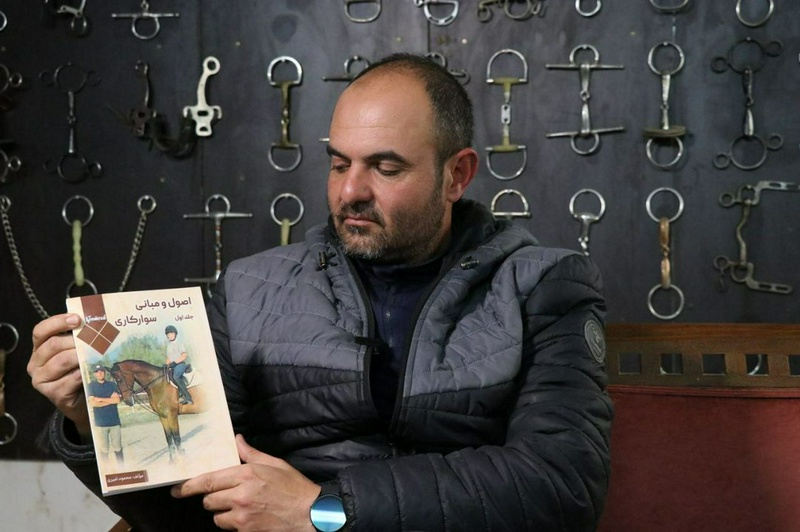
I hope that in the new year we think more and make better decisions so that we can witness the improvement of the horse and equestrian conditions in Iran. Thank you for listening to my words. The twenty-ninth episode of Radio Chaharnal is about the topic of learning and coaching in equestrianism. My guest is the dear Mahmoud Amiri, one of the very technical and very lovable coaches and riders, whom unfortunately we do not see in jumping fields due to physical problems that prevent him from participating in competitions, but he is very technical and knowledgeable as a coach. In this episode, you will hear very interesting talks. Personally, I learned a lot and congratulate dear Mahmoud Amiri on the publication of his book, which is the first chapter of his writings, and he plans to author other topics in the future and present them to the equestrian community.
I won't talk more and invite you to listen to the twenty-ninth episode of Radio Chaharnal and the first episode of the year 1403. In the name of the Creator, following the episodes that revolved around the topic of education with elders and instructors, in this episode, we are in the service of one of, or better to say, the instructors of the equestrian community. Now, maybe age doesn't match the instructors, but in my opinion, he is a master in his work. I am in the service of dear Mahmoud Amiri, the worthy son of Master Mohsen Amiri, one of the elders and beloveds of equestrian sports and truly great and renowned veterans. You gave me time and the honor to be in contact with the radio audience, and another thing is that I congratulate you on the publication of the book, and I announced it on my channel, and I hope those interested will pursue this book. In my opinion, the book is very smooth, and I read a few pages in about half an hour and enjoyed it a lot and even learned. Thank you. I know it has a second series, meaning there are several series. God willing, you will release it soon so that horse enthusiasts can use it and enjoy it. Well, we are at your service. First, I greet you and all the viewers and listeners of the good radio program. I thank you for the effort you put in and for setting up this page and channel, which at least allowed the new generation to hear the oral history of Iranian equestrianism over the past half-century live and raise the awareness of the new generation. You are welcome. Thank you for your kindness. I am at your service. As a friend and clubmate, I worked alongside you. I saw your work closely. Whether with riders or horses, you work very patiently, and I saw how you spend time on the base of riders and even your horses, which is one of the items that everyone who deals with horses should learn. I want to see from what year you started professional equestrian training for horses and riders, meaning how old were you when you started and began teaching? The truth is, from the year 75, I actually started my independent work under my father's supervision at the club where he was active. Meaning, while we had work independence and a responsibility was entrusted to us, we were also checked and supervised. Meaning, if our coach handed us a horse for work or an amateur student to work on, we were under the supervision of that head coach. The one who is actually our boss. We started our educational activities until today. Meaning, in the first seven or eight years of our training, when we were teaching our students or working with horses, we were under the supervision of a coach more experienced than ourselves. It wasn't that our coach, just because we had titles or competitive experiences, would leave us to our own devices.
Now, I had the chance to start work this way. 28 years, 76, 7 I think it was 76, 77. Now, one or two years, I might not remember exactly right now, but I remember that my father, from the age of 15 or 16, actually gave me the authority to work with amateur riders but under his supervision. Meaning, he controlled us. Well, dear Mahmoud, in any case, your father is one of the greats and truly renowned figures in this sport, and I know you started with your father. The process you started under your father's supervision in those years, how was it? Meaning, how were you trained? Did you start from the stable or were you in the manege? I want you to give an explanation so that the radio channel audience knows how your generation grew and came forward to stand here now. Yes, certainly. I started riding in 1364 at the Gendarmerie Club located in Seoul, near the Shaki Club. I started riding there in 64 under my father's supervision and, of course, his senior students at the time like Rakhshan Radpour, the late Farzin Farzaneh, and I think most of his senior students worked with us in the round manege. Meaning, our riding first started from inside the box. Meaning, before we started riding, we had to learn a series of issues about behaviorism, a series of issues about stable management, behaviorism, and...
Tool recognition Before we got close to the core, these explanations were given to us through senior and more experienced students like Mr. Radpour and Mr. Fardanish. In the late 1980s, Mahmoud Makarinejad, Hamid Maqsudi, Majid Maqsudi, and as I remember, Mr. Faramarz Teimouri, the son of the late Teimouri. These individuals, due to their experience, provided basic training to amateur riders under their supervision. Now from cleaning the saddle, the saddle house.
Tool recognition, grooming equipment, stable, horse bedding, the discipline required inside the stable. And since this club was a military club, we automatically had to start working like a soldier. From inside the box, before riding, it had to be groomed by the rider himself, meaning there was no one as a groom to come and do your work. As a rider, you had to go and groom before you rode, receive the saddle and equipment.
And check whether it is healthy or not. After grooming and saddling, we would enter a ring called the round ring, a two-line round ring that actually had two tall and short cement walls, and inside it, we would start the riding line with the Indian saddles of that time and what is now called the Shirazi saddle, and without stirrups for three to six months, depending on who.
Was checking us or standing over us to determine that you could change your ring. Meaning we, as amateur riders, were not allowed to leave the round ring. We were not allowed to be present in a ring where higher-level riders were. We had to be allowed by the head coach to enter higher-level group classes from 3 to 6 months inside the round ring.
Now that higher level at that time was called the upper ring, where higher-ranking riders, meaning the top 10 titles, for example, the 30 ranks at that time, were held three days a week. Many of them were titled, and it was very important for us to participate in their group work. It was a motivation for us, meaning we tried to reach there, we tried to move from the round ring to the higher-level ring for further training. After some time, they would give you stirrups, of course, even inside the round ring at the end of the ride, they would allow us to take stirrups.
But well, usually we would do the exercises without stirrups for more than 3 to 6 months, we would walk, trot without stirrups in a group inside the round. Meaning everything was under control. Then, at the coach's discretion, we could actually go with more professional energy, the program was the same there too. It wasn't that this exercise without stirrups was eliminated. Usually, we had to walk for 25 to 30 minutes at the beginning of the ride without stirrups and do our exercises in the trot without stirrups.
Meaning we had to have reached the level in that round ring where we could do the exercises without stirrups, and usually, 20 to 25 minutes at the end of our ride, they would allow us to take stirrups, that too with that saddle, with those very.
Very excellent. One of the instructors was a good rider, and I didn't have the chance to see it up close, but I heard a lot.
Did you do it in group classes or not? The truth is that even in the public classes that were held, at the end of each session after the riders were warmed up, they would do it, and the horses would also reach that readiness. They would ask us for a series of movements that 90% of the class members were able to perform. Like when, for example, the ride is coming to an end and the work is about to finish, they asked us before we dismounted.
To open the girth, the horse's girth, and in the same riding position, pull the saddle out from under us and place it on the fence next to the ring. It's a difficult task. In riding, this movement is called dismounting in motion. Meaning 10 riders come at a gallop simultaneously, pull their saddles out from under them, and hold them in their hands or on their heads while galloping. This movement is called dismounting, which is usually done at the professional levels at a gallop. They would also ask us for these movements or stand riding or.
Something that riders today use as standing walk or standing trot in their training to better distribute weight on the stirrup and their feet. At that time, it was implemented more intensely on us, called stand riding. Meaning all the riders who were supposed to go for jumping competitions or were interested in polo or wanted to work or participate in cross-country competitions or endurance competitions had to perform all these movements in classes that were conducted in groups. For example, stand riding was one of them.
Where the stirrups were shorter than the race stirrups, meaning the stirrup comes level with the front flap of the saddle. Now recently, the leather stirrups have become very short, but well, it's as if you are standing on the saddle. The name of this movement was stand riding, which was requested from all its riders in group classes or mount dismount. Mount dismount was something that the coach would order while you were walking, meaning you would jump down without stirrups and jump back up. These were among the movements that were requested from all its students. Now more professional movements like double jumping, double-sided jumping, like scissor jumping at a gallop.
Like the movement of laying the horse down, these became very specialized, and those who worked privately with them were asked for these movements. In public classes, we performed stand riding, dismounting, and mount dismount more. How much do you know about the impact of these movements on improving the rider, given your experience? Look, in my opinion, well, we enjoyed it at that time.
Because there was this possibility in that club where, for example, there were 60 horses, that you had the opportunity to perform these exercises on non-sporting horses, meaning there were horses that you had the opportunity to do these exercises on. For example, today, when I buy a horse for $50,000 or buy a domestic horse for, I don't know, 500 million tomans, performing these movements takes the work in a different direction. It's very good for the rider to know these things, but well, performing, for example, mount and dismount, performing, for example, movements.
Exhibition riding requires that you have the facilities for it. At least the main facilities, but it has a very significant impact on the rider. On the rider's control, on creating courage and mutual understanding with the horse, it certainly has an impact and can be positive, but well, performing it requires a series of good facilities. We need to have the horses, our class must have the tools for this type of work. Meaning.
It's certainly good to have a set of basic facilities in this way. After all, equestrianism, or almost now vaulting and equestrianism, is considered an Olympic discipline within the gymnastics family on horseback. Well, if it's considered an Olympic discipline, we're currently at absolute zero. There were some starts, but unfortunately, they weren't supported because I think there wasn't any money in it. That's exactly it, meaning if something didn't generate financially, unfortunately, it was completely canceled.
In one of the episodes, I think it was the second or third episode, I broadcast a conversation from Babak Khan Shakib, who said the best method is for amateur riders to first perform vaulting games or equestrianism, which practically has no stirrups and no hands in front, just two handles, to prepare the rider's seat and emphasized this a lot. I had many quotes from your father and the late Teymouri there, about how much these affect the riding process. You were in those classes, how much do you think this can help train an amateur rider? Because I have experience myself, meaning I started.
I worked in several sessions myself and rode and performed these movements in vaulting games. What is your opinion on this subject and how much can it affect that the amateur rider starts with it and then sits in the equestrian camera? Certainly, Master Babak Khan Shakib's words are a document, and the seat is the essence of riding, and for the rider to reach this good seat, it is better to have more direct contact with the horse's body.
Using the girth or vaulting saddle, which was used a lot in the past, or a girth with two handles installed on it, where the rider sat on a pad or blanket on the horse without a saddle and used the handles of this girth to maintain balance. Certainly, for adhesion and increasing body literacy, this work is very influential. A coach's duty is to increase your body literacy.
The connection with the horse and the first subject of the seat is that the rider's center of gravity and the horse's center of gravity get closer to each other, and this is one of the most correct and accurate methods in classic and modern riding that is emphasized. Were you at the Gendarmerie Club? Yes, we usually had 5 to 10 vaulting girths that were used for equestrian work. But well, I say because it was a club, it was like entering high school and choosing to go there.
Experimental, mathematical, humanistic, or anything else. It was the same there. You had this possibility, meaning even if someone wanted to be interested in racing and had the physical conditions, or was interested in polo, or in desert competitions, or jumping, or dressage, this possibility was provided for them in that club. I don't know, I think you didn't come to the Gendarmerie Club. The Gendarmerie Club was like a museum, meaning you entered this club and as you passed through the stable row, you felt like you had entered a museum. Meaning from those bars that.
Were installed in the wall troughs, 50 in a row, and behind it was the stable. There, the rider had the possibility to perform their activity at the highest level in any field they were interested in. Because well, Turkmen riders also rode there, like Ismail Khojandli and Ghafoor Jamali, who was one of our best jumpers in the 70s and jumped in high-level competitions. A rider who was a face, was a race coach, comes to that club and enters the jumping story, and there were very big competitions.
Now, what I mean is that this vaulting girth or vaulting saddle has a very direct connection for the rider to bring their center of gravity closer to the center of gravity and certainly will have a very positive impact on their future.
I completely explained your program after the classes ended. Usually, every two or three sessions before the class ended, we had to remove the saddles from the horse or the fence.
And after the work was done, again in the same order, we groomed the horse that we received, groomed it again, saddled it. After the class was over, we removed the saddle and washed our equipment with soap, groomed our horse, and handed it over. It wasn't that we just took the saddle and put it at home. By the way, let me say that the saddle house of that club was also like a museum, meaning those racks that were arranged in order, you entered the house and it completely took your grandeur, so beautifully arranged and tidy.
Also, the stables always smelled of soap, meaning they were constantly being washed. The people who worked there, we handed over. We had a person in the house and if your saddle wasn't clean and tidy, they wouldn't accept the saddle and said you had to take it back and wash it with soap. Now, if they saw fit, they would say to oil it afterward, but usually, we washed with soap. The basic principles of your training classes. Yes, also the horses when your work was done and dried, we had the duty to take the horse that was dried.
Into the manege. We had a manege for actually rolling our horses. After the work was done, it was mandatory for us to take the horse into the manege, it would roll, and after it rolled and got completely dusty, we would bring it and tie it in the stable row and start grooming, meaning this was part of the program that this horse had to roll after riding. Now, what mechanism rolling creates and we certainly know they say a horse that has worked a lot, rolls and gets up, its fatigue goes away.
Now, this is one discussion, and another discussion is that we were forced to groom for a longer time because it became dusty and sandy, and when we groomed, and what philosophy it has remained. We didn't know what philosophy it had at that time, later we realized what impact massage and grooming have on blood circulation and other issues. Explain about that rolling, what happens. Yes, what happens from standing on all fours for a very long time. Now in nature, it is moving, less pressure is concentrated on the limbs.
The survival factor in a horse is movement. When we bring horses from the herd and nature into the club, it's a completely artificial environment. Our horses stand in the box for at least 22 hours, and then if things are really good, they are out for two hours. Now, they get a hand walk, a grooming, some work outside the box, and then go back, get the post-work services, and go into the box. When it rolls, the entire 22-hour load is lifted from the hoof.
And his limbs move out, and an indescribable euphoria overwhelms him, which makes him rejuvenate and gain a lot of energy. At that time, they asked us to ensure that this rolling happens after work. One of the reasons why many roll over in the paddock and start kicking and running might be this. Practically a feeling of euphoria. Uncle, the conversations we've had so far were about this.
Depending on the conditions you grew up in, but when you started teaching and saw in yourself that you could be a coach, in the middle of the arena, I want to give a few keywords to the Radio Chahar Naal audience, and now that I'm learning myself, I ask you what is important for starting a beginner rider. Now, many coaches might hear your voice, as well as many instructors and many who are interested or currently working in the system, to determine if they are standing in the right place. This is the most important issue that I think we are very involved with, many who enter the riding system.
That initial coach plays a god-like role. I want it to be such that people can think about whether I am receiving the right training now or hearing irrelevant talk. What is your mindset model for training an amateur rider? Before answering your question, I want to say a few sentences that have always been engraved in my mind and should be mentioned. I remember my father telling me that in a country like England in the 80s and 90s, the salaries.
Three groups had a blank signed check, meaning they proposed this plan in England that the salaries of judges, pilots, and teacher coaches should be a blank signed check at the end of each month, so they could write whatever they needed in it. This first topic has an economic aspect because education is a very complex and, in my opinion, challenging issue. I will follow this topic later, its connection to education, the next issue being that.
Because I started riding at a club where the working method at that time, my perception was that the working model was Michel Robert's model, meaning riding with the use of the least tools and auxiliary equipment. We progressed based on that, and around the years 76 and 77, my coach determined that I could gradually start teaching. When we started teaching well.
Many young or teenage riders really want to teach more amateur riders and do it with motivation, even though they might make mistakes, but those who want to be coaches like this. Regarding the word coach, in my opinion, the conceptual definition of a coach differs from that of a teacher and an instructor. The root of the word coach comes from 'Rab,' meaning God, someone who is a creator, someone who nurtures something.
As a teacher, I can go to class and present a series of topics, and you, as a student, can learn and memorize or not, but when you are working as a coach, you must see the fruit of your work practically, not on paper, not in words, meaning you must be able to nurture a rider. A raw human is handed to you, and you are supposed to make a rider out of them. Now, that rider can be active in different disciplines. When I started my work under the supervision of a coach, the coaching and teaching work was much more in the first three or four years.
There were a series of excitements, for example, to make my riders stronger day by day, more prepared, more coordinated. After three or four years, when we were able to enter some of our riders into competitions, winning the competition became very important, but this winning and the name of the competition can hinder a rider's real progress. A golden point was mentioned, meaning that I would like to go to a competition with the interest that when I go to a competition, I go to win; no one goes to a competition to lose. This winning spirit.
And the greed for competition keeps you away from the reality of riding; you might not be able to understand the horse, the issues related to the mental connection between the horse and the rider, you might never be able to think about them, meaning you don't have the time for it. After three or four years, I came to the conclusion that if I want my riders to become more professional, have a more professional perspective, and have a correct understanding of the horse and riding story, I designed the program in such a way that I would build this foundation so strong.
That I feel this rider is going to make a name in this field in the future, meaning become a coach or a trainer or a professional longeur or engage in professional activity in a field. When I started working with my students, I taught them in such a way that they could later transfer it, meaning I conveyed all the points very clearly and transparently so that they could transfer it to the next person in the future. Now, how successful I was or not will be determined later. The next issue is that.
To start a rider's work, before approaching the horse, I don't want to boast about education or present something in a slogan-like manner, but in the book I wrote, all these issues are there, meaning a rider must know horse behavior before approaching the essence, meaning at least verbally, meaning if they haven't been in the club, if they haven't been in the main environment, the coach's duty is to explain behaviorism to the rider, how they view their surrounding environment.
Now, saying what the natural body temperature of a horse is, what its heart rate per minute is, what its breathing rate is, what the size of its heart is, what the size of its brain volume is, how the horse's vision is, the density of cone cells in its eyes, how it sees colors, that's great, but at least they should say that the horse in nature is a creature that is hunted and its first means of defense is to flee, meaning you must know how to approach to start your work, whether you want to team, ride, mount, sync, do veterinary work, nursing, anything.
I start with behaviorism, then tool knowledge, then how to approach the horse and mount, and the rider's positioning on the horse. To explain briefly, at first, you don't bring in someone to say, "Sir, saddle this horse, let the worker come, ride, sit on the horse, and go." 99% of the time, I went through all these stages, meaning starting with behaviorism. Now, I don't know if it's wrong or right, but I start with behaviorism, then tool knowledge to the extent that the rider needs.
I'm not going to explain about دو گاگ or types of آبخوری or هاکامو or whatever تدمان رنگکولان. Just enough for them to know some tools. You do a few theoretical sessions, half a session, half a session, in the first session you take a theory and then I almost eliminate it because we live in a country where everyone is in a hurry, everyone is stressed, everyone says me first, me first. This is a problem, whether it's identity, personality, cultural, or whatever, I don't know, but well, when you explain to the rider that in a country.
Which is the equestrian pole of the world, now it's no longer unipolar, the number of countries that have become equestrian poles has increased in Europe, you have to walk for a year, then go for three years, then they test you, if your center of gravity has approached the horse's center of gravity, they allow you to gallop. The person leaves and doesn't stay at all, meaning even the FBI itself went in a direction to make training a bit simpler, but we've taken it a bit too far. For example, let me tell you an interesting example, the word مسیج means message, for a while we used to say SMS, now even that's shortened to اس بده yes.
Nima: We practically Iranianize everything, and this is a problem that exists. Well, I myself really liked to always have a theoretical class at the beginning, but I see that riders don't pay for these things. I mean, they only see the money in exchange for sitting up there, meaning riding. That, for example, I come and explain to them for half an hour about equipment and سوم and I don't know about approaching, they practically don't see this training, and this is a big problem, yes unfortunately.
Mahmoud: In your talks, you mentioned a quote from your father about a blank check for three classes, then you said you want to bring it to a point, and your talk seemed incomplete to me. Continuing your conversation, that when a rider comes to register and you put a theoretical class for them, they return and say well.
I have to pay for these theoretical matters. This relates to that, meaning when you are a good graphic designer, when you are a good programmer, when you are a good translator, you have to pay for the work you do for me. Either I have to pay for it or spend 10 years to become a good graphic designer. Unfortunately, the economy and the equestrian field are directly related. Never mind that we had many people who loved horses and riding who spent years, years of their lives.
After the revolution, well before the revolution I wasn't there, but after the revolution in the 60s when there was war, many coaches practically sacrificed their families, their trips to keep their horses. My father gave ten from the pension in the 60s, during the war until 67, when hay was not available, when barley was not available. Therefore, our economy and the equestrian field, talking about our field, are directly related. There was a time when if you were very good yourself, you could achieve results with an ordinary horse. As we moved forward, we reached a point where you have to be very good and have a very good horse and work very well to get results. Well, this progress has been there, but well, this very subject makes the relationship between the economy and this sport more direct and closer. That's why I said, meaning you have to have financial capability to be able to implement your thoughts and what's in your mind.
Provide and arrange its facilities for yourself. Part of the reason for that example was this discussion. I talked about the country's champion owners with some kids in episode 10, and one point that I reached over the years, now you say in this article, I say we practically ruin our signature, and that's just because of the margin, meaning not having financial security. This is also to be able to change and keep my student, I'm forced to give him unnecessary praise, I'm forced to step on teachings and take him to a place earlier than his time, which is not his place at all, not belonging to that point, at least at that time and many other issues. And practically we, for example, from the camera's point of view, they are well off, coaches practically but in my opinion, considering the effort and hardship and what we endure during work, we really don't have any income. As the most basic, a very simple insurance that I haven't seen yet a rider, a coach, someone whose job is this, who has put their life into this work, from that club or from.
A reference to be insured. Now someone has given it to him, insured him, someone has self-employed insurance. We have this base while we should have a special insurance because we are doing a special risk but well practically it has no value for anyone and in my opinion clubs should come and design a process to insure your coaches. How whenever you want you raise the pension, if for example five coaches in a club now that for example the right of two million tomans becomes 10 million tomans, a club for example now I won't name, 10 million tomans figure insures its five to ten coaches.
In my opinion, it's not, meaning your horse expenses are laughable. It's completely true yes not having financial security has brought us to this day that we become a shorter-term society. In principle, exactly if I tell you in the morning that you are the decision-maker for the equestrian education system in this country.
What do you do so that in the long run no no now in whatever goal you set yourself, in general what process do you take forward to achieve better progress. It's a very difficult job and a very complex job but before that let me explain that in my opinion being a coach a big part of it is innate. Meaning you can tell from 200 meters away from the way they walk, from the way they dress, from the way they talk.
You can understand that you have to understand that this is a coach. Meaning the type of movement, the type of behavior, the type of speech, the type of clothing all of these are involved in it. In my opinion because I think for coaching you have to be strict, not a little, a lot. Because when the name of a level 4 coach is even on me, I find a responsibility towards it that responsibility.
Creates a series of educational authorities for me. Therefore, you have to be very strict even for level 4. Something that I think has been done for many years, I don't know why we don't follow this way of issuing certificates. Now if a coaching certificate is to be issued for those who are qualified or have been in that space, meaning they had a good space.
In professional environments, they have worked for years, snow and rain have fallen on their heads, and they have endured physical and mental pressures. This means a coach must have emerged from these tough conditions. Now, for a few years, indoor arenas have been built, coaches are indoors in summer and winter, but until the early 90s, you could feel nature in this work. A coach had to stand in minus 10 degrees, minus 15 degrees in the middle of the arena, working with students. It means experiencing the hardest conditions when movement happens, feeling the heat.
They should have worked alongside a qualified coach, with at least 10 years of sports experience and 5 years of assisting a coach, and no matter how strict you are with a coach, it doesn't harm the equestrian community. You might find complaints, but you will see better results in the future. My main point is that it should be very strict. If I want to ask you a little faster, how do you define that difficulty? For example, now someone in charge says, "Sir, we want to issue a coaching certificate, what items do you consider?" I want to know your mindset. Well, see someone who has lived with horses. Now, I had the chance to be born into an equestrian family. Let's assume that all our professionals were in clubs from a young age and started riding professionally. After 25, 30 years of work in this field, you can tell by looking at someone who wants to approach a horse, wants to lead a horse, wants to put a head collar on a horse.
Wants to bandage or saddle the horse or ride, you realize whether this person has gone through those stages or not. As an expert who is supposed to test coaching from qualified individuals, you understand this, and it's not complicated. You know yourself, a rider who comes to take a coaching test, it's quite clear. The way they approach the horse, prepare it, and move is not a complicated diagnosis, meaning I might.
You or other kids, everyone responsible for this matter, can tell what's going on with a 30-second glance. There's no need for someone to explain to them that I could, they didn't let me, or I was qualified, they didn't allow me, or such issues. But many, like Masoud and Maziar, and Faramarz, and now elders like Hossein Agha Fekri, have had many of these challenges.
They protested a lot, I even know they went to court over this issue, asking why they were rejected. But still, some are protesting, meaning how can it be done so that they don't protest, meaning they know they are not qualified, and they should go themselves. When Mr. Masoud Makarinejad, Mr. Maziar Jamshid, Mr. Faramarz Bab-al-Hawaij, Mr. Fekri are responsible for the education committee and holding coaching classes or exams, the federation must support them, meaning it should say I am behind you. Anyone who has any objections for any reason is not dealing with you, they are dealing with us.
Why should Masoud Makari go to court? You, the federation, are the party involved. Has the federation supported these four or five people? In your opinion, no, the words of these four are a document. Meaning if Mahmoud Amiri goes there and Maziar Jamshid or Masoud rejects him, they have rejected him, they are right. When the words of these four are a document, no one has the right to protest. Meaning there must be such strict laws in place, and the federation should truly support these individuals, saying don't worry, I am behind you, which has never been the case in any era. Not even these.
The fee they received compared to that activity. You know these were people who were passionate, they sacrificed their time, their work. Their income, let me say very clearly and simply. These gentlemen, when they were outside their clubs for training, for exams, their position in the club was definitely undermined. In the club where they worked, meaning the person was passionate about this work, went to register a few people, approve them, take exams, teach them a couple of things. In their club, for example, rest assured I have seen this, we have many such problems.
In recent years, as the internet speed in Iran has increased a bit and phones have become smart, we are witnessing something in the equestrian system called online education. Yes, now because I know you don't have Instagram, you might not be very familiar with it, but I definitely know you've seen it and heard a lot about it. Yes.
Some people come and teach a series of things online, saying you should do it this way, do that, and now some people in various parts of Iran unfortunately don't have good hands-on coaches and professional clubs due to wrong policies and are away from education, and because we don't have a reference to say this reference is now approved by the federation or now an organization like the Ministry of Education or now anything, the Ministry of Sports, I don't know, they have started online education and consequently a series of educational centers. Meaning we now have a university, meaning we have a university major called equestrian coaching.
How many branches do you think it has? Where does this lead us, or does it ultimately become effective, efficient, fruitful or not? Yes, because when you first brought this up, I laughed. About online education, I really laughed, I couldn't control my laughter, and this is my response. Meaning this smile that ends in laughter is that online education through whom and how.
And in what way it happens is a very important topic, and since our riding population has always been limited, now there are many more kids who work professionally, but generally in education or the coaching topic, it is defined in such a way that if you want to become a good coach one day, assuming you started riding at the age of 5, at the age of 35, they call you a mature rider, meaning you are a mature rider, not yet a coach. Now that some people are doing online education.
I don't have a page on Instagram, but they have shown me these online educations, mostly it's funny. Meaning it's not what they say, and a lot of planning needs to be done to prevent these events, or we or those in the education committee must definitely be so active that they properly inform people who have horses or want to start riding newly, to know what the right way is and not cause harm to themselves and their horses and.
...something happens to them. Regarding the university, the truth is, if I'm not mistaken, yes, at the beginning of the University of Applied Science alongside Mr. Faramarz Mohajer, Ms. Mohammadi contacted me saying there is such an opportunity, if you want, you can come here for training, Ms. Misha, yes, Ms. Misha Mohammadi, to be active, I followed the matter for a week and couldn't understand what is announced at a university that.
You can enter the university without an entrance exam, and after 4 years, we will give you equestrian coaching along with a bachelor's degree. I think the coaching was level two, this was announced, and well, the university attracted students this way to support its financial issues. In my opinion, this is not a wrong move, but it started from the wrong place, meaning the University of Applied Science started in the middle, not from the base. Someone who comes to the University of Applied Science to study horses.
Later, its advertising turned into horse breeding coaching, and the coach must also have a riding diploma, meaning that university or federation that allows the issuance of such certificates to the University of Applied Science must provide conditions for enthusiasts to enter farms and riding clubs much earlier. Alongside theoretical courses, they should also pass practical lessons. After obtaining a riding diploma, which is definitely.
A more basic level, they should enter the university, and in my opinion, I explained it, but I think it's a dream, more like a dream for us to issue a valid riding diploma and then they continue in university to classify it and turn it into now getting a bachelor's degree in riding or a coaching certificate. It can be implemented correctly, but well, it's very difficult for us, it's not possible. The certificate is important, unfortunately, for 90% it's important. The importance of the certificate means that.
Many young people are interested in having a certificate, meaning they might never use it. Do you think that by having a bachelor's degree in horse coaching, a person becomes a coach and rider? Many students came to us for internships or similar thesis projects and were scattered in various clubs. At the University of Applied Science, they were asked to work in a club for, say, 100 hours or 18 hours under a coach's supervision. When they came to the club to complete their sports internship, we realized that the situation was very bad. Even after they get their bachelor's degree, they can't get close to the main subject. Some students who were riders and went to the University of Applied Science had a completely different situation. They were riders and in good conditions, so working in the club was easier for them. But someone who has never seen a horse in their life and enters the university without an entrance exam to get a bachelor's degree, ultimately...
Or a coaching certificate is very problematic. A question that might confuse many enthusiasts is what is the criterion for choosing a coach? A wrong culture that unfortunately I have witnessed in recent years is that a coach is referred to as someone who gets results in the field, has become a rider and national champion, or has won a cup. Not to say they are bad coaches, but for the general public, choosing a coach is based on the positions they have achieved in competitions or their name in the ranking. The federation, in my opinion, has performed very weakly in this area, and our coaches have not been ranked. It's not clear what level they are if we want to choose a coach. We discussed this topic in detail in an episode we had with Masoud Nejad. Now, as a professional, if we want to tell the audience what the criteria for choosing a coach are, what would you say? The criterion for choosing a coach is that...
A coach, when he is still a field rider himself, has a positive point. The student likes his coach to compete and see him win and be seen more through that. This is a psychological issue that relates to the student's personality. The student likes his coach to be a champion or have experience in big competitions. This is not a bad thing, but...
When I, as a coach, have to participate in competitions or put more energy into myself as a competitive rider, I need to focus more. Either on my students or riders or horses that have not yet reached that level of competition. Therefore, if I want to be a competitive coach, I need to have a coach for myself. Meaning I become a coach who gets a coach for myself.
The rule is that even if you are a high-level coach, when you want to participate in high-level competitions, you must have a coach yourself. Therefore, being a field champion coach can be both a positive and a negative point for his student. That I can't spend all my energy and focus on you as a student. The same energy that I transfer to you as my student, if I am supposed to compete myself, someone must give it to me. Now, at any level, it doesn't mean if coaches for any reason don't have the conditions to participate in competitions, they are bad coaches or good coaches. Meaning I can't say because I don't compete and only coach, I'm good. No, I can not compete and coach and be good and vice versa. This depends a lot on the conditions and has many parameters.
But it's better for the coach to put more energy into the student. The student will definitely progress better. This is my opinion, and I don't think coaches who are constantly in competitions throughout the week have a different opinion. Meaning a coach who is in competition two or three days a week is actually not there for two or three days, probably a day before and after there are some issues before and after the competition. Conditions become a bit difficult for the coach himself. In my opinion, this...
Seeing the work efficiency of a coach, let me give an example about this topic. After we went through level 3 coaching classes and a PHS course under the federation in the 80s, the education committee decided that for those who have obtained their level three certificate and had efficiency in their coaching, meaning they have introduced good horses or riders...
They have introduced a series of phenomena, meaning they have added new people to this system to hold international classes for them. The same FEI classes, for example, in the first or second course I participated in, I was the only coach who was not present in the competitions and only worked with students and horses and was selected. Yes, I remember riding there and was very happy that the educational committee at the time, I think Masoud Makkari was there at that time, had seen that someone like Mahmoud Amiri, who could not continue his competitions for physical reasons, was active. Meaning he is achieving results in teaching and coaching. He is getting field results, successful field results, bringing young riders to national and provincial first places. What do I know, riders who are unknown, meaning people who are not recognized, and there it was very pleasing for me that the educational committee at the time...
Paid attention to the fact that among 14 people, 13 had field presence in competitions and I did not. I was not competing at that time and was invited to FEI classes under the supervision of a Greek instructor. I remember that instructor, who is now a close friend of mine, said a very golden sentence. He said when you want to coach, be on the ground, not on the horse. Yes, yes. I saw this very little in the kids. Meaning generally, there is little time and these engagements.
That a rider who now jumps from the field and competes wants to stand below his obstacle, meaning stand below the horse and conduct his class, generally that happens on the horse. He emphasized to all of you that if you want to coach, stand on the ground, not on the horse. Work a lot on the mental system of the rider you are watching. Of course, he had another sentence. The first session of the class, in the coaching classes, the first question he asked in our class was...
What is the duty of a coach? His first question was this. Then everyone was looking to give a technical or tactical answer, but the answer to that question was: help people. Meaning someone who has come to give you an international certificate, the first thing he raises is: help people. The first duty of a coach. Let me quote Mohammadreza Shabanali. Now this person generally teaches in the field of management. I really like him, he says the teacher's job is always simplification and I personally see this very little in the kids, meaning generally.
I am one of them. Those who consider the use of pompous terms as a kind of class. Sir, for example, you must now go to leg yielding or I don't know, terms that an amateur rider practically might not understand. But well, this simplification also seems to me to have a very positive effect on teaching the amateur rider. Following our talks and in response to the question of whether a good coach necessarily has to participate in competitions alongside coaching, I believe a good coach is a good coach even in a wheelchair.
Now if a coach for any reason such as aging, physical decline, or physical injuries cannot participate in competitions but has a complete understanding of how to transfer techniques and skills to the rider, he can do this even in a wheelchair. Therefore, this is a sentence I believe in: a good coach is a good coach even in a wheelchair.
Well, dear Mahmoud, I have benefited a lot so far. To sum up this conversation and the final word to the audience. Yes, following your talks about educational simplification.
In my opinion, a professional person in any sports field, now we are talking about our field which is somewhat different from all other fields, in addition to humans, we are also dealing with another living creature called a horse. A professional person is someone who explains very difficult tasks simply, whether practically or theoretically. Meaning he simplifies it so much for someone who has the conditions, explains it so simply that the person who is supposed to come into that flow and execute it.
At least mentally, he does not become unstable, does not think I am not cut out for this. Bravo that usually the opposite has happened. In past decades, our education was usually based on discouragement rather than learning. What does it mean? It means I want to start teaching with you, my educational basis is that I start with discouragement, I discourage you instead of having a learning aspect for you. In fact, now you are.
I take away the confidence, the confidence of the rider now at any level. Whereas in those FBI classes, our instructor constantly emphasized to us that when you want to tell a rider's flaw, first look even if there was no positive point in him, find a positive point, tell him and encourage him so that his ears open. After his ears open, tell him his flaw.
Did you understand? So our education should not be based on discouragement, it should be based on learning. Even the questions that are designed for these exams, whether theoretical or applied science or now this technical vocational story or coaching classes, in my opinion, the questions should be designed in such a way that the person who wants to take the exam, these questions also have a learning aspect for him. Now because we are talking about it, I should mention this. In this book I wrote for those who are interested, whether in.
Technical vocational, or applied science, or those who want to pursue riding professionally, I designed 400 questions. At the end of the book, the person who reads these questions, in addition to answering them very fluidly and smoothly, the previous question gives you a code about the next question. Meaning the questions are designed in such a way that as you read these questions, you learn a lot of things. Meaning you don't have to think much about what the answer to this question is. If you have read the previous questions, you answer the next question. This talk that I think.
It was necessary to say that our education is often based on discouragement rather than learning. Following your talk about this, our class instructor taught me a very golden point. The person turned to me and said that if you are going to teach someone something, you must first learn the way to penetrate their mind. And well, I said what's the way? He said you must first learn to make the person laugh so that he accepts you, his acceptance increases in front of you, not that he resists. He told me a very golden point. Meaning.
From then on, my entire learning and teaching process completely changed, and it had a very good impact on my students at least, that first, the gentleman should laugh. That is, he told me another point. He said, work in such a way that even if he comes to the club and doesn't ride, he should come to see you and feel good with you as a coach. And I really tried this, now I don't know if I achieved it or not. I really can't say it myself, but he said a very golden point about this topic. That's right, and here I want to tell the audience that I got a promise from Mr. Mahmoud that if God willing, God helps, his book.
We will also produce it in the form of an audiobook and if deemed appropriate, make it available to the general public, now at a lower price. Now I read the price of the book. The book is very complete and organized. I enjoyed reading it myself. Thank you for taking your time, hosting, and this interview was conducted at the Eagle Equestrian Club where you work, and the kids around who worked hard to provide these conditions. If you have nothing to say, we will say goodbye. Thank you for your time and.
This beautiful work you are doing for Iranian equestrian. Be healthy. It was very necessary, in my opinion, I also wanted to say a point to complete our final talk and in continuation of the final sentence, my talk is with riders who are just starting to pursue this field professionally or are moving from the amateur section to the semi-professional section. Assuming that I, as an amateur or semi-professional rider, have chosen a coach. Assuming that I have chosen a correct coach.
Achieving results in this field requires time, patience, tolerance, and trust. Mutual trust between coach and student. Because this sport is one that takes some time to reach the necessary coordination and skills. I recommend that if you have chosen the right coach, give that coach time. Allow him to execute the program he has designed in his mind for you and your horse.
Do not put pressure on your coach due to pressures or incorrect competitions, which would cause him to put pressure on you or your horse and work with stress. This will cause your horse or yourself to get injured. And the next point that riders should pay attention to, those who have just entered this field, is that.
This sport is a time-consuming sport. I think I have mentioned before that if you start riding at the age of 5, at the age of 35 in reputable and stylistic countries, you are considered a mature rider. That is, a lot of time is needed for me to reach the main understanding and the necessary techniques and skills to become a professional jumper or dressage rider, and now other disciplines, a lot of time is needed. Therefore, riders should try to, instead of erasing the problem and rushing and changing the coach or changing the club, before giving enough time to their coach.
All of these, in my opinion, are mistakes, and qualified coaches should be given enough time to achieve the desired results. You have spent time and really enjoyed it. God willing, wherever you are, be healthy. Thank you and bless you. I also thank you and say goodbye to all the followers of the Radio Channel program. Goodbye, hoping to see you again.
Thank you for being with me until this part of the episode and listening to my and Mahmoud Amiri's talks. I hope you enjoyed listening to these talks and found them informative. With the comments you leave for me, you help me create better programs for you. I am infinitely grateful for introducing the radio to your friends, and again I pray for you to have a very blessed year full of health and happiness. Until the next episode, I entrust you all to the great God. Take care of your horses.