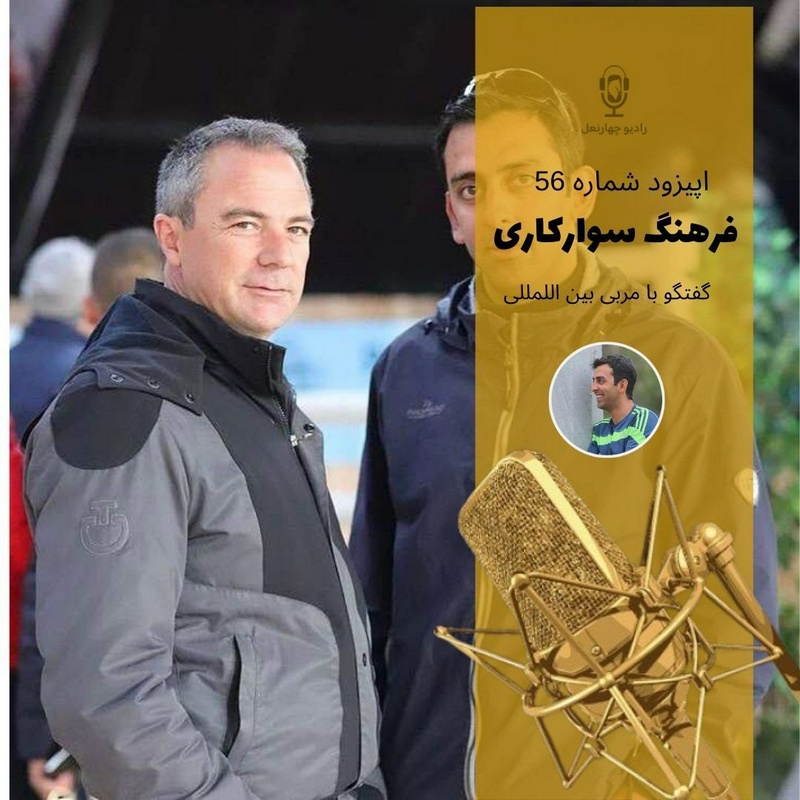
Stavros Georgopoulos, international trainer from Greece
خلاصه
In the fifty-sixth episode of Radio Chaharnal, the host discusses the state of equestrianism outside of Iran and its customs with Stauros Georgopoulos, an international equestrian coach from Greece. Stauros, with over 40 years of experience, emphasizes the importance of equestrian culture and the necessity of creating a suitable educational system. He points out the need to teach the basics of riding and train young horses, stressing that riders and trainers must achieve higher levels with an open mind and sufficient time in riding schools. Choosing suitable and experienced horses for amateur riders is also of special importance. Additionally, Stauros emphasizes the need to create a suitable environment and proper nutrition for raising champion horses and reforming the educational culture of equestrianism to improve the quality of the sport in the future. Finally, he highlights the importance of the fundamentals of riding and groundwork as a foundation for progress in this field.
نکات کلیدی
- استاپلوس مربی حرفهای سوارکاری با ۴۰ سال تجربه است.
- او در آتن یونان باشگاه دارد و به آموزش سوارکاران میپردازد.
- فرهنگ سوارکاری و سیستم آموزشی در ایران نیاز به بهبود دارد.
- یادگیری اصول اولیه سوارکاری نیاز به زمان و تمرین دارد.
- محیط مناسب و خوراک خوب برای رشد اسبها ضروری است.
سرفصلها
- تجربه و سابقه استاپلوس — استاپلوس با ۴۰ سال تجربه در سوارکاری و مربیگری در سطح بینالمللی فعالیت میکند.
- فرهنگ سوارکاری در ایران — بررسی وضعیت سوارکاری در ایران و نیاز به بهبود فرهنگ و سیستم آموزشی.
- اهمیت آموزش و محیط مناسب — نقش آموزش اصولی و محیط مناسب در تربیت سوارکاران و رشد اسبها.
پرسشهای متداول
استاپلوس چه مدت است که سوارکاری میکند؟
تقریباً ۴۰ سال است که سوارکاری میکنم.
استاپلوس در کجا مربیگری میکند؟
او مربی حرفهای سطح سه FEI است و باشگاه خود را در آتن یونان دارد.
استاپلوس نظرش درباره سوارکاری در ایران چیست؟
او معتقد است که سوارکارهای خوبی در ایران وجود دارند، اما فرهنگ سوارکاری و سیستم آموزشی نیاز به بهبود دارد.
چقدر زمان برای یادگیری اصول اولیه سوارکاری لازم است؟
حداقل دو تا سه سال زمان لازم است تا اصول اولیه سوارکاری یاد گرفته شود.
آیا سوارکاران آماتور نیاز به اسبهای با تجربه دارند؟
بله، سوارکاران آماتور حتماً نیاز به اسبهای با تجربه دارند.
متن کامل گفتگو
Greetings and respect to all dear listeners of the radio. I hope everyone is feeling as fresh as spring and having a good time.
I am here with the fifty-sixth episode of Radio Chahar Naal, and I am grateful to have the opportunity to be with you for another episode. In the fifty-sixth episode, I decided to gradually have conversations and interactions with friends I have outside of Iran to understand how equestrianism is progressing abroad, learn about their customs, cultures, rules, and many other things. For this reason, I decided to...
Talk to one of my friends who is a level 3 international coach. As you know, the coaching levels in the international system are reversed; 1, 2, 3, and 3 is the highest coaching degree in the FEI, which Staplos George Plos from Greece holds. He has traveled to Iran several times and participated in jumping competitions. He has been an FEI instructor and has held clinics here several times through one of my friends, which I personally think, having attended the classes, he is a technical and skilled individual.
For this reason, I decided to have a friendly conversation with him and share this conversation with you. I apologize in advance because I really don't have the facilities for phone recording, as the equipment is very expensive and available in specific places, and I couldn't provide these conditions. I apologize for the low sound quality during the conversation and hope that one day conditions will be provided to record these conversations better and with higher quality for you. I hope these talks will be informative for you and that you enjoy listening to them. If...
You would like to send it to others so that they can also learn and benefit from these talks. As always, to support Radio Chahar Naal, I will leave a link in the description of this episode. By clicking on that link, you can connect to a payment gateway and help Radio Chahar Naal as much as your generosity allows for its survival and progress. My colleagues in this episode, dear Farshid Jahanbazi, kindly translated Staplos' talks, and as always, the poster designer...
The Instagram cover and also the poster of the Radio Chahar Naal episode are Mrs. Negin Goodarzi and Erfan Moghaddam as the composers of Radio Chahar Naal are my colleagues in the fifty-sixth episode. I won't take more of your time and invite you to stay with me until the end of the episode.
My first question to Staplos was to ask him to introduce himself and tell us about his equestrian background.
Hello everyone. I have been riding for almost 40 years and have been an equestrian coach for about 20-something years. I started riding many years ago and am currently a professional level three FEI coach and also an FEI educational coach.
I travel almost all over the world, meet new coaches, and teach them how to become better riders, how to have better horses, and how to take their training and practice to another level. Currently, I have my own club in Athens, Greece, where I have my students annually and teach them, and I also try to continue riding as much as I can and also try to compete and participate in competitions. Personally...
Well, actually, I have been working worldwide for years in coaching and horse training. I have ridden in the UK, the Netherlands, and also Germany. The best part of my work was in 2004, when I was training with Luke in Germany before the Olympic Games. Actually, I was born in a riding club.
My father started his riding club many years ago, around 1971, and I was born in 1976 in the same place, and you could say that I have spent my entire life in the riding club. Currently, my sister and I jointly run our own club, where my sister is a dressage coach, and I am a jumping coach, and we run our current riding club together. I asked if you are still the national team coach of Slovenia or not.
Estonia, sorry. No, actually, I was never in Slovenia but in Estonia, but I haven't been there for years and am in my current place. My question to Staplos was that you have come to Iran several times and seen the conditions of horse work and our training and education model. Please, without any formality...
Describe us and explain how you evaluated us as a professional rider.
Well, if I want to talk about the past times, when I was in Iran, I saw a lot of riding there. There were very good horses there, and there were amazing riders at a very good level. But what was lacking was the equestrian culture.
Because, as you know, equestrianism is not just about the horse and the rider. In this sport, we need excellent veterinarians, good farriers at a professional level, very good coaches, and very good horses, and all of these need to be together. Well, at that time, there were quite a few of these shortages. I think now this situation has gradually improved, of course from what I've heard, because I haven't been there for a long time. I hope that in the future, the level of equestrianism in Iran will improve more and more.
But certainly, you need help in this area to learn the basics of riding and horse training. What is very important is to create an educational system for horses and young riders. From the very basic level, learn how a horse is trained and how it is brought to a higher level. This is a big deficiency because, based on what I've heard, I realized that there is still no knowledge of how we can train a young horse and gradually bring it to higher levels.
This way, you understand the horse much better than just buying a ready horse and entering it in competitions. Because you know what happens. I will tell you a story now. I remember that in the past in Iran, very good horses were bought. Horses at the Olympic level, at a very high level, with incredible scores and levels, and when they came to Iran, after a while, we saw that their level dropped significantly because the training was not correct, and the horses easily got out of their rhythm. In fact, you need higher quality training.
And this is only possible when you know how to develop a young horse, meaning a 4 or 5-year-old horse, to gradually bring it to the Grand Prix level. This way, you learn how to establish the basic principles and how to maintain those principles, which is much more important than teaching them. In my opinion, this is the duty of all of us in the equestrian community. My question was about your talk on building a proper and principled system...
Regarding the training of young horses and also amateur and young riders, whose responsibility is it? Should federations do this, or should a specific organization handle it, or is it the personal duty of each rider, and anyone interested should learn and pursue it themselves and strive for their growth?
Well, based on experience, I wanted to tell you a point that has always been my motto: all riders and trainers at all levels should have an open mind. It doesn't matter if you are a very good trainer or an average trainer; there is always something to learn for everyone. So first, you must enter this world with an open mind, and second, waiting for someone else never yields good results; you must strive yourself and try to reach higher levels and find and test different methods. Observe new riders, learn from them, analyze what they are doing. This matter is not dependent on the federation or specific individuals; it is personal for each individual, and you can have your personal plan and constantly strive to learn and.
Encouraging others to learn the basic principles of riding, everyone should personally try to learn as much as possible, and when everyone does this, the equestrian community will take its best form. I asked Master Rooz what the basic principles of working with an amateur rider are.
As far as I know, the important issue is the basic principles in riding.
First of all, every young rider should start from a riding school where they can learn the basic principles. How to control the horse, how to have the correct seat, and so on. Riders should not rush into professional sports and competitions. They should spend a long time riding in riding schools.
How much time is needed for this? I cannot give an exact answer; it depends on many things. It depends on the rider, their learning rate and talent, the balance they achieve in training. Balance and equilibrium are very important. The amount of practice they do during the week and, very importantly, the correct physical condition of the rider and the correct seat they can have on the horse and accurately learn the correct position of the horse and have proper control over the horse.
After that, the young rider can start thinking about entering professional sports and competing. Well, as I said, it is very important for young riders to spend a lot of time in riding school to learn correctly from the start and then enter the sport. How long it takes depends on the rider's age, physical condition, talent, number of training sessions per week, and many other things. So it cannot be said exactly how long or how many years it takes, maybe two years, maybe three years, or even five years. But what I know from experience is that they need at least two to three years to learn the basic principles of riding. What type of horses to use for amateur riders or so-called classic horses.
Amateur riders definitely need experienced horses, and everyone knows this. But the most important thing in choosing a horse for an amateur rider is the good mentality of that horse. That the horse can help the rider and, most importantly, be safe. A horse that is at least seven years old or even older. The older the horse, the better the learning process for both the horse and the rider, and if it has more experience, it is good.
For our amateur rider, it is much more suitable. My other question was whether you also train the horses you use for classes and whether they have weekly training or not?
Well, to be honest, we try to train the horses a little daily. But it depends on how many hours they work with them during the week. Because these horses work a lot, and of course, we try to keep them in their proper form. Sometimes with circle work or very light riding to keep their muscles soft and ready so that amateur riders can use them more easily and both can have more correct and smooth training.
I asked Master Rooz about the importance of dressage for horses and riders and what your daily program on the ground and groundwork and dressage with your horses is like.
Well, let me explain a little more to the listeners about the importance of dressage and groundwork. In fact, we try to train our horses and riders every day to improve on groundwork. Even if they are doing dressage or want to jump, it doesn't matter. Their groundwork must be done correctly. Correct groundwork is beneficial for both.
Therefore, my opinion is that every day, groundwork and dressage and its importance should be worked on and emphasized. And well, depending on the rider's interest in the field they are in, if they want to become a dressage rider or a jumper, well, then they can choose their path. But before choosing a path, they must be very careful to fully learn the basic principles of riding or dressage and then continue their specialty with full confidence.
Well, I believe that riders should spend a lot of time learning the basic principles of riding or dressage and groundwork and then move on to more professional training. And well, if they are in this stage and in this so-called path where they fully learn the basic principles and then enter their profession, the path becomes much smoother and easier for them. I asked Master Plus to explain more about horse production and share his expert opinions with us.
Regarding horse breeding, I don't exactly know where the problem is or if there is a problem at all, because it's not my specialty. But breeding.
I can say that it is a completely different and incredibly specialized field. Unfortunately, I don't know much about breeding, but I do know that horses need an exceptional environment to become champion horses and good horses. For their growth, it is necessary that especially in the early months of their lives, they have excellent feed and, so to speak, good forage available to them and are well cared for. Therefore, it is very important that horses grow up in a suitable environment and are in pastures and paddocks.
So that in the end, I can become an incredibly professional and good horse. I think a very important point is that horses should start their initial training when they are young, and this work should be done by specialists. You have to work on the training scale, and this is very important, and when you start working with young horses, it is very important to keep this training scale in mind. The first stage of training in the early years of horse training is very important because horses learn very quickly.
And they develop their learning. Therefore, there must be someone there who can teach the horse the right work in a specialized way, how to use its muscles, how to use its limbs, so that ultimately it can become an incredibly good horse with high performance. At the end of my talk, I asked Sarus to give us some advice as a professional so that we can use those talks for our growth and progress.
It is.
The system but I think the most important thing and the important part of the work is the basic training of equestrianism and.
Training equestrianism to horses and riders, and this system must be established, and this equestrian culture and educational culture must be established because there is no point in bringing a top coach to your country to teach you 150 riders or 150 jumping when you have very few people in the 110 classes. So, well, what's the point of bringing a top coach to work on class 50?
In fact, you have to reform the educational culture to train your young and amateur riders, advance their dressage work and ground work with great focus, and build a very good foundation of your riders, and based on that, you can develop much better riders in the future. Well, in fact, what I see in Iran after 10 years is the same good athletes and riders.
They come back to the fields, and well, what you have to do is focus on training new riders to bring more new riders into this sport, who even perform better than the old riders and jump with their horses because ultimately this sport is evolving, horses are evolving. Therefore, you need to have a larger base of riders who can get better and better day by day, and the next generation will be better than them.
This is our goal as an equestrian community, and in my opinion, this is the most important point that every coach and every member of the equestrian community should pay attention to and know its importance. Well, yes, I was very happy to talk to you again. I hope that.
I have given you useful answers and made a small contribution, and in the end, I want to say that the most important point is the importance of the basics of equestrianism and ground work, which should be the main focus of training, and well, the equestrian community should move in this direction and invest heavily in ground work and the basic principles of equestrianism. Thank you very much, goodbye. Well, I hope you enjoyed listening to these talks.
I apologize again for the poor sound quality of Stabus. I hope you overlook my mistake. Consider it due to my lack of facilities. Thank you for staying with me until the end, and as always, take care of your horses.