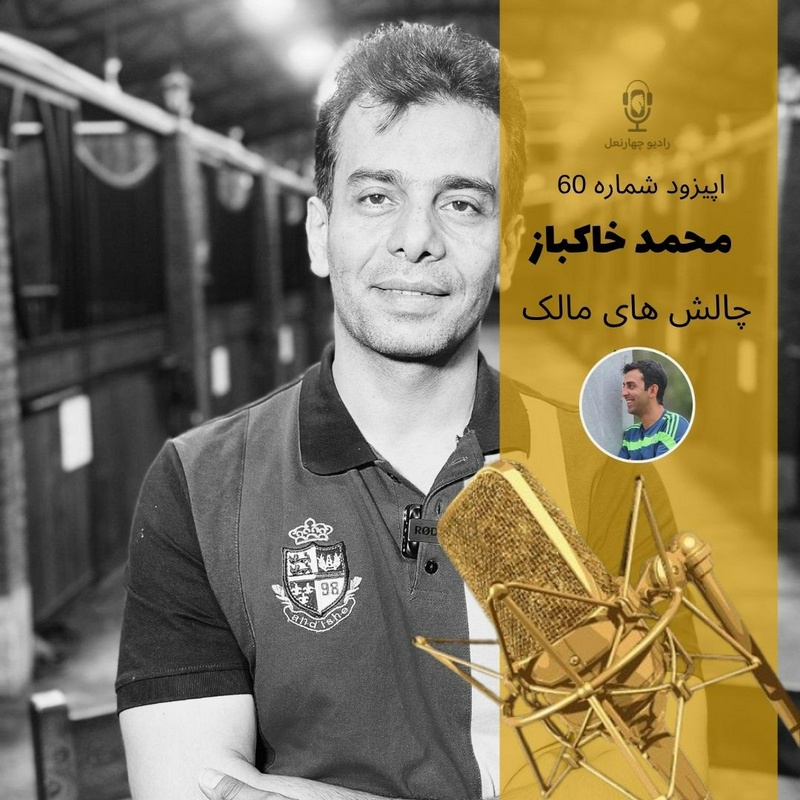
Mohammad Khakbaz, owner of the horse and club
خلاصه
In the sixtieth episode of Radio Chahar Nal, Mohammad Khakbaz, the owner of the club and rider, discussed the challenges of equestrianism in the counties and the importance of supporting Iranian brands, such as Timaj shoes. He spoke about his experiences in riding and the cultural issues present in the sport, emphasizing the need to create appropriate infrastructure for young riders. Khakbaz mentioned his frustrations in club management and the high costs of maintaining horses, calling for more attention from the federation to hold training classes and competitions in various regions. He also stressed the necessity of empathy and cooperation among members of the equestrian community to solve existing problems and urged listeners to share their opinions and ideas for improving the state of equestrianism. His hope for producing champion riders in Qom province reflects his love and commitment to this sport.
نکات کلیدی
- حمایت از برندهای ایرانی مانند تیماج ضروری است.
- محمد خاکباز از سال ۸۸ به اسبداری پرداخته و باشگاه مهراسب را تأسیس کرده است.
- نگهداری صحیح از اسبها و حفظ استانداردهای بالا در باشگاه اهمیت دارد.
- پیشنهاد برگزاری کلینیکهای آموزشی در شهرستانها برای بهبود وضعیت سوارکاری.
- مشکلات سوارکاری با همدلی و گفتگو حل میشود.
سرفصلها
- معرفی محمد خاکباز — نگاهی به سابقه و تجربههای محمد خاکباز در زمینه اسبداری و تأسیس باشگاه مهراسب.
- مزایای کفشهای تیماج — بررسی کیفیت و راحتی کفشهای تیماج و مقایسه با نمونههای خارجی.
- چالشهای سوارکاری در شهرستانها — مشکلات نگهداری اسبها و کمبود امکانات آموزشی و مسابقاتی در شهرستانها.
- راهکارهای بهبود وضعیت سوارکاری — پیشنهاداتی برای برگزاری کلینیکهای آموزشی و افزایش همدلی در جامعه سوارکاری.
پرسشهای متداول
تیماج چه مزایایی دارد؟
کیفیت و طراحی کفشها و راحتی آنها که با نمونههای خارجی قابل قیاس نیستند.
چگونه میتوان کفشهای تیماج را خرید؟
از طریق صفحه اینستاگرامشان سفارش دهید و در خانه تحویل بگیرید.
محمد خاکباز چه زمانی به اسبداری پرداخت؟
از سال ۸۸ اسبدار شده و با یک مادیون کره والنتینو شروع کرده است.
چرا نگهداری از اسبها در شهرستانها مشکل است؟
در شهرستانها هیچ حمایتی از لحاظ برگزاری کلاسهای آموزشی و مسابقات کشوری نمیشود.
پیشنهاد شما برای بهبود وضعیت سوارکاری چیست؟
فدراسیون باید از قهرمانان بخواهد که کلینیکهایی در شهرستانها برگزار کنند.
متن کامل گفتگو
Hello, as you all know, what I do on Radio Chahar Naal is support Iranian brands. Iranian brands strive hard to survive and certainly need the support and attention of all of us. The sponsor of this episode of Radio Chahar Naal is the shoe brand Timaj. Timaj is a brand that imports all the raw materials for its shoes from Turkey and produces incredibly stylish, durable, and comfortable shoes with Iranian art and craftsmanship.
One of the biggest advantages of Timaj, which I am a regular customer of, is the quality and design of the shoes, as well as their comfort, which honestly cannot be compared to foreign samples. We just forget that we are Iranian and our gaze is always outward. But many brands like Timaj have offered very good work in the market with precision and quality over the past few years. I will leave the link to their Instagram page in the description of this episode for you. You can easily order from their page and have it delivered to your home. If you feel there is a size issue or need to return, they support you easily and you can exchange your shoes. Their shop address is Argentina Square, Africa Shopping Center, No. 16, and you can also shop in person.
Greetings and respect to all you good listeners of the radio. Thank you for being with me so far, and I have reached 60 episodes, which is a great achievement for me that would not have been possible without your kindness and support. My guest on this episode is a horse owner and a club owner. Mohammad Khakbaz from Qom province is a professional horse owner and also owns a professional club called Mehrasb in Qom province. We came to the conclusion during a friendly conversation that we should record these talks and broadcast them as an episode for you dear ones.
We talked extensively about the issues and challenges that equestrians face in the towns, and I hope these talks help us find better solutions and help ourselves to progress and support the next generation that unfortunately is not seen. As always, to support Radio Chahar Naal, I will leave a link in the description of this episode for you. By clicking on that link, you can connect to a payment gateway and help Radio Chahar Naal as much as your generosity allows for the survival and advancement of the radio. My colleagues in this episode are dear Farshid Jahanbazi, as always, the designer of the Instagram cover poster and the Radio Chahar episode poster, and Ms. Negin Goodarzi and Erfan Moghadam as the composers of Radio Chahar Naal are my colleagues in episode 6.
Enjoy. I won't talk more and invite you to listen to the sixtieth episode. Hello, thank you for giving me this time and being a guest on the program as a horse owner and a club owner. Thank you very much. Greetings to you. I am truly grateful for the time you have given me, and I am very happy to talk with Radio Chahar Naal.
As a small member of this equestrian community, let's have a chat and remember Majid Hossein-Nejad, who we finally work together with. Yes, it was a coincidence. Yeah, yeah, I really didn't have a plan. But since at least 2008, if I'm not mistaken, I've been commuting to Tehran for a while. I'd like you to briefly tell us where you started and how you got here. Please. I have been a horse owner since about 2009.
I became a horse owner. I wasn't very professional before, but since 2009, I became a horse owner. I started with a Valentino mare. I really had it in a club here for about seven or eight months, but I wanted to progress. I wanted to do this sport professionally. I mean, I wanted to have the potential. Yeah, I mean, if I.
In my life, if I do something, I want it to be the best. If, for example, one day I came to this point to build a club, I wanted to have a really good club. When I started, we didn't have many coaches in Qom. I did a search. At that time, I didn't know anyone, and it was really a coincidence, which is very interesting. I went to a competition in Farmanara for the first time. I sat in Farmanara and watched. Then I asked one of the guys.
I am from Qom, I want to come to Tehran to ride with someone, and the distance is very important to me because I am in production and the factory and so on. The distance I wanted to travel from Qom to Tehran was very important to me. I didn't know anyone. I really didn't know the professional equestrian world at all. Then someone told me that the nearest club is at the end of Saveh Road. I said, well, who do you know? He said that Jam Club is close to Mr. Jamshid Khanani Maziar, yes.
Then, in short, through Mr. Amini, I had his number, Mohsen Mojtaba, Mohsen Mojtaba, I told the guys I have such a goal to go to Tehran to ride. I really want to learn riding the right way. Nothing else, now it's getting long, the talk is long, but this part is very important. I really happened to meet Mr. Jamshidkhani and I was very happy at that time that I went to a place where I think equestrianism finally themselves.
They were Colonel's students, and everything was principled from the ground up, I mean, really, the first good coach plays a very important role. It's the most important thing. Now, by chance, this happened to me by chance, which made things very easy for me. I was there for a few years. I changed a few horses and worked. Well, the conditions were a bit difficult for me because in my production work, I had to leave here every day at.
Four or five in the afternoon to go to Jam Club, ride two or three horses there. When I came back, it was really 12 or 1 at night, and then I had to get up early in the morning again. I did this for about four or five years. I did it two or three days a week. I went and came. My weekends were competitions. Again, this made me realize that it was really hard to go and come this route. I went back to Yazd, kept two horses in Jam, brought them here to Chabok Club with Mr. Tayebi, but the reality is that.
The conditions for keeping the horses were not ideal for me. This made me think about starting a club. Well, my goal was really to use it myself and also to be useful for my city, for the equestrian kids to progress together. I felt that if the conditions and infrastructure were good, it would be good for everyone. High commitment was required. Exactly, because the cost for the club and land and buying and these things you did.
Well, now I'll explain to you that along the way, things happened that made me think many times that I made a mistake. With the money I spent, I could have bought high-class horses. At that time, with the money I spent here, I could have bought five or six 145 cm horses, and this would have had a greater impact on my riding than running a club and these stories. Now, regarding construction, since I had built elsewhere before, I wasn't bothered by this issue. But later events made me really doubt what I did in many places and I became disappointed. What were the disappointments that came to me? Look, the reality is that you know better yourself. At the beginning of the work here, you lived with us and worked hard for us for a year. You really got us out of the mud at that time. We weren't professional in this work and didn't know many things. We owe the maintenance of many stable management issues and other things to you. You really know this club, you could almost say I used very high standards. You, in terms of stable space, ceiling height, air exit, ventilation, stable width, wash bay beauty, in every way you can say. Now, on the days when there were big competitions here, for example, big coaches from Tehran came, all the feedback was that everything was almost flawless but had high standards, and my thought was that a club with such facilities would be very well received. At least that the kids in my city would welcome it. Now, of course, the costs of such stables are higher than ordinary stables, but with that small difference, I thought it would be more welcomed. In the early days, many people said things that upset me. For example, they said that now the stable is beautiful, it doesn't mean anything, or many things that you know yourself. These made a person not have the heart and soul. In this economic situation where I am in production and business, I saw that I made many moves that made strange progress. I'm not happy about them because our economy is really not right. I'm not saying that work is right, but I did it with love, at least I could have made better investments elsewhere. I did it before. It's a famous example among us Iranians, or I would have bought dollars that have now increased tenfold. But this event made me upset in many places. You were aware of the board and these stories we had. Well, my expectation was that I didn't want anything special. At least from our equestrian board, I wanted us to hold more competitions here. After all, the arena has better standards, obstacles, practice obstacles, horse maintenance, and I wasn't collaborated with. I never understood the reason. That a person really did this work with motivation and what benefit it had for them, now what was the reason that this support wasn't there, is really a question for me. Those disappointments were there. Let me tell you that we came forward. The club got a little better, got busier, the receptions increased, but I still have the same problems right now as we are talking. I don't know if I have high expectations or if my view is professional. Even though I say I am really a small member of this community and don't have much experience, maybe a total of 15-16 years. But I believe that if everyone in every job has a professional view, meaning everyone does their job in the best way. As a club owner, it's my duty to take care of the horses in the best way. Meaning I have built a complex and I say to the guard, after all, we are using this animal and our view shouldn't be instrumental. It becomes a member of our family. After a while, we become attached to them. Exactly, you know sometimes we, for example, with a horse, even if we don't get results, it's hard for us to sell it. It's like, for example, for a child. Exactly. But I feel we have a cultural problem in the whole sports discussion. Now, in this sport, before that, I also did martial arts. I did martial arts for eight-nine years. There were the same problems there, the model was different. Exactly our cultural problem. Now, because I went to several cities, now for every job I looked at, in the riding system, this issue affects everyone. Whether it's the club owner, the coach, or the board. You know, I think we need to come to terms with ourselves somewhere about where we are going and how we are going to move forward. If we want to put these resources we have, this energy and this motivation in the direction of now going head-to-head with each other, constantly struggling, constantly going into margins, here a lot of very small children's share is wasted. I hope for their presence, I hope for their future, it really gets lost and we waste a lot of huge resources, the most important of which is their time and energy. In the end, it's like you can say like many club owners, I rent, I ride in Tehran. Unfortunately, it has happened. Sorry to interrupt, this happened a lot. Meaning, for example, someone came to me and said I rent all the stables. I never, even now that I am talking to you, this is really a county. You know that our boarding must be very cautious. We really don't take even half of the boarding of Tehran clubs so that everyone can. But the wheel here turns with difficulty. Meaning our balance is always negative and if I don't inject here from somewhere else, this cycle doesn't turn. Well, there have been many times when many people came and offered to rent the whole club and offered a very significant amount. But I was never satisfied to do this because I knew they would come and skimp on maintenance standards. Well, it's a simple calculation. If I have to give 10 to 12 kilos of hay a day, have shavings under my horse's feet, have first-class maintenance, have good human resources, always have the obstacle groomed, have high quality, well, it has a cost. If someone can make this cost less, they are definitely skimping somewhere. I was exactly not satisfied to take some money myself and have an income but let this happen. Look, your work seems right to me that you didn't make this place a source of income from many other horses because it doesn't make economic sense at all. In Iran, we generally have limited resources, especially horses. Meaning we don't have as many horses as we do in the jumping riding discussion.
We really have limitations, but due to the commitment you had not to wrong these animals, you didn't accept this issue. Thank God, I learned this way of thinking from Mr. Maziar. I mean, now, really those few years that I lived there, my view on horse breeding at least became professional. That is, dealing with horses and how to keep them. Well, you know yourself, now I have a horse that I've had for six or seven years and now it's 18 years old but still works well and is really healthy. I learned all this there. Well, this maintenance standard makes its benefits return to us as well. That is, we benefit from it. It costs more but it's in the interest of all of us and we have this problem in the provinces and this problem is very big.
Because I was on the same path with you for a while and was by your side, I am fully aware of what has happened, but the reality is that the decision I made in radio was not to complain, yes, to share our pains and problems but not to go on and on with negative talk. The reality is to move towards...
What is your suggestion? For example, any federation president or any of your board presidents, anyone you feel you have a civil demand for the growth and progress of your club first. I say that if it doesn't exist, it's wrong. That is, we say that we want for our master a little off the professional space, first my club, then my province, then my country. After all, a person must fix their own conditions. What demand do you want to have? Well, Mr. Mohsen, I can't really call it a demand. After all, I know that in the federation right now well...
We have many issues that are much larger and bigger. There are many problems and I address them. Now I always see from afar that the problem of the federation president and these stories are always there. Some people come, some teams have and what I say now I am much smaller than to say these things and make these criticisms. I have some minor information but well I see that what is clear from afar is team and team building. Some people leave, some people who are always constant, they are always there, yes.
And I think that our problem in our country is always the same. If you look, you see that some people's positions change without expertise. I don't have such expectations. Well, you see now here there is a potential and it's really a pity that in the provinces there is no support in terms of holding educational classes and national competitions. Well, here you know yourself at least I say one level.
Junior youth, a level of national champion owners that motivates other cities. Now I am not just as this club, there are clubs across the country that have this potential, have high facilities, can hold national championships, can hold cup competitions but well all competitions are gathered in Tehran, that too in two or three clubs. That is, it's not even Tehran, one issue is the issue of holding competitions, another issue.
The discussion of educational classes. Well, you see in the province I said the riding conditions are a little different from Tehran. The costs are not like Tehran. That is, really people find it a little difficult to spend. I think it's the federation's duty to support. Sir, now for example an idea came to my mind I said what's wrong if the federation passes a law that sir the champion anywhere, that is, for example, you hold several cups by the end of the year approximately 20.
The champions of these cups each hold a clinic one day in a city. It's an idea now maybe this is an immature talk I don't know if it can be done or not but well I think the federation can ask these people who are finally working there from its instructors, from those who finally teach to set aside some time for the kids in the provinces. Now the cost is not that it's without cost but well a cost that everyone can use so that if you are going to be in every city.
Someone is interested and has the means to have good horses to go to Tehran, take the horses to Tehran. Well, the same thing that has happened now. Now what I see is that the good riders of Isfahan all Tehran, the riders of Mashhad all Tehran, all have gathered. It's true Hamedan is the same. That is, all the good riders have taken their horses to Tehran but if well these competitions are difficult. I know holding a competition in the province is not an easy task but well out of 20 cups four cups can be held in the provinces two lower championship levels can be held in.
The provinces. This creates motivation. Mr. Mohsen, I really maybe if I go back today with my experience today to the first day maybe I wouldn't do it, maybe I really wouldn't do it. That is, you know yourself you were with us, club management is hard. I expect from you that sir for example I say who am I Mohammad Khakbaz and I have a factory, I am a director, someone comes to me and says sir this has become like this, it has a problem and you have to address it. Now in any position you have to.
Spend time. It has problems. After all, the club has specific issues. This is that I don't know but now at present that things are happening sometimes that I get discouraged, my motivation compared to the first day is very much that is I don't have the enthusiasm I had on the first day now. A discussion for example I have for holding these cup competitions. Well, the elders are talking. I as a rider speak very minor low level. Well, you all have become a tour of competitions. I have to send my horse two days earlier.
With a force after all we have a number of horses here. I have four or five forces no more. Send a force for a horse in clubs where competitions are usually held where Snap is not found. For example, a competition before the year I said to everyone two weeks earlier I couldn't get a single Snap. Well, then take it to another club to board, every morning from there bring my horse to the competition, I compete. Myself if the first level of the small tour is, eight in the morning is the course inspection, then five in the morning I set off from here. You know these are my issues and problems.
That for five or six days I have to leave work and life. Well, my professional work is not the main thing. After all, I have another job. Leave work and life for 5 days, take my horse to another place to board, every morning pick up my horse early take it to the competition, again its costs. That is, the cost now maybe I can afford these costs but for many it's hard. The reason for the cost now before the competitions were one day. I would send my horse in the morning or at most the night before, in the morning I would jump my level, return and come back to my work.
It was much easier for us to participate in the Tehran competitions, but unfortunately, this policy now, which I'm sure is all because of some income reasons, I don't know, but it's so much that there's a benefit in this story and who benefits from it, and what use they make of it, that everyone is complaining but nothing is being done. There's also a point, many kids came and protested, made programs about this issue, and there they said a lot that it's become very repetitive, it's become boring, and so on.
But you don't see anyone jumping, see if there's no demand in your business, then there's no supply, there's only demand. For example, if a small tour of 170 people suddenly becomes 50 people, then it's not worth holding it, and then a false market is created where you look and maybe, for example, in an event like a three-day cup tour, you become first, only a few photos come out of it.
There's no significant buying and selling, no new people are added to this system. 15 years ago, there was really no place, now you look at the 140 final, there are so many empty seats, exactly meaning people really don't have that enthusiasm anymore. We all have to be able to come.
I'm a small member, I don't accept it. I'm one of the pillars in your own city, where you live, after all, you've spent money, set up a horse club, built it, endured the hardships, you can't say this as a small member. Well, a small member might be someone who keeps a horse somewhere in a garden, feeds it once a week, gives it a carrot, and comes, they can't talk about it, but you who are professionally into horses, have a club.
You've spent time, worked with different trainers, I'm small. I personally criticize you, don't say you're a small member. In fact, all of us, wherever we are, don't necessarily have to have won ten national championships to be allowed to speak. Sir, speak up, we have to think about it, find a solution. Now I have a question, for example, you go on a tour to Tehran, how much does it cost you to jump at an average level? I think the last competition I went to, I calculated with boarding and horse transportation, worker's tip, registration fee.
I think it cost me about 60 million, 60 million for one competition for me, a medium tour. Yes, what was its output for me? Well, its output for me was that, how should I say, I don't know if you enjoyed it, well see if it was a one-day competition, my efficiency would have been higher. Meaning that, well, think about it, for example, I woke up at five in the morning today, came to the competition, I'm still sleepy, came to inspect the course, get on the horse, physically, in every way, my horse is tired, it's been on the road, and so on.
I didn't get a very good output from these competitions. If you mean that a psychological output happened for you in return, I don't go to competitions much anymore, I say sir, I spend this cost on training, whether it's my own training or the training of the kids riding at the club, I say sir, I spend this cost, even if I don't progress myself, at least it benefits the kids at this club, I hold courses, clinics, bring in trainers.
And I enjoy this more. Now in these few days that we've been bothering you for the coaching clinic discussion and really this enthusiasm that we all came and sat in class from morning and exchanged a lot of information and enjoyed it, I like this more than now.
I like competitions. Now, meaning this competition format doesn't even satisfy you as an athlete. A very beautiful saying Mr. Mehdi Jamshidkhani said and I really, may God preserve him, may God preserve him for the equestrian community, I have it as a motto, he said equestrianism is enjoyable the day you learn something in it, meaning the pleasure of equestrianism is in learning. Meaning if it's supposed to be that I come every day to this arena alone, do the same things as before, slowly I lose it, but when there's a coach.
Learn new points and all these in these clinics, in this education story and now I don't know, I really like if this happens that foreign coaches come, really there are some classes, what's wrong with it for the provincials, there are clinics, I think the cost really now I don't know, now there are coaches in Europe that I think don't have very high costs. Unfortunately, a cognitive error has formed in us Iranians in the field of equestrianism.
We think sir, for example, someone who has a very high level should work, because in the mind of the one who sir, we know, corrects mistakes, whereas I personally myself say that it doesn't offend anyone that sir, we're really not like that, that sir, someone comes who.
Does 150. Even in the interview I had with Stop Rost, you want a coach who comes to train you in the one and 10 levels, teach you, teach you how to teach. But unfortunately, our mindset is that sir, we have to bring an expensive person to impress each other, which is really just a waste of resources.
If we bring a cheaper coach, in the long run, we can work more days, but if we bring an expensive coach, well, we certainly can't afford to keep him and continue, meaning its continuity becomes difficult for us. Mr. Mohsen, Mohammad, before my final talk, of course, I thank you for taking this time, sir, from you and we are at your service.
What would you like to say that the audience of Radio Chaharal takes as a positive message? Well, I say we want to complain as little as possible. Well, in our talks, we said some things that might have been a bit of a result of despair, but in the end, let me say that if we all join hands in this equestrian community, really consider it our duty that each of us makes a contribution, now I, who am in the province, have a real output from our work, meaning really positive points.
Maybe I've been a bit upset, but in the end, if a rider can reach a point from this city, from this club, progress, go to international competitions, good things happen, well, finally, it takes away the fatigue. This is the duty of all of us, now whether in Tehran or in the provinces, to help keep this sport alive. There are always problems, Mr. Mohsen, meaning in any field you go.
There are problems, but as they say, complaining won't solve them. By helping, by being empathetic with each other, listening to each other, there's no harm. Unfortunately, in all fields, in everything in the country, the platform is in the hands of a few specific people, only a few people speak. In this sport, I say, I don't have any special expectations. You were kind to talk to me, the platform is in the hands of 145, yes, meaning that.
Now they also have really technical and correct discussions, but I say to myself, it's my responsibility to be a bit more grounded in society. Yes, I can't be all roses and sunshine. Sir, at the grassroots level, there's the horse owner, the club owner. They, like the parents of a child working in this field, should come and talk. Exactly, in my opinion, well, I've seen recently objections from some riders who said, for example, we might not register, not jump. I think that too.
Is not the right solution, and we will never reach a consensus on it. We won't. Now, in this discussion about the dollar and prices and such, we see when everything becomes expensive, we tend to buy more. I say we have a cultural problem, and it really won't be solved in a day or two. It won't, but we can talk. I say we've talked before. All problems can always be solved by talking. Now the solution is negotiation. Fighting doesn't solve anything.
It only wastes resources and creates distractions, and I don't know, some actions that give off negative energy. I say there are some who have just entered this sport. When they see the elders of a sport can't get along, can't sit at the same table, well, many become disappointed. They leave. Someone comes, for example, in our club, this has happened a lot. Someone comes with enthusiasm, buys a horse, starts working. Then I say, sir, you have all these good facilities, everything is top-notch.
Why, for example, doesn't your own committee in this small town with these two or three clubs welcome it? Why, for example, doesn't it give value? Well, it also gets influenced by this story. I mean to say we are a very small and limited community that I don't know why we can't get along. I mean mafia, gang, what story should I defend from, whether it's the federation or all committees. A problem that exists is that all of us Iranians, I mean all of us in this field, let me speak from our own field. Think, sir, the federation and committees have to perform miracles. Man.
We are the ones running this sport. I'm a coach, you're an accountant, you're a rider, you're a student. If we realize that our share is more than the head of the committee, more than the head of the federation, we must be so aware and active that the head of the federation works under us. We always look outward. That's our problem, and I always say, sir, if a situation arises across Iran where we reach that consensus, reach that agreement.
Our problems will really be solved. You can't let a bad consensus ruin it. A committee can't come and create a confrontation in it. Sir, they are all doing their job. We must move in the right direction. Mohammad, well, this is provided that we move from individual interests to collective interests. That is, to that sociological discussion. I mean, yes, if, for example, I'm an organizer holding a tour, only thinking about covering costs and having something left for me in this competition. God forbid, I don't intend to say that now, for example, behind this issue.
There's such a story or anything, but well, I say let's think a little collectively. Let's also think a little that, sir, everything is not about buying and selling horses and this story. We are humans living alongside each other, and our energies return. Every energy we give out, that same positive energy returns to us. Let's do teamwork. Let's do something that satisfies everyone. I'm not saying don't hold cups. Now I say this small experience I have is that, sir, for example, let's hold five out of ten cups. Let's hold some one-day competitions. Some competitions and.
The federation should come and hold one-day events in the provinces. Sir, hold it in Isfahan. Well, in the past, they used to hold competitions in Isfahan. I know that even Kermanshah. Now I say well, what's wrong with that? This causes us to hold one or two one-day competitions right here in this club, and really the day after the competition, we had a lot of interest. Many families, no, many people came new and really saw. There was advertising. They came, watched the competition, and said what a nice environment. They wanted to bring their families, their children.
This causes the community we are in, this equestrian society, to grow larger. That is, really by helping each other and having competitions or anything not just in one city, it motivates you too. Exactly, people from the provinces get motivated. Sir, for example, here you can have a cultural activity, even an income-generating activity. You reach four clubs, you add four expenses, you add four things, you create the right conditions. Sir Mohsen.
I held a competition here where Rakhshan came. Well, they said your arena is very standard. From every aspect, you can hold a 145 competition here. It just needs good fiber obstacles. Well, I said, sir, for example, this has a cost. There's no problem with that. But, for example, if I know a championship competition for teenagers is held here, I'll incur this cost. I'm very motivated for it. I want to say that you asked me what expectations I have from the federation. I want to say it's nothing special. We're not looking for anything extraordinary.
Yes, to be seen. The competition didn't happen, sir. In the education discussion, they can help us, and now the interesting thing is that the location of Qom province is a corridor where, for example, Isfahan, Arak is really weak. It has really become deprived in this sport. I don't know from this side Semnan. Many provinces close to Qom and maybe can't really access Tehran's facilities. But here can be a hub. Even at the educational level, here a class or the same competition you say. Now, God willing, we think this way that we don't just use it. Something for the future generations.
Finally, four before us put in the effort and delivered it to us. Thank you for taking the time. I really appreciate it. You're awesome. God willing, the club will always be full. A good student, and I hope that someday Qom province will have at least two riders with the potential to be national champions. God willing, with God's help. You're awesome. Goodbye. I hope you enjoyed hearing these words, and I ask you to help with your comments so I can produce better topics for you, and also if you think that.
If you have an idea that helps the community and all the people in the equestrian society need it, don't deprive me of it and help everyone benefit. You're all awesome. As always, take care of yourselves.