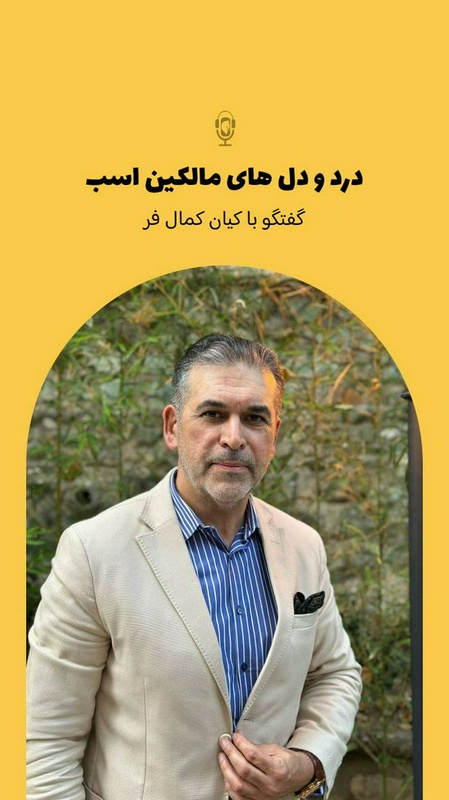
Kian Kamalfar on the concerns of a horse owner
خلاصه
In episode 64 of Radio Charle, Kian Kamalfar, a horse owner and active figure in the equestrian field of Iran, addresses the challenges and problems in this area and emphasizes the need for the voices of owners to be heard. He points out the cultural distance of Iranian society from animals and the economic problems resulting from sanctions, and stresses the importance of media and culture in promoting equestrianism. Kamalfar believes that cooperation and responsibility among owners, trainers, and the federation are essential for progress in this sport. He talks about the necessity of forming representative committees to support owners and improve equestrian conditions, and emphasizes the importance of proper education and conscious management. Ultimately, he considers patience and persistence in learning to be the key to achieving goals in this industry and urges listeners to pay attention to maintaining their authenticity.
نکات کلیدی
- مالکان سوارکاری در ایران مهجورترین بخش جامعه هستند.
- پیشرفت جامعه سوارکاری نیازمند توجه به کار فرهنگی و اخلاقیات است.
- جامعه سوارکاری شامل اعضای مختلفی است که در کنار هم به فعالیت میپردازند.
- تشکیل کمیته مالکین برای حمایت از جامعه سوارکاری ضروری است.
- آموزش صحیح و آگاهانه در سوارکاری اهمیت زیادی دارد.
سرفصلها
- تاریخچه و علاقهمندی به سوارکاری — شروع علاقهمندی به سوارکاری از سالهای ۸۳ یا ۸۴ و خاطرات خوب از باشگاهها.
- چالشهای مالکان در ایران — مهجوریت مالکان و مشکلات مدیریتی و اقتصادی در جامعه سوارکاری.
- راهکارهای بهبود جامعه سوارکاری — نیاز به کار فرهنگی، تشکیل کمیته مالکین و آموزش صحیح برای پیشرفت.
پرسشهای متداول
چند سال است که شما در سوارکاری فعالیت میکنید؟
تقریباً ۲۰ سال در زمینه اسبداری و سوارکاری فعالیت داشتهام.
مسئله اصلی مالکان در ایران چیست؟
مالکان مهجورترین بخش جامعه سوارکاری هستند و نیاز به دیده شدن دارند.
چرا جامعه سوارکاری در ایران شهرت و شناخت کافی ندارد؟
به دلیل مسائل مالی و کمبود رسانههای تخصصی در این حوزه است.
چگونه میتوان به پیشرفت جامعه سوارکاری کمک کرد؟
نیاز به کار فرهنگی دارد و باید به اخلاقیات و احترام در این جامعه توجه بیشتری شود.
چرا مالکین نمیتوانند صدای خود را به فدراسیون برسانند؟
چون کمیته مالکین و نظارت کافی بر امور باشگاهها وجود ندارد.
متن کامل گفتگو
Greetings to all you dear listeners of Radio Charl. We are here with episode 64. In this episode, I have sat down for a conversation with one of the owners in Iranian equestrianism, Mr. ...
He started a few years ago as a teenager and now participates in adult categories as well. You are going to hear some painful words that are very noteworthy because perhaps until now there hasn't been a space where these dear ones could make their voices heard. In this conversation, I talked in detail about the issues and problems of the owners and the equestrian community with Kian Kamalfar. I hope you send us your opinions in the form of comments or even directly so that we can develop better discussions over time.
In my opinion, as long as there is no conversation, no solution will be found. This episode is dedicated to the Tima shoe store, which is an Iranian brand with imported materials. The good news I have is that Tima has put on a very good sale because it wants to introduce its winter collections to the market. Therefore, they are offering the shoes they currently have with unbelievable discounts. I will leave the link to their store in the description of this episode. Be sure to check out their shoes, and I am sure that with the current prices, you will definitely make a purchase. Also, if you feel like you want to support us, you can enter the Radio Channel account from the link in the description of this episode and make us happy with any amount you like. My colleagues in this episode, as always, include the dear Farshid Jahanbazi, the designer of the Instagram cover poster and episode 64 poster. The dear Negar Goodarzi with her beautiful voice and Erfan Moghadas, the composer of the opening theme and...
End of Radio Javan podcasts. I hope you enjoy listening to the talks. I invite you to listen to the sixty-fourth episode of the radio. In the name of God, Mr. Kiani Kamalfar, thank you for the honor and for taking the time to have a conversation in the field of ownership with the channel. Personally, it was very interesting to me even before recording this interview. I hope we have a lot of insight. It's a pity that we, as a professional owner in Radio Charl...
We haven't had it until now. Now, Mohammad Khakbaz was there, the other club owner who was originally an owner before. But because I believe owners are the main pillar of this sport and need to be heard and seen, I decided to invite you, and you kindly accepted. Now, if you have a greeting, please go ahead so we can move on to other matters. I offer my respects. I have been a staunch supporter of Charl from day one until today, and may you be healthy. We have special respect for the efforts you have made for the equestrian community, in my opinion. We are progressing very well. It is very democratic.
In my opinion, your interviews have been very democratic, meaning you have given the interviewer the independence of opinion, and you have also had your own opinions, and the atmosphere, in my opinion, was very calming and listenable. That's why it's an honor for me to be at your service. Thank you for accepting this. The media of all my equestrian and sports community. So far, I haven't had the time to enter other fields, but it's in the program. There are endurance kids, beautiful Arab kids, show riders, racecourses. May God help and give success to do that too.
A brief introduction to your entry into the equestrian community and that you started getting acquainted with this beautiful creature, let's say very briefly, so we can move on to the topics. Please. Sure. However you say. I think it was from 2004 or 2005 directly. Before that, it was sporadic and not very serious. In 2004 and 2005, I became seriously interested. I started from the Siyahpoosh equestrian club. I have very, very pleasant and memorable memories of that beautiful club. It was a very good gathering. We were all friends, and we still are. I am still in contact with many of them. Horses have been a very strong, attractive, and amazing creature for me since childhood. They were extraordinary for me. I liked them in paintings. Since I am into architecture, I liked them to be present in architecture. Whether in the form of a statue or a relief. They have always been a beautiful creature for me. Of course, not only horses, but other creatures are also for me, but horses because their connection with humans...
Since ancient times, when we review the history of humanity and study human civilization, they have lived with horses. Yes, as a strange creature alongside humans, they have contributed to human progress. That is, when you study the history of civilization and human evolution, horses have been a companion to humans from the beginning, and in many places, history has, so to speak, been carried on the backs of horses. I really like what you said, and it's really true, and this horse made...
Equestrianism attractive to me. But as much as horses are very attractive to me today, equestrianism is also attractive. If someone asks me which I prefer more, watching horses or equestrianism, I can't choose. Because I like watching competitions. One of my pastimes is to have a competition and go watch it. If I have the time and the possibility. Now, it doesn't matter if it's a race, beauty, or jumping. Yes, well, of course, my discipline is jumping. Naturally, I like jumping more, but I also like other aspects. I really like beauty. If it's in Dubai, for example, a lot. Especially in Dubai...
Very good beauty competitions are held. It's attractive. The environment itself, the people themselves, the atmosphere is very... Let's not make the main topic too long. You have been active in the field of horse ownership and equestrianism for almost 20 years. You have been trained, have been an owner, have done horse breeding, have competed, and I think I remember you have jumped up to a height of 135. What do you think the problem, let's not say the main issue, of owners in Iran currently or during these 20 years has been? If I want to say it in one sentence...
The most neglected part of the equestrian community, which is also considered the most populous and forms the body of the equestrian community, are the owners. That is, as much as their population is vast, for example, the equestrian community is based on the owners. Now, it doesn't matter in different sections. On the other hand, they are the most neglected part, both materially and spiritually. And I think that from now on, the equestrian community should not only have the owners defend themselves, but the equestrian community really should...
House cleaning in terms of thought and perspective towards the beautiful word you chose, looking at the owners. Not because of the owners, but for our society, for our family. This family that exists now includes several thousand people. It is valuable in different parts and is an important family. Large, rich, wealthy, global, beautiful, with nature, with humanity, with ethics, with agility, with intelligence, with wisdom...
It deals with capability. The community is very powerful. You see it outside of Iran too, especially in European countries, it has also spread to the countries around the Persian Gulf. Equestrian sports have a very special place. But well, in my opinion, in Iranian society, that is, if you ask ten Iranians about the equestrian community, I doubt even one person would talk about it. This statistic is much smaller. I think maybe out of every hundred people or every 500 people you go...
Let's talk, but the equestrian community is another story. Equestrian sports have a strange story in sports. Now unfortunately because of its expense and because of the cultural background that we have had due to the last 400 years of war, disease, famine, and other problems, the Iranian community has distanced itself a bit from animals. Of course, it has gotten much better in the last 10-15 years and animals have gained rights. Unfortunately, we do not have an animal rights association, and I personally would love to establish a horse rights association. Well, because I say if you hold a competition in 42-degree heat, you are being unjust to the horse. It is true that you have your own expenses, but we have not reached that point. I want to talk a little more specifically about the issues you feel have been unfair to you as an owner. Places where you have been overlooked or ridiculed. Because my job is this anyway. From Iran, they have called me a coach, but the reality is that many have told me and I...
There has been modesty, a conflict of interest, even let me say it plainly. But you thankfully accepted and agreed. Your articulation is also good. I want to go a little deeper. Why is this word neglected and what subcategories does it have from the perspective of Kian Kamalfar? Before I directly answer your question, I want to point out something in between your words. You said the reason equestrian sports do not have enough fame and recognition in society is financial. I agree.
But always alongside material aspects, there are spiritual aspects too, and in my opinion, it's fifty-fifty. Now, what does that mean? Look at the media. From our national media, how much attention is given to horses, how much to equestrian sports. In my opinion, it is negligible. I don't see it at all. But if I want to say it very formally, we have an equestrian program on Radio Varzesh on Wednesdays from 3 to 4. Is it enough? How many people do you think listen to Radio Varzesh...
One radio or television or specialized program is not enough. We don't have any talk about it in the news either, while billions of tomans are hidden in this sport. Right now, it has potential and a large population is following it. Besides humans, with a living creature that has a historical background, like the Iranian horse, the Caspian horse, the Kurdish horse, the Turkmen horse, the Arabian horse. In any case, I want to tell you that this media issue is also a spiritual and non-material work...
Its foundation has a lot of problems. It's just interesting that I found one person who was an English Kayhan journalist before the revolution and only worked in the field of equestrian in Iran. Now let's interview him. Hopefully, I can arrange it soon and conduct an oral history interview with him. We don't have this media, and I really don't give media. I want a space that no, an open space for talking is very important. Why your media? I didn't flatter at first.
I expressed my real opinion as a member of this community. The day I saw you put this up, I went into myself and thought how interesting. Because it takes courage. Your work is not something anyone can do. No, I'm serious. The equestrian community is a very challenging community. Unfortunately, ethics are very weak. Everyone belittles each other, destroys each other, and there is a lot of gossip in it. In my opinion, it needs cultural work. You said the past 10-15 years. Look, in the past 10-15 years...
Highway construction has progressed, but it's not because we were forced to for the equestrian community. That is, sometimes progress is inherent. The potential forces have not been actualized. With the passage of time, it has progressed anyway. Now a coincidence has happened and horse imports have occurred. Foreign horses have come in. Naturally, our competitions have changed. The change in clothing compared to those imports from the 80s to the mid-decade...
The golden time of horse imports was a battle. Now in every breed and every film. In general, in imports, you go into any profession, it becomes historical. Its saddle is the same European champion, its clothing is the same clothing of the European champion, but its riding is at the level of Mohsen Pour Heydari myself. Well, we didn't produce the knowledge. Now my opinion is less...
No, you didn't. If we say zero, it might be a bit unkind, but little. Someone went, someone didn't cover it, went to learn on their own. Its speed has increased. Now hopefully its filter will also be removed so that we have more access, but it has been self-driven. That is, our organization should go produce knowledge. God billions of tomans. But riding that is at the level of, for example, the original seaside and taking pictures. Now let's return to the same main discussion. What infrastructures, that is, what conditions have arisen that...
The horse has reached that point. Because many owners have come to me. I remember before. Now I won't name names because I know they don't like it. But my passion is that, for example, at 3 in the afternoon I close the factory, pack up and come to the club. My club is 90 kilometers away from my factory. Now the condition is that I want to go to the factory at home unless I have to. That is, again, it is that passion that doesn't let go. Many owners have come in these few years. Now for whatever reason, they have been treated unkindly that when you lose a horse from this sport, a farrier, a boarding, a function, a...
Veterinarian, a photographer, and many others are deprived of it. The idea means the way of thinking has been this condition. What roots has it had? Let me give an example from sociology. We have a chapter in sociology that relates to the management of society. We can generalize it to the country and at home and in the neighbor and in the building and in our alley. That is, from a very large scale, bring it to a very small scale, it becomes our home. Look, every society consists of two people. That is, from two people and above it becomes a society, right?
We can manage society with a top-down perspective or a bottom-up perspective. Top-down means governance management from the people to the ruler. Now we can say, for example, in a household with parents and two children. For instance, we can say that children should adapt to their parents to behave correctly. We can say that parents should raise their children in a way that the family has a proper center. A third theory emerged in the twentieth century after modernity, in fact, in postmodernism, which says we...
We have a one-to-one descent between bottom-up and top-down. Just as a leader must perform their leadership correctly, the people or members of society must also have their share. The problem we have in the equestrian community, not just in the equestrian community, but in most Iranian communities you refer to and face, is this management issue where we either expect everything to happen for us from top to bottom or the upper expects...
The lower ones to adapt themselves, conform, and create conditions. This is wrong. Both are wrong. Now we are always looking for a savior. Someone should come, the head of the federation, the manager. We should demand. Exactly. Now the aspect of transcendence in a sociological discussion returns to both the economic dimension, the scientific and technical knowledge dimension, and the cultural dimension. If we remove any of these three components and leave a gap, it will face challenges.
Now I return to the previous discussion that it should be from bottom to top and simultaneously from top to bottom. If we have a cultural problem in the middle sections of the equestrian community, the issue will never be resolved. Each of us, in whatever position we are, I as a horse owner, you as a coach, as a veterinarian, he as a club owner, he as the head of the board, another as the secretary of the board, the federation secretary, etc., each of us is a member of the equestrian community.
If our collective wisdom lacks the necessary and sufficient culture to be present and exist in this scene, we will experience collective disruption or lack thereof. Also, economic problems exist in the society we live in. Until 10 days ago, there was a war, and for 20 years we have been under sanctions. Let me tell you that the import and export of horses from our country is prohibited, and we cannot practically participate in any international competition. It is a one-way highway, economically and then scientifically.
I will not talk about technical knowledge regarding this section. Let me tell you that the reason for the marginalization of the equestrian community in our discourse is only the focus on the owners. In my opinion, the equestrian community, as I mentioned before, is marginalized in Iranian society and is not given enough attention. Its dimensions are cultural, economic, and scientific, and that one-to-one top-down and bottom-up management has not been observed in it. So, I conclude your question for these three reasons.
I was explaining my answer to reach a conclusion about the equestrian community. Now you tell me what the first question here is about the equestrian community? What does it mean? You certainly know this answer. To bring the discussion to a conclusion, I will explain it to you. In my opinion, the equestrian community forms the core of the federation society.
And consequently, there are the boards, educational centers. Let me tell you these are the management core and the position of the custodian of the equestrian community. Now each with their roles and the committees that the federation has recently formed. Let me tell you we come to the next circle where there are coaches, clubs, veterinarians, farriers, riders, equestrians, CAS, advertisers, secretaries, sheriffs, judges, all these members of the equestrian community. If I miss something, no offense to anyone.
Naturally, the owners and naturally the sellers who are engaged in selling goods in this industry, whether as suppliers or producers or importers, it does not matter, they are sellers. Now they sell feed, they sell medicine, they sell clothes, they sell equipment, they sell fodder, or something else. These are all part of the equestrian community family. Now if you zoom out and look at the equestrian community from above, the so-called hot rod here is the community. The owners have formed it, meaning those who own horses and the bold part of the community are the owners. Therefore, if the equestrian community...
Has been marginalized, in fact, its hot rod is naturally limited due to the same three factors I mentioned. We have both management issues, cultural issues, economic issues, and scientific issues. We have media discussions, we have the importance of giving, we have presenting. All of these have come together to make the equestrian community centered. Consequently, the owners, who are a prominent and populous member of the owners' community.
Many friends, when you talk like this, take a bit of a guard. Whereas in reality, whether in racing competitions, beauty competitions, endurance, or jumping, it does not matter. There is a horse there that has an owner. In most of these cases, the owner of that horse is separate from the rider of that horse. Yes, recently, as you said, our equestrianism has grown a bit. Owners are more present in the competition fields, but before this, the owner was the owner, the rider was the rider, the coach was the coach.
The trader was the trader, the organizer was the organizer. Now it might be a mixed stew. Mr. Maziar Jamshidkhani says something very beautiful. Look, I am both an owner, a coach, and a club owner. That is, he plays a role in three very important areas of the equestrian community, and in reality, he has a club, he is a coach, and he is an owner. Now he does other things in between, he supplies hay, he does training work. I want to tell you that in any case, the owners...
Are the backbone and infrastructure of the equestrian community. Neglecting the owners' community leads to stagnation and weakening of the equestrian community, and conversely, strengthening the owners leads to the growth of our community. With any policy-making or with any wrong or right policy implementation, we can support or weaken. We can highlight enthusiasm and excitement in the equestrian community or, conversely, reduce it. Now you see with a very brief look...
See how much of our policy-making in the past 15 years, as you say, has progressed, has nothing to do with the long story. In the past 10-20 years, how much of our policy-making has been in line with the elevation of the equestrian community and how much of our policy-making has been against the elevation of the equestrian community. Its report card is clear. Yes, it is completely clear. We see it in competitions, we see it in training, we see it in coaches, we see it in the bands, we see it in veterinarians, we see it in the federation, we see it in the boards, everywhere.
He says, what is evident needs no explanation. Unfortunately, we have a problem; it has become a luxury item. Now, unfortunately, it has become a luxury item. When industrial machinery was part of the family, it was transported. But since the industrial revolution happened, its functionality changed and it became a luxury item, and unfortunately, we became directly involved with an economy under sanctions. Owners became smaller. We never went towards saying, sir, the economy is bad, sanctions are like this, we know all these pressures, but someone who has a horse and keeps a horse.
The interest and enthusiasm in him are so great that he is not worried about it. Sir, now I know someone who is a tenant but has a very ordinary and normal car, but his horse was worth billions. He had this interest, well sir, unfortunately, part of this enthusiasm is related to sanctions, economic issues, war, and Corona. A very major part is management and policy-making that we haven't had. I mean, we...
What is the big weakness of the owners? He hears me, he can contact me. I talked, it's not that at all. Anyone who feels like talking to help exactly.
We haven't had this policy that, sir, the economy is bad, what should we do to continue? What should we do to lower our costs? What should we do to encourage the owner? We haven't had it. Mr. Pourheidari, I have a slogan that I have always had in the past 10-12 years since I became more interested in sociology. I want to tell you, please, I say that awareness is the source of happiness. Yes, if you reflect on this sentence for a few seconds, the root...
What we refer to in life as happiness and prosperity goes back to your awareness. You want to be successful in business, you want to be successful in religion, you want to be successful in sports, you want to be a successful person in society, you want to be a successful person among friends and neighbors. If you have the necessary awareness in that field and that subject, you can move towards success and the desire for happiness.
Otherwise, you either stagnate or regress. Now we have stagnated and regressed. Now I say it's very important. If the president of the federation, if our board president, if our referee, our coach, our speaker, Radio Four, not Kian Kamalfar, Hassan, Hossein, Taghi, the country of Iran, the Iranian nation seek awareness, they can better guide this country and consequently its smaller communities and get closer to success.
But if we sit and wait for a miracle to happen from the sky and suddenly happiness befalls us, such a thing will not happen. Now apply this to the equestrian community. We cannot sit and watch for the equestrian community to improve. Neither the president of the federation should sit and watch, nor I as an owner, nor you as a coach, nor that sheriff, nor that farrier, nor that veterinarian, nor the others.
Everyone must be active. In what direction? If the equestrian community grows, your income improves, you benefit in coaching. I want to get a better horse and ride it, I benefit. Another wants to have a better federation and leave his name as a legacy, this happens. Finish this. Awareness, awareness is the source of happiness. The root of our current misery and misfortune in any field you think of, I in the construction industry, go talk to a doctor, go talk to...
A chemical engineer, go talk to a shopkeeper. In any field you place, it's misery, misfortune, regression, or stagnation. If it's very good, it's either regressing. You asked which equestrian community is it? Has it regressed or stagnated? In some places, it has stagnated, in some places, it has regressed. I remembered that dialogue of Naqi that I went to ruin. Truly in confirmation of your talk, Majid Hosseinnejad taught me a very beautiful sentence.
Why doesn't this awareness turn into behavior and operational progress? My own club, an umbrella under my supervision, helps me as a coach to go to a county, sir, teach according to their pocket. Why?
We have both economic and scientific problems. Let's take awareness. Now that this scholar is in the grave, what use is it to me? If each of us tries to leave a legacy of ourselves, the situation will improve. What is written on your tombstone? I try to think about it. In life, I tried that tomorrow I go to the grave, it says young and unsuccessful. Now I don't know.
A kind and caring father, Mohsen, what do I know, he had a microphone, for example. Now anything. Even if we are in the world of awareness, we took it with us to the world. This unfortunately exists. Becoming pepper, being potential, please.
You reach management that you said awareness must be operationalized. I agree with you 100%, not 99 percent. Knowledge without action is useless. Let's go back to that being neglected. I want to use a sentence with your permission, a bit radical, a bit extremist, but I want to say it. For seven, eight years, Mr. Pourheidari, I've been looking for this word...
Shout it out. Shout like the Iranian nation that this freedom is stuck in its throat. Now everyone has an interpretation of it. Yes, it is stuck. Religious is stuck, communist is stuck, liberal is stuck, everyone has this freedom stuck here. Bravo, it's a lot of awareness. We just think we know twice. This word that I want to use is exploitation. Mr. Heidari, sociology in Iran tells us this. We have a method...
Let's go to the crossroads. You want to go forward, you are the same two people who were bothering each other with their Iranian politeness, now they are bothering each other in another way. A ladder there shows itself, it says I should go first. The club owner says I should benefit. The coach says I should benefit. The federation says I have to be there for you to be there. The veterinarian says I studied it, I have to get paid for it. The farrier says I gave my back in this field. The groom says I eat dust for you to love me, I have to get paid for it.
Because look at this thought, it says everyone go aside, if I'm not there, none of you are. Individualism, what do we all do to each other? We look at the ladder and in some places, we insult harshly, we belittle, we question each other, we ignore each other. Let's ignore we are a family. Just as the role of the father is important, the role of the mother is important, the role of the child. Why is a family formed at all? For the child. Unless people go and have a white marriage, stay friends, go and get married to form a family and have children.
So, my child's role is as important as the father's. Look at families who, heaven forbid, don't have children, see how upset they are, they suffer. Therefore, roles are important. The owner has an important role, the trainer has an important role, the club has an important role, the veterinarian has an important role, the federation has an important role, the competition organizer has an important role, the technical observer has an important role, the person speaking into the microphone at competitions has an important role, they bring excitement. If someone speaks sleepily, the competition goes up in the air. People are different. Mr. Mohsen Pour Heydari with any level of education.
With any level of knowledge he has, he has had the ability to start this radio. I come and speak in it, words that I wanted to say for 10 years and couldn't. You created a gathering for me to come and speak, that's an art. Why is your camera blue? Can't your microphone be smaller? Why are you wearing a short-sleeved shirt? Can't the green be white? Criticize until the end, just sit like this and criticize. We know how to criticize. Criticizing doesn't solve the problem, it doesn't hurt. That's exactly it. Then you go talk to the trainer, they justify something, you go talk to the owner, they justify something.
You go talk to the federation, everyone wants to justify in the lack of that economy and that awareness and that knowledge and that culture. We are also justifiers, we are also a ladder. See what a disaster it becomes. The story is about to explode. Unless you talk to someone on the street and say someone wants to open it and tear it apart.
It is completely visible, it can be provided in the social context, it is clear that the equestrian community is highly competitive. An equestrian sits on a horse. I'm not saying 145, you and I have experienced this issue. We started from 20 centimeters, today we jump, for example, one meter. You much more. I myself am saying that if you can have this ability, not just with your own horse, if they give you a strange horse, ride it twice, and be able to jump a one-meter X with it, how much experience is behind it...
This difficult sport, this expensive and controversial sport requires very strong, conscious, and wise management. Equally, it requires a very high culture. If I, as an owner, do not have the necessary equestrian community culture, with my behavior, thoughts, ethics, and spirit, I harm the equestrian community. With the same spirit that I want to exploit the trainer, veterinarian, and groom. This trainer who jumps 130 today has put his life, his soul, his health into it to make money. Because we don't have ignorant equestrians. How can equestrianism progress? My belief is that if an equestrian is not intelligent, agile, and wise, they cannot progress in equestrianism. That's right, exactly like that. Therefore, a trainer who comes and jumps beautifully must show themselves and the rider should benefit.
The trainer should not have an exploitative view either. Now this trainer and owner, you provide for them. Every dual relationship in the equestrian community has this story. Unfortunately, when we hold a competition, we want to exploit. We want to participate correctly. Why don't you wear your shoes properly? Why don't you show respect? Why do you mock the rules? Why do you hit your lame horse so it doesn't limp and jumps? Don't do it, sir, aren't you the owner? Isn't that horse yours?
If I talk historically, it's beyond the scope of your discussion, but let me briefly say that whatever we suffer from is from history. Mr. Pour Heydari, Iran has been invaded three times by overturning forces: 1. The Greeks during the Achaemenid Darius, 2. The Arabs during the Sassanids, 3. The Mongols seven centuries later. See, those who came changed Iranian society. Whatever we were, they said don't be. Your religion, your behavior, your clothes, your cover, your business, your work, your house, your decoration, everything had to change. It should become like this. The Greek said become Greek, the Arab said become Arab, the Mongol said become Mongolian. And these are theoretical differences, ideological differences, cultural differences. The Mongol has a culture, the Arab has another culture. You go from this master to that city, your dialect changes. Ethnicism is prominent, woe to nationalism, woe to nationalism.
We think fascism only belonged to the 21st century and Mr. Hitler. No, from much earlier, from the time of the emergence of humanity's policy on this planet, fascism has existed. It said this cave is mine, if you step into my cave, I'll break your leg. This is the root of fascism. The nationalist says I shouldn't live, whereas humans are tribal creatures, social beings. If you leave me and you alone, we can't live. We are dependent. Humans are tribal creatures, but they want to defend these borders for their own benefit. So if you ask where the cultural root is, we have to read history.
Which we don't read, we don't have the patience for it, we don't spend time on it. We watch a hundred useless movies, a hundred useless series. But you told me you like to listen to podcasts in your car, you really like biographies. Why do you like biographies? You want to get acquainted with realities for life, know people, what they were, how they lived their lives. This helps you plan your own life. Is everyone like this? They play Bandar music, even if they're in traffic for two hours. Man, listen to something, learn. Listen to music too.
The 21st century, considering the advancement of science and the conditions we have, a very important part of this culture is related to deterrent laws. Again, we go back to our ups and downs and bottom-up. If we come and blame everything on the higher-ups, we become nothing. Look, we came during the Pahlavi era and said everything is the Shah's fault, the Shah must go. What happened? Did it get better? Are we better now? We can't say now that the Islamic Republic is bad, it must go. The Islamic Republic goes, will a republic be established the next morning?
It's ugly. I say you shouldn't say Mohsen let's go right now. We didn't reach there to be comfortable with each other. We are very limited. Change Kamelfar. Sir, your boots don't fit the g.
Deterrent laws should exist, meaning the laws should be such that I don't allow myself. Well, we said it now, we said the higher-ups should be correct to be able to write the right laws. I, the subordinate, sir, come here. My job is here. Ask for our opinion. Now I'm ready to bet on one process.
Everyone is tired of holding competitions, unfortunately, I'm a moral teacher. I see the subordinate here more. Sir, I have a trainer. Sir, I don't jump in competitions. I'm announcing this too.
Let us not be opportunistic anymore. At some point, I beat my chest with these words. Yes, well, but we don't want to reach there. It's not that we don't want to; we are afraid the company won't jump. Sir, for once and for all, don't participate in a competition. Don't boycott this anymore. You can do it culturally. Now, this isn't culture. Sir, how many committees does the federation have? I think 12. As far as I've seen, it has 12 committees. How much are these committees in control of their work and influence?
How successful have they been? I mean, in our minds, we can answer. Each of us who has been living in the equestrian community for 10 years, 5 years, 20 years. If the problem is still with the tour, what does it go back to? If the problem is with the police station, what does it go back to? If it's in endurance, if we don't want to talk about a specific person. My opinion is not about individuals at all. Because we.
We can't fix anything with individualism. Bravo. I am speaking generally. When I say coaches shouldn't have a ladder mentality, I don't mean my coaches had a ladder mentality. I have an obsession with this issue. No, I had both very good coaches and very bad coaches. We all did. Yes, we all had the same in school. We had very good teachers, very bad teachers. It was just luck. The coach also had a very good owner, a very bad owner. Everything is reciprocal. Let's not be defensive. We are all one family. We want to draw conclusions from these words. We don't want to destroy either. We don't want to blame someone else.
I am an owner, I am at fault. My coach is at fault. My federation is at fault. Other members are also at fault. Let's take responsibility for our faults. Now let's become empathetic, synergistic. We must converge from divergence. We must break positions. But I am here to negotiate. Who is the owner? Excuse me, now we don't understand anything that allows him to talk to me. Why does he give an expert opinion? My coach.
What is tangible is that we were humiliated with it. Now it's not a matter of profit and loss. I didn't come to buy to make a profit. But for someone to come and tell you with authority that as an owner, you shouldn't think you should spend. What kind of talk is this? It's like saying, sir, why do you want to buy a sofa to make a profit? You should buy a sofa to spend. No, maybe I wanted to put my sofa on the wall and sell it again.
I wanted to sell a car, I wanted to sell a house, I wanted to sell a villa, I wanted to use my tennis racket and sell it again. I don't want to compare a horse with a tennis racket or with a sofa or with a house, but when you look into the eyes of someone who makes a living from this work and I, as an owner, spend so that you other members of the equestrian community benefit and profit, you shouldn't bring dignity to this level that you are not allowed to think this way. Your work must be so correct, and you must be so managerial, prudent, and aware of equestrian work that you say, Mr. Kamalifar.
The horse you want to buy costs a thousand tomans, do you have this amount or not? I can also buy an 800-toman horse for you, but it won't solve your problem. Put the ball in the owner's court. But what do we do? What does the coach do? They go and show the thousand-toman horse to the person and say 3000 tomans. Not all coaches, they don't dare. What is the result? Good horses become scarce, owners don't progress, the coach doesn't want to come and jump, he wants to show himself and enjoy his ride.
When he jumps his horse, he wants to buy a better horse. Don't look at people as disposable. This is a golden sentence. This sentence is said by someone who has almost 20 years of professional equestrian experience and the first few years recreationally.
I got angry. In the competition, it took 10 years to understand where I am. Now you came wrong for 10 seconds, which is still now a learning experience, and there's no solution. Well, 10 years of life cost is very valuable, which was after the age of 30. Yes, you were around 30 years old. After all, it was the golden time. Now, the one who rides from childhood, you who are 24 years old, what is your solution?
I learned a lot about both ownership and the community system. How should this system be exited, and what solution do we have to put a positive path that is both feasible and implementable? I told you, both from top to bottom and from bottom to top, we must think about it simultaneously and become empathetic with its pain. If you like the principle, if you like the equestrian sport, if you like the horse industry.
If we like the development of the equestrian community, you and I and others must all join hands simultaneously, and as you said, if we have awareness, which hopefully we do, we improve it, develop it, and advance it, we implement it. How? Both from top to bottom, meaning it should shine from the federation and from the members, owners, coaches, veterinarians, farriers, grooms, and other sellers. Everyone must join hands so we can inform our community and family. I think my first step has been almost seven or eight years in this thought.
I have asked the federation a couple of times, and I am still asking now, humbly asking, not expectantly and, as they say, aggressively. No, I am very humbly asking them to think about the owners. We definitely need an owners' committee. We definitely need an owners' committee. I will say it a hundred more times until 100 years later, for our community, for our family, the owners' community must be under the federation's auspices.
They should be under the support of the federation and the boards. The education issue must also be corrected. In education, you already know, we are reviewing these lessons. We have a lot of problems in education. How does an owner enter the equestrian community? He goes to a club and says hello, I want to come to class. They give him a coach, it's not clear what his level is, whether he has a card or not, whether he knows or not, whether he has communication skills, sociology, psychology is not a criterion at all. But what does he know? We don't know what he knows. He gets involved, in session 20, session 60, session 100 he rides. Now they say, sir, you must buy a horse.
Now it's just the beginning of misery. It means in the name of God, I want to step into misery. We must pay a lot of attention to our education. Education is very important. In the discussion of awareness and then the owners' committee as care and attention. Look, we say the owner must pay attention to his coach, must pay him fairly, not haggle, I don't know, pay more, be in debt now, have a veterinarian, get good medicine for his horse, do this, do that. It's all about the owner doing, doing, doing. Well, what should others do?
Buying a horse can lead to selling a bad horse to someone, during a competition it can be poorly organized, when it comes to ownership claims, no one even asks who you are, they say go, you have one horse, why are you talking so much? An owner is someone who has one horse up to 100, whether you have one or 100, it doesn't matter. At every price scale, yes, there should be a committee and we don't have one, it's missing now. A question, does it mean I, as an owner, can't have a say with the federation, go to a place, sir, convey my pain, sir, we sleep at night and wake up in the morning, the club raises prices, why?
Oh dear, I know a club in this boarding war that has raised prices, God Toman. Then in the war, in the war, they cut it off, saying I can't, you have millions, you're taking boarding, they say hay has become expensive, then you reduce hay by eight Toman. It's interesting, see it's a disaster, this isn't interesting, this is exploitation in the true sense. Then that club has 200 horses, 10 top trainers, none of them make a sound, why? Because the owner is blind.
You're at the end. Therefore, as a suggestion, let's be in pain, not have divergence, have convergence, not behave like a ladder. Let's establish a trainers' committee, establish an owners' committee. Now let's think that our owners in the morning and our training, I emphasize training is very important, yes really. But what do our trainers get through the federation?
Kazemian was the president of the federation that I was pursuing, now it didn't happen for whatever reason. We need a supervisory system for trainers' work, well and this doesn't mean policing. This means that the ministry, I gave a very simple solution to the federation. Now I say here, in every club where there are many trainers, a trainers' committee, a technical trainers' committee, there should be a head coach to supervise the work of the trainers working at the club and that head coach should be accountable.
50 club spies take photos and videos, no sir, it has happened. There should be a condition that sir, you are a student, owner, creator, whatever title you have, sir, I am an unsatisfied trainer, this did such and such, then spoke, ruined my character, sir, someone should take this to the federation. Why is the trainers' committee set up? In the training discussion, shouldn't one of its tasks be this? Yes, no, it's not supervision, it should be overall. This is our problem. One of the reasons the word friends might be offended but this.
The unbridled boarding system is due to the lack of federation supervision. Why? Because in the federation's statute there is no supervision over club affairs. Supervision over sports club affairs is the responsibility of the provincial sports department. They also have a resolution, they don't comply every year. Unfortunately, each is an autonomous state. Now my question was, sir, we now have the owners' committee, what are the duties of the owners' committee? See, since owners are present in all parts of the equestrian community, I mean in terms of diversity.
Horse ownership is one of the beautiful activities that is present everywhere and naturally, in the owners' committee, each of these should be present. Maybe it should be one of the most populous committees of the federation. That is, if we have 7 people in the jumping committee, I don't know, now I'm speaking very abstractly, for example, if it's seven people, maybe the owners' committee needs to be 15 people to have richer coverage. So we need one, suppose we have the committee.
What policies should we implement through the owners' committee? See, in collaboration and synergy with other committees, here it is the duty of the federation secretary, the federation president, and senior federation officials to be able to coordinate these committees with each other. Excellent, coordinating, what is it in Persian? I think convergence, something like that, connected. Exactly, they should match them together and have work exchange with each other.
And let me tell you that if this coordination does not exist, it becomes what it is now. Everyone plays their own tune. You want to hold a concert, for example, the violin plays its melody, the double bass does its work, the piano does its work, which doesn't work at all. They must play together and a beautiful music should come out of this. Yes, the federation should do the same. We are not saying it hasn't done it, we are saying it hasn't been enough. Because see, saying from afar, make it limp, is not good. The federation hasn't done anything, the federation there, no, they have done some things.
But it hasn't been enough, it needs more power and supervision. Very extensive, very extensive. It's interesting, you talk about polo. In my opinion, now this sentence of the poor guy whose podcast will be soon, but now that the podcast is broadcast, they have heard the previous podcast. But really its committees and dimensions are very large. Honestly, the president.
His work is a lot, because both the population is large and then the fields are very different. Here a strong secretary is also needed. Now I hope these words for those who Mr. Pourheidari we have in the equestrian community, I can name for you, right now we have people who can lead powerfully. Unfortunately, we don't give them a chance, we undermine, we gossip behind their backs, we block, we don't accept. Sir, I must accept Mr. Pourheidari now. He is the first person who has started this media.
Now his score is 18, it doesn't matter. 18 is much better than nothing. Isn't it? You who don't claim to be 20, no one does. No, that is now modesty, claiming to be twenty is wrong. It's right but 18 is a reasonable score, 17 is a good score, 16 is also good in my opinion. Sir, being 16 is better than being nothing. Exactly, we are nothing in ownership now. Yes really nothing at all.
Just hitting it saying this is what it is, no talk. We know better, we have experience, we have expertise, you don't understand, you just have to pay. Sir, thank you very much, I learned a lot and I hope those who listened to this podcast. I have always had an idea on Radio Channel One, that is, my perception has been that sir, let's go back and think again to see where this.
And I announce again, anyone from the owner, owner of Sahar Club, no one thinks that the podium is only for a specific group, no, it belongs to the whole community and that is that sir, we come and talk. No sir, it doesn't have an impact, it has a lot of impact. I myself may not have listened the first night but I do something for myself, I send you something else to definitely listen to your podcast. Please, it has an effect, sir, it has an effect.
In repetition, in patience, in perseverance, the commitment I made is that, well, maybe this doesn't need to be said, but it costs me nothing but time, yet I say no, this takes time. We must continue to produce and talk for a long time until we finally make those things we want little by little in ten years. But anyway, thank you, I'm taking a picture of this chart, it was an interesting thing.
Any command, any order, any suggestion, any point of view, anytime, goodbye. This was episode 64 of Radio 4. I hope these talks have been informative for you and don't forget us in your good prayers. As always, take care of yourself and your originality.