Amir Farjamfar, President of the Eventing Committee of the Equestrian Federation
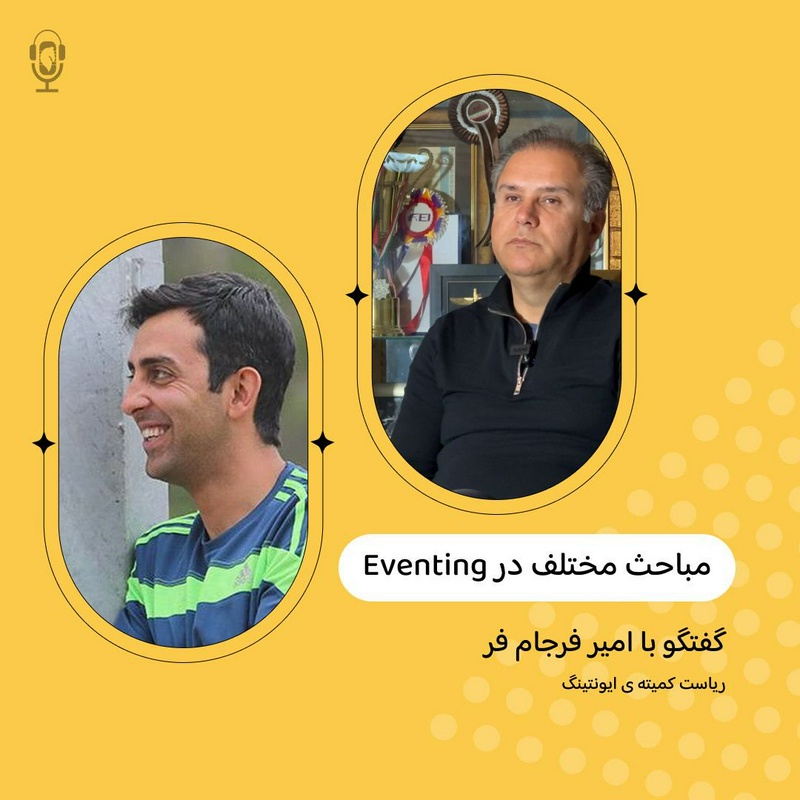
خلاصه
In the fifty-fourth episode of Radio Four, Amir Farjamfar, the head of the Eventing Committee of the Equestrian Federation, discusses his efforts to develop the sport of Eventing in Iran. He refers to the history of this discipline, from its beginnings in England to its entry into the Olympics, and emphasizes the importance of creating a market and competition in the provinces. Farjamfar addresses the existing challenges in the education and judging of Eventing and stresses the need to improve the level of judging and utilize native horses. Additionally, the need for decentralization and improvement of educational facilities in the provinces to attract young riders and elevate the level of equestrianism in the country is raised. He expresses dissatisfaction with the lack of adequate support from officials and federations and hopes that with the cooperation of provincial committees and proper planning, they will achieve international competitions.
نکات کلیدی
- ایونتینگ رشتهای نوپا در سوارکاری است که بهدنبال ایجاد بازار جدیدی برای سوارکاری در شهرستانها میباشد.
- اعضای کمیته ایونتینگ شامل چندین سوارکار با تجربه هستند که بهصورت تیمی فعالیت میکنند.
- ایونتینگ یک رشته ورزشی شامل درساژ، پرش و کراس کانتری است.
- ورود خانمها به این رشته از سال ۱۹۶۴ آزاد شده است.
- چالش اصلی در آموزش ایونتینگ، داوری و درساژ است.
سرفصلها
- معرفی ایونتینگ — بررسی مفهوم و تاریخچه ایونتینگ و نحوه برگزاری مسابقات.
- اعضای کمیته ایونتینگ — معرفی اعضای کمیته و نقش آنها در توسعه ایونتینگ.
- چالشهای ایونتینگ — بررسی چالشهای موجود در آموزش و داوری ایونتینگ و راهکارهای پیشنهادی.
- توسعه ایونتینگ در شهرستانها — نقش ایونتینگ در ایجاد بازار جدید برای سوارکاری در شهرستانها و مشکلات تمرکز امکانات در تهران.
پرسشهای متداول
ایونتینگ چیست؟
ایونتینگ به معنای لغوی رویداد تلقی میشود و به مسابقات سهروزه اطلاق میشود، اما ممکن است مسابقات در یک روز یا چند روز برگزار شود.
اعضای کمیته ایونتینگ چه کسانی هستند؟
اعضای کمیته شامل جناب آقای ایلیا محمدی، آقای عرفان آسیایی، آقای محسن مسگریان، سرکار خانم خمسه، آقای مهدی بختیاری و آقای طوفان ترابی هستند.
چرا ایونتینگ در شهرستانها بیشتر مورد توجه قرار میگیرد؟
چون ایونتینگ میتواند بازاری جدید برای سوارکاری تعریف کند و امیدی در دل شهرستانیها ایجاد کند تا رقابت کنند.
فرمت مسابقات ایونتینگ چگونه است؟
مسابقات ایونتینگ به دو فرمت کوتاهمدت و طولانی تقسیم میشود که شامل مراحل درساژ، پرش و کراس کانتری است.
چگونه میتوان داوران ایونتینگ را آموزش داد؟
باید با دعوت از مدرسین خبره و برنامهریزی مناسب، آموزشهای لازم را برای داوران فراهم کنیم.
متن کامل گفتگو
Hello to all of you regular listeners and companions of Radio Four. I am very pleased to be with you in another episode and I thank God for giving me the energy and ability to produce more technical content to improve equestrian culture. Episode fifty-four of Radio Four was my conversation with Amir Farjamfar, the head of the Eventing Committee of the Equestrian Federation. I should give you a brief introduction about Amir Farjamfar. Amir Farjamfar is one of the experienced and veteran riders who has worked hard over the years from Kermanshah province and has constantly kept himself updated. I can confidently say that he has kept classical riding alive in Kermanshah and continues his path with hope for the future. Well, as you know, we did not have the sport of eventing officially in the horse industry and equestrianism. In the federation that exists, thanks to the president of the federation and their colleagues, a committee titled Eventing was formed, which Amir Farjamfar dear is the head of this committee, and you will get to know their good colleagues, whose names they will mention later in the episode. They are working hard on this committee, and we are supposed to hear good news. I am sure it will become one of the very popular disciplines, especially in the counties. Considering the number of horses we have in our vast land, we can define a new discipline and market. The second point, as always, I should thank those dear ones who support us in any way. I kiss each of their hands, whether they share the episodes or send the posts to each other. I am really grateful to all of them and wish them all health. If you have any suggestions to help improve, update, and enrich the radio programs, there is a link in the description of this episode through which you can make financial contributions to the radio. Even if you don't help, it will be free, and with all the love and interest I have for all of you dear ones, I will continue more energetically. Well, I should mention my colleagues and thank them. Dear Farshid Jahanbazi, the designer of the Instagram cover and poster of this episode, Ms. Negin Goodarzi and Erfan Moghadam are the composers of the podcast's opening and the end of Radio Four. I won't talk more and invite you to listen to episode fifty-four of the radio together.
Hello. In this section, I am a guest of Mr. Amir Farjamfar, who is the head of the Eventing Committee of the Federation. I greet you, Mr. Farjamfar, and I am happy to be your guest in your beautiful city, Kermanshah, and I am honored that you accepted me as a guest. We are going to talk extensively about eventing in this conversation. Thank you for giving me your time. If you have any greetings, please go ahead so we can get to the questions. Yes, I would like to pay my respects to the good and understanding audience of Radio Four and also seek permission from the teachers and veterans of equestrian sports. I am at your service. Thank you again for accepting me and agreeing to do this interview. Because one of the emerging equestrian disciplines, which unfortunately we have been mispronouncing for years, is being launched thanks to your activities and your committee, which is moving forward very strongly. And I think if a little more attention is paid to this discipline, the counties will be more involved. Because unfortunately, our equestrian community has become a community of jumping and tour competitions, and we are completely away from that part and practically we can say we are lost. Now, thank God, with your presence and your committee, a hope has been created in the hearts, especially of the county people, that there is such a space, it is possible to compete, and a market can be defined for it. Because the main problem is the lack of a market. That's why systems face challenges after a while. Well, sir, generally speaking, you think that I also don't know what eventing is. Let me first say that my work is group-based, and we work as a team with knowledgeable and good kids. I wanted to say that Amir Farjamfar alone has not been and will not be prominent. Name the members of your committee. Our committee members are our good friends in the committee, Mr. Ilya Mohammadi, Mr. Erfan Asiyayi, Mr. Mohsen Mesgarian, Ms. Khamseh, and Mr. Mehdi Bakhtiari, and also Mr. Tofan Torabi, who are not the storms of Iran, but it has been decided that we will use their presence and three-day work experiences at the first opportunity they come. Yes, yes, they have also participated in international competitions and tours. It has been decided that now they have come, we will have a session with them to use the experiences and the potential that has been in the sport of eventing and in fact, they have had ranks or a specific rank. Apart from Tofan, no one else in the committee practically has field translation of eventing. Apart from Tofan, in competitions, no. Well, what is eventing? Eventing is literally considered an event and has no other interpretation, and this term, which is mistakenly referred to as three-day competitions, is incorrect, and we follow the competitions in various formats, which I will subsequently explain to you, and that someone says three-day competitions because the competitions may be held in one day or several days, even more than three days, depending on the type of competition and the conditions of the participants. Well, what are these items that are held under the title of eventing related to the original exactly?
Why, if you allow me, I will give a history of eventing to know. It is said that eventing originated from a ceremony in England for fox hunting and also the practice of the cavalry of this country, which has gradually progressed in the discussion of dressage, the discipline that was in the military parade of the British army. In the jumping section and the course, as they say, the endurance and stamina of the horse are measured. That military branch continued until 1912, the beginning of the 20th century, when eventing entered the Olympic Games, of course with a long format that was held in four sections A, B, C, and D, and the local form that was in the region in England called Badminton, where competitions were followed locally, and usually amateur riders of the British army participated in these competitions. But in 1912, in Stockholm, Sweden, the competitions officially entered the Olympic Games and were always held with the same long format until 1952, only men were allowed to participate in eventing competitions, and from 1964, the first woman who participated in the competitions was from the United States, and after that, the competitions were mixed, and women also participated in this section. What was this long format? The long format, as I said, was held in four sections A, B, C, and D, which first the A and B stages were completed, then inside what was A and B, they had a road course.
Now there were hedges or obstacles that they passed through. Part of it was charged, and they entered a vet check or a box where the horse's heart rate was actually measured. If the heart rate reached 80 within 10 minutes, they were allowed to participate in the next stage of the competition, and if such a thing happened, the rider was eliminated. This was in the long section, which I should not forget in 1964 what sections D and C were. At that time, it continued the cross-country section, went to dressage, and also had a section under the title of road course, and then entered the veterinary gate. There the horse's heart rate was checked, and within 10 minutes, as I said, the same property had not changed. Its long format was held in this way at that time, correct.
Well, from 1964, the entry of women into this discipline was allowed. Did the general format of the discipline change as well? Yes, until 2004, it was held in this way, but in 2004, a special event occurred in the rules and regulations of eventing competitions, and the formats were divided into two parts, short-term and long-term formats.
Short formats were usually implemented in the basics, for example, in type 30 B and A, the formats were almost short-term, but in competitions from one-star to five-star, depending on the type of competition and the conditions of the participants, the formats became longer, even held for four days or maybe more, depending on the number and participants in the competition. Correct. Now these types A, B, and C, which are now shorter formats that you mentioned.
These include exactly what things in the short-term format, which is type 30, the rider is held in terms of distance on the day, and the rider sees that we say in jumping the levels must be filled to move to the next stage in the beginner level and then the subsequent levels, the stages are completed, and we qualify and come up. In eventing and in the eventing discipline, we say it is called "mer."
That is, the rider must be "mer" from level 30 to B and then from B to A. In level 30, the dressage competitions are the same basic dressage, preliminary, and natural obstacle cross-country competitions and jumping competitions are combined as a derby in a large arena and held in a limited space. Subsequently, what are the obstacles in the levels? 80 centimeters at most, yes.
Or preliminary and the height of the cross-country combined obstacles and so-called cross-country up to a maximum height of 80 in section B, it rises, the height to 90 centimeters, and also some cross-country competitions come out of the track and arena, and there the rider for the first time gains experience entering the cross-country section and experiences.
Jumping over obstacles also gains an interpretation, correct. In section A, the competitions are held at a height of one meter, the dressage test rises, the cross-country test certainly rises, and also the jumping competitions inside the arena are the same one meter, and after being "mer" in this stage, they enter the competitions from one-star to five-star. Now, for example, we from C which.
The base level is the same introductory level. In our national laws, because this sport is an emerging sport, we have also brought a B test. You did not go directly to the B test. This intermediate test is actually implemented between the C and B tests, which is because it is the first time, the rider.
Enters the cross-country. We set the height of the cross-country obstacles at the same 80 centimeters, which is called pre-B, meaning before the B stage. After being "mer" in the stage, of course, let me also tell you something, in every stage, if the rider is expelled twice, now either due to falling or capping or any other incident, they are disqualified, meaning they must return to the previous stage. Point and start, yes exactly, this has caused that now the FEI has had this measure that.
The rider advances safely and completely securely and accepts no risk. Well, you know that the eventing discipline begins with dressage, and riders who are active in the eventing discipline must be said to be among the professional riders because in the dressage section, they reach the next stages from dressage, meaning its base must actually be good, meaning we can both get good scores in the section and also it becomes actually.
We lose points, and that in the dressage section, riders must insist very much, work more, learn, be taught, and this causes both the horse and the rider to find their way to the next stages safely and securely. We come from type C, which is low, to A, and from there we qualify or are qualified, so to speak, we come in levels from one-star to five-star.
What challenges should there be? I ask this from this perspective so that maybe many dear ones who are now listening to this file or are interested in this discipline know, sir, if, for example, one year, two years, or however long they are learning or staying in a system, where are they supposed to reach, and then, for example, do they need to go to higher classes, receive more training, or maybe change their location or think that, sir, we should hold a one-star condition in our own country. Can you give a brief explanation about one to five? It is said that in one-star to five-star.
In fact, diversity in the cross-country section and shape is created, the number of obstacles, the length of the course, and the speed of the competition change according to the holding of competitions with the level it has, meaning one-star to five-star. In one-star, the height is still one meter, but the course becomes more difficult, the course becomes longer, sometimes up to 4,000 meters and even more. In the five-star level, the course rises to.
9 kilometers, 9000 meters, the height rises to 135, and the type of obstacles, excuse me, the test of obstacles that the type of natural obstacles in such a way that we have a corner obstacle which is one of the hard obstacles, water obstacles, keyhole obstacles, obstacles now with many names, and the rider must reach the finish line through harder courses, and time management in this section.
It is much more effective. In dressage, as I said, they must pass the advanced test for higher stages. Then here, in the one-star to five-star stage, do we have a veterinary check or not? Yes, we do not have it between the course, but between the stages, there is definitely a veterinary check. For example, a check is done on the second day, now, for example, jumping in the arena, we have both a veterinary check and the rider is checked because the check is for reading the microchip of the horse that.
In fact, the rider has. Yes, it is interesting. You were chosen as the head of the Eventing Committee, and when you accepted the responsibility, what potential did you have, or did you have nothing and came to build?
Because I think until now, at least we have been at the level of a club, they have poured soil around the club, put four logs, and two cushions, and made it eventing. I want to see what was in your mind, that is, what were the things in your mind that you accepted and entered a path that until now we are very unfamiliar with, practically, but I think we have a lot of potential to do it because of our geographical extent. Yes, let me say this here that.
Regarding the acceptance of the headship of the committee, regardless of who was supposed to take the helm, during a meeting we had with Mr. Kazemian at the Equestrian Federation, I had gone there for a task. Mr. Kazemian kindly said that we must work on eventing and follow this discipline. We, along with friends, entered the topics of rules and regulations of eventing. In detail, within three months, we extracted all the eventing rules until 2024, and when we presented them, Mr. Kazemian and Ms. Ghafari kindly appointed me as the head of the Eventing Committee. Subsequently, we reached a series of new topics that we followed up on in a short period and were translated. Now our national and international rules and regulations have been submitted to the federation and have been approved by the board of directors. It has been decided that the rules and regulations will be presented in the assembly and that will also be approved. If we succeed in the approval of the rules section, God willing, we have a plan that in the education discussion, which is very sensitive and we need this section, we must go very far in the committee and this education must spread to all parts of the country.
Because it is really necessary to first be educated, then establish the foundation of the team and team management. Thank God, I have had many provincial trips at the beginning of the way. I have traveled to various provinces, and the talents are amazing. A very important point is that we are now using native horses well. That is, our native horses are now participating in competitions and have performed very well.
These horses that are now in various parts of the country are either unused or have had no definition for their sports work until today, I think they are being used. There is a lot of reception in the counties and a lot of potential. Well, my own diagnosis was that we should break the structure and all competitions have spread from Tehran to the outside. Now we should start from the counties and finally hold national competitions and big competitions in Tehran. For two reasons: because competitions in the counties must be held in a natural space, and this possibility is very low in Tehran. We have very suitable spaces for holding eventing competitions in the northern provinces of the country to the extent that we can even hold international competitions. In the south of the country, Khuzestan, Dezful, Shushtar, the trips we had, there are diverse spaces and very suitable places for the eventing discipline. One point that now I myself have had in these few tours to other provinces, apart from Tehran, the reality is that you were among the few people who did not leave the trench in Kermanshah. Even though you went to Tehran and rode outside of Iran and I know you have the potential to ride in any country, but you stayed and built a club and are doing cultural work. For example, in the region where you are, and basically the Kurdish horse and riding shows with the flag have taken the classic work, and personally, as a friend, I thank you because many have preferred these benefits to stay in their city and fight and create conditions.
Your intelligence and the choice of a person who may have been the only one who could have started the sleeping train or a train that has no fuel shows that with the spirit you have and you stand to revive the counties, this eventing train will, as they say, be on track in the next four or five years. I hope that at least we will see that day together. Well, first of all, I thank you for the kindness you have towards me, but I think we coaches have a special mission, and that is to become a source of influence during coaching, meaning to leave a mark of ourselves. As in the past, there were also great coaches and teachers in Iran who caused equestrian sports to take shape today and still work hard, and we are grateful to these dear ones. I think the mission of all of us coaches is for the whole country. God willing, continue with such effort and tirelessness. You said that you have a lot of work in the education discussion. If I want to ask very informally, which part do you think is more challenging than the other parts? Look, because you are going to, many provinces that have potential, at least about, for example, Birjand, they say Birjand has a lot of space, really flat and good and tidy lands that I think you can also have a base there. The people of Birjand may not have even heard the name eventing in practice, and how are you going to spread it first, and how are the other provinces going to understand that there is such a thing? Then the next challenge is which part is the hardest part? Let me answer your first question: In education, in all work levels, whether in the judging section, the police section, the coaching section, the trainer section, the rider, all these parts must have education. It is really