How gymnastics helps every horse in jumping
Sometimes my clinics are more entertaining for me than for the participants, especially in the Q&A section.
Whenever possible, I like to dedicate a part of my clinics and seminars to questions and answers, because it means I am talking about a topic that is at least interesting to one other person in the room.
This is much better than delivering the same repetitive and pre-prepared speech that I gave last week; and the questions help me stay current on topics that are hot and being discussed among the members.
Most of the time, I have heard this question before and have an answer for it.
A few years ago, I wrote a note about the most common questions in clinics.
You can find it in Practical Horseman magazine.
Gymnastic exercises are only limited by the coach's imagination.
Bert de Nemethy, the legendary show jumping coach of the United States equestrian team, once told me that when he designed a cavaletti or gymnastic exercises, he took responsibility for the placement of the horse's foot or step.
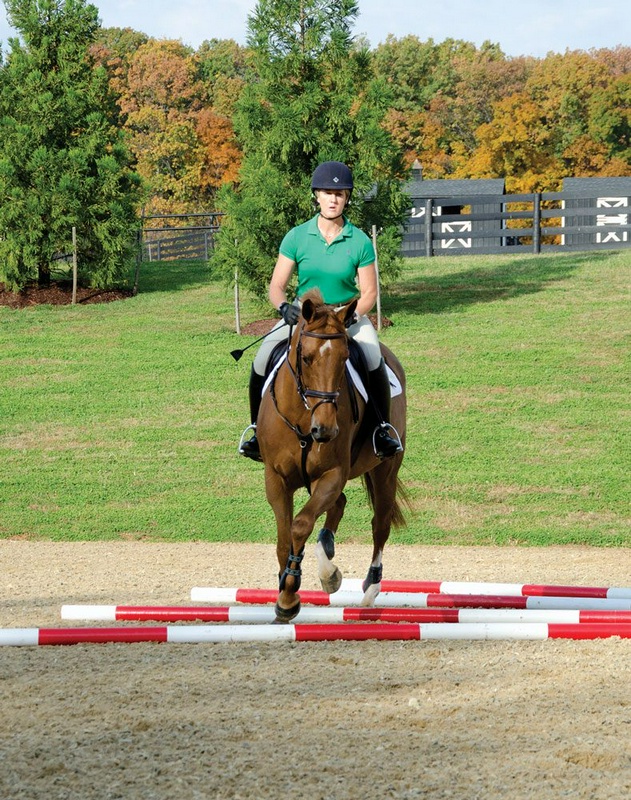
The curved cavaletti pattern you see here teaches horses to maintain their rhythm even when their bodies are bent.
Since the distance between each rail varies from 3 feet on the inside to 6 feet on the outside, Allison Springer has carefully guided Sophia exactly to the right spot on the first cavaletti so that Sophia has room for one stride in between each cavaletti with her normal working canter.
From the degree of Sophia's body bend, it can be seen that Allison's aids are classically correct.
However, every now and then, a question is asked that makes me pause and think more deeply.
In one of the recent clinics, I was explaining the gymnastic exercises I was going to use that day when a young lady raised her hand and asked, "Jim, okay, my horse has a good jump and we can definitely do these exercises, but why do you even use gymnastics?"
I had heard various forms of this question before and gave my usual short answer: Gymnastics, which I mean by placing two or more obstacles at a specified and measured distance apart, helps both you and your horse jump better.
These exercises improve the horse's foot placement, technique, and confidence.
At the same time, you also get the opportunity to make your jump more predictable through repetition and focus on a specific part of your jumping movement each time.
For example, what does it feel like when you land on your ankles, or how do your elbows in the air follow the horse's mouth movement?
While all these reasons are valid, I later thought that gymnastics is a much broader and deeper topic than my short answer suggests; and it would be better to discuss these answers with more detail than what is possible under the time pressure of a clinic.
The next time you jump a set of gymnastic exercises, I want you to keep this sequence in mind, because this is exactly what I am looking for: relaxation, straightness, readiness, balance, and attention.
One of the many advantages of doing gymnastics is that you already know the right answer beforehand.
Every time you take a step or a stride, your mind should be pre-planned for executing the next part of this gymnastic exercise.
When a rider jumps a gymnastic line, their head must remain at a constant level throughout the exercise, and their seat should be as far from the saddle as seen in the sitting-to-standing phase of the canter.
When Allison and Sophia jumped this line, you can see the reason for my statement when I said, "Allison, come again.
Stay a little closer to the saddle and keep your hands lower at the highest point of the jump arc.
" The next time you see Allison, you will notice the results of her hard work in exercises like this.
Measure the distances carefully; one of the features of gymnastic jumping is that the distances used are measured with great precision.
When you set up your exercises, do not rely on your steps; use a measuring tape.
The reason is that the distance you use is designed to have a specific effect on your horse's stride, and you can focus on that effect while executing the gymnastic exercise.
For example, at the beginning of my gymnastic exercises, I place a distance-setting pole 9 feet before the obstacle.
This pole does exactly what its name suggests; it sets your horse's legs for the correct take-off point over the first obstacle.
If this pole is too close to the obstacle or too far from it, you will have incorrect jumps until you measure the distance precisely and place the pole in the right spot.
There is enough variability in training horses; therefore, there is no reason to introduce a variable that we can normally control.
Predictability; I think one of the main reasons that horses and riders enjoy gymnastic jumping so much and benefit from it is that their activity becomes predictable.
When you enter a gymnastic exercise at a canter, you should know the desired outcome in advance.
You can spend your time riding in a predetermined rhythm instead of thinking to yourself, "Oh my God, I hope this one works.
" Because you and your horse are moving in a rhythm, both of you will become calmer, and your confidence will increase.
Calmness is important for several reasons.
When your horse is calm, it becomes easier to teach them to jump with good form.
Most horses jump well when they are free; that is, they use their legs correctly.
They only have problems when we put our weight on their backs and interfere with their mouths.
Gymnastic jumping teaches your horse to jump as well with your weight on its back as it does when it is free.
To achieve this goal, a large part of your initial gymnastic lessons with me will be done on a long or loose rein.
I want you to learn to be a "smart passenger," and I want your horse to become smart and self-reliant independent of your interference.
Only when you are completely confident in the saddle, without putting pressure on your horse's mouth, and your horse can maintain its speed and rhythm without your help, then and only then are you ready for advanced work over obstacles.
Gymnastic exercises do not necessarily have to be performed on flat ground.
These exercises can have the same beneficial effect on cross-country horses and riders as gymnastic work does in the riding arena.
Sharon White is introducing Dan Sheffield, the show, to the practice of bending downhill.
Show had previously become familiar with the concept of single and double bends on flat ground, so this exercise is the next logical step in his training process.
It can be understood that Show is still inexperienced, but he has the willingness to cooperate; he lands a bit short after the first jump.
Sharon corrects this issue by gathering his hind legs at the moment of his landing.
With minimal encouragement, Show operates with much more confidence on the second and third rails.
This exercise is designed on a slope that has a slight downhill, but it is not steep enough for me to call it a steep slope, and it can be jumped from both directions.
Considering that Show is a preliminary level horse, the rails are initially set relatively low, but I never have a problem with setting the jump too low at the beginning.
Once my horse understands the concept of the exercise, I can raise the rails.
The similarities with the educational scale before continuing, mentally note the similarity of this process with the educational scale in dressage: rhythm, relaxation, contact, forwardness, body alignment, and collection.
As soon as you move with rhythm, relaxation begins as well.
When you become calm and stable in the saddle while jumping, then I will introduce contact to you and your horse.
But until your body position is completely stable and your horse has learned to maintain self-control and initiative on its own, I will not teach you and your horse to use contact over jumps.
Once both of you gain confidence, then I will introduce the use of contact while jumping to you.
After the exercise, you and your horse will feel comfortable jumping while maintaining a connection between your hands and his mouth.
Next, still using gymnastic exercises, I will teach you to control your horse's forwardness by lengthening and shortening his stride.
It is hard for me to talk about jumping without mentioning dressage.
You should pay attention to the order in which I talk about changing your horse's stride: first we go forward, then we collect.
This principle in jumping is just as true as it is in dressage.
At this stage, I will introduce gymnastic exercises that teach you and your horse to work with the correct body alignment; in other words, we need to ensure that you and your horse can navigate angles, narrow obstacles, corners, and similar items well.
Just as it is in dressage, collection is the last thing we teach our horses.
Collection while jumping, Jim?
Really?
Yes, really.
Let's address this topic as usual by talking about dressage.
If I ride a 4-year-old Thoroughbred that has just come from the racetrack, keep my upper body straight, apply pressure with my heels, and maintain contact with the reins, what happens?
You guessed it right; I take off like a rocket.
This inexperienced horse of mine leans on the bit, shifts his weight to the front legs, and increases his speed.
This reaction is not what I want, but it is what I get.
Now let's return to this horse four years later and see what a proper training can change.
After warming up, if I apply the same aids as before, the horse responds to these aids by rounding his stride and increasing energy, without changing his rhythm or balance.
Well, this was a simple and general explanation of collection in dressage; but what about collection in jumping with a horse?
Let's consider the same inexperienced 4-year-old Thoroughbred and see what happens to his jump when I take the reins in the air over the obstacle.
He arches his back in the air and, after landing, moves faster than the moment he leaves the ground; almost the same reaction he shows when I take the reins on the ground.
However, after four years of proper jumping training with a horse, if I take a stronger contact in the air, he rounds his back and lands with a collected stride.
Given the continuity and interconnection of modern show jumping paths, the advantages of this are quite clear.
Throughout this column, I have talked about using gymnastic exercises to improve your horse's jump.
However, you should know that gymnastic jumping can also be a valuable tool for dressage horses.
A day of gymnastic jumping can prevent your dressage horse from becoming bored.
It can also help soften and loosen your horse.
For example, if he has stiffness on the left side of his body — which means his right muscles have shortened — you can take him on a circle to the left and over small obstacles, 2 feet or less, in a canter.
After a few repetitions, he gradually lands with the inside hand, lowers his head and neck in the air, and stretches his body while jumping.
Gymnastic jumping is a valuable tool for almost any horse.
About Jim Wofford Jim Wofford, a veteran columnist for Practical Horseman magazine, competed in three Olympic Games and two World Championships.
He was also a highly respected trainer.
Over the decades, from 1978 onwards, he had at least one student on each of the U.S. Olympic, World Championship, and Pan American teams.
He passed away on February 2, 2023.
A version of Jim's book titled Modern Gymnastics: Systematic Training for Jumping Horses is available from www.
TrafalgarBooks.
This article was first published in the February 2016 issue of Practical Horseman.
Source: Practical Horseman – Training