How to be a confident and assured leader for your horse.
We ride and compete because nothing in the world is better for us than the bond between the horse and the rider.
However, we know that this relationship is not always flawless.
I hold many educational clinics for riders at all levels, and I often have to help students whose enthusiasm for riding has been diminished by a lack of confidence in working with their horses.
I don't have a magic formula for boosting a rider's confidence, but I have something close to it: tools that a student can use to solve almost any problem they have with their horse.
My starting point is that in the competitive partnership of your relationship with your horse, there must be a leader, and that leader must be you.
Think about it for a moment.
In this partnership, you are the only one who knows the map; where you are going and what you are doing.
Only you know when to turn right or left in the dressage arena, when you will reach the water jump in the cross-country section, or what the next obstacle is in the show jumping course.
So you must be the leader.
Furthermore, your horse also wants you to be in charge.
A shy horse may need everything from precise commands to encouragement and reassurance, while a confident or aggressive horse may perform better with minimal guidance.
In any case, the key to communicating with your horse, understanding its needs, and conveying your desires to it — in other words, establishing your leadership position — is always the same: training and repetition.
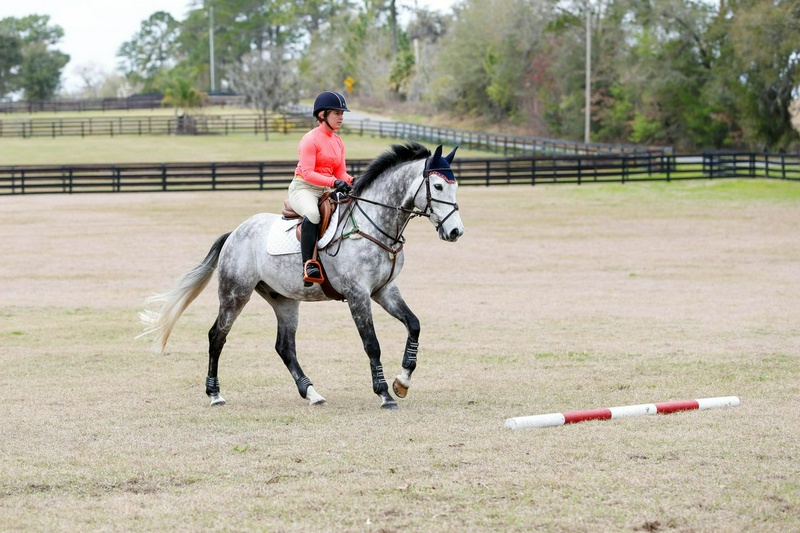
This horse is "Royal Alliance"; the result of "Royal Appearances," a son of "River Man," out of a mare named "My Martina," who was a Thoroughbred steeplechaser.
This horse, owned by "Wits and Eventing" in Thorndale, North Carolina, is now working at the training level, is 7 years old, and was a stallion until late in his 5th year.
Undoubtedly, he has not been an easy horse.
He doesn't underestimate himself!
Therefore, almost everything mentioned in this article is what I have had to do with him.
Since he was gelded late, at every stage of his training process, I have had to clarify that he is not my leader, but I am his leader.
As we will see in these photos, he loves to jump, but I had to convince him that it is I who decides when, where, and how to jump.
Let's start from the ground up.
Riders who face a lack of confidence usually want to focus on issues they struggle with when they are actually in the saddle; however, I recommend thinking about more basic skills first.
Suppose your horse does not stand still when mounting.
For some riders, this is frightening and can be troublesome or even sometimes become a safety issue.
The reality we often overlook is that all these basic skills in working with horses are interconnected.
The essence of the matter is always paying attention to details.
In my experience working with some of the best riders in the world, their horses stand still when mounting.
Why?
Because the rider pays attention to this skill.
Their horses are properly guided because the rider pays attention to it.
They pay as much attention to the work under the saddle as they do to the work from the ground, because they know that all of these are components of a single unit of good horsemanship and good riding.
Of course, we know it is not uncommon for a very good rider to overlook the fact that their horse walks away when mounting for years, until something shows them: "Maybe this has to do with the fact that my counter hand change is always a bit late."
Again, I emphasize, in the horse's mind, all these behaviors are interconnected.
The essence of the matter is whether he knows what you want and whether he does it when you ask him to.
If these simple yet important details have become problematic for you and your horse, your trainer can probably suggest an exercise to teach him to stand or guide you to a groundwork program.
If you can teach your dog to sit, you can teach your horse to stand still.
From the ground: Establishing correct mounting 1.
Aliance stands square and still; something he had never done before.
To achieve this position, we first got help from someone on the ground to hold his reins.
The other part of the work was: if he moves when I mount, I get off again.
Then I mount again, and if he moves again, I get off and mount again.
And if he takes a step aside, I get off once more and mount again.
Again and again.
If your horse is very fussy, it may be necessary to have someone on the ground help you at the start.
If he only wants to move a little and is not really behaving badly, just continue this repetition of getting off and mounting again.
2.
I guarantee that if you persist, your horse will eventually stand calm and still.
It may take some time, but he will reach a point where it seems he says: "Okay, I will stand."
Of course, this is tiring because you want to start your riding, but it pays off.
It took a long time for this horse to reach this point, but the reward is this: now he stands calmly and seems to say: "Alright boss, what should I do now?"
I have the reins soft and relaxed in my hands, and he is just waiting for my next command.
Foundations in motion to maintain that sense of connection and confidence when you mount your horse, have a plan before you place your foot in the stirrup.
Having a plan helps you focus on a specific task instead of concentrating on anxiety, while also strengthening your role as the leader of this partnership; because you define a task for your horse from the very beginning.
Does this seem complicated?
Not at all.
Your plan when you are mounted and ready to move is to set off with a positive four-beat step.
Here we return again to the classic scale of training; the very foundation upon which everything is built: everything starts with rhythm, and rhythm leads to relaxation.
Rhythm is probably the most important skill I teach, and I pay more attention to it than anything else when riding.
If you mount with a feeling of anxiety and tension, maintaining rhythm becomes difficult; because you do not allow your horse to walk with a step and move freely, and as a result, he also becomes tense.
If you have trouble creating a rhythm of the walk with your own body, count in your mind along with the horse's steps: one, two, three, four.
If that doesn't work either, count out loud.
When my students have trouble establishing a steady rhythm of the walk, I ask them to do just that.
When you articulate it and hear it, your body responds to it.
Of course, sometimes the horse should not start the movement with the walk; for example, when it is too cold, stiff, or anxious.
In this case, it is better to start with a trot, but you still need to have a plan as a leader.
I tell my students: "Before your horse determines something for you, determine something for it."
Instead of just trotting around the arena, focus on a specific topic: spirals with a loose rein, from the inside rein to the outside rein, softening one side of the body and then the other, until the horse settles into a calm rhythm and begins to establish contact with your hand.
In this situation, you are no longer worried about your own anxiety; rather, you are using a simple tool to communicate with your horse.
For riders who are used to working in an enclosed space, losing some confidence outside the arena is not unusual.
Riding in a field is no different from riding elsewhere: you need to be sure that you can go wherever you want and move at whatever speed you want.
This is where having a plan becomes important.
Before you even leave the stable, decide how you will keep both yourself and your horse engaged outside the arena with simple exercise patterns and transitions to higher and lower gaits.
You can use this strategy to maintain leadership in all your flatwork exercises.
Basics in movement: Starting off 1.
The starting point is here: Alliance is standing completely square and calm, ready for whatever we are about to do.
My cue for him to walk is to keep my upper body elongated, sit deep in the saddle, keep my legs still, and apply just a gentle pressure with my calf.
When he moves forward, I count in my mind: one, two, three, four.
If the first time I ask him for something, he does not respond as I want, he needs to see the consequence: first, I add a little heel, then a little spur, and if there is still no response, I continue with a gentle tap from the whip until he learns.
Of course, I don’t just leave it there; I don’t want him to think he needs very strong help to walk.
2.
My ultimate goal is to get a response with the least amount of help.
Again, I achieve this through repetition until when I ask him to "walk" with my seat and calf, just as you see here, he starts off with a steady and rhythmic step.
Basic principles in movement: Executing the figure eight 1.
Executing the figure eight or serpentine at a trot is a good way to remind a nervous or restless horse that you are the leader.
This exercise is also a great way to warm him up for the next phase of work: while giving him the opportunity to stretch one side of his body, you are also warming up both sides of his body; then, by changing direction, you help stretch the other side.
Here we pass directly across the diagonal with a good and steady trot.
Alliance moves in a connected frame, even though we are still at the beginning of the exercise and I do not want too much engagement from him.
My contact is the same on both reins, and I keep my sitting-trot light and low.
2.
When we turn left, my head is up, and my eyes are looking at the place I want to go.
My inside rein is soft, and I guide him forward with my inside leg and drive him towards the outside rein; the same rein that determines the size of our arc.
The size of the circles depends somewhat on the space we are working in and also on my horse's physical readiness compared to his level of attention.
If he gets distracted, I want smaller shapes.
Again, everything relates to repetition.
The result does not come in the first circle.
I repeat until I reach the trot I want.
3.
This photo was taken after I and Alliance had worked on this shape for a few minutes.
You can see that while we are crossing the diagonal in the opposite direction of photo 1, he has become more forward and is working more actively from behind.
4.
A few repetitions later, I can now fully feel that connection between the inside leg and the outside rein in the left bend.
See how much his right hind leg steps under his body.
His back has lifted under me and has softened, and he is listening with more attention.
Counter on a pole and halt 1.
This exercise is useful for improving communication with any horse that finds countering over a simple pole on the ground so exciting that he loses his balance or lands with speed afterward.
In this photo, Alliance, who loves jumping, has become a bit excited upon seeing the pole on the ground; a state evident from his focused face and ears pricked forward.
My eyes are up, and I am looking at the place I want to go.
My hand contact is soft, and I am sitting in a light three-point position; my upper body is leaning forward, and my seat only touches the saddle.
2.
I am getting ready to ask Alliance to halt; since he is a young horse, he reaches the halt through the trot.
My seat has come closer to the saddle, my upper body is more vertical, and I have closed my fingers on the reins.
He is still in the counter, but his ears show that he has picked up my signal.
3.
I am here in the sitting part of the posting, and Alliance has returned to the trot so cooperatively that I think to myself: "Wow, this really works!"
As these photos show, a downward transition is always a forward transition: at every stage, I ride my horse up to the connection and give him the opportunity to do what I have asked.
At this moment, I do not pull back on the reins.
With my seat and leg, I send him towards the bridle and remain patient.
Depending on the horse and its energy level, it may not even be necessary to apply more pressure.
If you have a relatively spirited horse, you may need to use more restraining aids until he understands the concept, but he will eventually get it.
4.
If you ride the horse forward in the downward transition, the result will be a square halt.
This halt shows the result of patient repetition.
Alliance is standing completely square with even contact.
His ears are alert but calm, and his tail remains still.
He is waiting for me to tell him the next exercise.
Now, building confidence over jumps is no different from strengthening your confidence in riding in general.
If we assume your horse already knows how to jump, does it go exactly where you want it to in the arena or outside in the training field, and does it move at the speed you have in mind?
If I have a student whose confidence is really low over small and simple jumps, I have no hesitation in taking the work back to ground poles.
When you lack confidence, it is usually because you feel you do not have enough control.
How do you stop the horse when you want to stand still?
How do you get it moving when you want it to?
Do you turn right?
Do you turn left?
Everything — including the scale of the exercise, direction, and rhythm — comes back to this issue in some way.
To feel confident over jumps, you need to know that the control is in your hands.
You can do anything with ground poles.
Canter over one and stop.
Canter over one and stop.
Pass through a series of poles at a trot or canter.
Create a figure eight or even a complete course.
With these exercises, you reinforce the forward and holding aids, as well as the aids for going right and left every day.
With repetition, it can be refined so that whatever goes through your mind, the horse does just that.
In my clinics, we often encounter horses that speed up after landing from a jump.
For a rider who is already a bit hesitant about jumping, this can be a confidence issue.
I use a simple strategy to help my students.
Speeding up after a jump is actually losing rhythm.
I tell students to immediately transition down to a trot after the jump and only take the canter again when the horse is in a calm rhythm.
If you have this plan in mind from the start, your confidence will increase.
It really works.
And if you repeat this downward transition enough, I guarantee that eventually your horse will jump the obstacle and then slow down by itself.
I find it interesting that some riders are hesitant to use this tool, as if they think doing so means they are not good enough.
In fact, I have a favorite memory about this topic.
Years ago, one of my good friends — who is also one of my horse owners — signed us up for a clinic with Greg Best, a two-time Olympic silver medalist in show jumping.
My friend is a relatively beginner rider, and I am a professional at the FEI level.
In the end, we ended up in a group where we were jumping about 2 feet.
I was riding a horse at the preliminary level that I was very proud of, but it was a strong horse, and that day I couldn’t get it to do what I wanted.
It kept speeding up after the jumps, and eventually Greg said, “Your problem is that you can’t maintain your rhythm.
I think you need to make a transition to a trot when you land.
Stay on course, transition to a trot, and then take the canter again.”
It was a solution that simple and that effective.
And my friend was really excited about this experience!
Over jumps: Addressing the rushing after the jump 1.
Aliance jumps from a cross rail to a small oxer, but the amount of extra jump over this small obstacle clearly shows that this is exactly what he wants to do.
I have kept my heel down, my lower leg is in the correct position, and my hand contact remains steady as I move with him over the jump.
2.
You can see his eagerness from the way he approaches this small oxer.
I am in my three-point position during these counter strides, maintaining contact by following his movement and opening my elbow.
3.
Alliance makes another big jump over the oxer; a moment when many young horses start to speed up.
I am in a two-point position, staying with him, maintaining contact, looking ahead, and assessing my next move to prevent him from accelerating after landing.
4.
After landing, I returned to a light three-point and asked for a canter.
Here, a moment later, I have gone to two-point; that is, the rising part of the sitting-rising canter.
Alliance, who prefers to continue the counter, has slightly leaned forward on my hands.
Instead of pulling him back with my hands, I have stabilized my back a bit and used my core to encourage him to shift his balance back.
To do this better, I could have lowered my heels more.
5.
The result is: a transition to canter where he is both balanced and moving forward.
I continue the canter until Alliance becomes stable and calm in this stride, and then...
6.
I look again in the direction I intend to go, ask for a counter, and get an amazing and balanced start in the canter.
When I work with a horse that tends to speed up after jumps, I am ready to repeat this sequence as many times as necessary until he automatically slows down after the obstacle and waits for the cue, because I know this method works.
Don't rush the last point about how to become your horse's leader, which is something Ian Millar, the Olympic show jumping rider from Canada, told me: never rush your horse.
If you don't feel pressed for time, he learns better and more consistently.
If you only have 15 minutes for your horse, you can still accomplish a lot in that time; for example, valuable groundwork.
But before you put on his bridle, you need to clearly define what you want to do.
All the tools I have described will be effective if you are willing to repeat them enough times for your horse to understand what you want.
The basic principles of good horsemanship and good riding are not a magic formula that top riders keep to themselves.
These basic principles are the same things that have always been.
Building confidence means being prepared to recognize these basic principles and repeat them over and over again.
When you become your horse's leader, repetition is also a key factor in dealing with the natural anxiety of challenges like riding on a cross-country course.
The reality is that eventing is a sport that creates fear, and part of its appeal is overcoming that fear.
When you do this over and over again, your fear becomes less about real terror and more about performance anxiety; like, "I hope I don't mess up at jump 6."
In this process, it is essential not to rush to higher levels.
A good leader takes care of those they guide.
Before you move up a level, the current level of competition should seem easy for you and your horse.
If your horse is confident and you have done all the basic principles I have talked about, you are probably ready.
"You can handle it," says Sharon White. "As a rider who is still learning, you want to train alongside someone who gives you the feeling that you can handle it; whatever challenge is in front of you at that moment."
Her training and educational program at Last Frontier Farm in Summit Point, West Virginia, is exactly such a source of encouragement and confidence.
The appreciation of her students is evident to anyone who has seen the wave of support from the orange-clad fans who follow her on the cross-country course.
Sharon's professional path has been shaped by some of the greats of the equestrian sport.
In her early years, she rode with legendary eventers Bruce Davidson and Torrance Watkins.
One of the ongoing influences on her has been Jim Wofford, an international star, who continues to play the role of a reliable advisor for her riding and her overall professional path.
Jim says, "She is a unique package.
She is an outstanding rider and horse person and also a very good coach.
Unlike many top riders, she tells her students what they need to do to improve; not what Sharon herself was doing."
Linda Zang, an FEI "O" judge and Grand Prix dressage rider, also regularly comes to Sharon's farm for coaching.
About Sharon White: Sharon White is an international three-day event rider at the CCI5 level, a coach, and a Level 4 certified instructor of the United States Eventing Association, operating at Last Frontier Farm in Summit Point, West Virginia.
White's record includes over 10 appearances at the Kentucky three-day event with five different horses.
She has also traveled abroad to compete in CCI5 events at Le Lion d'Angers (France) and Les Etoiles de Pau (France), as well as CCI4* events at Boekelo (Netherlands) and Hartpury (Britain).
Recently, she won a team silver medal with Klaus 63 at the 2023 Pan American Games.
This article was first published in the May 2015 issue of Practical Horseman.
Source: Practical Horseman – Training