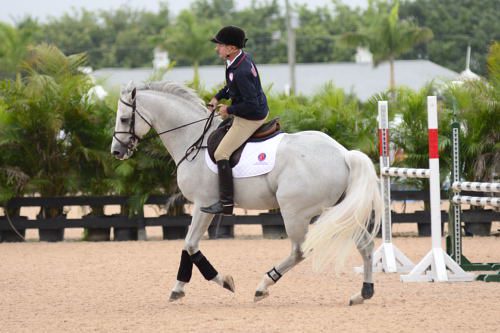
Flatwork without stirrups on the fourth day of the George Morris clinic
[PHOTOGALLERY uniquename=”galleria-azur”] Photos?
________________________________________________________ January 5, 2013?
Every year there is a day when 12 riders present at George's clinic perform the entire session without stirrups and on flat work.
Today was that day.
And although the riders themselves are probably not very eager for this day, the spectators certainly welcome it; because George almost always gets on at least one horse and shows everyone how this work should be done.
He proved that he still has "that ability"; and not just by riding one horse, but by riding two horses, each for about half an hour, without stirrups and with very little break.
And he continues to make it look easy.
In this session, George once again emphasized his previous lessons; on the necessity that the horse must be calm, moving forward, and most importantly, straight.
He used the same lateral exercises and transitions to increase the lateral and longitudinal softness of the horses.
He also emphasized the connection between the rider's inside leg and their outside hand.
When stirrups are set aside, riders can firmly establish their seat bones on the horse's "fixed" back; a matter that allows the horses to accept the aids and be able to round, work from behind, and be more elevated in front.
Although today's sessions were not as long as previous days, George presented numerous teaching points and practical insights.
Here are a few of my favorite points: the rhythm of your horse in turns should be the same rhythm it has in a straight line.
Shoulder-in helps you bring your horse in front of your legs.
From there, just let it go forward towards an increased length of stride.
Don't push.
It is not the horse that determines the length of the reins.
It is you who determines the length of the reins.
When you work without stirrups, the horse must accept your seat and show compliance.
If the horse escapes from the neck area, it is not working correctly.
The horse should come from the hindquarters to the mouth; not by pulling, sawing the hands, or using draw reins.
Ride from back to front and feel the horse's hind legs "dancing."
A sequence of about 10 steps of shoulder-in with 10 steps of haunches-in brings the horse's hind legs more under its body and encourages it to begin to collect.
The lateral work you ask from your horse does not need to be completely flawless for a dressage class.
It just needs to have a gymnastic role for the horse.
Over-bending the neck has become a habit in our country.
Keep the head and neck straight and bend the horse from the middle of its body with your inside leg.
For jumping horses, I do not perform many transitions from canter to trot.
I work in canter because if I am going to jump, I do not want to ask them to shorten and then fall into trot.
Even if the exercise is not flawless, do not prolong one exercise too long.
Mechanical repetition is not the answer.
I never start with flying changes; first, I want the horse to listen to my leg in the counter canter.
The hand should not be "hanging" on the horse's mouth.
I do not care how much pressure is needed for a half-halt.
You must release.
These are performance horses.
We need horses that are lively and competitive.
I do not want them to be flawless.
But they must accept contact with the bit.
When collecting, you should ask the horse to go slower without losing its activity.
Be careful with your legs to keep the horse's rhythm steady.
For a horse with a downward body structure, the simplest way to transfer weight to the hindquarters is to raise its poll.
The second way is to engage the hind leg, and the third is to do both together.
Riding without stirrups helps you feel your horse's balance better.
When performing a downward transition, think about "stretching your spine."
A stretched spine "perches" the seat on the back of the horse.
Lengthening causes the upper line of the horse's body to stretch.
Let the horse "turn around the bit."
Do not pull it down.
Half-pass is just that haunches-in on a diagonal line.
The inside rein is the rein for bending and softening.
Your outside hand should be steady.
Whatever you teach your horse, it may later want to use against you.
For example, it might use shoulder-in to escape contact with the bit or perform a flying change just before jumping.
Contact should be direct, soft, and clear from the elbow to the bit.
If not, I take with my hand and bind my leg.
When the horse gets stiff, it is tempting to be rougher with your hands.
What matters is the release.
In the half-seat, the hands should move backward and upward toward the belly, not toward the front arch of the saddle.
Anger is always wrong because anger is too intense.
When the horse chews the bit and foam comes out of its mouth, it is a sign of softness and calmness.
Impulsion is the mother of the art of riding.
Without impulsion, you cannot do anything with the horse.
Calmness in the horse does not mean being loose.
You still keep the horse under your control and listen to it.
Your first aid is the inside leg; right behind the girth.
This aid is more dominant than the outside leg.
The outside hand regulates impulsion and direction of movement and is your dominant rein.
The inside rein helps soften the horse's jaw.
Never think of the outside rein without the inside leg.
Repeated reverse turns (turning toward the wall) soften the horses and prepare them for turning.
Only the horse's head bends in the direction of movement.
Not the neck.
If the horse enters the counter instead of increasing the trot, this is a backward type of resistance.
Short reins and a soft arm, not long reins and a stiff arm.
Do not make shoulder-in too long in the counter.
This puts too much pressure on the horse.
It might be better to ask for just 10 steps each time.
What is interesting in taking and releasing is the release itself.
Good riders release when the horse responds; great riders do this just before the horse responds.
Working in the opposite counter helps the horse collect.
Turning the horse's head takes its hindquarters off the line of movement.
Leg yield is the first step.
In leg yield, there is no bending.
If the horse gets stiff in transitions, repeat until it softens and responds.
Keep a sharper bit for jumping with the horse.
Use simple snaffle for flatwork.
And my favorite: training the horse means playing.
A play that has structure and boundaries.
This is the summary of our coverage of this clinic this year.
Sources and appendices: www.
usefnetwork.
com Source: Practical Horseman – Training