Speed in cross-country magnifies the rider's mistakes.
You establish your connection with the horse through your body position.
The correct position creates a sense of unity and allows you to connect with it in a subtle and imperceptible way.
This is the foundation of correct riding, and it is amazing how much better your results become when you ride correctly.
In the previous two columns, I examined the correct position for dressage and show jumping with the horse, respectively.
This month, we are going to review the basics of body position in cross-country.
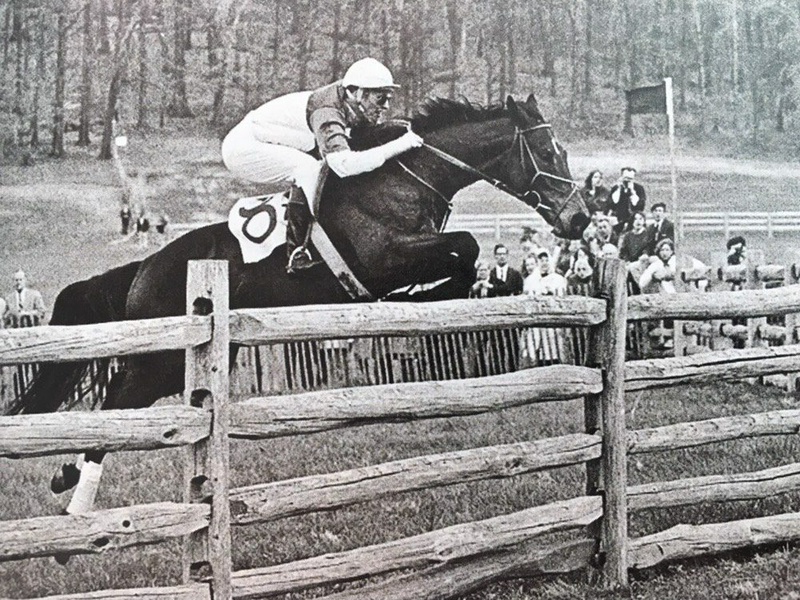
In this image, Louis "Paddy" Nelson is seen on Heffy while jumping the legendary thirteenth obstacle at the Maryland Hunt Cup 1971.
Paddy knows as much about riding over obstacles at high speed as any other living rider.
When he tells you, "Speed magnifies your mistakes," he means that increasing speed over fixed obstacles reveals even the slightest weakness in your body position.
The first thing people notice about the cross-country phase in eventing is the role of speed; a factor that becomes increasingly important as you progress from beginner to advanced levels.
One reason for this is that "speed magnifies mistakes."
This quote is from Louis "Paddy" Nelson; one of the greatest jockeys in our wooden competitions.
Paddy knows well about riding at speed over fixed obstacles, as he has won the Maryland Hunt Cup three times between 1968 and 1989.
In the Hunt Cup, obstacles are made of wooden planks, posts, and rails, with heights that can reach nearly 5 feet.
Paddy's statement is a serious warning that if you want to stay away from accidents and injuries, your basic body position in cross-country must be as flawless as possible, because the speed of this phase multiplies every mistake you make.
You establish your connection with the horse through your body position.
The correct position creates a sense of unity and allows you to connect with it in a subtle and imperceptible way.
This is the foundation of correct riding, and it is amazing how much better your results become when you ride correctly.
At higher levels, shorter stirrups, the correct cross-country position at lower levels (pre-novice to training) is the same as the show jumping position: when you are sitting in the saddle, you should adjust the length of the stirrup so that the back of your knee has a 90-degree angle.
If you are riding at these levels, you are accustomed to this stirrup length due to your work in the show jumping arena.
At these levels, the speed required in cross-country is not that high, and the changes in terrain are not so significant that you need to alter your body position.
However, when the requirements of the levels change, you must also change your position.
From the preliminary level onwards, both your speed and the height of the obstacles increase, and the variety of terrain becomes much more challenging.
As your speed increases, you should shorten the stirrup straps and close the hip joint angle.
This allows you to stay balanced and remain in sync and connected with your horse's movement.
In general, my recommendation is to shorten the stirrup straps by 1 inch for each star level.
That is, at the preliminary or one-star level, you should ride in cross-country 1 inch shorter than the show jumping stirrup length; at the intermediate level, 2 inches shorter, and so on.
Some trainers have recently suggested that we return to a position that was very common in the eighteenth century; that is, standing with straight legs in the saddle and with long stirrups.
Fortunately, scientific research has confirmed that this is not the most effective position for your horse to canter, and therefore, it is not considered the correct position.
I have reviewed this research in the science of cantering.
Regardless of the length of the stirrups, the stirrup leather should always form a vertical line: on inclines, declines, and flat surfaces.
The stirrup leather can only support your weight when it is vertical.
Many riders try to ride in a saddle with shorter stirrups that are essentially not designed for such a position; as a result, when landing after jumps, their feet are pushed back.
Riders who find themselves in this unstable position usually raise the stirrups back to the appropriate jumping length; even if the speed required for their competition level demands that they ride shorter.
If you are going to ride cross-country at speed, you are responsible for doing so with balance and coordination for your horse; and the shorter you ride with the stirrups, the more physical fitness you need to be able to sit still and calmly in the correct position at speeds of up to 20 miles per hour.
We ask our horses to do difficult things; we should not make their work harder by interfering with their natural movements.
You can also improve your physical fitness to some extent while practicing this position.
In both warm-up canter sessions and gym canters, adjust the stirrups at least one hole shorter than the length you use at your competition level.
Perform warm-up canter sessions in a two-point position instead of posting.
If you listen closely, you can hear my laughter; most of us cannot go three five-minute canter sessions in a two-point position, let alone stay in that position during gym canter sessions.
Even if you may not succeed, keep going.
Along with preparing your horse physically, make your own physical fitness a serious project.
When you cross the finish line with a clear and fast round and feel that both you and your horse can return to the start line and go through the same course once again, then you will see that these efforts were worth it.
Working with short stirrups is hard, but when you return the stirrup leathers to your competition length, the correct sitting and riding position becomes instinctive for you.
In my February column, I talked about the beneficial effects of riding without stirrups.
Riding in dressage without stirrups makes your body position more independent; when you take the stirrups again, you feel like the stirrups have become shorter, even though you haven't changed the length of the stirrup leathers.
Similarly, after practicing cantering with very short stirrup leathers and then lengthening them to the appropriate competition size, you will feel like you have ridden with longer stirrups than you actually have; and this will give you more confidence and assurance in your cross-country position.
Replace sensitivity with stability; speed in cross-country also requires a few other adjustments.
You may remember that in show jumping, I want you to place your chest of the leg on the stirrup tread, so that your little toe rests against the outer branch of the stirrup.
But when you start cantering at higher speeds, push your leg a little deeper into the stirrup and rest your chest of the leg against the inner branch of the stirrup.
This position of the leg is not as soft and sensitive as the show jumping position, but it is safer.
The shorter your stirrups are, the more severe the penalty for losing them will be; remember that speed magnifies mistakes.
When you are competing in rain and mud or have just crossed a deep water obstacle, the treads of the stirrups and the soles of the boots may become slippery.
In these conditions, I recommend that you place your foot completely "in" the stirrup; that is, the foot should go forward in the stirrup enough that the heel of the boot reaches the tread of the stirrup.
There are situations where it is wise to sacrifice sensitivity for safety.
Keep in mind that when you are going to canter, keep the reins shorter.
If you adjusted the reins while you were sitting in the saddle, when you rise to the two-point position, you will notice they are too long because your upper body will be closer to the horse's neck.
Bruce Davidson, as an eventing rider, is famous for winning an Olympic gold medal and a world championship.
What we need to think about is that his results are based on a deep and complete understanding of all three disciplines that make up eventing: dressage, show jumping, and cross-country.
In this picture, Bruce is seen on Apollonax crossing the thirteenth obstacle at the Maryland Hunt Cup 1983, and it seems he has come out for a quiet counter on a Sunday.
His confidence stems from the secure placement of his lower legs.
His stirrup leather is slightly behind the vertical line; this means Bruce has seen the "long distance" on approach and has gathered his legs to ensure Apollonax takes off from the obstacle with proper placement.
His slightly defensive upper body confirms this interpretation.
At this speed, the slightest hesitation or slip can throw you out of the saddle.
Bruce makes sure that when his horse lands, it is in a safe balance.
When eventing riders get used to competing over wooden obstacles, the speed of higher eventing seems slow in comparison.
Calmness at peak speed Now that you have made all these adjustments, it is time to talk about your actual body position when cantering in cross-country.
Cross-country courses usually have between 20 to 30 jumping efforts.
This may seem like a lot, but to complete the course, you need to take several hundred canter strides.
What I mean is that you spend much more time cantering than jumping.
So now that you have a suitable saddle for cross-country and have matched your fitness level to your horse's, it is time to discuss a position that is both safer and more efficient for cantering in cross-country.
The terminology is different, but to be in the most efficient canter position, you should be in a position that I call "two-point"; that is, your weight is on your knees and ankles, and your body remains suspended above the horse's back.
I want you to keep your seat close to the saddle while cantering, without sitting on the saddle or, worse, bouncing up and down in the counter or canter.
Your back should create an angle of approximately 45 degrees with the ground, and your elbows should be well ahead of your hip bones.
When you practice your body position in dressage and jumping with your horse, you can often check your position by looking at the mirror in the arena.
Although this is not possible in open spaces, we can all ask a friend to take a few photos or a short video with a smartphone.
Make sure you absorb your horse's movement with your knees and ankles, not with your hip joints.
You should feel as if you are standing on a trampoline, with the surface of the trampoline lifting your knees towards your hips and then bringing them back down.
When preparing your horse's body, look at your shadow; does the distance between your seat bones and the saddle remain constant, or does your upper body move forward and backward?
If you can see this extra movement yourself, your horse will feel it too, and its balance will be disrupted.
It is easy to understand that you must be calm and still in the saddle during the canter and gallop, but executing it is difficult.
You should carefully review your own videos, watch other riders who have found the balanced gallop, and continue until you find the right answer.
Success in modern eventing requires technical perfection in all three phases.
It is not enough to just study the nuances of collection in dressage or achieve precision in approaching jumping obstacles.
You must examine every aspect of your cross-country riding because, ultimately, speed magnifies mistakes.
About Jim Wofford Jim Wofford, a veteran columnist for Practical Horseman, competed in three Olympic Games and two World Championships.
He also became a five-time national champion of the United States.
In addition, he was a highly respected coach.
Throughout several decades, starting from 1978, he had at least one student on each of the United States Olympic, World Championship, and Pan American teams.
He passed away on February 2, 2023.
Source: Practical Horseman – Training