Cross-country training for better course control
1.
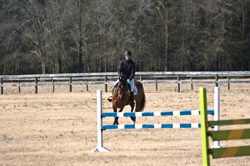
When I turn towards the first obstacle, I see a straight passage through the center of all three obstacles and keep Fernhill Frolic straight and balanced between my aids.
| Photos by Amy Catherine Drago.
As eventing riders progress through various levels, it’s not just the increasing size of the obstacles that challenges them.
The precision questions that become increasingly difficult and their bases are visible from the same training level on the course often surprise riders who have just reached a new level.
They soon realize how quickly the obstacles come up and how fast their reaction needs to be.
Preparing for angled combinations and turning questions does not require taking the horse with a trailer to the cross-country course.
In fact, familiarizing your horse — and yourself — with these challenging questions should start at home in the arena; a place where you can adjust the height of the obstacles and eliminate the slope and other complicating factors from the equation.
In the May 2010 issue of Practical Horseman titled "4 Exercises for Better Control in Cross-Country," I introduced four exercises taken from a training video by the eye of the rider; a video I produced with my colleague and coach Jim Wofford.
These exercises simulate cross-country course questions; questions that are seen from the training level up to advanced.
These exercises test your skills, identify weaknesses, and help you develop a key tool that can significantly improve your ability to respond to challenging questions of control: your eyes.
Learning to look where you want to go — and doing this quickly in difficult combinations — helps you place your horse on the right path and ensures you have the maximum time possible to prepare for the next obstacle.
As Jim says in the video: "The rider's eyes control the horse's path.
.
.
If I can get you to look where you’re going, I can almost guarantee that your performance over jumps will improve."
3 obstacles angled to each other (2 strides) 2.
When obstacle 1 disappeared between Frolic, in this exercise, which is a variation of the fourth exercise in my magazine article, you will navigate three obstacles set at right angles to each other in two direct strides.
This exercise simulates questions that typically aren’t seen until the intermediate and advanced levels in cross-country.
This exercise is for experienced horses and riders and should not be attempted unless you are completely proficient and established in all other exercises.
Layout first set up the middle obstacle, then walk 25 feet from the outside of one base, turn 90 degrees, and place the inner base of the first obstacle.
Complete the construction of this obstacle so that it is perpendicular to the middle obstacle.
Return to the middle obstacle.
Walk 25 feet from the outside of the other base, turn 90 degrees, and place the inner base of the third obstacle.
Complete the construction of that obstacle so that it is also perpendicular to the middle obstacle.
To start, keep the height of the obstacles at least one foot lower than your competition height.
The skills you practice prepare for the obstacles and react to them in situations where the distance between them is much shorter, improving your horse’s rideability.
3.
I jump over obstacle 2 and shift my focus to the center of obstacle 3. The way to execute this exercise is to assess the alignment of your horse's movement and accuracy.
With only two strides between the obstacles and the angle changes that tempt the horse to drop its left shoulder between obstacles 1 and 2 and exit to the right between obstacles 2 and 3 (or if you’re not careful, before obstacle 1), your horse must remain completely straight and evenly between your hands and legs.
Any deviation to one side or falling onto one shoulder must be corrected in the same stride it occurs; there is no room for major corrections here.
Like exercise 3, do not turn towards the first obstacle until you see a straight line between all three obstacles.
Then be ready to shift your gaze from the center of one jump to the center of the next jump and then the next.
Eye correction: In this exercise, there is no room for error; you cannot be slow in using your eyes.
If you do not look for the next obstacle at the moment the one you are jumping disappears from your horse's ears, you will not have time to recognize whether you have gone off the correct line or not, let alone react in time to correct it.
4.
Above obstacle 3, it can be seen that Frolik remains completely straight and in the center of the path.
Doug Payne competes at the FEI levels in eventing and dressage and, from his current base at Misty Hollow Farm in Oldwick, New Jersey, focuses on training, exercising, and selling horses.
He is a graduate of the Rochester Institute of Technology with a degree in mechanical engineering and also holds a judging license and technical delegate position for the United States Equestrian Federation in eventing.
He recently placed second with Petty Springsteen and the horse Running Order, one of the horses featured in the rider's eye training video, at the Fair Hill International CCI**; a joint project with Olympic rider and coach, Jim Wofford.
For more information, visit www.
dpequestrian.
com.
For more exercises to enhance your eye and improve horse guidance, refer to Doug's article "4 Exercises for Better Control in Cross-Country" in the May 2010 issue of Practical Horseman magazine.
Sources and attachments: www.
HorseBooksEtc.
com Source: Practical Horseman – Training