His practice for confidence in cross-country.
The last thing you should worry about when riding in cross-country is whether you will reach the obstacle safely if you don't see an ideal distance.
There are few riders who can stay flawless throughout the entire course.
But more importantly, when your horse expects you to tell him exactly when and how to jump at each jump, he loses his initiative; and along with that, he also loses his innate and brilliant ability to use his ballet-like foot movements to get out of trouble.
A safe jump has little to do with seeing an ideal distance.
What matters is your reaction speed and your ability to keep the horse in the right balance, with the appropriate forward driving force and awareness of his path as he approaches the obstacle.
If you provide all of this, the horse can focus on the task ahead and make decisions for himself.
Next, I will introduce an exercise that helps you build these skills.
The "V" layout of the exercise can be performed by riders at all levels, as long as they are comfortable jumping small obstacles, and it can be executed both in the arena and in the field.
For this exercise, you need two jump standards, two poles, and a plastic block—or a similar support—that is used to raise the cavaletti.
To set up the exercise: place the two jump standards 8 to 10 feet apart.
Angle the standards so that the side with the cup of the jump faces a block that is about 12 feet away and positioned in the middle of them.
Place one end of a pole on the block and the other end in the cup.
Repeat the same with the second pole and the second standard to create the "V" shape.
The jump does not need to be large; it just needs to be high enough for the horse to make an effort to jump, but low enough that you can do many jumps without tiring him out.
For this exercise, you need two jump standards, two poles, and a plastic block for raising the cavaletti or a similar support.
First, you should jump through the standards and over the block, meaning jump from the tip facing outward; this is the easier version of the exercise.
Entering in a canter from the open end and exiting over the tip of the "V," you turn your legs into sensors and guides and send the horse forward.
If your horse makes a mistake, don't worry.
He learns very, very quickly.
Once you have completed the first exercise and your horse is comfortable jumping over it, you can reverse the direction and jump from the tip facing inward, meaning start by jumping over the block, which is more challenging.
By guiding the horse in a canter over the tip and entering towards the wider side, you provide him with a direct and focused plan for the path ahead.
Next, I will explain how to ride these exercises more precisely.
Remember the tips for success with the acronym E-L-B-O-W.
You are training initiative in your horse, but you still need to establish three vital characteristics: forward driving force, line of movement, and balance; that is, ELB in the word "elbow."
And OW is what results if you cannot build a horse that goes forward.
Start your horse's engine.
This means keeping your horse completely in front of your leg and ensuring he takes you toward the obstacle.
Find your line.
Show your horse where you intend to go and keep its focus on that path.
To do this, wrap your legs softly and continuously around its body and guide it along a path resembling a tube between these two legs, passing through that straight path.
Avoid sudden forward body throws.
The horse's balance, in simplest terms, is like a seesaw.
If you lean your weight on the front part of its body, that part goes down; if you sit on the back part, the front of its body goes up.
Therefore, you should keep your upper body back and not suddenly throw yourself forward during jumps.
This is an instinctive movement, but if you are even a little forward and your horse takes a shorter step, stumbles, or hits an obstacle, you might fall off the saddle.
Even if you don't fall, you will shift from your position and disrupt its balance; and nothing destroys a horse's confidence faster than this.
When you can fairly and completely bring your horse directly to a difficult obstacle by managing the engine, line, and balance, it will learn on its own where to separate.
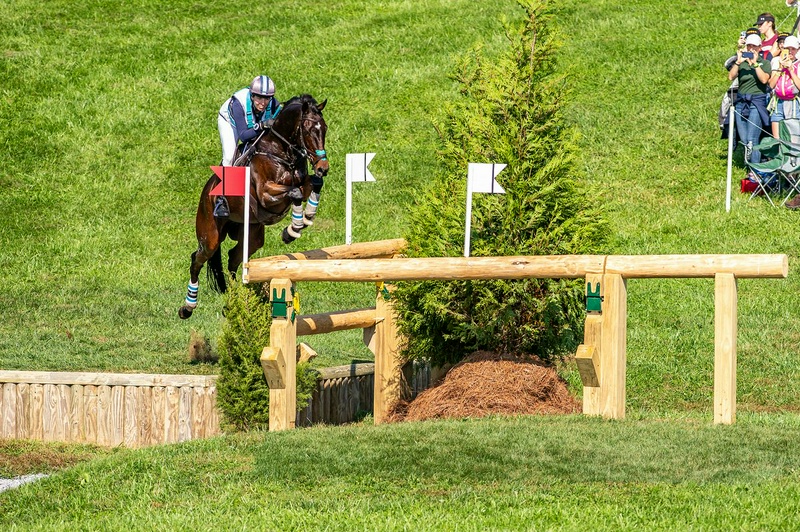
In this image, Boyd Martin and Federman B are passing through a corner obstacle in the CCI5* cross-country competition of the 2025 Kentucky Three-Day Event.
Maintain a steady connection with your horse's mouth.
This connection should be elastic and soft, not a choking pressure.
Without it, the horse is like a tightrope walker without a balance pole; ready to fall.
If it pulls you along, with a half halt tell it: "In this elastic contact, hold yourself."
But this should be done momentarily and then soften the hand.
If it pulls again 10 steps later, give the same reminder.
Eventually, it will understand that you do not like this pulling.
Let your horse find the separation point on its own.
This part is difficult, but when you teach it to be mindful of you by approaching the obstacle fairly and directly while maintaining the engine, line, and balance, your mistakes will decrease, and soon the horse's initiative will come into play.
It will start looking at the obstacle and find the appropriate separation point on its own.
After a jumping path, stop straight.
There is no need to stop in a specific number of steps.
Just make sure you stop in a straight line.
This is one of the best ways to teach the horse to listen and to prompt it to sit back.
Even if it is inherently a forward and fast horse, stopping straight will quickly instill a sense of discipline and also more power in its hindquarters; the part that will be more ready to engage.
Keep your foot on the horse.
For a quick reaction, you need to sense what is coming and face it using your leg as a sensor.
This is not a stiff and hard leg; it is a soft and accompanying leg.
This is not a "go faster" leg; it is a "come here and stay straight and balanced" leg.
That is, your leg is softly wrapped around the horse's body to sense the moment it loses its driving force, bends to the left, or veers to the right, and be ready to correct it.
If your horse is slow to the leg and you apply leg, it should be responsive.
If it is very sensitive, just a gentle pressure will be enough for it.
How to ride this exercise First, jump from the easier direction; start the exercise by jumping from the side you need to pass through the standards and jump over the block known as "point out"; this path is easier.
1.
Enter with a sitting-rising canter and go straight through the standards to just in front of the block in canter.
Keep your gaze up and focus on a point beyond them, and gently keep your lower leg around the horse to maintain its focus, bringing it towards your hand and keeping it in front of your lower leg.
2.
Maintain a soft and elastic contact, and in the last half-second, when the horse is almost at the top of the obstacle and it’s too late to speed up, apply a little pressure with the legs that have been around its body.
It should jump straight over the middle of the obstacle.
If you apply your legs one or two steps too early, it may speed up; if you apply them too late, it may drift to one side.
This may not be the easiest jump, and you may even miss the movement; however, it should be straight.
3.
Land, continue straight to the counter, collect the horse with your rhythm, and bring it to a complete stop.
Then repeat the exercise.
Correction: If your horse wants to take control and run, rise more slowly in the sitting-rising canter and think about "walk" in the last step.
You are not actually supposed to walk, but you should reach the feeling of "wait."
Jump the harder direction 1.
Go towards the block with a sitting-rising canter, this time from the tip of the obstacle.
In such a jump, the horse may feel a bit constricted, so make sure your legs are softly around it; a soft but alert presence that senses what’s happening keeps it straight and ensures that your horse takes you along to think only about "forward."
Help its balance by maintaining contact and minimizing your body movement.
2.
Keep your eyes up and again, at the last moment, when it’s too late to speed up, apply your legs.
3.
Exit the obstacle with a counter, collect the horse, and bring it straight to a complete stop.
Correction: If your horse drifts sideways or escapes from the obstacle, do whatever is necessary—without circling—to get it over a pole in any shape and at any point, even if the jump is not beautiful and the pole falls in front of you.
You should never give your horse the choice to escape from the obstacle or refuse to jump.
Summary After this exercise, your horse will think about how to jump the obstacle itself and will become very straight.
You will gradually realize that you can approach the obstacle almost with any type of technical question, at an angle, and even without a perfectly ideal distance; and this gives you and your horse confidence.
We thank Dekra for supporting our coverage of the 2026 Kentucky Defender three-day event.
This coverage includes preparatory events, interviews with riders, competition reports, horse introductions, photos, videos, and more.
More content: To see more of our coverage of this year’s Kentucky Defender three-day event, click here.
About Lucinda Green Lucinda Green, a silver medalist from the Olympics in Britain and an MBE, has an outstanding record in eventing.
She has conquered the Badminton Horse Trials with a record of 6 championships, each with a different horse, and has also won twice at the Burghley Horse Trials.
She became the world champion in 1982 in Luhmühlen, Germany, and also won 3 team gold medals at the European Championships.
Lucinda has also won the Tony Collins Trophy 7 times, awarded for the highest British Eventing score in a single eventing season, and in 2008 she received the Outstanding Contribution to Equestrian Sport award.
Although she still competes, today she is also recognized as a cross-country coach at the international level, an equestrian sports journalist, and a commentator.
This article was first published in the Spring 2020 issue of Practical Horseman.
Source: Practical Horseman – Training