Different training program for eventing and dressage horses
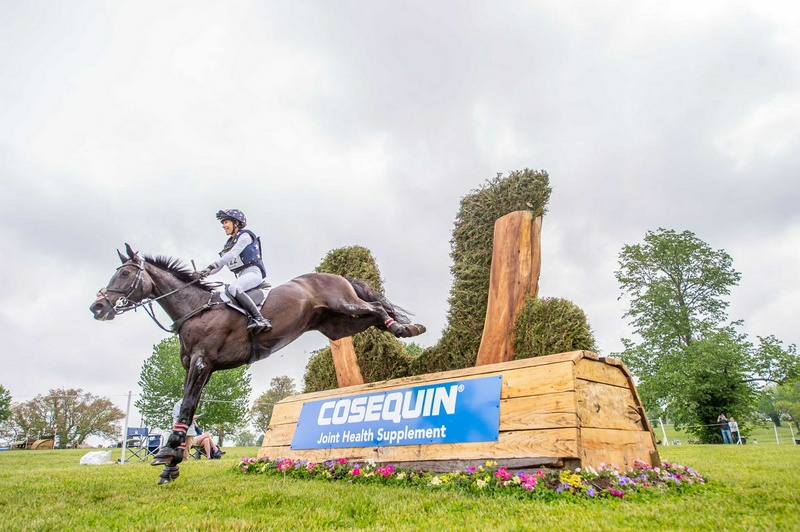
Laine Ashker, a five-star eventing rider and Grand Prix dressage rider, spoke about reaching high levels in both sports during a special webinar for members of "Practical Horseman Plus" titled "Learning from Multiple Disciplines," which took place in October.
Here, she explains how she prepares and trains her Grand Prix dressage horse Zeppelin and her four-star eventing horse Lovedance, and why she takes her horses out of the arena in both training programs.
Question: How do you manage two different training systems for eventing and dressage?
Answer: The feeding program for the horses is different.
Their fitness program is also different.
My dressage horses do not need to go at a gallop, but at the same time, they shouldn’t be confined to the arena seven days a week.
That’s why I strongly believe we need to do the necessary dressage work, but alongside that, we should have days of outdoor riding and days of fitness training; days when I work them in a trot uphill and downhill for 10 to 20 minutes because I believe that cross-training is very important for dressage horses.
It’s very easy to get stuck in the dressage arena, and then the horses become bored.
Eventing horses need to do everything.
They need to jump.
They need to work on dressage.
They need to be lunged; they need to do trot sets and gallop sets.
Maintaining this balance is challenging.
Eventing horses usually have more Thoroughbred blood, so given the amount of calories they burn in work, I never have to worry about them being overweight.
Moreover, you actually want their bodies to be more compact.
For the level that "Lovedance" competes at, a heavy horse is not suitable.
He is inherently a big horse.
You don’t want him to be too heavy, but you also don’t want him to be too lean because he needs to have muscle.
There is a very fine line here.
Dressage horses can carry a few extra kilos because they use that for muscle building.
When I first entered the sport of dressage, I thought these horses were like show ponies.
I imagined they were all overweight.
At that time, I didn’t understand how much fitness a dressage horse needs to perform a Grand Prix test.
It’s really incredible.
They are not fat; they are like bodybuilders, while eventing horses are more like CrossFit athletes.
So you need to create a program for these horses that provides the best physical structure, fitness, and mental and physical health.
Question: How does Zeppelin's fitness compare to Lovedance's?
Answer: The type of muscle building you want for dressage horses is different from that for eventing horses.
What you see for an eventing horse is more based on endurance.
When you work on a jumping session and jump 10 jumps in a row, it creates a different type of muscle structure compared to when you work on leg yields, half-passes, and pirouettes.
Mondays are usually rest days, and Tuesdays are typically lunging days for my eventing horses.
I really enjoy lunging.
I like to closely observe my horses and see how their bodies feel.
I always start them without a helper rein.
Some horses never work with a helper rein because they just want to stretch and work on the poles; others may use it depending on their training program.
This also creates a better connection between you and your horse.
When you can use voice commands and the horses understand them, I think a closer bond is formed.
The goal is not to tire them out; the goal is to create better communication and to see the quality of their movement and their physical condition.
After that, we usually have a dressage day for all the horses, and then a jumping day is scheduled for the eventing horses.
On jumping day, Zeppelin does about 15 minutes of canter uphill and downhill on the hills.
This canter is not fast.
The horse is on the bit, and when going downhill, it should collect; it might even take a few steps of passage.
When going uphill, it pulls its body down and moves more elongated.
If someone has seen the Olympics or competitions where these Grand Prix horses participate, they know they must be incredibly fit; not just physically, but also in terms of endurance.
You perform a 6.5-minute freestyle test, where the pressure is fully on you the entire time.
The horses must be ready, and I take this very seriously.
For Lati, there was at least one 40-minute canter session in the program to prepare for the final of the American Open Eventing.
In these kinds of workouts, you really get used to listening to Apple Music.
His last Chaharnal was a 12-minute counter, but normally his program consisted of three 5-minute counters, with a bit of sprinting and 2 minutes of walking in between.
Everything really depends on the conditions.
My two young eventing horses do not work in canter until they are ready for the three-star level; because the canter workouts we do for endurance keep them very fit.
If there is a real warmblood, I start the canter work from the two-star level.
If it has more blood, like these two young horses of mine, they do not enter the canter program until they reach the three-star level.
When I was in Wellington, Florida this year, I really got used to using the aqua treadmill.
If you go to a specific center that offers these services, it is not necessarily expensive.
It’s clear that none of us have an extra $300,000 to buy one of these machines, but using it was very cost-effective.
I’m almost sure that when I bought sessions in bulk, the cost per session ended up being $40.
There are no hills in Wellington, so to prepare Lati for competition at the four-star level, the amount of work done in just 10 minutes on this aqua treadmill from the upper body area was amazing.
I make sure to do this every year.
I think this is essential for the horses; whether they are recovering from an injury or, like my horses, when they just need to get fit without pressure and strengthen their physical foundation.
Unfortunately, I do not have access to such a facility here in Richmond, Virginia, but when I am in Wellington, I try to take advantage of it.
People in Ocala or Kentucky have access to these aqua treadmills, and they are really amazing.
I dedicate at least one day in my horses' work schedule to hacking, and this applies to all horses.
They should be able to go out on trails.
It is important that my dressage horses also cross water.
Competitions come up where it has rained and the ground is wet, and they need to trust me.
I work a lot without a saddle with both of my horses, and I think this really helps improve my seat.
I care a lot about the relationship.
I don't do much riding with other people's horses.
I usually don't take a lot of horses to quickly bring them up to higher levels.
I go at a steady pace and really enjoy the relational aspect that develops in horsemanship.
In addition to special member webinars, get acquainted with all the benefits you enjoy as a Practical Horseman+ member here.
Click here to read more articles with Lynn Ashker.
About Lynn Ashker: Lynn Ashker, a five-star eventing rider, competes with her mare Loudoun in the cross-country phase of the Cossquin Lexington CCI4-S at the 2026 Defender Kentucky Three-Day Event.
Thanks to her mother, Valerie, the horses were part of Lynn Ashker's life even before she was born.
This early familiarity shaped Ashker's subsequent equestrian journey; to the point where she became interested in retired Thoroughbreds from racing.
Ashker made her five-star debut at the age of 21 with the retired racehorse It Saint James Place.
She has now competed with 16 horses in FEI competitions and has over 100 international starts, including several appearances at the five-star level.
This summer, Ashker, along with Loudoun, became the champion at the Maryland International CCI & HT at the CCI4-S level and also placed second at the Plantation Field CCI4*-S in September.
In recent years, Ashker has become more serious about dressage at higher levels and completed her first CDI in 2018.
Since then, she has earned a USDF gold medal and recorded her first CDI victory with Zeppelin in May 2023.
She has also competed at the Grand Prix level with Boogie Woogie and Atlas.
Ashker is the first athlete to compete in both the U.S. Equestrian Federation's dressage and eventing competitions.
Source: Practical Horseman – Training