The role of "reference point" in improving horse jumping
As usual, I will start the discussion with history.
Most people in the world of hunting, show jumping, and eventing have heard the name Bert de Nemty to some extent, but few know exactly why he is so well-known.
The answer is simple: he brought a completely integrated educational system to the United States as the coach of the U.S. eventing team.
By training horses and riders in dressage, he enabled riders to have better control over their horses.
All of us who ride and train any type of show jumping horse owe him a debt of gratitude forever.
Just as we pay homage to General Harry Chamberlin's teachings about the rider's body position over obstacles by keeping our heels down every time, when we work with our horses on flat work — even though we often may not realize it — we benefit from de Nemty's educational system.
(I think I know what flat work with a horse means, but honestly, I'm afraid to ask.)
Reference points Since we use two different body positions for dressage and show jumping in our equestrian sport, it is necessary to employ two distinct methods to communicate with the horses as well.
I teach my riders to use the body position appropriate to each section of eventing.
Dressage requires a position that I call "three-point," as the rider sits deep in the saddle, with their weight on the two sit bones and the pubic bone.
I also call the jumping position "two-point"; that is, a position where the rider leans on their two knees.
When you think about these two positions, it is clear that the dressage position is much more suitable for transmitting subtle effects from the rider's lower back and sit bones, while show jumpers need to rely more on their heels and hands for communication.
It is true that show jumpers bring their seat closer to the saddle as they approach the obstacle, but at the same time, they must also close their hip angle to stay in sync with the horse's movement.
This clearly reduces the effectiveness of the seat aids.
If they keep their upper body completely vertical and straight, they fall behind the horse's movement when jumping and usually hang on the reins to maintain balance and stay on the horse, pushing with their legs.
When dressage and show jumping conflict, like many riders, I was initially taught to keep my gaze above the obstacle; but when I focused my gaze into the distance, all I found was an endless number of strides.
When I focused my attention on the top rail, my accuracy improved dramatically.
I had learned that, generally, a horse sees clearly where its nose is pointed, and the rider must also focus their gaze on a specific point so that their eyes are focused on that point.
For the horse to see the obstacle clearly, we must allow it to bring its nose forward toward the obstacle; therefore, keeping it in the classical dressage frame as it approaches the obstacle disrupts its vision.
To find their appropriate stride, I want both of my athletes to look at one thing at the same time.
Without a fixed reference point, it is impossible to measure the distance accurately; here, that point is the top rail of an imposing vertical obstacle.
Adrian Sternlicht and Cadence Z are clearly thinking about one thing in a moment.
In a fraction of a second, the pole leaves Adrian's field of vision between Cadence Z's ears, and he will realize that his horse is on the verge of taking off from the ground.
Modern riders fully understand that they should use dressage to train their jumping horses on the ground; that is not the issue.
The problem arises when riders try to directly apply the principles of dressage to jumping.
Let me give you an example.
It is clear that we want the horse to see the obstacle as it approaches.
Veterinarians have different viewpoints, but in general, there is consensus that a horse sees clearly where its nose is pointed.
However, if we approach the obstacle while the horse's head and neck are in the correct position for dressage, meaning its face is perpendicular to the ground — or nearly perpendicular to the ground — we actually hinder its ability to see the obstacle.
This often leads to something that the rider perceives as "resistance," while in reality, the horse is trying to open its neck and raise its nose to see the obstacle and gauge its effort and adjust its foot placement.
The goal of dressage is to enhance our ability to control our horses; we hope that after a long period of regular training, our horses will willingly and generously offer their strength to us.
Due to the two different positions I mentioned earlier, when we insist on applying classical dressage directly to our jumping, we encounter problems: the dressage position is based on sitting, while the jumping position is based on the stirrups.
I regularly face this contradiction.
A new student who is currently practicing over 3-foot obstacles at home and jumps at a height of 2 feet and 9 inches in competition complains that her horse is passing through her half-halt and pulling her to an irregular point for take-off.
I ask her to approach an obstacle and show me.
As soon as her horse starts to move faster, she applies the classical aids for the half-halt as usual: she straightens and verticalizes her upper body, tightens her back, and closes her legs against her resisting hands.
The result is the same: the horse raises its head, inverts its back, and runs toward another unsuitable distance.
When I ask her about this, she replies that she has been taught to "collect the horse like a spring and keep its weight on the hind hands so it can jump."
Very well, I say, let me ask you a question.
Among all the types of horses that jump — from steeplechase and equitation horses to show jumpers, hunters, and eventing horses — which ones have the best form over the obstacle?
Most riders usually respond: "Show hunters."
Then we talk about the frame that hunter riders present their horse to the obstacle with; the degree of compactness in those horses' bodies, the amount of contact from the rider's hands, the level of support from the rider's legs, and such matters.
Although technical crossover between disciplines in equestrian sports has unfortunately decreased these days, most eventing riders have at least seen the execution of hunters.
They are usually surprised when they realize that the best show hunters jump with admirable form from a height of 4 feet; and they are even more surprised when we talk about the fact that show hunters are consistently on the hand — although with excellent balance and rhythm — and jump without rein support and with a clear lack of help from the rider's leg.
Instead of a half-halt when approaching the obstacle.
.
.
Here, I usually skip my long speech about the messy jumping technique of show hunters and get to my conclusion: a horse does not need to coil up like a spring to jump well.
Show hunters are not my only example of good jumping horses; on the other end of the speed spectrum, good steeplechase and timber competition horses are also exceptional jumpers, they too are just as much on the hand and show no signs of tension and coiling in their dressage.
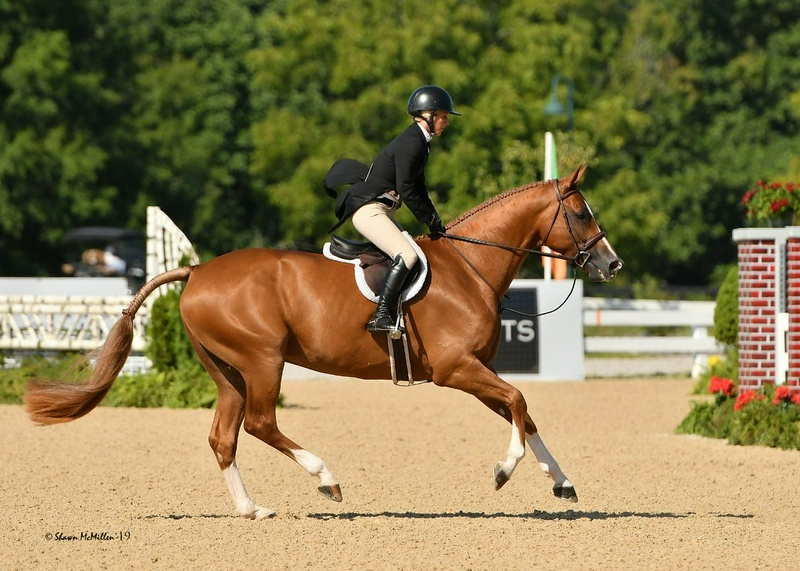
I am often told that to jump, a horse must "coil up like a spring," but I always disagree with this opinion; because I have seen working hunters jump from a smooth, balanced, and pleasant stride with impeccable lightness; just as you see here in the performance of MTM Heirs To You and Natalie Hagen.
Hunters are shown with a soft rein, with minimal pressure from the legs to drive or the hands to restrain; and all this while clearing obstacles up to 4 feet and 3 inches.
On the other end of the speed spectrum, timber competition horses also jump from obstacles up to 4 feet and 3 inches while moving on the hand at a speed of 30 miles per hour, maintaining balance, while their jockeys keep a consistent contact with the reins, without making any effort to "find the stride."
The key to success at both ends of this speed spectrum is balance; the best hunters and timber competition horses approach the obstacle, jump, land, and move away, all at a steady speed.
The horse's speed may change, but the balance must remain unchanged.
After this discussion, I ask the rider to approach the same obstacle again, but this time with a very light seat in the saddle, with their shoulders ahead of their hips, legs remaining quiet, and hands soft, only making contact enough so that the reins do not become loose and floaty.
I tell them that when their horse starts to go faster, I want them to close their hip angle a few degrees more, release the leg pressure, and squeeze the reins as if they want to wring water out of a sponge.
In practice, I have asked the rider to ride slightly ahead of the horse's movement.
This rider did not use classical dressage aids to achieve the result, but their horse immediately understood what they wanted.
This method, as it usually does, proved effective, and they were able to deliver a performance that was closer to my ideal pattern: I want the horse and rider to approach the obstacle, jump, land, and move away; and all these stages should be done at a steady speed.
My argument is that a horse that can maintain this consistency and rhythm is in balance and will therefore jump to the best of its ability.
Try this exercise yourself at home; many eventing riders are so well-trained in using classical dressage that at first, my words are not believable to them.
They are still stuck in the same mindset of "sit deeper, close your heels, and correct your hands" when approaching the obstacle, and their horses continue to cling to them and resist it.
I have another simple exercise that helps them understand how using a different approach can yield results; and it should be effective for you as well.
Throughout this exercise, maintain your two-point position.
I want you to move along the long side of the arena at a canter while in two-point, then ask your horse to come down to a walk by passing through a trot, without disturbing your two-point position.
To do this, squeeze your knees against the horse's sides like a clothespin and simultaneously close your hands; if necessary, rest your hands on the horse's neck to keep them steady.
When you close your knees, remember to apply pressure with the back of your knees; if you close the front of your knees, your lower leg will swing back.
Be careful that you are closing the door here without kicking it; and when you can do this, your "aids" will no longer interfere with each other.
When you simplify your aids, your horse becomes more sensitive to both the heel pressure and the hands.
Bill Steinkraus, Olympic gold medalist, told me: "Push to go, and close your hand to stop."
He later reminded me that he didn't want to see me pushing or pulling, and certainly not doing both at the same time; but he wanted me to simplify and separate my aids.
This method worked for me, and I am sure it will work for you as well.
About Jim Wofford Jim Wofford competed in three Olympic Games and two World Championships.
He also became the national champion of the United States five times with five different horses.
Wofford was a highly respected coach.
Since 1978 and over several decades, he had at least one student on every Olympic, World Championship, and Pan American team from the United States.
He passed away on February 2, 2023.
This article was first published in the Fall 2021 issue of Practical Horseman.
Source: Practical Horseman – Training