The science of riding a horse on Chaharnal
An ordinary cross-country course at the introductory level has about 25 jumping efforts.
Meanwhile, your horse takes more than 600 steps in a two-mile introductory course at Chaharnal.
Since your time in cantering is much longer than jumping over obstacles, it follows that you must carefully examine the body position in canter.
If your body position is weak or inefficient, it will have a significant impact on your horse's performance.
Fortunately, there is now scientific research that helps determine the correct canter position.
John Frederick Herring, in this beautiful work titled "Priam," gives us a clear image of the old canter position; a position that was common until the late 1890s.
In this image, the upper body is upright, and the legs are straight, with the rider's weight firmly on the saddle.
If you were to Photoshop a body protector and competition number onto these riders, unfortunately but accurately, you would get an image similar to the same canter position that I see today in competitions.
Willie Sims, an American jockey, first employed this collected and bent position in England in 1895, but it was his compatriot, James F. "Tod" Sloan, who popularized this new style.
Sloan's success during that period, achieving an astonishing 46 percent win rate in his races in 1898, forced other jockeys of the time to abandon traditional long stirrups and the upright position.
This new position marked the greatest recorded gradual change in racehorses: between 1895 and 1905, the average time of racehorses improved by 5 to 7 percent.
(Since then, these times have only improved by 1 percent.)
The revolution in riding from 1895 to 1905 must have been an exciting period for horse enthusiasts and riders, especially considering that Federico Caprilli was also inventing the "forward seat" during these years.
Caprilli had an equally transformative impact on jumping as Sims and Sloan did on cantering.
The obvious link between these two revolutionary positions is that in both, the rider's weight is placed on the horse's withers, creating a balanced and elastic connection with the horse.
In a study at the Royal Veterinary College, the workload imposed on horses in canter was examined; first using sandbags and riders sitting upright on the horses, and then with jockeys in the normal canter position, collected on the withers.
The results of this study showed that when sandbags or upright riders were on the saddle, the metabolic and mechanical costs for the horses were proportional to the load they carried on their backs.
However, when jockeys were positioned collected on the withers, the metabolic and mechanical pressures decreased.
In practice, when riders use a balanced position, horses are only required to carry their weight and no longer have to accelerate the rider's weight with each step.
(In passing, this study likely addresses the old debate among horse enthusiasts about "live weight versus dead weight." In my opinion, advocates of "live weight" win this debate.)
One important finding of this research is that each time a horse takes a step in canter, in addition to the horizontal advance of its limbs, there is also a vertical displacement in the withers area.
This means that if the rider stands with straight legs, each step the horse takes must push the rider's weight upward and also carry it forward.
In practice, a rider whose legs are straight applies their weight directly onto the horse's withers; while a rider who goes with bent knees remains "floating" above the horse.
Alan Wilson, one of the co-authors of this study, pointed out that jockeys save energy by staying afloat above the horse; energy that would otherwise be spent lifting the rider's weight with each step.
Wilson says efficient jockeys "do not follow the horse's movement, but rather remain relatively still."
He continues: "If they apply pressure at the right moment, it’s as if they can make the horse move; just like a child making a swing sway."
He also explains that because the rider uses their legs like a piston or shock absorber, "this is a difficult task."
The heart rate of jockeys during a race has been recorded at up to 190 beats per minute.
The study from the Royal Veterinary College referenced a similar and interesting research about humans conducted by Lawrence Rome from the University of Pennsylvania.
Rome experimented with backpack design and showed that if a backpack is suspended with elastic cords within a frame, its weight shifts less relative to the movement of the person carrying it, thus reducing the amount of work required.
The message of this research for eventing riders, in the summary from the Royal Veterinary College, Dr. Faw says: "Our research shows that if jockeys are seated or take a vertical position with straight legs, separating themselves from the horse's movement will be difficult or impossible.
We believe that a jockey in a compact position separates themselves from the horse with relative movement.
Interestingly, we also found that a jockey compensates slightly too much for the horse's movement when adjusting their position.
Therefore, the oscillations of the displacement and speed of the horse and jockey together may be slightly less than the oscillations of the horse alone."
Riders have no escape from the laws of physics.
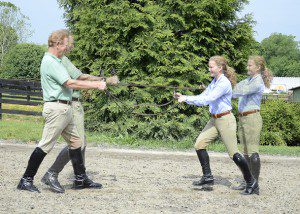
When Marley Stone stands straight and leans on her reins, just a very slight pull from me is enough to throw her off balance.
In a direct contest of strength, the heavier and stronger force wins every time.
Naturally, the implications of this study from the Royal Veterinary College are both clear and significant for the world of eventing.
Our primary responsibility as equestrians is to ensure the comfort and welfare of our horses.
When we reach a position that guarantees their comfort while simultaneously making them more efficient when performing the tasks we ask of them, we must ensure we use that same position.
I am the first to warn that riders should not ride in cross-country with the same stirrup length as flat race jockeys.
This position is too extreme for riders who need to jump over varying terrain, inclines, descents, and similar obstacles.
However, we can undoubtedly apply the principles identified in the RVC study: elasticity, efficiency, poise, and balance.
Of all these principles, I consider balance to be the most important factor for eventing riders, as our balance on our horses has a very significant impact on the balance of the horses themselves.
Riders who sit with straight legs are inherently unstable.
This position is like a needle balanced on its tip; any external factor can topple it.
This potential instability is why riders with a straight leg are forced to lean their hands on the horse's neck.
I do not agree with this situation; both due to the lack of stability and because pressing the fingertips on the horse's neck locks the rider's hands and makes it impossible to maintain soft, elastic, and responsive hands at all times.
Angles give you leverage; it is a fact that most of our horses show a lot of interest in cross-country work and may force us to use a connection with their mouths that, although ideally should be elastic, sometimes inevitably becomes very firm.
We need a situation that allows us to control our horses in cross-country while still being consistent with the general principles established in the RVC study.
Again, it must be said that when horses become overly enthusiastic, the straight leg position is not effective.
Because riders who stand completely upright have no angle in their body position, they either have to lean back to strengthen the contact or resort to sharper bits for control.
A rider who uses the recommended position from the RVC study will have significant leverage once they learn how to utilize it.
I advise riders with overly enthusiastic cross-country horses to use this leverage for control instead of sharp bits.
Due to the higher speed of cross-country at the prelim level and above, it is necessary to adjust our stirrups shorter than for jumping with a horse.
An observer who pays attention should notice that when a cross-country rider is sitting in the saddle, the angle of the knee is slightly less than the 90-degree angle I recommend for jumping with a horse.
(My recommendation for lower-level riders is to keep the stirrup leather length the same for jumping with a horse and cross-country; that is, when sitting, the back of the knee should have a 90-degree angle.
) My impression is that lower speeds at the introductory levels do not force us to lean our bodies forward this much.
Furthermore, many novice riders still do not have the physical readiness and stability necessary for riding with shorter stirrups.
The relationship between the length of your stirrup leather and the design of your saddle is also an important concept.
The leverage of the Chaharnal position must always be applied in such a way that our hands and arms act through the upper line of the horse's body, not against its mouth.
For example, when your horse starts to pull, I want you to lower your hips towards the saddle and shift your center of gravity slightly further back without sitting on the saddle.
In this case, your restraining action should be limited to closing your hands at the base of the withers and along the upper line of the horse's body; if necessary, reinforce this with a single bridge of the reins.
I want your hands to ask the horse to wait with the front hand until its hindquarters catch up, not to try to shorten its neck.
This is similar to the aid you use in dressage; when you close your leg and wait with your hand for the horse to soften in its mouth.
The only difference is that at higher speeds, you no longer need to close your leg; your horse has already engaged its hindquarters under its body due to the mechanics of Chaharnal.
Remember that as soon as your horse softens in the mouth and collects its stride, soften your hand.
The reason for the low position of the hands is that from the moment we raise our hands above the horse's mouth, we are actually pitting his power against our own, and according to the laws of physics, this is a confrontation in which we will lose every time.
From here, you can see how effective a lever you have by applying the technique shown here.
If you have ever wondered how 100-pound riders can control 1000-pound racehorses, the answer is right here.
They sit still and use leverage.
Marley has the same basic form in the saddle that we saw on the ground in the previous image.
There is an angle at his knees and elbows, and his hips are slightly behind his knees.
In addition, he has a bridge in his reins.
I have put all my weight on his reins and am pulling with all my strength, but Marley can resist a lot of force using his leverage.
Note that he has held his weight without pulling back.
If you need to slow down your horse, I want you to do this without shortening his neck.
When he gets too fast, lower your hips slightly and bring them back about one or two centimeters behind your knees.
Then close your hands and press the bridge against his neck.
The principles of using the bridge in Chaharnal are the same principles you use when you want the horse to yield in the jaw during dressage, with the difference that in Chaharnal, due to the increased activity of the horse's hindquarters, you no longer need to close your calves.
When he slows down and responds to the pressure of your hands, soften your hands as a reward, but do not let either the reins rise or his neck extend.
This teaches him to go in a steady body shape and rhythm in Chaharnal.
In addition, those riders have exceptional physical fitness.
I guess at least half of the cross-country riders I see stand in their stirrups do this because they lack the physical fitness to maintain a balanced and flexible position.
This is neither efficient nor safe, but it is understandable and correctable.
In terms of safety, when I was watching the Rolex competition in 2011, it was clear to me that the fatigue of the horses played a significant role in some of the difficulties the riders faced, especially in the final sections of the four-mile course.
I can't help but think that perhaps if the riders had more physical fitness and employed a more efficient Chaharnal position, some of those problems could have been avoided.
Although sitting in a vertical position is easier for the rider, science has shown us that a balanced and flexible position puts less pressure on the horse.
This article was first published in the August 2011 issue of Practical Horseman.
Source: Practical Horseman – Training