Correct habits in cross-country for success in eventing
Eventing as a sport requires a very high level of physical ability from both the horse and the rider.
Cross-country can be considered the most challenging phase, as it requires a combination of precision, speed, balance, adjustability, and confidence.
However, you can work on and enhance all these skills by establishing strong habits in the training field and with the approach that cross-country is always a positive experience for your horse.
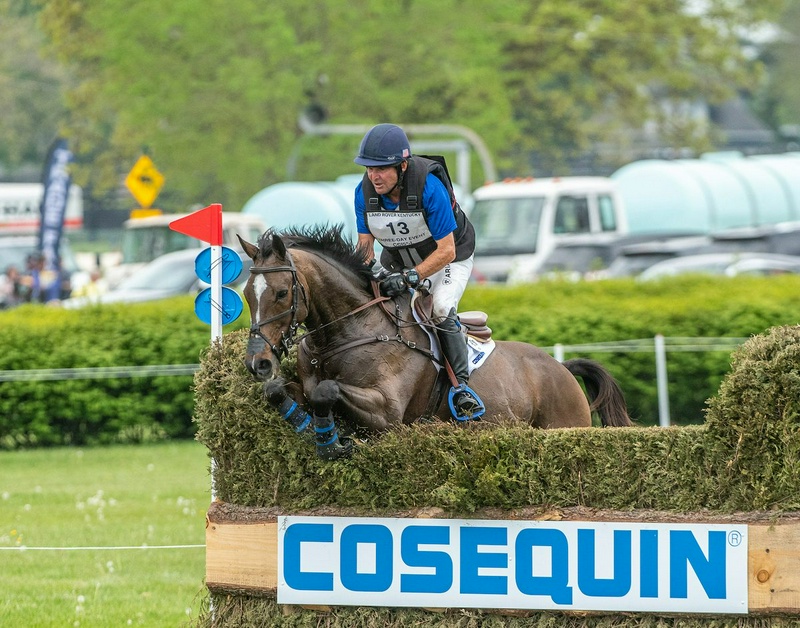
Philip Dutton, seven-time Olympic rider, on Sea of Clouds at the 2022 Land Rover Kentucky Three-Day Event.
Here, I will explain how to cultivate good habits in cross-country so that you can navigate top-level courses with confidence and consistency.
Then you can incorporate these principles into your training program so that they become a natural and subconscious behavior during competition.
Success in cross-country is always a process and requires patience, practice, and careful attention to the small details that accumulate over time.
The use of markers to maintain a line of travel is one of the most valuable habits you can create in cross-country, using markers to find and maintain your line to the obstacles.
When training or when you are walking the course before the competition, find specific objects like rocks, trees, patches of grass, or anything else that can serve as a marker for gauging your distance to a particular obstacle.
For example, I know that I have two strides to obstacle 4 when I pass this rock, or any issue you might encounter in that section of the course.
In practice, find specific objects like rocks, trees, patches of grass, or anything else that can serve both as a marker for your distance to an obstacle and as a reminder of where to turn.
You can also use these objects as reminders of tasks you need to perform in specific sections of the course.
For instance, to master approaching corner obstacles, I might choose a specific tree along the path to the corner obstacle as a marker to remind me where to turn.
Or when I reach this rock, I should start counting my strides for the next obstacle.
To improve adjustability, practice jumping the same obstacle with longer and shorter distances.
For longer distances, if you need more space, maintain a slightly wider line in the turn.
When going for shorter distances, use your marker to remind you to slow down and be completely straight so you can fit in the maximum number of strides possible.
Whenever in doubt, shorten the distance to fit in more strides.
Patience is a key principle, and you must teach this to your horse as well.
Practice precision; you need to practice at home and perfect how to execute the approaches you want to create, and become so skilled in riding towards the specific elements of the course that you can truly visualize it even in your sleep.
This is what allows you to recreate that desired ride whenever necessary.
Skewed obstacles are situations where precision is paramount.
You need a horse that moves with energy and forward momentum, but you should not be on a flat and overly open stride.
In angled obstacles, it is important that your horse is balanced, as these obstacles may appear a bit different to him, and you want this experience to be a good one for him.
When approaching an angled obstacle, raise the reins a bit higher and keep your hands wider apart so that your horse is directed towards the obstacle.
If he starts to drift, this will help correct his position.
In obstacles with a sharp angle, aim in such a way that your foot passes close to the inner flag; you should not give your horse a chance to escape past the obstacle, but at the same time, he must learn how to jump these types of obstacles.
When approaching an angled obstacle, raise the reins a bit higher and keep your hands wider apart so that your horse is directed towards the obstacle.
This will help if he starts to drift, allowing you to correct his position.
Also, if you have leaned too much on your horse's neck, it will be more difficult for you to make this correction.
Make mistakes and correct them yourself — most of us — and this includes both the horse and the rider — are not clever enough to know exactly what balance and speed we need on the approach to an obstacle.
But you must learn how to establish direction and rhythm from the beginning; especially in difficult combinations.
You will make mistakes — many of them.
But the goal is to learn from each mistake so that you are prepared to make the necessary corrections next time.
For example, consider a cross-country training exercise that includes two narrow obstacles in a turn and has a drop after landing.
We will jump this exercise from both directions — first in a left turn with a gentle downward slope and then in a right turn with a gentle upward slope.
On the downhill approach, be ready for the first obstacle on the left turn.
As you turn, collect your horse and bring him back to a shorter, 10-foot stride, and wait for the second obstacle.
You cannot land and just charge towards the second obstacle with speed or drop the reins and tell your horse, "Go ahead, do it yourself."
You must have complete control of the turn after landing so that you can shorten your horse's stride.
Your job is to bring him to the obstacle with the right speed, the right stride length, and the right balance so that he can make the best use of his body over the obstacle.
At the same time, he must learn to respect the obstacle.
When you perform this exercise on the uphill path, you should attack it with a bit of power after landing and then collect more at the end.
After the first obstacle, land with a specific plan to turn right and get your horse moving so that when the slope becomes a bit steeper at the second obstacle, you have enough momentum.
After that, most horses naturally shorten their stride and easily pass over the second narrow obstacle.
Water jumping habits, especially if you are riding an inexperienced horse or one that is not yet accustomed to water, it is always better to familiarize him with every water section of the course before you enter the water at a gallop and jump through it.
During warm-up, pass through the water at a walk, trot, and canter from both directions so that the horse becomes familiar with its depth.
Especially if you are riding an inexperienced horse or one that is not yet accustomed to water, it is always better to familiarize him with every water section of the course before you enter the water at a gallop and jump through it.
When approaching a blue combination, like crossing with Chaharnal through water to reach a bank and then a bounce, you need power; however, you should not seek a distance that is excessively long.
When coming through the water, your focus should be on maintaining a steady rhythm and balancing the horse before the technical elements.
In the last one or two steps, lift the reins higher and sit back a bit to allow the bounce to form naturally.
Some horses are prone to going off course in the bounce during such combinations.
For example, if your horse tends to drift left when entering the bounce, take the right canter to make it easier for them with this section, and pass through a circle between the bank and the second element of the bounce.
Once they confidently go through this circle a few times, approach the second element at an angle and in sitting canter, and just quietly jump over it to build their confidence.
Then, try it again with canter and still at an angle, aiming to jump exactly from the middle of the obstacle.
Finally, approach it one more time with canter and try to jump the second element as much as possible from the right side.
Now go back and execute the entire combination again, being mindful of the possibility of going off course.
It is important for the hands to remain soft, but at the same time, you need to engage with more assertiveness and ride this combination with an aggressive approach.
Body position is always vital for safety, success, and effective communication with the horse; however, in cross-country, your riding does not always have to look beautiful and flawless, as you need to take action and constantly react, maintaining your focus every second to be prepared for unforeseen events.
As we know, in equestrian sports, things often do not go according to plan; therefore, the ability to adapt quickly is a key factor in cross-country.
Soft control is another training exercise in cross-country, which is a sunken road; for example, a bank going down that is followed by one or two steps to an upward bank.
Here, the goal is to prevent the horse from jumping too far out when descending from the bank, so they have enough space and opportunity for the exit bounce towards the second bank that is going up.
If the horse lands too far from the first bank, they will have to really collect themselves to adjust their steps.
This can be more challenging with a sharp or aggressive horse, but the key point is to make them come down calmly and controlled from the bank so that you can properly ride to the second element.
Here, the horse jumped too far from the first bank, which caused them not to have enough space for a bouncing jump towards the second bank.
If your horse lands too far after the first bank, they will have to really collect themselves to adjust their steps.
However, be careful not to hold your horse too much.
This is likely to cause them to jump out farther because their legs will be stretched out upon landing.
Therefore, maintain contact, but stay soft so they do not resist against you.
You should not collect them like a spring ready to explode.
You need to collect them more and then let them go.
Do not miss any opportunities to approach the first bank; if you can take it with canter, that is even better.
In this case, you can land and act more aggressively in passing through the bouncing jump.
Do not miss any opportunity to approach the bank; if you can take it at a canter, that’s even better.
This way, you land with enough space for a jumping leap and can act more aggressively towards the exit bank.
Basic principles: less is better in cross-country training sessions, always strive to perform the least number of jumps possible, but do them with good quality.
Quality is much more important than quantity.
The important thing is to create multiple good experiences for your horse so that its confidence continues to build.
Do not focus all your attention on finding the ideal distance every time.
If you don’t see it, just keep your upper body straight, maintain a compact and steady position, and wait; because you might have made a slight mistake or your horse might hesitate.
Maintaining this suitable vertical position and a strong connection between your legs and hands also helps you easily navigate any mistakes.
Read more here about how Philip Dutton keeps his eventing horses fresh, healthy, and performing at the highest level with smart training strategies and an overall health program.
About Philip Dutton: Philip Dutton is a rider who has competed in the Olympics seven times and has won three Olympic medals.
Originally from Australia, he represented his country in three Olympic Games and four World Championships.
He became a U.S. citizen in 2006.
Since then, he has competed for the U.S. in four Olympic Games and three World Championships.
His last Olympic appearance was with Z in the Tokyo 2020 Olympics, where the U.S. team placed sixth.
Philip and his wife, Evie, own and manage two farms and also train horses there.
These two facilities include True Prospect Farm in West Grove, Pennsylvania, and Buck Ridge Farm in Loxahatchee, Florida.
Source: Practical Horseman – Training