Gymnastics training for horse agility and rider stability
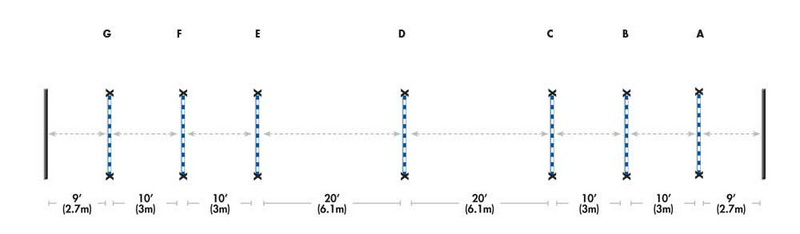
As I have said many times, show jumping is the best tool we have to improve the performance of the horse and the physical condition of the rider.
Here you can see one of my favorite gymnastic exercises.
What it is: a gymnastic "bounce" exercise where the horse, after landing from one obstacle, immediately jumps over the next obstacle without taking a single step in between.
Goals • Improve agility, self-carriage, and the horse's ability to jump from multiple consecutive efforts without losing rhythm, balance, and order of steps.
• Create an opportunity to practice and strengthen the rider's two-point position.
Benefits • Bounce is a good exercise for increasing agility.
The horse learns to keep its shoulders forward during the jump, and its jumping technique improves.
• Bounce is an excellent exercise for practicing and strengthening the two-point position; because there is not enough time for the rider to sit back in the saddle before the next jump.
• Bounce makes the rider aware of the opening and closing of their elbows; a topic that is fundamental to learning proper performance and the correct coordination of the hands with the horse's movement.
Tips • Approach the gymnastic obstacle with a calm, regular, and balanced rhythm, and keep contact with the bit light, or even somewhat loose, to maintain or awaken the horse's initiative.
• Adopt smart riding and be non-intrusive to the horse.
When the horse reaches the obstacle, it should adjust its step placement and carry its body over the obstacle.
Your job is not to obstruct it.
• First, look at the pole and then keep your gaze on the first obstacle in the sequence until that obstacle is out of sight between the horse's ears.
Repeat this process for each obstacle.
This helps maintain your straight line during the gymnastic exercise and improves your timing.
• Do not lean forward.
When the horse lifts off the ground to jump, feel as if it has raised its withers towards your chest.
• When you add another element to the gymnastic exercise, first approach the new section so that the horse immediately notices the change in its environment.
• If you encounter a problem, lower the height of the obstacle or remove the last obstacle and lower the rest so that the horse moves forward again with willingness.
Execution method 1.
Start with a pole on the ground between the standards at point A (according to the diagram above) and place a ground pole 9 feet away from it, between the standards.
This placing pole helps to correctly identify the horse's take-off point.
2.
After you have gone back and forth over these two poles a few times, set obstacle A at a height of 2 feet.
Jump a few times in a canter; approach the placing pole, then take two steps and pass over obstacle A.
3.
Then reverse the course and continue working in the opposite direction.
Approach the obstacle through the open line of standards and head towards a vertical 2-foot obstacle that has a placing pole on the ground, 9 feet behind it.
Your horse approaches the obstacle in a canter, jumps over the vertical, lands in a counter, and passes over the 9-foot placing pole.
Once you and your horse have gained enough confidence in both directions on this part of the gymnastic exercise…
4.
Place a second obstacle, the same size as A, on the standards at point B.
Work back and forth a few times in both directions; from the placing pole to the bounce and from the bounce to the placing pole.
We introduced our inexperienced show horse, Royal Alliance, to this gymnastic exercise of bounce by adding just one new element each time.
5.
When your horse is calm and balanced, add a pole at C.
Repeat this a few times in both directions.
6.
Add a pole at D and set its height to about 2 feet.
As you approach the pole set before A in a canter, your horse will now bounce from A to B and from B to C, then take a step in canter and jump from D.
7.
When your horse jumps well from A to D and canters calmly from D to A, create E, F, and G with the same dimensions and distances.
It’s better to set up this part of the gymnastic exercise all at once to reduce the total number of repetitions you do with your horse.
Since the obstacles E, F, and G are new to your horse, approach them first from G.
Complete the gymnastic line when you ride the entire gymnastic line, your horse approaches the first set pole in canter, jumps the first obstacle, does a bounce, bounces again, lands, takes a step at a distance of 20 feet, jumps the vertical obstacle, takes another step at the next 20-foot distance, does a bounce, bounces again, and finally passes over the last 9-foot ground pole in canter.
Throughout this exercise, focus on maintaining your body position so that your back can move freely underneath your horse.
In the sections of consecutive jumps, remain in a balanced two-point position and in the one-stride parts of this gymnastic exercise, return to a light three-point position.
By keeping your elbows relaxed, maintain a light and soft contact with your horse’s mouth.
This gymnastic exercise will cause your horse's head and neck to noticeably move forward and backward.
Keeping your elbows relaxed helps you learn how to maintain consistent contact with your horse’s mouth throughout the jumping effort.
When your horse is comfortable with this exercise, approach it from both directions.
This article was first published in the December 2016 issue of Practical Horseman magazine.
Source: Practical Horseman – Training