The principles of cross-country riding from the perspective of Andreas Dibowski
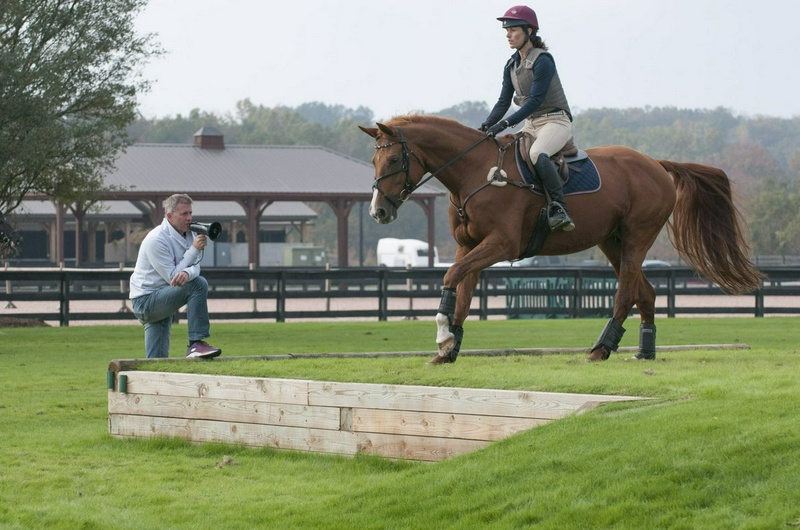
Andreas Dibowski is a man of few words.
He has a good command of English, but his advice to riders is simple and brief; "forward" is his most common command.
In all exercises and work on the course, he asks his students to ride the horse forward and straight.
He also wants the rider to maintain supportive contact through both the reins and the leg, and the upper body should be used correctly; something that helps with control, balance, and the quality of jumping.
Before starting the cross-country section of this clinic, Andreas Dibowski used gymnastic exercises as part of the warm-up.
Here, Andreas is teaching Ginny Clark; while she guides the gelding Oldenburg "Le Corsaire," owned by Head for More LLC, through a six-bar grid; a grid designed to encourage forward riding.
A group of 20 eventing riders had a rare opportunity to participate in this Olympic gold medalist's clinic and get a close look at the German training philosophy.
Andreas recently went to the Tryon International Equestrian Center during the American Trakehner Association symposium to give jumping and cross-country lessons to horses and riders, from novice to advanced levels.
These sessions included work on the course using combinations, related distances, and turning exercises.
In the warm-up, he wanted riders to practice transitions and turns and adjust the stride length in the canter; alternating between sending the horse forward and then collecting.
This work engaged the horses' bodies and kept their minds focused and alert.
Nancy Catherine Webb and her Trakehner "Cardinali" approached the obstacle table closely, but since the horse was moving ahead of her leg and the rider maintained supportive contact, they were able to jump the obstacle safely.
In such a situation, the rider could easily release contact and allow the horse to fall on the forehand, and according to Andreas, "to ride into the jumping pit."
From Andreas's perspective, the responsibilities of the horse and rider in cross-country riding are a shared responsibility for the outcome.
According to him, the rider's responsibility is to show the horse the correct direction, give it the appropriate speed, maintain their own balance, and be aware of the horse's physical condition and their own fitness.
The horse's responsibility is to find the moment of jumping.
Finding the distance for riders competing in jumping disciplines has practically become an obsession, but Andreas emphasizes that in cross-country, counting down steps and telling the horse when to jump is "completely dangerous."
If the rider makes a mistake or the horse gets distracted and takes an extra step, they may come too close to the obstacle.
This usually happens when the rider is ahead of the movement, lacks sufficient contact and balance, and wants to determine the moment of jumping themselves.
Andreas calls this situation "riding into the jumping pit."
Andreas said, "Horses must always be jumping or galloping in front of the leg; in that case, it doesn't matter if you arrive a meter closer to the obstacle or a little further away."
"What I see in this clinic is that many riders try to do everything flawlessly, but then forget the quality of the canter; therefore, they are always looking for the ideal distance, ride slower, and exhaust the horse's entire physical capacity.
"It doesn't matter whether we are facing a vertical obstacle, an oxer, or narrow fences; we must keep the horses in front of our forward aids at all times.
"This is the principle of everything we need for safe jumping over any type of cross-country obstacle.
"When we train the horses, we need to show them what they can do, not what they cannot do.
" Andreas says this.
The Thoroughbred horse Tick Maynard, Remarkable-54, had previously completed a preliminary level competition before this clinic.
At the preliminary level, narrow obstacles like this become more common.
Using guide rails during training helps the horse see the path better while maintaining the alignment of its body.
Andreas says, "When we train the horses, we need to show them what they can do, not what they cannot do.
"While the rider must be aware of the distance to the obstacle, their main focus should be on creating a powerful canter and maintaining it until the obstacle.
If the rider sees the distance will shorten, they should not release the reins and slow down.
Instead, they should maintain contact, close the leg, and create more activity in the canter.
Andreas said, "If we have good speed and good quality in the canter, we should lift the body, put the horse in an uphill position, and at the same time apply a little pressure to create more activity.
"In my opinion, the best distance is always a short distance to the obstacle.
"This does not mean we give the reins and let the horse escape under the obstacle, but when the distance is short and we can keep the horse and maintain the uphill position, this is the best opportunity for a powerful and safe jump.
Andreas advised, "Never look for a long distance.
"Sometimes this happens; when the horse is overly motivated or the rider is looking for a long distance, but this is always more dangerous.
"If the horse really jumps from a long distance, it is important for the rider to focus on collecting it again and getting a better distance for the next obstacle.
Andreas said if the horse jumps from a long distance multiple times, it loses trust in the rider and gradually starts adding strides.
Building trust and calmness from the time a young horse's training begins until the rider asks it to perform more difficult tasks is crucial.
A horse that has trust will try its best for its rider, and in this situation, both can focus on their responsibilities.
The author and pony Amy Clare, Willow, jump from an Irish bank.
Andreas said, "We build great trust every day and at all times, and it is very important not to destroy it.
When we train the horses, we need to show them what they can do, not what they cannot do.
"For example, when you want to familiarize a horse with angled obstacles, instead of leaving the path open for it to learn to escape beside the obstacle, use guide rails."
By bringing the shoulders and upper body back while maintaining the connection, the rider can give a half-halt and simultaneously engage the leg to help the horse carry itself better; as a result, the same active and powerful counter is created that we need for safe jumping.
He said, "When we start to engage with the bit or pull the reins, the horse no longer does this."
Andreas prefers a longer rein to a shorter one; not only because it helps the rider's position, but also because it allows the horse to use its neck to maintain balance.
Andreas said, "I often tell riders to keep the reins longer and not too short; because when they make the reins too short, they also pull their own bodies too far forward, and the horses become too short in the neck.
The neck is a very important part of the horse's body for it to find its balance."
He said, "It is always better to keep the horse's neck stretched enough.
Some horses, especially hot-blooded ones or when overly motivated, have the problem of becoming short in the neck.
Keeping these horses on a good line in cross-country is very difficult."
Even with longer reins, Andreas insists on maintaining the connection as they approach the obstacle.
This is where the hand, seat, and leg work together to bring the horse to an uphill balance.
Andreas also wants the horse to seek the connection, not for the rider to impose the connection on it.
A longer neck also helps the horse move straighter in its body, making control easier for the rider; and it returns to the same responsibility of the rider who, in addition to speed, must also provide direction.
Andreas repeatedly reminded the athletes to ride the horse straight after a combination or after the last obstacle of the course.
Riders were also not allowed to suddenly resort to downward transitions to stop the horse at the end of a round, and instead, they had to execute downward transitions with appropriate quality and keep the horse working until the rider decided to stop.
He said, "The moment after the obstacle is also the moment before the next obstacle.
If you stop your riding and the horse does whatever it wants at that moment, then the rider will need more time to prepare for the next obstacle.
We want to move from point A to point B in a straight line, with a jump in between.
From the very beginning, I try to teach riders and horses that the horse must obey the rider, but if the rider does not show the path to the horse, why should the horse follow them?"
Andreas concluded that ultimately, safety is the most important issue.
Safe riding is possible when both the horse and rider are responsible, maintain their balance together, and trust each other.
Andreas Dibowski, who is currently ranked thirteenth in the FEI world ranking of eventing riders, is a consistent figure in the German eventing team.
He has competed in three editions of the World Equestrian Games and three editions of the Olympic Games; Dibowski was part of the gold medal-winning champion team at the 2008 Hong Kong Olympics with FRH Butts Leon.
In 2016, he also became the champion of the CCI**** Luhmühlen competition with It's Me XX.
Source: Practical Horseman – Training