Calm start in the box for the cross-country start
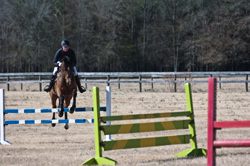
A good start on the cross-country eventing course is the first step towards a successful finish.
This may seem obvious, but at all levels, you have seen eventing riders struggling with a horse that is rearing or spinning in the start box instead of calmly focusing on the course ahead, leading to an inappropriate start.
This type of rocky start has become a bigger weakness, given the recent trend in course design where the first cross-country obstacle is placed closer to the start box than in the past; in one recent three-star competition, I measured the distance from the start to the first jump, and it was only eight strides.
This means you have neither much space nor time to regain the horse's balance, get its attention, and find the right distance to the obstacle.
It is much better to have an easy start and then build your rhythm and speed to the obstacle.
In my experience, a horse's misbehavior in the start box often develops when the horse perceives the box as a place of excitement, charging in with a sudden full gallop right from the start; a common mistake made by both professionals and amateurs.
After a few explosive starts like this, the horse begins to anticipate, and from the moment it sees the box, it becomes difficult to control.
The simplest way to prevent this problem is to always approach cross-country with a calm and low-stress mindset.
Utilize the new design of the start box; a box that now has a back entrance so the rider can enter from behind, rather than having to go to the front of the box, enter, and then turn around.
The rules allow you to bring the horse in from behind while waiting for the start time, exit from the front, and then re-enter from behind.
.
.
And repeat this as many times as you wish.
This method of starting is much more calming; especially if you remember to take a few deep breaths as well.
Imagine your horse has already learned that the start box is an exciting place.
In this case, there are a few things that, if done consistently and steadily, can help keep it calm.
Practice with the start box beforehand.
Well before the cross-country phase—and if you have arrived at the competition venue early, even the day before—saddle your horse, ride it to the start box, calmly enter and exit the box a few times, then return it to the stable and put it back in its place.
Your goal in this session is to take as much tension out of this situation as possible; therefore, if your horse gets nervous just by seeing the start box, ask a friend to come along for the first few times and help guide the horse in and out of the box.
(To maintain respect and also to clarify that you are not practicing on the cross-country course, be sure to coordinate with the competition organizer in advance and explain exactly what you want to do.)
Once again, pay attention to your own breathing and take deep, slow breaths; your horse will notice this.
Some riders even recommend taking the horse to graze in the start box; it’s worth a try, although I personally think horses are smart enough to understand the difference between grazing with a halter and being prepared to work with a saddle and equipment.
Adjust your plan for a later start.
When the timer announces "two minutes," many riders go to the start box at a trot; however, when you get there, those two minutes can seem very long.
Instead, when you reach the two-minute mark, your plan should be to trot a good, large circle of 20 or 30 meters near the box, in the area where you can hear the timer.
(Avoid turning the horse in a small circle; the goal is to keep him calm.)
When you hear "10 seconds," return to a walk, start your stopwatch, and enter the box at a walk for the start.
Before you let him know it's time for serious work, get him well away from the box: trot out of the box, pick up the canter, and head toward the first jump.
I usually do this when preparing young horses, and when I look at my watch during the course, I only add 10 seconds to the remaining time; because I know I started the stopwatch about 10 seconds before crossing the start line.
Even if it takes you a few seconds to trot out of the box, it is negligible compared to the time you lose due to the horse getting flustered.
And even if your horse hesitates or pauses a bit at the first jump, pushing him in that first step after leaving the start box only creates another problem.
Set the conditions so that you stay calm.
Someone who comes with you to the start box can make a big difference; you need someone to help you stay focused.
For example, if your coach or a knowledgeable riding friend comes with you to the box and reviews the course while offering constructive tips—like reminding you to breathe—it can be calming.
But that overly cautious well-wisher who makes you more anxious with a string of reminders—"Aren't you thirsty? Do you need to use the restroom? Is your watch on? Did you tighten the girth? Where's your whip?"—can add to your tension.
If you can find a polite way to have that person not accompany you to the start, your performance on the course will improve.
Darren Kiyakia, riding the Thoroughbred Windfall 2, was a member of the United States eventing team that won a bronze medal at the 2004 Athens Olympics and also earned an individual gold medal at the 2003 Pan American Games.
Darren, based at Independence Farm in Springville, New York, and Ocala, Florida, serves on the High Performance and Events Committees of the United States Eventing Association and is a faculty member and evaluator for the association's coaching certification program.
Get acquainted with Darren's system for training your horse to jump the coffin in cross-country in the November and December 2007 issues of Practical Horseman.
Source: Practical Horseman – Training