5 ways to start retraining a retired Thoroughbred from competition
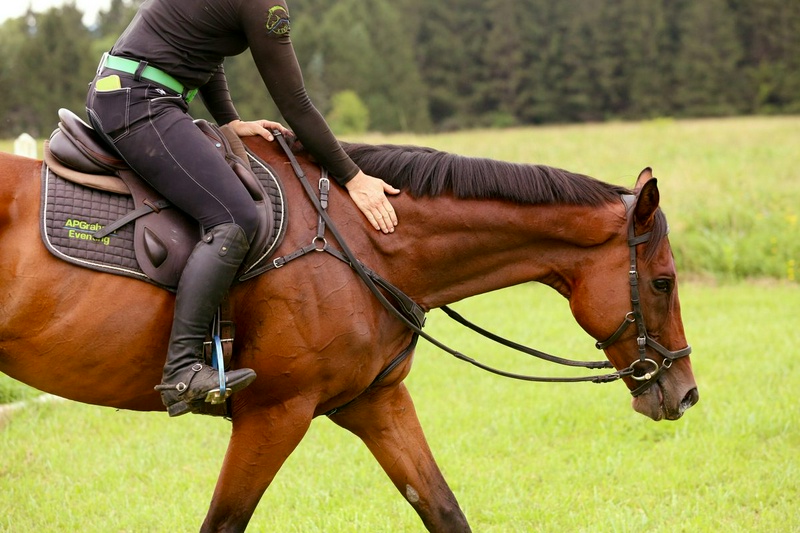
Graham Obrey, owner of Kiwi Sporthorses, typically keeps 20 to 30 off-the-track Thoroughbreds (OTTB) at his farm in Lansing, New York at any given time.
Graham has made a name for himself in the Thoroughbred industry not only through retraining and selling horses but also with his "Thoroughbred Logic" column on HorseNation.com and through various podcasts, including "OTTB on Tap" and "Retired Racehorse Radio."
He is a regular participant in the Retired Racehorse Project (RRP) and has also presented at the "Thoroughbred Makeover" program of this organization.
Graham also conducts "Thoroughbred Logic" clinics and is currently writing a book of the same title for Trafalgar Square Books.
Graham often purchases horses directly from the racetrack and begins their initial retraining; sometimes with the goal of pursuing a competitive path in eventing and sometimes to sell them as inexperienced but promising horses.
He also runs a nonprofit organization called Stall 13 that addresses Thoroughbreds considered to have "challenging cases" from two angles; both horses that have just come off the track and need rehabilitation, and those that have encountered problems in their second careers and require more care and assessment before they can be placed on a better path.
His goal is not to turn every Thoroughbred into a uniform final product.
Instead, he wants to give each horse the tools to become balanced, confident, and rideable.
Here are 5 tips for starting the retraining of your retired Thoroughbred; when this horse is adjusting to its new career path.
1.
First observe; let the horse show you what kind of personality it has. Graham's first training tool is observation.
When a new horse arrives, he does not immediately start intensive under-saddle training.
He watches how the horse copes with the new environment, being in the paddock, other horses, and daily handling.
He says, "The question I ask myself while doing these things, from the moment I turn the horse loose in the paddock and take it in and out to the first ride, is: What kind of horse is this, and what does it need to be safe and understand our requests well enough to feel satisfied with what we are doing?"
Depending on the horse's personality and recent history, they may initially be placed in a small paddock with clearly defined and visible fencing.
Once the horse learns the basics of being in the paddock, Graham gradually introduces it to the herd; a task that usually takes place within the first couple of days of the horse's arrival at his farm, and then he carefully monitors it.
His background in cultural anthropology, including a PhD and years of teaching at Emory University, has reinforced his belief that before attempting to change behavior, one must simply observe it.
He says, "I just stand there for 20 or 30 minutes and watch to see what they do and how they interact.
Because the behavior a horse shows in the field is the same behavior it will exhibit under saddle."
Drawing on his background in cultural anthropology, Graham enjoys letting retired Thoroughbreds from the track loose together in the paddock and observing their herd dynamics.
A sharp and reactive horse may require a different approach than a horse that wants to take control from the very beginning.
Graham uses dynamics from both groups; for example, he mentions Explorer, a very large Thoroughbred that had come there as a loan horse.
The owner of this horse had told Graham that he had been the dominant horse in the previous herd and could also be pushy and dominant under saddle.
Graham introduced him into a herd with more dominant horses in Kivu, and within a few hours, Explorer moved to the middle or bottom of the hierarchy, making handling and working with him in the stable much easier.
In contrast, a horse lacking confidence may require the opposite approach: a calm and hassle-free herd where it can gradually feel more secure.
The same type of observation continues in groundwork.
How is the horse guided?
Does it stop when the handler stops?
Does it push into the handler's space with its shoulder?
Does it try to cross boundaries?
All these observations are part of the training process from Graham's perspective.
He says, "Generally, I want my horses and dogs to be trained almost the same way: if they are too pushy, if they don’t recognize any boundaries, if they want to rummage through my pockets for treats or push me around, it’s time to set clear boundaries and start groundwork."
Graham has a particularly clear view on boundaries.
Horses are given enough space to make mistakes and find the correct answers themselves, rather than being micromanaged at every moment.
He says, "I will give you as much time as you need to find your answer, but that answer must be an effort, not a ‘no’."
Try this: before getting on a retired racehorse that has just arrived, spend some time watching it in the pasture and working with it on the ground.
Instead of immediately wanting to correct everything, note its initial reactions.
Use these observations to understand what type of support and what boundaries it needs.
2.
Before asking for complex movements, establish "forward movement" before the first ride, Graham conducts his initial assessment of the horse's character in the same observations in the arena and approaches the first ride with a specific plan.
When he gets on, his first priority is simple: moving forward.
He usually does not lunge the horse before the first ride.
Instead, he relies on his observations, his riding skills, and, if necessary, the help of someone on the ground.
The mounting platform itself can also be part of the training process.
A racehorse may have had a jockey thrown on its back thousands of times but may never have learned to stand quietly and still next to the mounting platform.
Graham does not assume that the horse understands what he considers a normal and everyday task.
Many times, the first test is the mounting platform itself.
In the racecourse, usually, the jockey is simply thrown on the horse's back, so some horses may never have seen the mounting platform before.
When he gets on, he starts with basic questions: Can we walk?
Can we move forward?
Can we steer?
Can we maintain the rhythm?
The answer to these questions shows him where to start.
Some horses need a calm rider with minimal interference, while others require a clear command to "go," as they get stuck behind the leg.
Graham cites one of his horses named Humphrey, who reacted very strongly during the first ride.
Instead of pulling on the reins, Graham focused on staying centered and sitting quietly in the saddle, "like a sack of potatoes," and gave the horse a chance to move past that moment.
Very soon, the horse calmed down and took a step forward.
Graham has no problem with the mischievousness and playfulness of horses under saddle.
He says, "They can go in any direction, but it's usually not a bad thing.
They just need to understand that the leg means forward movement."
The result was not that every inexperienced Thoroughbred should be left to its own devices when reacting; the point was that the rider needed to understand what the horse was telling them before choosing any type of intervention.
When the horse starts to move, Graham likes to bring it into a forward canter very quickly in the same session, as this reveals the basics very quickly: rhythm, guidance, balance, and brakes.
He says these brakes are often better than what riders expect.
He explains, "Brakes almost never come from the reins.
Brakes come from your body.
If you pull on the horse's face, it pulls back in response; it's just like pressing the gas pedal!"
Many Thoroughbreds understand the body position associated with slowing down because this position is similar to something they have experienced during racing.
Graham encourages riders to use their whole body and legs instead of grabbing the horse's mouth.
He says one common mistake is applying pressure with the ankle or lower leg.
This may send the Thoroughbred forward instead of slowing it down.
Instead, the rider should think about connecting the leg, thigh, seat, and upper body in a clear half-halt.
Try this: first establish a forward rhythm.
When the horse is moving confidently, practice transitioning between gaits and half-halts using your body and legs before reaching for the reins.
Instead of pulling the reins to stop the horse, think about engaging your core muscles and sitting tall and straight.
3.
Use the "disappearing triangle" to teach the use of the hindquarters and passing through the back to the horse. When the horse moves forward, Graham addresses one of the key elements of his training system: helping the horse understand how to use its hindquarters and pass through its back.
His simple visualization tool is called the "disappearing triangle."
Start from a canter with a steady rhythm and move the outside hand about 6 to 12 inches away from the horse's neck.
This creates a triangular space between the horse's neck, the outside rein, and an imaginary line between the rider's outside hand and the horse's hindquarters.
Then the rider uses the inside leg to guide the horse's ribs and shoulders toward this open space while maintaining supportive contact with the outside rein.
The goal is for the horse to "disappear" the triangle by moving its shoulders and ribs into that space.
Graham shows the initial outer hand position for the "disappearing triangle"; 6 to 12 inches away from the horse's neck.
This exercise is essentially an exaggerated form of working with the inner leg towards the outer rein, but Graham finds this visual concept particularly useful for inexperienced horses, as it clearly demonstrates the desired movement.
Note that the inner hand should not force the horse's head into position.
Instead, this hand should remain soft and not interfere so that the rider can influence the horse's body with the inner leg and outer rein.
Graham explains: "When you guide the horse with the inner leg towards the outer rein, you are asking it to step from behind and maintain its balance on the outer hind leg.
When the horse successfully fills the triangle, the rider can soften the inner aids while maintaining gentle support from the outer rein.
The result may be a horse that feels more powerful and suspended in the canter.
Its head and neck may eventually come lower, but Graham warns riders not to make this the main goal.
He says: "Do not assess success based on the position of the head and neck.
Pay more attention to the ribs, shoulders, and back of the horse."
Graham does not get overly concerned with the horse's head position in the early stages.
He says: "When the horse disappears the triangle, its movement—especially in the canter—becomes more suspended and will simply feel more powerful, as it is now using its outer hind leg to push and engage its back.
At the same time, its head may also come down.
...
My advice is not to assess success based on the head and neck; sometimes the release in the area of the withers and base of the neck is the last thing to happen.
You may do the exercise correctly but still not have achieved the head and neck position.
That comes gradually; pay more attention to the ribs, shoulders, and back of the horse."
Try this exercise: in a balanced canter, move your outer hand about 6 to 12 inches away from the horse's neck.
With your inner leg, guide the horse's ribs and shoulders towards that space while keeping the inner hand neutral.
When the horse fills that space, soften the pressure.
The goal is better connection throughout the body, not achieving a specific position for the head.
4.
Let circles teach balance Graham conducts a large part of his early exercises on a circle because the circle gives the young horse just a balance issue to solve, rather than constantly asking it to reorganize itself.
His usual starting point is a circle with a diameter of 20 to 30 meters.
He explains that on the circle, the horse must maintain a uniform bend, and at the same time, the rider can clearly see where the horse changes rhythm, falls in, falls out, or loses balance.
These patterns later become useful information for training.
Graham says: "If you recognize their patterns, you can predict them and use them to your advantage."
Suppose a horse consistently slows down at a specific point on the circle.
Instead of fighting this tendency, the rider can use it to teach a half-halt.
On the contrary, if the horse moves faster in another part of the circle and relies on its body to move, the rider can use that moment to enhance the forward movement while simultaneously supporting the outer shoulder.
The goal is to make the entire circle uniform.
Whether on the lunge or under saddle, the aim is to achieve a truly round circle with uniform bending and a soft feel on the rope or reins.
Circles also give the rider the opportunity to teach the horse that balance does not necessarily come from speed.
Thoroughbred horses have used speed to create balance during their racing careers, and Graham wants them to explore another option: using the hindquarters.
Try this exercise: create a 20-meter circle at a walk.
Pay close attention to where the horse speeds up, slows down, falls in, or bulges out.
Use these predictable moments as training opportunities.
Gradually ask the horse to maintain the same rhythm and balance throughout the entire circle.
5.
Connect the circles and teach the horse to change balance when the horse can maintain an acceptable balance on a circle, Graham introduces patterns that ask it to reorganize its body.
The figure eight is particularly useful because it connects two circles and forces the horse to change its bending and balance.
At first, Graham walks a diagonal path between two semicircles, creating a shape resembling "8"; like two semicircles connected by diagonal lines.
This gives the horse the opportunity to reorganize its body without resorting to speed for compensation.
As the horse becomes more proficient, the diagonals can be worked at a trot.
Gradually, the two circles become rounder, and the shape of the "eight" resembles a snowman more; also, the transition between them becomes smoother, so the horse effectively changes its balance from the center instead of rushing through the middle.
Serpentines, starting from shallow loops that exit the track and return to it, work on the horse's ability to change bending without losing balance.
Shallow loops along the long side of the arena provide another useful progression: the rider asks the horse to bend to one side while simultaneously changing bending from straight and then establishing the new bend.
This exercise helps address one of the common issues in inexperienced horses: the horse appears to be bent, but in reality, it is leaning to one side or dropping one of the shoulders.
Graham particularly emphasizes finding the correct alignment of the body before adding more bending.
Imagine a horse dropping its right shoulder as it passes by the gate.
It may seem to have the correct bend because its body is arched, but in reality, the shoulder is moving away from the rider and dropping.
Turning the horse more does not solve this problem; it may just create another form of the same imbalance.
Instead, Graham suggests finding the moment when the horse straightens and then "skip the next turn."
In other words, start the shallow loop, establish the bend, pass through the point where the horse straightens, and then instead of immediately imposing the second bend, continue straight.
When the horse truly straightens throughout its body, the rider can reshape the new bend with the inside leg and outside rein.
This process teaches the horse that straightness is a state it can return to, not something the rider has to force.
Do this exercise: go along the long side in a shallow serpentine.
As you change direction, look for that moment when the horse's shoulders come back under its body and it straightens.
Instead of immediately wanting the next bend, take a few straight steps.
Then establish the new bend with the inside leg and outside rein.
A balanced horse is a more confident horse, according to Graham; all these exercises have a goal beyond achieving a better score in dressage.
The ultimate aim is a retired racehorse that can adjust its balance and remain mentally available to its rider.
He says, "A balanced horse is a wiser horse.
Such a horse does not worry about what lies ahead.
It is ready and capable of doing everything; walking slowly, going fast, turning, jumping, waiting, managing traffic in the warm-up ring, or galloping towards a big cross-country jump."
When a horse understands the concept of moving forward and straight, it becomes a horse that the rider can truly work with.
He said, "Based on moving forward and straightness, they can create bend, engage their back, and stay in front of the rider's leg; meaning they can go forward, take half-halts, turn, and do all those things.
All these horses, from the most agile to the heaviest, have gained from these two key elements of agility and rideability."
This versatility starts from components that are surprisingly fundamental: observation, boundary setting, moving forward, and straightness.
An inexperienced Thoroughbred does not necessarily need more pressure or more complex exercises; it needs to understand what the rider wants, have enough space to make mistakes, and learn how to use its body to find the answers.
This process boosts the horse's confidence and makes riding it safer.
For Graham, this is the essence of retraining.
He said, "A horse that moves straight and forward is a capable and safe horse.
One of the enjoyable aspects of this way of working is that it breeds brave horses."
Over time and with experience, a horse can progress in its training.
He said, "The more balance they have, the more capable and confident they become.
Therefore, establishing a solid foundation on the principle that balance comes from engaging the hindquarters, alongside moving forward, gives these horses the ability to bravely face anything that comes their way."
From here on, bend, adjustability, jumping skills, and finesse can be developed.
The horse learns to change speed without losing balance, to turn without disrupting its equilibrium, and to respond to the rider's requests without losing its initiative.
And ultimately, this is what allows a former racehorse to become an eager partner in a new career.
Source: Practical Horseman – Training