How to make your horse understand you better
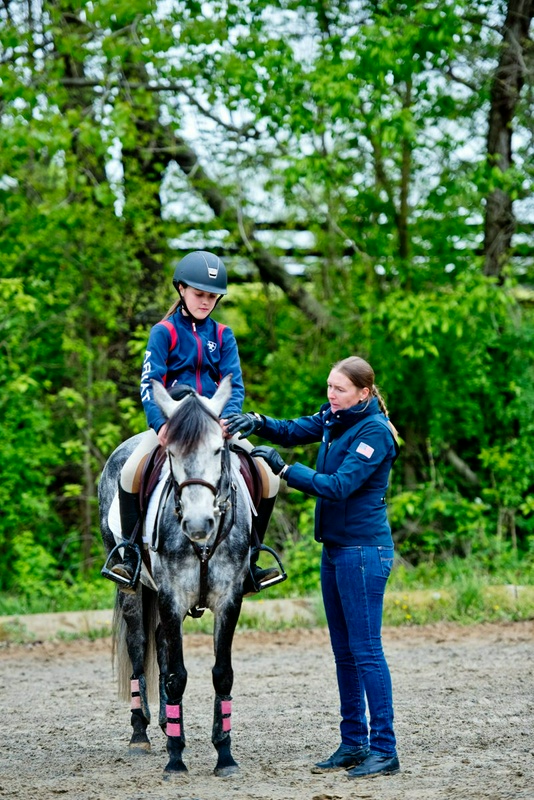
Callan Solem, a prominent show jumping rider, reviews this checklist every day with every horse he rides: Check your riding equipment.
Check your body position.
Check your aids.
Check your attitude and emotions.
He shared this list with 18 participating riders at the clinic and explained how each of these items relates to safe and correct riding as well as proper horse management principles.
These riders came from the Serene Acres Riding Center in Bluemont, Virginia, and earned a day of training with Callan after winning the group spirit award at the 2016 Washington International Horse Show.
Callan, who is now based in Chester Springs, Pennsylvania, brought extensive experience to the clinic: he has competed on the U.S. Nations Cup team in Rio de Janeiro, Rotterdam, Lummen, Falsterbo, and Rome.
He and VDL Wizard achieved the best result among Americans at the 2016 Longines FEI World Cup Final in Gothenburg, Sweden, finishing in seventh place; Callan was also on the short list of 10 top riders considered for the 2016 Olympics.
At the Washington International Horse Show clinic, riders from the smallest pony riders to adult amateurs all coped with the cool, rainy spring day and practiced.
However, Callan created a warm atmosphere and structured environment for each training session; a structure that reminded riders how important the fundamentals are at every level of riding while allowing them to forget about the weather.
As each group began riding, Callan assessed the riders' skill levels as well as the horses' equipment.
He made small adjustments to improve fit and comfort: he repositioned one horse's bridle keepers, loosened another horse's overly tight breastplate, and gathered excess leather from the stirrups to prevent it from flapping around as the horses moved.
He emphasized the importance of attending to these seemingly small details.
He said, "This prevents these items from becoming extra distractions; distractions that might divert the horse's attention from what it needs to do."
As they warmed up, Callan asked the riders to check their body positions and focus on these points: the upper body aligned with the pelvis, the elbow mobile; not locked straight nor held too much at a right angle, allowing freedom of movement both forward and backward, and the heel deep.
Callan said, "When your horse is comfortable with your body position, it can carry you easily."
He then asked, "Why do we focus on the fundamentals?"
One rider answered, "So we have a quiet leg," and another said, "So our horse can understand."
Callan explained that horses need to perform well without having to navigate distractions and push them aside.
A solid body position minimizes distractions and keeps the aids clear.
To strengthen the riders' leg positions, Callan introduced a simple sitting-rising trot exercise: riders should "stay up for two steps and sit for one step."
"As riders improved, the way their horses moved also improved.
Many also found that at this stage, using aids had become easier for them.
Kallen said about the aids that calming the lower leg keeps the connection simple; calming the hand guides the horse; and calming the body allows the rider to sit better around the horse so that the effect of the aids is clearer and more distinct.
The last topic that was considered during the warm-up was the rider's emotions and attitude.
As always happens, some horses were calm, some were more excitable, and others easily got distracted.
Kallen encouraged riders of calm horses to raise their energy level and to do this by using the aids quickly, lightly, and frequently, rather than with more intensity.
In contrast, those riding more excitable and distracted horses needed to bring their emotions down to a calmer level; by taking deep breaths, becoming calmer in the use of aids, and sitting closer to their horses; 'Stay calm and slow in your mind.'
Ensuring that the energy between the horse and rider was appropriate and positive created a better training session.
Transitions began after the riders warmed up their horses and completed the checklist of necessary items.
Building on the more stable positions achieved in the warm-up, Kallen asked the riders to improve their transitions.
He designed patterns that included multiple changes between gaits.
One of these patterns included the following: move at a trot along the long side of the arena and then take the horse to canter.
On the short side, ride a circle.
A few strides after completing the circle, perform a transition to trot.
About 12 feet ahead, perform a transition to walk and immediately after that return to canter.
In forward transitions, riders needed to focus on keeping their shoulders back while moving their horses with the least possible use of the lower leg.
To perform downward transitions, it was necessary to maintain depth in the seat and contact with the leg while creating a give-and-take on the reins with 'fingers,' even if these transitions took longer.
Kallen said, 'It is much better to do a large number of soft and smooth transitions than to just keep going or tighten your horse's mouth.'
He reminded them, 'When we keep our body position calm and stable, the horses hear our voice better.'
One or two riders had trouble finding a canter that their horses could maintain and return to.
Kallen told them that the best canter for a horse is the one it performs in the pasture and encouraged riders to strive for that ideal state; whether it required pushing the horse forward or just 'softening it a bit.'
As soon as the transitions became smooth and the horses and riders reached a state of calm in their work, trot poles and small jumps were also added to the practice.
Kallen initially asked the riders to trot over a ground pole that was slightly off the center line."
To raise riders' awareness of the horse's condition, he asked them to announce loudly which front leg the horse was leading with as it passed the first pole.
This was challenging for some of the younger riders, but they enjoyed the effort to identify it.
Then, one stride after the canter poles, about 9 feet, Colin set up a cross-rail jump—or for the more advanced riders, a small vertical jump—and after that, at a distance of two strides, 22 feet, he placed a small oxer.
The riders would canter over the four poles, jump the cross-rail, and then clear the oxer at a counter canter.
Once the riders mastered this exercise, he asked them to go the same course again and then move in a right circle at a counter canter, passing over a cavaletti that was perpendicular to the line of canter poles.
After that, he added more jumps to create a course consisting of 6 to 8 obstacles.
As the riders took turns going through the course, several key points emerged: focus on body position.
Colin told the riders that immediately after landing from a jump, the first thing they should do is check and adjust their position: "Head up, shoulders back, legs down"; so that "your joints feel soft and fluid."
Maintain a steady counter canter rhythm until reaching the jumps.
Colin asked the riders to count out loud to correct their counter canter rhythm on the approach line to the jumps: "One–two, one–two...
."
This exercise addressed the issue of counter canter instability on the approach line.
Planning and making the right choices while navigating the course.
The lessons previously learned about transitions and patterns became crucial at this stage for executing the planned courses.
As the pairs of horse and rider jumped over the obstacles, Colin reminded them to look where they were going, count "one–two" in the counter canter, and ride according to a pre-designed pattern.
The confidence of the horses and riders grew more and more, and soon everyone could reach the next jump in the course as they wanted.
Thanks to the planning the riders were doing, it was no longer a question of whether they would navigate the course well; it was about how they would do it.
They took wider or sharper turns depending on their choice, came in longer or shorter distances, and rode with more or less rhythm.
At the end of this intense day, the riders were tired but happy and excited that their collective spirit in the Washington International Horse Show had paid off and led to a great clinic with Colin.
When asked what the most important takeaway of the day was, James Daugherty, with the enthusiastic agreement of the other group members, said: "He explained why we should do these simple things, not just telling us we have to do them"; a statement that clearly illustrated the benefits of a day spent working on the fundamentals.
Source: Practical Horseman – Training