Successful Strategies in Show Jumping for Eventing Riders
If you are an eventing rider, you have certainly noticed for a while now that, like in dressage, the show jumping phase in this discipline is increasingly playing a more important role in your final result.
Knocking down one or two obstacles in the jumping section can eliminate your position in the ranking table, even if your horse is a true star in cross-country.
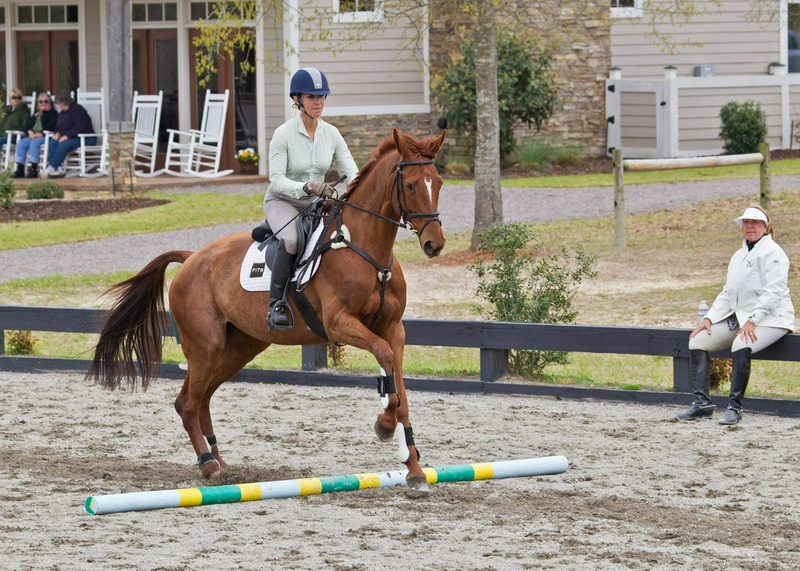
I find it very interesting how Laine Ashker's horse, Rising Spirit, collected itself on its hindquarters while cantering over a ground pole in the high-performance US Equestrian training session for eventing riders held early last year in Aiken, South Carolina.
The flatwork necessary for success in show jumping is inherently slower and more relaxed than the forward and dynamic work needed for successfully executing a dressage test.
| © Hof Pix Sport Horse Photography This is why top eventing riders on the lengthy training list of the United States Equestrian Federation have been receiving specialized "technical" training from show jumping and dressage experts for several years.
In 2010, when the goal for these riders was to win the World Equestrian Games, I trained elite American eventers and worked with them again in early 2011; my insights on what they need to do to improve apply to eventing riders at any level.
Essentially, I want my eventing students in show jumping to enter with the same goal that the full-time show jumping riders under my instruction pursue: to be able to navigate every line flawlessly.
What do I mean by this?
While it is not possible to summarize all the details of my training methods in one article, I can talk about the main aspects of show jumping that eventing riders typically need to focus on and why they are important.
The challenge for eventing riders in show jumping begins here: finding a horse that possesses both the courage and spirit necessary to perform what is asked of it in the cross-country phase of eventing, as well as the level of precision we seek in the show jumping arena, is very rare.
Many horses that excel in cross-country have no problem with brief contact with an obstacle.
They are not bad jumpers; they just are not the kind of exceptionally precise horses that would even hesitate to have the slightest contact with an obstacle.
In fact, more experienced horses have learned that they can even clear some cross-country obstacles, such as brush fences, from several inches above the obstacle and still make contact.
However, when it comes to jumping in the arena, even that slight contact can lead to a rail coming down.
Additionally, we are looking for horses in show jumping that jump in a specific way; they quickly tuck their front legs and also elevate their hindquarters to clear the back of the obstacle well.
Many good three-day event horses naturally have a somewhat unusual jumping style that needs to be converted into a more suitable form for show jumping.
They need to learn to reduce their speed, shift their weight back, and instead of jumping forward, they should leap upwards.
Later, I will discuss the types of exercises I give to eventing riders to develop this form in their horses.
The eventing riders I work with are all good riders.
Unlike show jumping in the United States — which, as I have said many times, I feel is at risk of breeding a generation of weak and overly supported riders — eventing in this country cultivates tough and bold riders who are progressing with every horse they can get their hands on.
Working with these riders is enjoyable; they are eager to learn, truly eager to learn, and at the same time resilient; something I love.
They are so brave and powerful that they can transfer this courage to their horses to tackle the most challenging part, which is cross-country.
However, in my opinion, they need to refine their skills in the other two phases as well.
Their sport has also become a full-time activity like the hunter and jumper disciplines, running 365 days a year, leaving no time for anything other than going to competitions.
In the past, top eventers like Bruce Davidson would come to a show jumping riding club like ours for about a month during the off-season to practice and compete.
I know they also worked with dressage riders and participated in dressage competitions for one or two months throughout the year alongside professionals.
But now, instead of spending six months of the year solely on show jumping or solely on dressage, they work on three-day eventing every day throughout the year.
The challenge for American eventing riders is that instead of having a hand in everything, they need to specialize in all areas; like Michael Jung, the young German eventer who won the individual gold medal at the 2010 World Equestrian Games.
He is truly exceptional in all three phases of eventing.
In 2010, he went to a show jumping competition in Stuttgart and defeated all the show jumping riders in Europe.
I have heard that he has also won against some of the best dressage riders in the world in dressage classes.
If American three-day eventing riders want to beat someone like him, they must perfect their skills in each phase.
I will mention a few examples of things we work on when they ride with me.
I work on position with many eventing riders.
They all tend to be a type of strong and active riders.
In cross-country, they separate from the horse in a galloping position and when they reach complex jumping questions, they know how to drive the horse forward with their legs and seat to clear those massive and intimidating obstacles.
In show jumping, your horse still needs to be moving forward and in front of your leg, but this energy must be harnessed and balanced.
In addition to moving forward, the horse must remain as calm as possible to focus on a clear round.
In most situations on the show jumping course, instead of sitting in front of the obstacle and driving the horse forward, you need to be calm, steady, and controlled with your body.
If you are constantly bouncing up and down, jump ahead of the horse, or apply too much pressure, your horse will likely respond by going faster, flattening out, and hitting the pole.
On the other hand, most show jumping obstacles are not that intimidating for eventing horses; therefore, it is your job to help your horse focus on the quality of its jump.
To help eventing riders learn to keep their bodies steadier when jumping over obstacles in show jumping, I work on a lot of two-point exercises; so that they remain separated from their horses until the obstacle, rather than returning to the saddle and pushing the horse forward with pressure.
We also work a lot on the upper body position; that the shoulders remain up and the body is calm and still, rather than the rider dropping the upper body down to push the horse forward.
A light seat and a steady upper body encourage the horse to perform its jump more smoothly and thoughtfully, clearing the obstacle without error.
From my experience in flatwork, I have seen that eventing riders have a different background in ground work compared to us show jumping riders.
Their beautiful dressage work, which is forward, dynamic, and has a steady rhythm, is what makes good dressage tests.
Here, the main emphasis is on the quality of the movements and transitions.
For example, their transitions must be completely smooth and without interruption.
Although riders want these transitions to occur at specific points, this goal should not come at the expense of the quality of executing those transitions.
For a horse to perform well in show jumping, flatwork is a bit slower and more relaxed compared to dressage.
However, there is a strong emphasis on how quickly the horse responds to your request, not on how much flair and expression it executes it with.
For instance, in ground work, you want your horse to immediately go to Chaharnal upon your request and then, whenever you want, to immediately collect.
This way, you can move at a Chaharnal pace during a course, then collect the horse in three strides with a completely controlled frame for a jump or a line, send it forward again, and collect it once more in three strides; meaning the change between different speeds should happen much more quickly.
Strength training for show jumping I work a lot with gymnastics and ground lines to help three-day event horses and their riders find a better jumping style.
A gymnastics exercise that has a lot of ground lines, angled oxers, and slightly longer strides can help a horse that does not have very sharp front legs.
For a horse that jumps low and flat with its hind legs, I set up a line of two or three bounces spaced about 10 feet apart and place the ground lines slightly ahead of the poles to shorten the distances a bit.
This encourages it to act quicker at its hind end and, of course, can help the front end as well.
The goal of gymnastics is for the horse to realize that if it adjusts its jumping style a little this way or that way, it can clear the obstacle without error, neither brushing it nor knocking the rail down.
The goal is always to help the horse jump better, not to scare it.
Diagram 1: In the counter movement from left to right, give the horse the field with your hands and encourage it with your leg, as the distance between the obstacles and their height increases.
In the opposite direction, as the obstacles become smaller and the distances become tighter, close your fingers and keep your shoulders up.
In many of these types of exercises, I ask riders to navigate these obstacles at a collected canter, then turn left or right, go along the long side of the arena, and repeat the exercise three or four times; or to circle and jump the same obstacles from the other direction.
If a rider does not execute the exercise correctly, I tell them: "Make a loop and do it again."
At this stage, many eventing riders say: "My horse is tired. This exercise is too heavy!"
This always makes me laugh.
My response is: "I thought your horses could gallop four miles, but this type of work tires them out."
From a training perspective, I find it interesting that jumping horses with my horse probably cannot gallop four miles at a full gallop; however, they can go for hours at a collected canter over small jumps up and down without getting too hot.
The preparation that eventing riders give to their horses for cross-country galloping is a science; however, they must also develop physical fitness for this type of collected work.
This work is tedious, but it is important; like the compulsory section in figure skating versus the free performance.
Discipline is when I ask my eventing students to navigate a jumping course with their horse or repeat a line of obstacles and add one stride or take one stride away, they all initially tell me: "I can't see the distance! I can't see the distance!"
I say: "Yes, you can. You can see the distance. You all see the distances very well. What you are not used to is the focus, discipline, and attention needed to see the best possible distance to each obstacle."
Many times the issue is "Don't see that distance; see another distance!"
As horses move forward in the arena, they often lengthen their strides at the end, and the distances that the rider sees also become longer and flatter.
Again, it is the rider's responsibility to ensure that the control they have at the end of the course is the same control they had at the beginning.
I want my eventing riders to do the same types of exercises that we always do for jumping.
For example, I set up interesting gymnastics on a curve; for instance, lines where you have to come forward after a turn to achieve four long strides, which is 64 feet, to the obstacle.
If your horse has a medium stride, you can jump this line from center to center.
If your horse has a shorter stride, you learn that you need to jump the line from the center of the first obstacle to the inside corner of the second obstacle.
If your horse has a longer stride, you learn that you need to jump from the center to the outside corner.
This exercise also shows which direction your horse tends to drift.
Diagram 2: To ride this line well, you need to come forward after the turn to achieve four long strides.
If your horse has a medium stride, jump it from center to center.
If its stride is shorter, jump it from the center of the first obstacle to the inside corner of the second obstacle.
If your horse has a longer stride, perform the jump from the middle to the outside corner.
Sometimes I also ask the rider to reach an in-and-out with a stretched canter where the distance between the obstacles is short; for one stride, 21 feet.
To achieve a good time on a stadium course, you must approach the obstacle just as you would when going through the turns with Chaharnal; however, you must then resist the temptation to enter with a long stride, as doing so makes it very difficult to fit one stride between two obstacles and increases the likelihood of knocking a rail down.
Instead, with 4 or 5 strides left to the obstacle, you should shorten the horse's stride so that you can enter the jump at a slower speed and fit that one stride correctly (Diagram 3 on the right).
Diagram 3: Approach this in-and-out calmly with Chaharnal and, with 4 or 5 strides left to the first obstacle, softly collect your horse so that you can enter the jump at a slow speed and fit that one stride correctly.
In my training sessions with eventing riders last year, we worked on the jumping style of the horses with a line of bounce jumps set at a height of 2 feet, spaced 9 to 10 feet apart; usually two bounces in a row, along with a ground line and a rail placement, either at the entrance of the bounces or at their exit (Diagram 4 below).
I like this exercise because it helps the horse to be quick both in the front and back end, but the ground lines prevent them from getting too close to the obstacle.
As the horse improves, we gradually increase the height of the bounces, but not more than 3 feet.
Another one of my favorite exercises is to set two vertical obstacles in a line spaced 4 and a half strides apart, which is 66 feet, and ask the rider to jump it in both 4 strides and 5 strides: either you enter with a flowing rhythm and take one stride out, or you enter slowly and add one stride.
Then I place that same line within a complete course and say, “Alright, if this is the last line of the course on the way back home, you want to take one stride out; on the other hand, if you have a short tight turn immediately after this line, you need to make sure you add one stride.”
This exercise enhances your ability to do whatever you want to do in that line based on its position in the course and what you need to do afterward.
I love adding and subtracting strides, shortening and lengthening strides.
It’s not just about controlling the horse; it’s about your ability to make the right decision and then execute it.
All my lessons are designed to reveal problems and weaknesses.
When a horse makes a mistake in one of these exercises, I want the rider to understand what they did wrong and find a way to correct it.
I show different ways and various topics to work on.
Riders need to understand that it is this flawless quality of riding that allows horses to jump without touching the obstacles.
Diagram 4: I like to work on the jumping style of the horse with a line of 2-foot bounces.
For each vertical obstacle, a ground line is placed slightly ahead of the base of the obstacle.
The bounces help the horse to be quicker in the front end and back end, but the ground lines prevent them from getting too close to the obstacle.
The point is to know the best shape of your horse's jump and how to build it; not just once, but throughout the entire course.
In competitions, this process starts from warming up for the stadium section: I want my eventing riders to really plan their warm-up based on what is ideal for that horse on that day.
Do they need to jump a gymnastic exercise that morning?
Do they want to have a warm-up with obstacles or not?
Should they use the ground line or work without it?
I try to give them a different kind of hope and philosophy about the jumping part of their sport: with focus and discipline, they can reach a level that affects the way their horses jump over each obstacle.
I hope my most important impact on the eventing riders I teach is to broaden their horizons and spend more time jumping with their horses, not just within the framework of their own discipline.
I would love for them to take their horses to the Winter Equestrian Festival in Wellington, Florida, and participate in many classes.
For eventing riders, one round of jumping with horses as part of an event is not enough to really know their horses: which lines are difficult or easy for them, what spooks them, and how they react to different environments and types of ground.
Eventing riders in the United States should follow the model of the world-class eventing riders I know in Europe; figures like Mark Todd or Lucinda Prior-Palmer Green, who are also good jumpers themselves.
Katie Monahan Prudent had experience coaching eventing riders before she began working with the talented eventing team riders of the United States in 2010; a position later taken over by Lauren Hough, the Olympic show jumping rider.
She said, "I have been friends for years with Karen and David O'Connor, who are near my Plain Bay Farm in Middleburg, Virginia.
I have also taught my very good friend Ian Beiny, whose Surefire Farm is in Purcellville, and I have great respect for him, as well as Allison Springer, who is one of the most promising young eventing riders."
Katie's brilliant professional career in the hunter/jumper world began at the junior level; winning both the Medal and Maclay finals, and then several championship titles in the hunter ring, before she became an international star in show jumping.
She was a member of the 1986 World Champion show jumping team, and has won nearly every major grand prix in the United States and has been named the United States Equestrian Federation's Rider of the Year three times.
She now runs an international training program with her husband, Henri Prudent, a French rider.
They split their time between Middleburg and Rosier au Salin in France.
The latest example of Katie's many successful young show jumping students is Reed Kessler; a member of the 2011 Young Riders Show Jumping Team who successfully competed in the European Tour for Young Riders last year.
This team achieved its first victory in the Nations Cup in Austria last June.
Katie, who remains an active competitor herself, intends to continue riding.
She said, "I would like to stay at a good level in the coming years so that I can take a group of up-and-coming riders to Europe and compete alongside them."
This article was first published in the May 2012 issue of Practical Horseman.
Source: Practical Horseman – Training