Ryan Wood's strategy for confidence in corner jumping
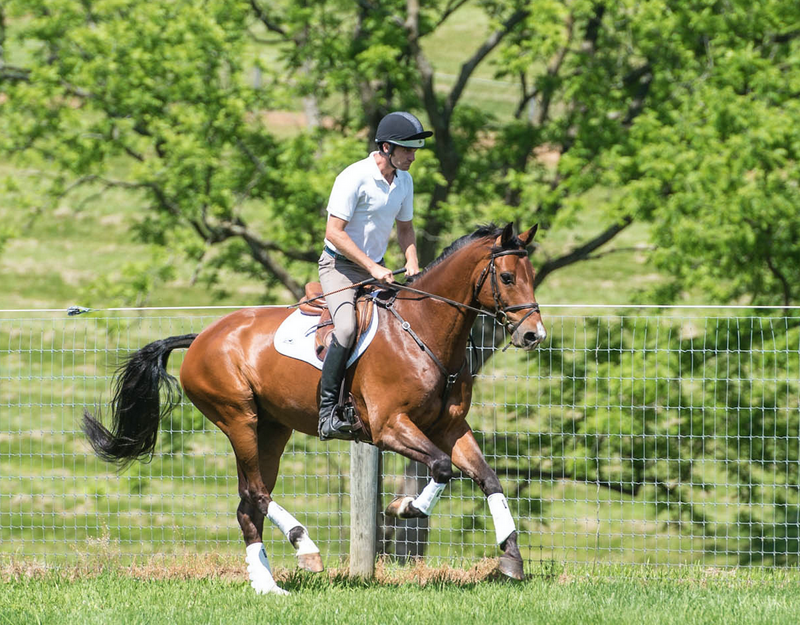
Corner obstacles are common components of almost every cross-country course in the United States.
From the training level onward, horses and riders must be prepared to navigate corner obstacles.
When I want to familiarize young riders and horses with corner obstacles, I always use a consistent method; first, I create a simulated corner in the arena to introduce the concept, and then we proceed to jump a real corner on the cross-country course.
In introducing corner obstacles, the key point is that jumping these obstacles entirely depends on the step-by-step progression process.
First, you need to establish the correct canter on a flat surface and then work in the arena on a simulated corner before going out to jump a corner on the cross-country course.
Only then will your horse jump it with the same confidence that Alcatraz, Sarah Hughes's 12-year-old Hanoverian gelding, displays in this picture.
Whether you are practicing dressage, show jumping, or cross-country, there is always a progression process.
You start from the basics and gradually advance, and jumping a corner obstacle is no different.
First, your seat, leg, and hand aids need to be correct, which I will explain in the next section.
Then, you build confidence by jumping a simulated corner in the arena using a barrel and two jump standards; this prepares you for success to step outside the safe confines of the arena and jump a corner on the cross-country course.
Step one: Develop the correct canter. Confident jumping of a corner obstacle begins with having the right canter.
A corner obstacle is a test of precision, and for these types of questions, I like to slightly reduce the speed of the canter between obstacles during the approach.
You still need a forward and positive canter, but approaching at a slower speed gives your horse more time to see the obstacle and understand the question posed.
Practice this canter before working on the corner in the arena, focusing on your aids.
The combination of your seat, leg, and hand aids that you use when approaching the corner gives your horse the best opportunity to jump it confidently.
1.
You can practice developing the correct canter in the arena or anywhere you perform your canters.
I start at the same speed between obstacles that I would use in cross-country; that is, a forward canter at a faster pace.
In this case, you will be in a two-point position; your seat is out of the saddle, and your knee angle is 110 degrees.
Make sure you have shortened your stirrups enough so that in the two-point position, your back remains off the saddle.
2.
Now I start to bring my upper body back and reduce Alcatraz from a canter to a positive, forward canter.
This is the canter I establish before reaching the corner.
For practice, choose a marker in your canter area; like a tree or an obstacle.
Practice reducing your speed from a canter to your desired canter until the moment you pass that marker.
Depending on how quickly you can slow and balance your horse, you may need to start this process from a distance well before the marker.
The more you practice, the easier this transition will become for you.
3.
Then I sit firmly in the saddle and take a defensive sitting position, bringing my upper body back to be straight and vertical.
My legs are in constant and driving contact with Alcatraz's sides — something like the legs of Philip Dutton — and this makes it clear to Alcatraz that I want him to move confidently forward.
This is a position I use four to five steps before the corner.
4.
As I bring my seat closer to the saddle, I hold both hands a few inches apart to create a channel for Alcatraz's shoulders.
This is the same hand position I use when approaching the corner to encourage him to maintain his line.
This hand position and the driving leg aids send him forward and make it clear that you want to jump the corner.
Step 2: Corner exercise in the arena layout: Create a simulated corner in your arena so that there is enough space to jump it from both directions: lay a barrel on its side.
Place two standards close together about 10 feet away from it, so that the cups face the barrel.
Depending on your level, this distance can be even less.
Place one end of a 12-foot pole on the barrel and the other end in the cup.
Do the same with the second pole and standard.
Place a ground pole at the base of each vertical obstacle.
Place one end of the last pole on the front of the barrel and the other end on the ground, so that it is positioned at an angle of about 100 to 110 degrees outward from the obstacle.
This pole acts like a wing or guide rail to direct the horse and encourage him to jump.
Focus point: To determine which part of the corner you should focus on and from which point to jump, bisect the angle; visualize a line that divides the angle into two halves from the widest part of the corner to its tip.
In the center of that line, imagine another line coming towards you at a 90-degree angle.
This is your approach line.
The goal is to choose a "path of passage" over the corner that encompasses both the narrowest part of the corner — without risking a refusal — and the widest part of it, without expecting too much jumping ability from your horse.
If you approach the corner from the middle of this path, you will still have a margin of error if your horse drifts slightly off the line while approaching.
Note >> Reaching the stage where you jump the obstacle as a complete corner may not happen in one jumping practice session.
In the first session, you can start by lowering the front pole from the cup to the ground and using a top pole to guide the horse.
In the second session, you can first briefly review the first session's exercise, then if your horse jumps confidently, put the pole back in the cup and continue using the top pole.
In the third jumping practice session, you can remove the top pole.
1.
I lowered the front pole of the corner from the cup and placed it on the ground.
This softens the front view of the corner and helps Alcatraz better understand the concept of jumping this obstacle.
At this stage, having a helper on the ground is useful to be able to put the poles in or take them out of the cup and change the position of the top pole.
About five steps away from the corner, I went into a defensive position in the saddle; that is, I sat and kept my upper body straight and vertical.
I also made sure that my legs were firmly positioned on both sides of his body and I held my hands wider apart.
The simultaneous combination of leg, seat, and hand aids caused Alcatraz to confidently jump from the corner.
(He was a bit lively that day, which is why I used a shorter release here.)
2.
Alcatraz has competed at the advanced level, so this corner is no longer challenging for him.
If he were a less experienced horse, I would ensure that he confidently jumped the corner from both directions with the front pole lowered.
If he hesitates, I continue to jump with the lowered front pole until he jumps confidently.
After that, my helper would place the front pole inside the cup, and I would approach again; just as I do here, with the same aids from the seat, legs, and hands, along with the guide pole, so that it is completely clear to Alcatraz that I want him to jump the corner.
Note >> Horses and riders progress at different speeds when jumping from corners in the arena.
The key point is to proceed at a speed that builds confidence in both you and your horse.
If reaching this stage takes three or more jumping practice sessions, it is worth it when you lay the groundwork for this exercise in the arena.
3.
After Alcatraz confidently jumped the corner obstacle with the help of the guide rail, my helper removes it, and I approach the obstacle as I did before: sitting defensively in the saddle, legs firmly on both sides of his body, and hands further apart.
4.
Now Alcatraz is ready to jump the corner obstacle at a higher height; something that prepares him for the actual dimensions of this obstacle when we go to the cross-country course.
When should you go to cross-country?
After you have practiced enough jumping with your horse in the jumping arena, and he jumps the simulated corner obstacle without any poles above, confidently in both directions, it is time to go to the cross-country course.
Make sure to construct the simulated corner obstacle so that its height and width resemble the corner obstacle you will encounter in your cross-country field.
If you do not have a corner obstacle at home, try to ensure that the course you take your horse to has suitable ground and is not too muddy so that your horse does not slip while still learning and loses confidence.
Also, make sure that your corner obstacle is secured with stakes in the ground so that if your horse hits it with one of its legs, it does not move.
When approaching a corner obstacle in cross-country, have a pole with you to create a top for the obstacle and ask a ground helper to place it on the tip of the corner obstacle at an angle of about 110 degrees, just like in practice in the ring.
Step 3: Jumping from a corner obstacle in cross-country 1.
I started warming up with various counter exercises and aids that were explained earlier, and then I took him over a few simpler obstacles — a log, a coop, and a table — to ensure he jumps straight and has no doubts.
Then, I pick up the Chaharnal between the obstacles, get into a two-point position, and approach the corner obstacle.
2.
A few steps before the corner obstacle, I turned Alcatraz from the Chaharnal between the obstacles into a forward and positive counter, and for this, I lowered myself in the light seat.
Now, about four strides before the corner obstacle, I sit in the saddle and bring my upper body back to be close to a fully upright position.
I also keep my legs firmly on both sides of Alcatraz and open my hands wider.
Note >> If at any stage you feel you lack confidence, remember that this exercise is based on a step-by-step progression.
In your jumping practice sessions on the cross-country course, continue to use the pole.
Whenever you feel ready to take the next step, remove the pole and jump the corner obstacle in both directions.
3.
Our progress has paid off.
Alcatraz jumps confidently and in good form.
I use automatic release to maintain contact with Alcatraz's mouth.
To ensure that this was not just a random occurrence, I jump the corner obstacle once again in the same direction.
He jumps confidently again, so I ask for assistance to move the pole and we jump the corner obstacle from the other direction.
We are soon ready to jump the corner obstacle without a guide rail.
Mission accomplished!
Understand that your aids play a completely decisive role in successfully jumping corner obstacles.
If you approach the corner obstacle with too much speed, the horse may misinterpret the request.
If you enter with low energy and loose reins, the likelihood of refusal increases.
If a refusal occurs, think about what happened and why.
Did you approach the obstacle with the wrong line, perhaps at too steep an angle, so that your horse did not understand the request?
Were your hands not open enough to create a corridor?
Were you in a canter position instead of a defensive seat?
Did you keep both legs firmly on either side of the horse to encourage him to move forward?
If during practice with corner obstacles in cross-country your horse refuses the obstacle, put the pole back in place to return him to a familiar situation that he understands.
It’s also a good idea to jump another obstacle like a table or log before returning to the corner obstacle; an obstacle you know your horse will confidently clear.
This will redirect his mind to the idea that he needs to go from one side of the obstacle to the other.
If your horse continues to refuse the obstacle after putting the pole back, it is usually easier to resolve this issue in the arena than on the cross-country course.
There, return to repeating the previous steps of this exercise.
Place a pole next to the simulated corner obstacle in the arena, lay the front rail on the ground, and then start again from the beginning, raising the obstacle step by step.
About Ryan Wood Ryan Wood, who is of Australian descent, grew up in a pony club and began competing in eventing at the age of 8.
He bought his first horse, an Australian stock horse named Countdown, through a local newspaper for $1,000.
Ryan and Countdown progressed together in eventing levels, and when they were both 19 years old, they completed their first CCI* competition in Adelaide.
Ryan successfully competed throughout Australia, achieving top rankings at Melbourne CCI, Sydney CCI, and Warwick CIC-W.
He trained with a number of top riders and worked for them, including Guy Wallace, the Australian eventing rider, Norbert van Laak, the Olympic dressage coach, and prominent show jumping champions, Ludger Beerbaum and Ernst Hofschröer.
Ryan moved to the United States in 2008 and began his career with Bruce Davidson before transferring to Phillip Dutton's True Prospect Farm in Unionville, Pennsylvania.
He now runs his own business at True Prospect Farm.
Since moving to the United States, Ryan has become one of the top eventing riders in the country.
In 2016, he became the champion of the Jersey Fresh CCI, Bromont CCI, and the final of the Adequan USEA Gold Cup at the American Eventing Championships.
We thank Kent Nutrition Group and Blue Seal for our coverage of the 2025 Defender Kentucky Three-Day Event.
This coverage includes event previews, interviews with riders, competition reports, horse introductions, photos, videos, and more.
This article was first published in the December 2017 issue of Practical Horseman.
Sources and Attachments: 2025 Defender Kentucky Three-Day Event Kent Nutrition Group Blue Seal Source: Practical Horseman – Training