The training of Tick Minard to improve the adjustability and responsiveness of the horse.
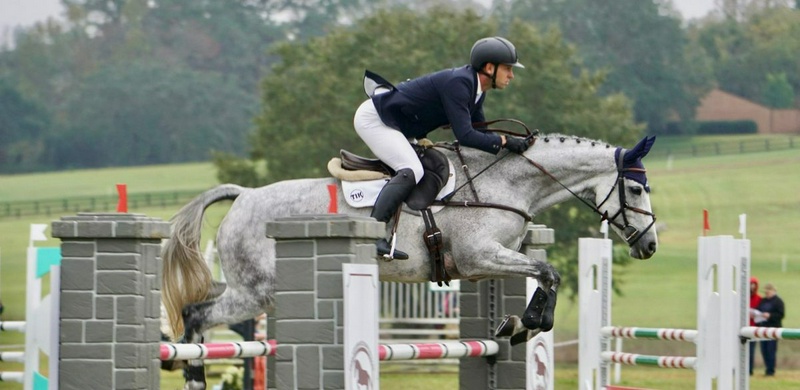
This very useful exercise by Tik Maynard works on the horse's adjustability and responsiveness.
The combination of groundwork and actual riding makes it suitable for the off-season and turns it into a fun activity to do with your fellow riders.
The required equipment is 2 ground poles and 2 cones; this exercise can be set up almost anywhere, even outdoors and in a nearby field.
The 60-foot distance is just a suggestion and can be adjusted to fit your space.
Why we as riders need to know what stride length our horse is moving at any moment.
This is important because when we are in a competition, we need to be able to coordinate ourselves with whatever stride length the course designer asks of us.
The smooth and quick practice of changing stride length during this exercise will help you in competitions, as your horse will become more adjustable and responsive.
You will also gain the confidence as a rider that your horse can handle any adjustability challenge you face.
There are countless ways to make this exercise easier or harder.
I recommend challenging yourself, but if necessary, never be afraid to take a step back.
How to always keep these three priorities in mind while executing this exercise: Is your horse in a safe position at the end?
Are you safe at the end?
Does your horse have more relaxation at the end compared to the beginning?
A horse needs a certain level of calmness to learn.
This exercise can be progressed in 15 gradual steps: Have your horse walk over the poles.
You should be able to do this with a "loose rein"; that is, the horse should calmly walk beside you over the ground poles several times.
Mounted on the horse and with a high rein, walk over the poles at a walk.
Again, the horse should be able to walk calmly over the poles.
Without stress.
From the very beginning, you must ensure that you are passing through the center of each pole; this is why the cones are placed in the middle to help gauge your alignment.
First pole at a walk, second pole at a trot: Regardless of how connected you are with the bit — which should match your training level — it is enough to gently take the trot after passing over the first pole at a walk.
First pole at a trot, second pole at a walk: This is where some people struggle.
60 feet is a good distance for executing a nice downward transition, so don’t rush.
Both poles at a trot: Again, your goal should be to maintain a calm and steady rhythm throughout.
First pole at a trot, second pole at a canter: This is a great way to practice your upward transitions to canter; request the transition over the first pole.
Or make this transition in the middle of the distance between the two poles.
First pole at a canter, second pole at a trot: Just like the trot to walk transitions, remember that you have enough time to make the transition.
Canter over both poles: It doesn’t matter if you are in a half-seat or sitting fully in the saddle; your only goal at this stage is to confidently canter over both poles.
If you have trouble maintaining the canter hand over both poles, instead of imagining the path as a square, try to pass over the poles in an oval-shaped path.
Cross over both poles at a canter and count the steps.
This is where doing this exercise with friends can be helpful, as you can assist each other in counting the steps.
Consistently reach five steps: challenge yourself to have five even 10-foot steps between the two poles.
An additional 10 feet is also considered for takeoff and landing.
Shift between five and six steps four times in a row.
The key point to be able to change between two different step lengths is planning.
You will soon realize that you cannot just rely on the reins to make these adjustments.
Use your seat and lower leg to adjust the step length, and think about changing balance before you think about changing speed.
Execute this pattern: five, six, seven, six, five steps.
The challenge at this stage is to continuously shorten your horse's step and then immediately lengthen it again.
Execute this pattern: four, five, six, seven, six, five, four steps.
This is actually a repetition of the previous exercise, but with a higher degree of difficulty.
Execute this pattern: four, seven, four, seven.
While the previous two exercises involved gradual transitions in step length, this stage creates a greater challenge for an immediate change from four steps to seven steps.
Be creative!
Change direction each time and perform a flying change over the second pole.
Add more steps or turn the poles into obstacles.
Set up this exercise outdoors and use the terrain features.
I cannot emphasize enough that if your horse has a problem at any part, step back one stage so it can calmly perform the previous stage.
I am looking for the horse's mouth to be closed, its tail to remain calm, and it to be able to maintain rhythm.
If your horse has difficulty calming down with you on its back, first lead it from the ground over the poles until it is ready to practice again with the rider.
If it becomes anxious when you want to bring it to the bit, return to riding with a loose and calm rein.
I do not want the horse to go towards the jump at all unless it can first move calmly in walk, trot, and canter — both in the arena and outdoors — with a relaxed rein.
Finally, when riding, take a moment and pay attention to your horse's ears.
During hacking and flatwork, they should be relatively calm and even a bit floppy.
When you start jumping, its eyes and ears should be directed towards the obstacle.
The horse should synchronize with its rider for a moment before the turn before the obstacle and then focus its attention on the upcoming jump.
Your challenge as a rider is to see if you can connect with the horse without interfering with its work.
And the best way to achieve this goal is to practice, practice, and practice again on these ground poles.
About Tick Maynard, this exercise is part of the book "Grid Pro Co: 52 Effective Jumping Exercises from the World's Top Riders" by Margaret Rizzo McElroy.
Tick Maynard operates at Copperline Farm in Citra, Florida, with his wife, Sinéad Maynard, who is also an eventing rider.
His professional activity is a combination of eventing and natural horsemanship, and he has students of all levels and disciplines.
He is the author of the bestselling memoir "In the Middle, Men Ride Horses."
This section of the book "Grid Pro Co" by Margaret Rizzo McCloughy has been republished with permission from Trafalgar Square Books.
Source: Practical Horseman – Training