Strengthening the partnership between rider and horse in eventing
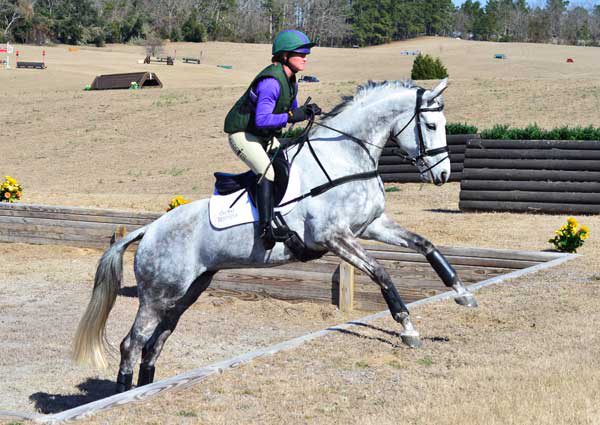
Like many upper-level eventing riders, I have ridden almost every type of horse you can imagine.
I enjoy taking a horse that lacks a bit of confidence — whether in dressage, cross-country, or even in its overall life situation — and designing a program for it to build its confidence.
In the long term, my goal is to establish a stronger connection and build a better partnership with my horse.
It is at that point that I feel ready to face any challenge because for me, it all comes back to that partnership.
I do not have a predetermined plan.
I use the foundational principles I have learned from some of the best riders in the field to tailor whatever I do to each horse.
I want to illustrate how this approach works by discussing two completely different horses that I have recently brought up to the CCI level or higher: River King (Riley), a Holsteiner, and Here's to You (Quincy), a Thoroughbred.
My focus will be on what I had to do to train each of them to face one of the classic cross-country questions at upper levels, namely the sunken road.
Training two complete opposites physically, eventing is easy for Riley; he is brave, has a naturally high athletic ability, and his body is built upwards.
When he came to me, he was already competing at the CCI level and could gather his legs over obstacles without really putting any pressure on himself.
The biggest physical thing he lacked was that he didn’t know how to round his body over jumps; and I knew that when he reached the CCI level, this could create difficult moments for us because at that level and above, the spacing between the elements of combinations requires the horse to be able to gather itself and, so to speak, go inward.
If he doesn’t round his body over jumps, he can’t gather himself.
In terms of training Riley to use his whole body as a unit, there was a lot of work to be done.
Mentally, Riley's biggest challenge was keeping his focus on what was ahead of him.
When several elements were close together, like the sunken road, just as he was about to take off to clear the first element, he would look down and at what was behind it, and he would twist, hit the obstacle, or lose his line; and this made adjusting strides for the subsequent elements difficult.
The physical questions that were easy for Riley posed a significant challenge for Quincy.
He has a powerful hind end, but his body is built downwards, and in other areas, he needed so much work on the form of his front limbs that we jokingly referred to him as "spaghetti legs."
Often, his hind end would push before his front end realized it needed to move.
If upper-level horses are not quick enough with their legs, they can struggle to make the necessary adjustments while moving.
Quincy needed to develop his leg work to the point where, when he finds himself in a situation and has no time to think, his muscle memory kicks in.
I knew that the better upper-level horses are at working with their legs, the more options they create for themselves, and the less likely they are to make mistakes.
When I first saw him, Quincy might not have seemed like the right horse for the CCI level at first glance, but from the moment he arrived to me as a horse at the preliminary level, I had a very good feeling about him; because he had the scope, power, and willingness necessary to jump over any obstacle.
My job was to help him better develop the technique of his front end.
Mentally, riding Quincy was easier than riding Riley, as Quincy was very intelligent and understood well what was coming up on the course.
However, his mind sometimes raced ahead so quickly that his body, especially the front end, couldn't keep up.
His default mode was to take off from the ground with more power from his hindquarters and make a bigger jump.
This could bring him too close to the next element and make the jump more difficult.
In general, in cross-country, I want my horses' minds to work more calmly — really analyze the questions on the course — while their bodies need to react quickly.
Whenever I focused on a specific question, like the road-ditch with Quincy and Riley, I would revert back to this ideal pattern.
With Quincy, I needed to slow everything down and keep the elements small and simple so he could execute them correctly.
With Riley, it was exactly the opposite.
Our exercises at home had to be serious and significant enough for him to understand that he needed to care and focus.
If I set the same exercise for both horses, I would set it for Quincy at a height of 2 feet 6 inches, because he is just as aware of a 2-foot-6-inch obstacle as he is sensitive and alert to a 4-foot-6-inch one.
But for Riley, I had to make the exercise challenging enough from the start to grab his attention and sharpen his mind.
Now let’s look at the question we are going to analyze, which is the road-ditch, and see what challenge this question posed for each of the horses.
In the photos on the following pages, I will illustrate this section with my newest stable horse, Shem On The Moon.
What is the first element of the road-ditch?
The road-ditch at the advanced level consists of an "entry" jump, which is usually a vertical obstacle, immediately followed by a bank or a one-stride distance, and then a significant vertical drop is seen.
After this drop, there is a one-stride distance across the "road," and then the horse must jump up the earthen slope on the other side, and immediately after this ascent, another jumping effort, the "exit" jump, is ahead.
The entry element usually has a relatively fixed structure in terms of the type of question it poses.
However, in the exit section, the tougher courses require you to jump over something that needs much more power; you must show that your horse can maintain its strength in the very technical previous part of this question.
This exit element can be very diverse.
In a CCI, it might be two strides to a massive corner, while in an advanced level event, it could be a bank to a simple and small rail.
The road-ditch question encompasses all the necessary elements for a good ride in cross-country: it requires balance and coordination from both the horse and rider, as well as the ability to communicate between them, all while everything is changing at high speed.
In approaching the obstacle, after executing a transition from Chaharnal to a balanced canter, both my horse and I need to be mindful — which is one of the most important factors — to read the question of the obstacle correctly and jump it properly.
In my opinion, the biggest challenge in this question is that both the horse and the rider need to regain their balance after landing from the drop.
The horse lands in the pit with all its weight on the front legs and must shift its weight back to be able to jump out.
If the rider loses their position in this quick change at the advanced level, there is no time to recover it.
What is the next step in training?
Generally, when I want to train a horse or rider to cross a sunken road, I break this question into separate parts.
I start with practicing a simple drop and then add an element before the drop.
We also work separately on the upward bank and then practice the upward bank with another element on the other side of the obstacle.
Often, when the drop section of this exercise is going well, I add a small bounce, about 2 feet, a step or two from the bottom of the drop.
This is a lower-risk and more forgiving way to determine whether the horse can land, regain its balance, and quickly tuck its legs before facing an upward bank too soon.
Upward banks are not among the obstacles that forgive mistakes much, and it is very easy for an inexperienced horse to get caught or fall when jumping up.
When I feel that the horse or student has gained enough confidence with these elements, I take them with a trailer to a facility that has a real sunken road; that is, an obstacle with two or three steps at the bottom, to execute everything together.
This was the foundational program I used to train Quincy and Riley to cross the sunken road, but since these two were very different in their individual characteristics, I had to adapt my method for each of them separately.
Riley: Learning to look down, Riley had encountered sunken roads before reaching me and was completely confident in this question.
However, I knew that when we moved to the advanced level, he needed to be able to change his form and adjust his body, not just tuck his legs out of the way of the obstacle.
Advanced-level horses must maintain their balance, but at the same time, they need to learn to look down to know where to place their legs.
This also involves building a rounder form in their bodies so they can tuck themselves.
Since Riley was not focusing on his jumps beforehand, he did not look at what was behind the first element until the moment he was just about to take off — and then his balance was disrupted.
(This problem had not arisen until he had to jump the rail before the sunken road and then enter the drop with a bounce.
) Shimeon D. Mon (Delta) is completely focused on the obstacle before the drop and looks at the task he is about to perform.
I also look at the obstacle until it goes out of sight between his ears, and then I keep my gaze up.
Delta's withers have risen, and the front of his body is light, and I maintain this form with a seat close to the saddle and soft yet supportive reins; the contact allows him to look and keeps his balance high without restricting him.
My leg is active on his body to encourage him to take the step forward and underneath himself from behind.
Considering that there is a drop right behind this obstacle, I want to follow Delta's movement but not restrict his jump.
At the same time, I need to look ahead and not let my eyes fall on the drop.
I still support him with this contact; I let him use his head and neck, but at the same time, I keep him straight.
Delta is completely straight, standing in front square and balanced, and he has maintained himself very well, and his posture is alert to what lies ahead.
When Delta looks down, his body shape noticeably changes.
I have kept my weight back, very close to the saddle, my heels are down, and my leg has come slightly forward, but I haven't brought my upper body back because I want to encourage him.
I need to be in a position where, if something goes wrong, I remain safe and stable in the saddle.
While maintaining contact, I open my elbow wider to give him enough rein to see down and recognize his intended path.
My upper body remains prepared and balanced while I look up and forward, not down; the very place he is staring at.
Here, Delta has shifted his weight back to free the front of his body for the jump down, and I have also moved forward with his movement; my heels are down, my weight has gone forward in my leg, and I am close to the saddle.
I have raised my hands slightly to maintain contact because Delta has not yet started to come down.
One of the common mistakes riders make when jumping from a drop is sitting back too soon and too much; as a result, their hip angle locks, creating that "whipping" effect upon landing.
Here, my hips bend with his movement and are ready to be driven forward, providing the support I need.
I have settled in the saddle, and as I approach the bank, my focus is on the step and timing.
Delta has raised his head and neck to see the obstacle, and my hand moves with him.
My leg has gone back again to ensure he is still coming well from behind.
His croup is tucked under his body, and his withers have risen.
My upper body is vertical but relaxed and calm.
I have gathered his canter like a spring to have the necessary force for the jump to the top of the bank.
Here, I have bent my elbow and raised my hand slightly so that Delta receives the extra support he needs for a soft landing when coming up from the bank, without creating any backward effect on the reins.
If I had brought my hands back, my upper body would have been thrown back, affecting his balance.
Now I am seated in the saddle again, accompanying Delta as he approaches the next element.
His head and neck have taken responsibility for guiding with the reins.
If I had shortened the reins for the jump up, I would have restricted him at the very moment he needs to use his head and neck.
| © Juan Blas At higher levels, simply reaching the obstacle is not enough.
You must approach the obstacle with enough correct alignment and balance so that your horse can jump over any obstacle.
If you had seen this obstacle alone, you would never have seen all those changes in Delta's balance and mine that had occurred before; we are connected as one unit.
| © Juan Blas For overall preparation, we did a lot of work with Cavalti so that Riley had to pay attention to what was in front of him.
We also had many jumping exercises where I would change the components of the obstacles so that he would have to change his body form.
We might go from a tall, open obstacle to something short and wide in a bend or a stride distance.
I always changed the distances so that he would never get used to doing the exercise in just one way, and sometimes I would place something bulky and solid like a flower box at the base of the wide obstacle to encourage him to look at it.
I had to keep thinking constantly.
As a rider, in something like a sunken road, you need to be careful that you are guiding your horse, but you are not interfering with his work.
A rider never wants to distract the horse while he is trying to jump, and a question like a sunken road is more of a continuous effort to jump than a series of separate jumps.
Many times in the process of training Riley to look at the path ahead of him, it happened that when I came in a Chaharnal and then wanted to prepare him for this question, I ended up circling in front of the obstacle instead of passing through.
I didn't want him to think he could half-listen to me and just push through this section by stiffening his body and using strength; but at the same time, I didn't want to hold him back and restrict him during this question, as it wouldn't help him learn to use his body more correctly.
Another part of the challenge was convincing him to transition from the Chaharnal to the body frame and speed we needed for this question.
I thought that when we reached the CCI Bromont competition in June 2013, we had put all these pieces together.
We had a very good run until we reached a huge drop where we had to turn to jump from two narrow angled cabins.
I thought I had gathered him enough on the approach; my logic was, "Surely when he sees that big drop, he will hesitate"; but he did not hesitate and just threw himself down the drop because he couldn't see the next element behind the turn, and then there was no way to turn and place the horse correctly for the cabins.
In the end, we received 20 penalties because we had to circle down the obstacle.
We started the summer again from square one and worked on this concept: "Even if you don't see something, you have to listen to me!"
"Time and time again, I took him up the slope in my small practice field, asking him to add an extra step before jumping the small obstacle at the top of the slope, then we would jump back down and circle.
The key part of this exercise was that small obstacle before the drop; I didn't want to put too much pressure on Riley by practicing on a big drop, but I knew that he would simply jump down from a drop of 2 or 3 feet without gathering his body and using power from behind.
That small obstacle at the top of the slope effectively forced him to put in more effort for that small drop.
He learned to land softer and then could listen to me.
This required a lot of repetition.
Quincy: "Use your components, not your strength!"
"The exact feature of Quincy that made me think he had international potential — that is, his power — was the same thing that caused us trouble in technical questions like Sunken Road.
Although he was somewhat timid at first, he is not the type of horse that shies away from his jumps.
He usually jumped very large drops, and his body structure, which was on the hand, made it difficult for him to recover his balance and act quickly and sharply with his front legs; instead of working with his front legs, he tried to jump higher.
If he passed through a combination the first time but acted very clumsily on the exit, this would scare him and cause him to jump higher and harder the next time.
He would eventually find a way to pass, but that clumsy jump increased the likelihood of losing his confidence.
I started working with Quincy earlier than Riley in his professional career, and for this reason, the connection between us had formed better.
His previous owner, Rebecca Poulin, came and worked with me for a while, and I rode him in his first Preliminary competition.
I realized that to face a question like Sunken Road, we needed to approach it with a sense close to incapacity; that is, we should give Quincy time to think, rather than getting him into trouble with his jumps.
Everything I do with him goes back to this concept: 'Use your parts, not your strength!'
Another challenge is that he does not accept the bit well.
A large part of his training and physical preparation is done with a hackamore or bitless bridle because when he is not engaged with his bit, we get more done.
When it came to Sunken Road, the transition from Chaharnal to a more compact form with Quincy was a bit easier than with Riley, because Quincy focused so much on the jump that he looked at it and somewhat held himself back.
My focus was on teaching him to use his front legs better and to be quicker with his legs; otherwise, his legs would slow down and he would push back before the front section.
In training, at different distances, I added small placing poles and bounce rails before different sections, everywhere — between sections.
We approached all these questions at a slow speed, and the multitude of elements encouraged him to keep all parts of his body moving.
Gradually, I increased the height of the jumps so that he would learn that just because the obstacles had risen 1 foot, it didn’t mean he could ignore everything else and just jump big.
He needed to focus on what was in front of him and think about it.
This was especially important in the sunken road exit section; a place where he could easily jump powerfully up the slope and get too close to the final element.
I knew that in 2011, I had reached a turning point with Quincy; in our second CCI competition at Fair Hill International in Maryland, when Karen O'Connor asked how our cross-country went and I said, 'The whole course felt like his brain was in slow motion!'
That was when I realized he could finally calm his mind and instead of just jumping, think about each step.
In that competition, we placed in the top 10, and the following spring, we headed to the CCI three-day Rolex Kentucky competition.
Our cross-country course there was amazing, except for one refusal at obstacle 9C, which was 'Coffin,' where the ditch surprised Quincy."
He got one of his front legs caught, because as I later realized, I had ridden him more aggressively than usual on the approach to the obstacle and caught him off guard.
He gathered his legs back under him in time to prevent what appeared in some photos to be an imminent rotational fall, but we lost our line for the next part.
His overall performance convinced me that he was ready for international competition, and that autumn we went to the Blenheim Palace CCI international eventing competitions in England.
After an outstanding dressage test that brought us a score of 44, I returned to a "protective mother" mode due to my concern that I felt he wasn't in the best shape during our jumping practice, and we proceeded at a slower pace than necessary on the cross-country course.
I received a time penalty, and in the end, the horse still had a lot of energy left.
When the next day we had a clear round in show jumping, I was angry with myself, but at the same time, I knew Quincy truly belonged at that level.
The summary of results I have achieved with Riley, Quincy, and other horses has increased my confidence in my training program and in the way I tailor it individually for each horse.
Since I had raised Quincy from the preliminary level upwards, when I got Riley in 2012 as an intermediate level eventing horse, I was so confident in what I was doing that I prepared him for the advanced level.
I also had the confidence to recognize in late 2013 that despite his remarkable progress in cross-country form, international eventing was not going to be the profession I had in mind for Riley.
The easier, softer, and smoother he became to ride, the more indifferent he was on stadium day towards the obstacles he had previously jumped over; although those jumps were somewhat irregular.
I knew I was dealing with a horse that from the very beginning didn’t care much about what was in front of him.
I couldn’t instill in him the desire to avoid touching those poles on the last day.
He is now very happy in his new role as a Young Rider horse.
After Delta became comfortable jumping towards the vertical obstacle and then the drop, I added a bounce after the drop.
This bounce teaches Delta to collect himself and regain balance while I stay centered and support him.
My elbows have come back and my hands are a bit wider to maintain contact; just like what I need to do after landing from a drop when my reins are a bit longer.
And just like when I land after a drop, my gaze is up and my shoulders are straight, but the angle of my pelvis changes with his movement and does not lock against this movement.
| © Juan Blas Meanwhile, I eagerly await the day when all the pieces of the puzzle come together for Quincy and he can shine.
I know he has the ability.
If he performs well at Rolex this spring, we would love to head back to competitions abroad.
Emily Bashir's life with horses began in Michigan; with a 4-year-old pony that had not yet been broken and was purchased by her mother when Emily was 6 years old.
She laughs, saying, "When I was growing up, everything was based on serious trial and error."
Her early presence in the 4-H program ignited her competitive spirit, and fate intervened when the first riding club her mother found for her was an eventing facility; the Berlewood stable owned by Margaret Spencer.
Emily, after her first trip to Rolex at the age of 10 with a group from that riding club, was motivated to challenge herself more.
She believes her success in the sport of riding is "more than anything due to being in the right place and connecting with the right people from those early years."
Participating in clinics with prominent eventing coaches like Jim Wofford and Karen and David O'Connor during her teenage years was very important to her.
Gert Zuter, a dressage coach, challenged her in one of the dressage clinics to use higher-level dressage movements, which pushed her.
She credits Ralph Hill, an eventing rider, for helping her "recognize the mind of each horse as an independent individual and tailor the training program to fit each one's way of thinking."
Today, Emily, along with her husband, Jeffrey Bashir, a veterinarian for sport horses, runs the Brickland Eventing facility in Somerset, Virginia; their son Nicholas, who is 10 years old, eagerly plays soccer.
Emily, a popular coach, also holds a Level 4 ICP coaching certification from the United States Eventing Association.
These days, she is focused on the goal of "placing myself on horses that are not only competitive at high levels but also have the ability to compete internationally."
(Her plans to compete abroad in 2013 were postponed because she decided to withdraw Quincy from Rolex CCI*** due to a minor soft tissue injury he sustained while warming up.)
Her newest horse in the stable is Shimeon de Mont, known as Delta; a 7-year-old Trakehner/Thoroughbred mare by Silm Sun Seeker.
She says, "She has all the qualities we want: her movements are beautiful, she is brave, calm, and balanced, and at the same time, I see many areas where I can work on and further develop."
This article was first published in the May 2014 issue of Practical Horseman.
Source: Practical Horseman – Training