Le rôle de la nutrition dans l'amélioration des muscles supérieurs des chevaux de sport
Cet article est présenté par Mad Barn.
La ligne du dessus d'un cheval de sport peut souvent indiquer des problèmes avant toute autre chose.
Peut-être que votre selle est positionnée différemment ?
Ou peut-être que votre cheval semble avoir le dos et les reins plus plats ou moins de puissance à l'arrière ?
Parfois, les changements sont d'abord subtils et apparaissent sous forme de lignes plus douces avec moins de muscles dans la région de la croupe ou un cadre qui n'est plus aussi fort et robuste qu'avant.
Dans ces conditions, vous pourriez être tenté de vous tourner immédiatement vers un complément pour la ligne du dessus.
Et dans les bonnes conditions, un soutien nutritionnel ciblé peut faire une différence significative.
Cependant, la faiblesse de la ligne du dessus est rarement due uniquement à une carence nutritionnelle.
Cela peut être dû à un manque de calories, à une qualité de fourrage médiocre, à une insuffisance de protéines, à des vitamines et minéraux déséquilibrés, à une perte musculaire liée à l'âge, à un inconfort, à des problèmes de santé ou à un programme d'entraînement qui ne renforce pas les muscles appropriés.
C'est pourquoi le soutien de la ligne du dessus doit commencer par une vue d'ensemble de la santé globale, du régime alimentaire et de l'entraînement de votre cheval de sport.
Avant de choisir un complément, considérez le programme nutritionnel complet, la qualité et la quantité de fourrage, le niveau de travail, l'état corporel et tout changement dans sa santé ou sa gestion.
Un vétérinaire et un nutritionniste équin peuvent aider à identifier toute carence susceptible de limiter la croissance musculaire.
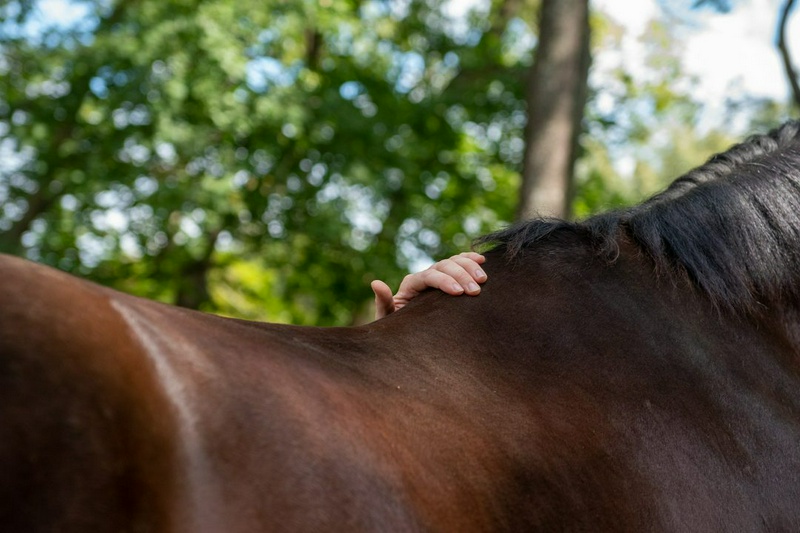
La santé de la ligne du dessus commence par l'ensemble du cheval. Les muscles de la ligne du dessus se trouvent dans la partie supérieure du corps du cheval et s'étendent du cou et des épaules jusqu'au dos, aux reins, à la croupe et aux cuisses.
Ces muscles jouent un rôle central dans la force, le mouvement, la performance et l'apparence générale du cheval.
©Amy K.
Dragoo Les muscles de la ligne du dessus se trouvent dans la partie supérieure du corps du cheval et s'étendent du cou et des épaules jusqu'au dos, aux reins, à la croupe et aux cuisses.
Ces muscles sont essentiels pour la force, le mouvement, la posture et la performance du cheval.
Ils déterminent également l'apparence de l'état corporel, c'est pourquoi la perte de la ligne du dessus peut être préoccupante pour les propriétaires de chevaux de sport actifs.
Dans la plupart des cas, une ligne du dessus saine commence par les mêmes principes qui soutiennent la performance globale : un régime alimentaire basé sur le fourrage, une énergie digestible suffisante pour maintenir l'état corporel, des protéines de haute qualité, des vitamines et des minéraux appropriés, et des entraînements réguliers qui renforcent progressivement le cheval.
Les compléments peuvent soutenir ce processus, mais ne peuvent pas remplacer un régime alimentaire déséquilibré ou des entraînements irréguliers.
Le fourrage nécessite une attention particulière car il fournit une grande partie de l'énergie quotidienne du cheval et contribue à l'apport total en protéines.
Si la consommation de fourrage ou de pâturage est faible, irrégulière ou mal alignée avec les besoins du cheval, le développement de la ligne du dessus peut être stoppé même avec l'ajout de compléments.
L'analyse du fourrage, ainsi que l'examen des céréales et des compléments actuels, peut aider à clarifier si le régime alimentaire répond réellement aux besoins du cheval.
Faire la distinction entre l'état corporel et la ligne du dessus : sachez ce que vous regardez. L'une des premières étapes utiles est de différencier une ligne du dessus faible d'un état corporel faible.
Un cheval avec une ligne du dessus faible peut ne pas avoir une couverture musculaire suffisante dans la région du dos, des reins et de l'arrière.
Ce changement peut être plus visible dans la région de la selle ou sur la croupe, où le cheval peut sembler moins plein.
Les chevaux avec une mauvaise condition corporelle peuvent sembler "plats" ou faibles dans la région de la ligne du dessus.
Ils peuvent également sembler "côtes" en raison d'un manque de couverture graisseuse ou de masse corporelle globale, pas seulement en raison d'un manque de muscle.
©Amy K.
Dragoo Un cheval qui est sous-poids peut sembler similaire.
Les chevaux avec une condition corporelle basse peuvent sembler plats dans la région de la ligne du dessus en raison d'un manque de masse corporelle et de couverture graisseuse globale, pas seulement en raison d'un manque de muscle.
Ces chevaux peuvent sembler côtes ou contractés.
Dans cette situation, augmenter l'apport calorique, améliorer la qualité du fourrage et augmenter progressivement la condition physique créent souvent la plus grande amélioration visible.
L'ajustement de la selle peut fournir un autre indice.
Si la selle commence à faire un pont, à vaciller ou à se déplacer plus qu'auparavant, cela peut être dû à un changement dans la forme du dos du cheval.
Cela ne signifie pas toujours qu'un supplément est nécessaire, mais c'est un signe pour revoir le régime alimentaire, la charge de travail, la douleur, la santé dentaire et la gestion du cheval avant que le problème ne devienne plus difficile.
Pourquoi les chevaux perdent-ils leur ligne du dessus La perte de la ligne du dessus se produit généralement au fil du temps.
Cela peut se produire après une période de réduction du travail, un changement de fourrage, une saison de compétition difficile, un problème de santé ou le processus naturel de vieillissement.
Souvent, plusieurs petits facteurs interfèrent ensemble jusqu'à ce que le cheval ne puisse plus maintenir sa couverture musculaire précédente.
L'apport calorique est l'une des premières variables à vérifier.
Lorsque le cheval ne consomme pas suffisamment d'énergie digestible pour maintenir sa condition corporelle, le corps priorise les fonctions essentielles sur le maintien du muscle.
Le résultat peut être un ramollissement progressif ou une perte de définition dans la région de la ligne du dessus.
L'exercice régulier et approprié est un stimulant pour le développement musculaire et aide à maintenir les muscles de la ligne du dessus au fil du temps.
©Amy K.
Dragoo La qualité des protéines est tout aussi importante.
La protéine globale sur l'étiquette de l'aliment ne dit pas tout car le cheval doit décomposer la protéine alimentaire en acides aminés pour que ces nutriments soient utilisés pour construire et réparer le muscle.
Les acides aminés essentiels sont particulièrement importants car le cheval ne peut pas les produire en quantité suffisante ; ils doivent être fournis par son régime alimentaire.
Même lorsque la protéine globale semble suffisante, un déséquilibre dans les acides aminés clés peut limiter la synthèse naturelle des protéines musculaires.
Le statut des vitamines et des minéraux est également important, car le métabolisme normal des muscles dépend d'un approvisionnement continu en micronutriments.
L'exercice irrégulier, les maladies dentaires, les conditions métaboliques ou endocriniennes, le stress chronique, la douleur dorsale, la boiterie, l'ajustement inapproprié de la selle, les blessures et le repos prolongé peuvent conduire à la même apparence : un cheval qui perd sa force et sa forme.
Quand les acides aminés sont le maillon manquant, de nombreux propriétaires sont surpris que le cheval puisse consommer suffisamment de calories et être encore déficient en acides aminés nécessaires pour soutenir les muscles.
Ici, les suppléments ciblés peuvent être utiles, surtout lorsque le régime alimentaire global est équilibré et que le cheval a une activité appropriée.
Pour les chevaux dont le principal déficit est la consommation d'acides aminés essentiels, Three Amigos est l'option la plus directe dans la hiérarchie du soutien.
Ce produit fournit de la lysine, de la méthionine et de la thréonine, trois acides aminés essentiels limitants, dans un rapport conçu pour soutenir le développement, le maintien et la récupération des muscles.
D'un point de vue pratique, ce produit convient aux chevaux qui ont besoin d'aide pour fournir les blocs de construction musculaire, tandis que le programme alimentaire restant est en bon état.
Cette distinction est importante.
Three Amigos n'est pas conçu pour compenser une faible consommation de fourrage, un apport calorique insuffisant ou un déséquilibre minéral généralisé.
Ce produit fonctionne mieux lorsque le régime alimentaire du cheval a été examiné, que la condition physique est adéquate ou en amélioration, que l'exercice régulier est pratiqué et que la préoccupation restante est le soutien de la synthèse des protéines et le développement de muscles maigres.
Lorsque l'ensemble du régime alimentaire nécessite un soutien supplémentaire, certains chevaux ont besoin de plus d'une combinaison ciblée d'acides aminés.
Si le cheval reçoit une petite quantité de céréales, a un accès limité à des pâturages de qualité ou est principalement maintenu sur un fourrage non équilibré, le régime alimentaire global peut être déficient en plus que des acides aminés.
Dans ce cas, un supplément complet de vitamines et de minéraux avec le soutien des acides aminés peut être un meilleur point de départ.
Omneity® est conçu pour les chevaux nourris principalement au fourrage et fournit des vitamines et des minéraux clés, y compris la vitamine E, le sélénium, le magnésium, le potassium, les vitamines du groupe B et des oligo-éléments, ainsi que des acides aminés.
Pour de nombreux chevaux dont le régime alimentaire est basé sur le foin ou le pâturage avec peu d'aliments enrichis, Omneity® peut offrir une approche plus large pour soutenir la base nutritionnelle sur laquelle le développement musculaire supérieur dépend.
AminoTrace+ occupe une position plus spécialisée.
Ce produit fournit des niveaux plus élevés de nutriments, y compris la lysine, la méthionine et la thréonine, et convient aux chevaux soumis à un travail intense.
Il est également formulé pour les chevaux ayant des besoins métaboliques spécifiques ou nourris avec du fourrage riche en fer.
Pour ces chevaux, la bonne réponse peut ne pas être simplement d'ajouter plus de calories ou une source spécifique d'acides aminés, mais de choisir une formule qui s'aligne mieux avec les besoins métaboliques et minéraux du cheval.
Lorsque le cheval a besoin de plus de calories, tout cheval qui a une apparence faible n'a pas nécessairement une carence en acides aminés.
Certains chevaux ont besoin de plus d'énergie pour prendre du poids, reconstruire leur condition physique et répondre pleinement à l'entraînement.
Dans ces cas, la priorité peut être les calories plutôt qu'un supplément principalement conçu pour la synthèse des protéines musculaires.
Pour les chevaux qui ont besoin de plus d'énergie pour augmenter ou maintenir leur condition physique, W-3 Oil peut être plus approprié.
W-3 Oil fournit une source concentrée de graisses et d'acides gras oméga-3 et ajoute des calories tout en soutenant la qualité du pelage.
Ce produit n'offre pas le même type de soutien pour les muscles supérieurs que Three Amigos, Omneity® ou AminoTrace+; il convient plutôt aux chevaux dont l'apparence est limitée par la consommation globale de calories et la condition physique.
La clé est d'adapter le produit au problème.
Un cheval maigre peut avoir besoin de plus d'énergie digestible.
Un régime alimentaire basé sur le fourrage peut nécessiter un équilibre plus large de vitamines et de minéraux.
Un cheval avec une condition physique adéquate et une ration équilibrée peut avoir besoin d'acides aminés essentiels ciblés.
Un cheval soumis à un travail intense ou ayant des besoins métaboliques spécifiques peut avoir besoin du soutien renforcé offert par AminoTrace+.
Quels éléments vérifier avant d'ajouter un complément
Avant d'apporter des modifications, examinez le programme complet de votre cheval.
- Combien de fourrage consomme-t-il ?
- Son fourrage a-t-il changé ?
- Son score d'état corporel est-il approprié ?
- Mastique-t-il facilement ?
- Son volume de travail a-t-il augmenté, diminué ou est-il instable ?
- Présente-t-il des signes de douleur, de boiterie ou d'inconfort de la selle qui empêchent l'utilisation correcte de ses muscles supérieurs ?
Ces questions ne visent pas à retarder l'action. Leur objectif est de rendre vos actions plus efficaces. Si le problème principal est une consommation de fourrage insuffisante, un inconfort dentaire ou une douleur sous la selle, ajouter un complément seul peut être décevant. Si le régime alimentaire de votre cheval est solide et qu'il fonctionne correctement, un soutien nutritionnel ciblé peut être une partie intelligente de votre programme.
Une approche pratique consiste à d'abord s'occuper des bases : qualité et consommation de fourrage, calories totales, qualité des protéines, équilibre des vitamines et des minéraux, et entraînement approprié. À partir de là, choisissez un complément qui comble le manque nutritionnel le plus probable au lieu d'empiler des produits sur une ration inconnue.
Conclusion
Pour améliorer la ligne du dessus de votre cheval, vous devez mieux comprendre le programme global de votre cheval. Les calories, le fourrage, les acides aminés, les vitamines, les minéraux, l'état de santé, le confort et l'entraînement continu influencent tous la capacité du cheval sportif à construire et à maintenir les muscles nécessaires à la performance. Les compléments sont précieux lorsqu'ils sont utilisés pour résoudre le bon problème.
Three Amigos est un choix ciblé lorsque les acides aminés limitants sont le problème principal. Omneity® offre un soutien plus large en vitamines et minéraux pour les régimes à base de fourrage. AminoTrace+ fournit un soutien amélioré pour les chevaux travaillant dur, les chevaux ayant des considérations métaboliques ou les chevaux consommant un fourrage riche en fer. W-3 Oil est plus approprié pour les chevaux qui ont besoin de plus de calories et de graisses pour maintenir leur condition corporelle.
Les programmes de ligne du dessus les plus réussis ne sont pas construits sur des suppositions. Ces programmes résultent d'une évaluation honnête du cheval, d'un équilibre précis du régime alimentaire et de l'utilisation de compléments pour soutenir des carences nutritionnelles identifiées.
Pour plus d'informations : Pour en savoir plus sur Mad Barn, cliquez ici. Pour en savoir plus sur la nutrition des chevaux sportifs, cliquez ici.