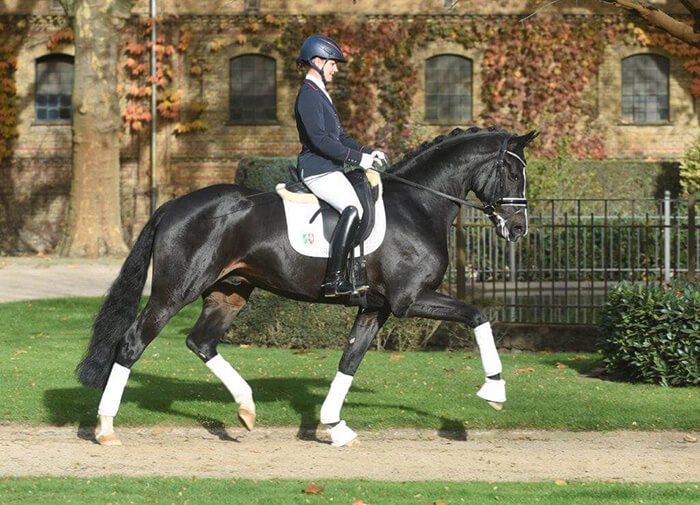
Certaines associations de races sont un peu prudentes dans la fourniture de statistiques, mais nous savons qu'en 2023, l'étalon le plus utilisé dans le livre Westphalie était Diamantenglanz (Diamond First / Bon Coeur).
Tandis que les éleveurs de saut d'obstacles restaient fidèles aux gènes éprouvés de Cornet Obolensky (Clinton / Heartbreaker).
Extreme US était l'étalon KWPN le plus utilisé en 2023, Extreme US (Escamillo / Vivaldi).
Dans le nord de la Suède, les statistiques sont plus à jour, donc nous savons que l'étalon le plus populaire en 2025 était Devin Franco G (Vivino / Bon Coeur).
Devin Franco (photo – Michaela Sword) Devin Franco, qui n'a que cinq ans, a été renvoyé à son propriétaire et éleveur précédent en raison de problèmes respiratoires.
Cela confirme les inquiétudes de nombreux éleveurs avisés selon lesquelles de nombreux jeunes étalons populaires n'atteignent jamais une carrière compétitive ou même un test de performance, en raison de l'instabilité, ce qui soulève la question de savoir quel sera l'impact à long terme sur les gènes.
Pour compliquer les choses, le père de Devin Franco, Vivino, a maintenant neuf ans et n'a même pas un résultat de performance dans la base de données FEI.
Donnerhall, vraiment un grand étalon.
.
.
Jetons un coup d'œil au dernier classement des étalons, mais d'abord examinons ce qui fait un étalon de premier plan.
.
.
Évidemment, la performance au plus haut niveau est un bon début, mais ce n'est pas tout, il y a eu plus d'une star de spectacle qui a échoué en reproduction et vice versa.
En référence à mon premier paragraphe, nous aimons voir un étalon qui a duré et prouvé sa santé.
Par exemple, le grand Donnerhall, qui a concouru pour la dernière fois à l'âge de dix-neuf ans en tant que membre de l'équipe allemande aux WEG de Rome.
Nous aimons aussi avoir un étalon qui a transmis une caractéristique particulière à sa progéniture.
Regardez à nouveau Donnerhall, leur volonté de travailler et leur capacité d'apprentissage ont été.
Une caractéristique particulière peut même éclipser les résultats compétitifs.
Par exemple, Rubinstein, pas un grand compétiteur, pas même le père de grands compétiteurs, mais une source éprouvée de tempérament excellent – vraiment certains éleveurs avisés ont les yeux qui s'illuminent en entendant la lettre R, même si c'est dans la quatrième ligne d'un pedigree.
Une des caractéristiques importantes que nous recherchons est la capacité de produire des chevaux mâles exceptionnels.
C'est ici que le troisième membre de l'ancien trio puissant, à savoir Donnerhall, Rubinstein et Weltmeyer, rencontre des difficultés.
Même avec les opportunités qui n'ont été données à aucun autre cheval dans le livre hanovrien, Weltmeyer, comme Rubinstein, n'a pas réussi à produire un cheval mâle exceptionnel.
Je suis sûr qu'une série de stars mâles D vient rapidement à l'esprit.
Johnson encore une fois, Johnson (Jazz / Flemmingh) a été choisi comme le meilleur cheval mâle de dressage WBFSH, pour la quatrième fois consécutive, donc il doit être un grand cheval mâle, peut-être.
.
Johnson a eu une performance forte avec Hans Peter Minderhoud et sa meilleure victoire au Grand Prix de Rotterdam avec un score de 79.
240.
Il a également passé notre test de santé et a concouru jusqu'à l'âge de dix-sept ans.
Descendants ?
Sa meilleure performance dans le classement actuel de Hartsuiker (Scandic) est classée 19ème au monde.
Il a 33 étalons approuvés, mais toujours pas de star.
Hexagon Double Dutch est classé 176ème et Meggles Boston est classé 302ème.
Et quelles caractéristiques transmet-il à ses descendants ?
Le rapport sommaire des descendants KWPN dit : un ensemble homogène de poulains de selle avec une bonne structure rectangulaire et des mouvements impressionnants.
Ces poulains utilisent bien leurs jambes et montrent beaucoup de flexibilité et une bonne auto-portance.
Cependant, il faut noter que ses descendants peuvent être enclins à donner des coups de pied, de sorte qu'au moins une écurie d'entraînement néerlandaise réputée n'accepte aucun Johnson dans ses écuries, même les descendants d'une jument Johnson.
Totilas, maintenant en tant qu'étalon prouvé cette année, Totilas (Gribaldi / Glendale) est passé de la quatrième à la deuxième place.
Beaucoup, y compris moi-même, pensaient que ce cheval noir était plus un résultat qu'une cause, mais il nous a prouvé le contraire, bien qu'avec l'aide de nombreuses juments dont la qualité était garantie en raison du coût élevé de l'accouplement, du moins lors des premières saisons.
Ses quatre meilleurs chevaux sont tous parmi les trente meilleurs chevaux du monde, et son meilleur cheval, Total Hope, qui est devenu une star avec Isabel Freese, est né de la jument internationale d'Isabell Werth, Weihegold (Don Schufro / Sandro Hit).
Les autres sont également de lignées royales – son numéro deux, Gotilas du Feuillard, est issu d'une jument de la lignée Ferro, Toto Jr (Desperados) et Torvestlettens Titanium (Stedinger).
Total Hope le reste des dix meilleurs chevaux est un mélange intéressant de ceux qui ont réussi dans les compétitions du Grand Prix et de ceux qui ne l'ont pas fait.
Le troisième du classement, Quaterback (Quaterman I / Brandenburger), n'a eu aucune compétition au niveau FEI, le quatrième classé Vitalis (Vivaldi / D-Day) était un concurrent moyen au Prix St Georges, mais a été un étalon et un producteur influent d'étalons, tandis que Zack en cinquième position (Rousseau / Jazz), était une star sérieuse du Grand Prix international.
Apache (UB40 / Krack C), qui est classé sixième, a participé aux compétitions du Grand Prix.
Bien qu'un peu imprévisible sur le terrain, il est connu comme le père de bons chevaux de Grand Prix.
Quaterback a reçu un score de 10 pour le mouvement du contre-galop à l'âge de 3 ans, en septième position se trouve Dante Weltino, dont la lignée remonte à certaines des stars précédentes du classement.
Il est le fils de Danone I, de fils de De Niro, et d'une mère de la lignée Welt Hit II.
Dante Weltino ce cheval noir a bien performé dans les compétitions du Grand Prix et est maintenant reconnu comme un père passionnant, ce qui est sans doute la raison de son saut de la 31ème place l'année dernière à cette position.
Jazz en compétition à Jerez, le père de Johnson, le grand Jazz (Cocktail / Ulster), qui est tombé de la cinquième à la huitième place, restera toujours l'un des grands du dressage, un concurrent du Grand Prix et un père légendaire.
Bordeaux Bordeaux (United / Gribaldi), qui est resté à la neuvième place comme l'année dernière, est lui-même un concurrent moyen du Grand Prix mais est reconnu comme un père passionnant.
À la fin du top dix, Zonik NOP (Zack / Romanov) qui est passé de la 55e place à ici, principalement grâce au sens actuel du dressage international, Zonik Plus (d'une mère de race Hohenstein) qui est classé troisième mondial.
Le nouveau sens du dressage, Zonik Plus Je me souviens encore des pères de saut, avec un peu d'incrédulité, d'un appel que j'ai reçu d'un homme qui se targue d'être un éleveur de saut d'obstacles de premier plan.
Il a demandé : « Quels chevaux dois-je utiliser la saison prochaine ?
Quels pères seront en vogue ?
» Quand j'ai expliqué que je devais savoir quelles juments et quels étaient leurs besoins, il s'est fâché.
C'est la formule qui fait les vrais éleveurs.
Je me souviens qu'Alois Pollmann-Schweckhorst, qui a monté Chacco-Blue (qui est classé troisième cette année) tout au long de sa carrière, m'a dit quelles caractéristiques ce cheval avait transmises à la génération suivante : il a dit : « Il a transmis à la génération suivante une technique extraordinaire, une technique de l'avant-main et, le plus important, une attitude positive envers le sport.
Certains chevaux peuvent être un peu sensibles au début, paraître un peu excentriques quand ils sont jeunes, pas vraiment excentriques, mais leurs sens sont à 100 %, ce qu'ils entendent, ce qu'ils voient, et cela prend un peu de temps pour qu'ils se calment.
Ce n'est pas une faiblesse, c'est quelque chose que chaque bon jeune cheval a.
» « Chacco-Blue, une attitude positive envers le sport…
» Il a également souligné que bien que le propriétaire de ce cheval, Paul Schockemöhle, ait accouplé Chacco-Blue avec de nombreuses juments, il connaissait bien chacune d'elles, comment elles étaient élevées et, plus important encore, ce qu'elles avaient produit.
Cornet Obolensky Un regard sur les dix meilleurs chevaux de cette année à Aachen montre qu'ils sont tous des étalons extraordinaires et c'est à l'éleveur de faire le bon choix en analysant les besoins de ses juments.
Alors, quels facteurs devons-nous prendre en compte avant de nous tourner vers le cheval numéro un de cette année, Cornet Obolensky (Clinton / Heartbreaker) ?
Ce cheval gris a acquis une grande réputation en saut d'obstacles, mais son cavalier, Marco Kutscher, m'a dit à quel point il était difficile de travailler avec lui, surtout au début de leur collaboration.
Il a dit : « Quand j'ai commencé à le monter, il avait quatre ans.
Quand il avait cinq ans, je l'ai emmené à un vrai concours.
Je me souviens exactement, en mai, le premier concours en extérieur.
Cornet était spécial, à la maison il était paresseux, il ne ressemblait même pas à un étalon, mais quand vous le sortiez du camion, il devenait comme un lion.
Il se dressait sur ses deux pattes, fou, hurlait, sauvage, incontrôlable, rien - tout ce que vous lui aviez appris à la maison était oublié.
À la maison, il fallait presque le pousser pour qu'il bouge.
» Bien qu'il ait été l'un des étalons les plus réussis de l'histoire du saut d'obstacles, ses descendants sont connus pour leurs caractéristiques particulières.
Peut-être devrions-nous rechercher des juments avec un excellent tempérament, car il semble que Cornet transmette tout le reste, comme la précision, la puissance et l'amplitude à ses descendants, à condition qu'ils puissent nécessiter un cavalier habile et astucieux pour les gérer.
Kannan La deuxième place de cette liste revient à Kannan (Voltaire / Nimmerdor) qui est presque l'opposé de Cornet, car il est connu pour produire des chevaux si agréables à monter que même s'ils ne deviennent pas des stars internationales - et il y en a beaucoup - ils peuvent être appréciés par des cavaliers amateurs.
Diamant est à la quatrième place, l'athlète et étalon extraordinaire, Diamant de Sémilly (Le Tot de Sémilly / Elf II).
Ayant concouru aux Jeux Olympiques avec le fils de son éleveur, son influence en tant qu'étalon s'est étendue à travers l'Europe.
En fait, il a semblé pendant un moment qu'il était plus populaire à Holstein que dans son pays natal, la France, bien que l'équilibre soit revenu et que cette année, ses huit meilleurs chevaux soient tous reconnus sous la marque Selle Français, menés par le cheval numéro trois mondial, Bond Jamesbond de Hay (de la jument Kannan).
Diamant est actuellement le leader des étalons agréés, avec un nombre impressionnant de 169 fils approuvés.
Mylord Carthago Le prochain cheval dans notre top dix, Mylord Carthago (Carthago / Jalisco B), soulève une autre question de choix : élevons-nous pour un rendement rapide ou pour une renommée et une gloire durables ?
Encore une fois, laissons Anaud Evain faire valoir son point : il a dit : « Mylord a hérité de la capacité sportive de Carthago, mais il a fallu beaucoup de temps pour que Mylord Carthago devienne un athlète efficace, et il semble que les descendants de Mylord aient également besoin de temps pour devenir efficaces.
Ils ont besoin de temps pour se développer.
Il y a deux vitesses sur le marché.
La vitesse de vente des poulains et des chevaux de trois ans, qui est la préoccupation de tous ceux qui élèvent pour l'argent et ont besoin de vendre des jeunes.
» Ensuite, il y a des étalons comme Mylord et Kannan ou For Pleasure qui ne sont pas si populaires dans ce commerce.
Si vous recherchez le premier marché, il y a des étalons comme Heartbreaker, Caretino, Catoki qui ont des sauts beaux et attrayants, même s'ils n'ont pas toute la puissance et la capacité.
Si vous voulez produire un champion pour le long terme, vous pourriez penser à For Pleasure ou Kannan ou Mylord - l'éleveur doit décider ce qu'il veut produire.
Les cinq autres étalons dans le classement de saut n'ont pas de place pour les produits non prouvés de la publicité coûteuse.
Dans l'ordre, ils sont : Vigo d’Arouilles (Nabab d’Rêve / Fleuri du Manoir), Comme il Faut (Cornet Obolensky / Ramiro), Toulon (Heartbreaker / Jokinal de Bornival), Emerald (Diamant de Semilly / Carthago).
.
.
Les meilleurs étalons WBFSH 2025 en concours complet Malgré le récent boom de l'élevage pour le sport du concours complet, nos meilleurs étalons ont principalement été élevés pour le saut d'obstacles et seuls quelques-uns ont prouvé leur valeur sur le parcours de cross-country.
Diarado Diarado (Diamant de Sémilly / Corrado) est de nouveau en tête du classement et son équipe est menée par la star internationale Tom McEwen, soit JL Dublin (Canto 16).
Diarado a certainement été élevé avec l'objectif du saut, combinant le meilleur de la France et le meilleur de Holstein.
Il était une surprise lors de la licence Holsteiner et a servi un grand nombre de juments dans ses premières saisons.
Il a produit quelques stars internationales de saut, mais il est vite apparu que la plupart de ses descendants, comme leur père, étaient des sauteurs moyens.
Heureusement, il a été découvert qu'ils étaient très adaptés au concours complet, d'autant plus que cet étalon bai avait réussi à attirer des juments de qualité qu'aucun étalon de concours complet n'aurait pu atteindre.
Jaguar Mail Le deuxième étalon, Jaguar Mail (Hand in Glove xx / Laudanum xx) a été beaucoup plus réussi et a participé à l'équipe de saut olympique suédoise aux Jeux de 2008.
Cependant, avec un pedigree composé à 7/8 de Thoroughbred, il était un étalon idéal pour le concours complet, mais comme Thomas Carlile, qui a mené plusieurs de ses descendants au succès dans les compétitions mondiales, l'a découvert, les meilleurs provenaient des juments Anglo-Arab qui leur donnaient une acuité à l'avant que Jaguar et ses descendants n'avaient pas.
Obos Quality, le troisième étalon Obos Quality (Quick Star / Domino) était un sauteur de Grand Prix, mais en tant que l'un des étalons européens importés en Irlande, il est devenu l'un des étalons de concours complet les plus en vue au monde sur de bonnes juments irlandaises.
Upsilon et Thomas Carlile sur le chemin du quatrième étalon est le premier à être vraiment devenu une star du concours complet.
Le cheval Upsilon (Canturo / O’vive aa) avec Thomas Carlile a brillé aux Championnats du Monde des Jeunes Chevaux en concours complet et a terminé vice-champion dans la classe des sept ans.
Il a ensuite remporté le concours trois étoiles de Barbury Castle, mais une blessure a mis fin à sa carrière professionnelle.
En France, Upsilon a été reconnu comme le sauveur de la race Anglo Arab, car il restait très peu d'étalons Anglo et Upsilon, grâce à sa mère Anglo, était éligible à l'extension AA.
Le descendant le plus réussi d'Upsilon cette saison est la jument 4* nommée Golden de Beliard AA qui, comme vous pouvez le deviner, est montée par Thomas Carlile.
Grafenstolz et Michael Jung, le cinquième étalon, un Trakehner nommé Grafenstolz (Polarion TSF / Camelot) avec Michael Jung a remporté les Championnats du Monde des six ans et a ensuite participé à des concours trois étoiles avant de se concentrer sur ses activités reproductrices.
Son principal concurrent est l'une des véritables stars du monde du concours complet, Lordships Graffalo, qui est classé deuxième mondial avec Ros Canter.
Lordships Graffalo est né de Cornish Queen, ce qui rappelle qu'il y avait peu de personnes courageuses qui se sont lancées dans l'élevage de chevaux de concours complet avant que cela ne devienne à la mode et rentable.
La mère de Graffalo, Cornish Queen, est issue du cheval deux étoiles Rock King, lui-même issu de l'étalon prolifique en concours complet, Just A Monarch xx, et du cheval quatre étoiles Cornish Faer, issu d'un autre étalon pionnier en concours complet, Ben Faerie xx.
Lordships Graffalo, nos dix meilleurs chevaux incluent cinq autres très bons chevaux, mais aucun d'entre eux n'a été élevé spécifiquement pour le concours complet.
Ces chevaux sont : Contendro I (Contender / Reichsgraf), Kannan (Voltaire / Nimmerdor), Diacontinus (Diarado / Contendro I), Vigo d’Arsouilles (Nabab de Rêve / Fleuri du Manoir) et enfin Sligo Candy Boy (Balou du Rouet / Conley 2).
Source : The Horse Magazine