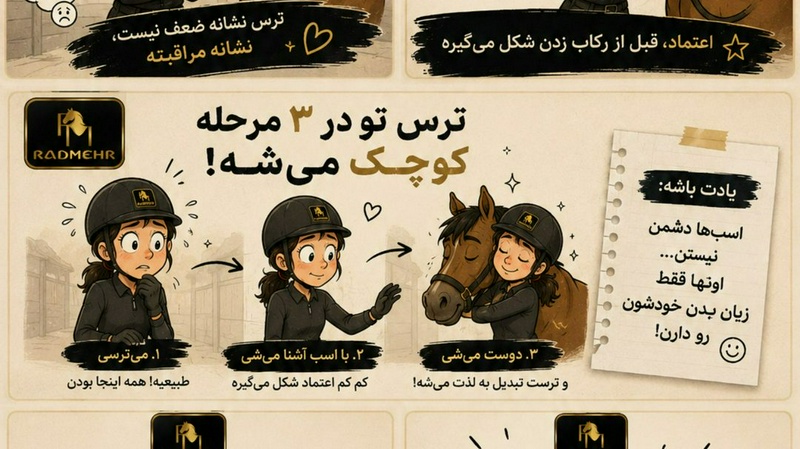
Dans cet article, en examinant la relation entre la peur, le comportement humain et la réaction du cheval, des solutions pour faire face progressivement et en toute sécurité à cette peur sont proposées ; de la compréhension du langage corporel du cheval et du choix de l'environnement et du cheval appropriés à la maîtrise de la respiration, à la gestion des émotions et au passage progressif du sol à la selle.
Introduction Pour quelqu'un qui a peur des chevaux, s'approcher de cet animal peut sembler bien plus grand que ce qui paraît de l'extérieur.
Le cheval peut simplement se tenir calmement, mais l'esprit imagine des scénarios de danger avant tout événement : « Et s'il se mettait soudainement à bouger ?
Et si je perdais le contrôle ?
» Ces imaginations peuvent mettre le corps en état d'alerte.
Cette réaction n'est pas nécessairement un signe de faiblesse.
Le cerveau humain est conçu pour identifier les menaces.
Lorsqu'il perçoit quelque chose de dangereux, le corps peut se préparer à réagir en augmentant le rythme cardiaque, en modifiant la respiration et en contractant les muscles.
Ainsi, la première étape n'est pas de lutter contre la peur ; c'est de la reconnaître.
Comment la peur se transmet-elle dans la relation entre l'homme et le cheval ?
La relation entre le cavalier et le cheval est une communication bilatérale.
Le cheval prête attention aux signaux de l'environnement et du corps humain, et les changements dans la posture, la respiration et les mouvements du cavalier peuvent faire partie des informations qu'il reçoit.
Lorsque la personne est anxieuse, son corps peut se raidir, sa respiration peut changer ou ses mouvements peuvent devenir involontaires et désordonnés.
Cette situation peut rendre l'interaction plus difficile et, par conséquent, augmenter le sentiment de danger dans l'esprit du cavalier.
C'est pourquoi l'objectif n'est pas de se forcer à dire « je ne devrais pas avoir peur ».
L'objectif est de gérer l'intensité de la peur afin de pouvoir communiquer consciemment et plus calmement avec le cheval.
Connais le cheval ; avant d'attendre de lui qu'il soit calme, l'une des meilleures façons de réduire la peur est de comprendre le langage corporel du cheval.
Les oreilles, les yeux, la tête et la posture générale du cheval peuvent nous fournir des indices sur son niveau d'attention et son état.
Connaître ces signes aide à ne pas interpréter chaque mouvement du cheval comme un danger inconnu.
En plus de connaître le comportement, le choix du cheval approprié est très important.
Pour une personne qui surmonte sa peur, un cheval calme, prévisible et adapté à son niveau de compétence peut offrir une expérience totalement différente de celle d'un cheval sensible ou énergique.
Commencez par le sol, pas par la monte Faire face à la peur est mieux de manière progressive.
On peut commencer par se familiariser et observer le cheval, puis s'approcher et toucher, et ensuite, si prêt, passer à l'interaction et à la monte.
Il n'est pas nécessaire de commencer par l'étape la plus difficile.
Si chaque étape est accompagnée d'un calme relatif et d'un sentiment de contrôle, la personne a l'occasion de reconnaître la nouvelle expérience comme gérable plutôt que comme une situation totalement menaçante.
De petits pas, s'ils sont bien choisis, peuvent construire de grands chemins.
Contrôle ton corps En cas d'anxiété, la respiration et les muscles peuvent entrer dans un cycle de tension.
C'est pourquoi, avant de commencer et dans les moments critiques, concentrez-vous sur une respiration calme et coordonnée.
Relâchez autant que possible les épaules et les muscles supplémentaires et concentrez-vous sur un point ou un chemin précis.
Si vous sentez que l'anxiété augmente, continuer à tout prix n'est pas l'objectif.
Réduire l'intensité de la situation, faire une pause et revenir à une étape où vous vous sentez plus en contrôle peut être un choix plus logique.
Liste de contrôle dorée avant de monter Avant de commencer, vérifiez trois domaines : 1.
Équipement et environnement : L'équipement approprié et les dispositifs de sécurité sont-ils prêts ?
L'environnement est-il adapté à l'entraînement ?
2.
Santé et comportement du cheval : Le cheval est-il dans un état physique et comportemental approprié pour l'entraînement ?
En cas de doute, demandez l'aide d'un entraîneur ou d'une personne informée.
3.
Votre état mental : Pouvez-vous maintenir votre concentration et le contrôle de votre corps ?
Si l'anxiété est élevée, prenez quelques minutes pour vous détendre et réguler votre respiration.
Erreurs qui augmentent la peur Trois erreurs peuvent rendre le chemin de la confrontation avec la peur plus difficile : Passer soudainement de zéro à une monte complète Choisir un cheval inadapté au niveau de compétence et essayer de « réduire à zéro » la peur au lieu de la gérer.
Le courage ne signifie pas ne pas avoir peur.
Le courage signifie choisir consciemment et en toute sécurité la prochaine étape malgré la peur.
Conclusion Surmonter la peur des chevaux n'est pas une course.
Le bon chemin est de construire la confiance ; une confiance qui se forme par la connaissance du cheval, des expériences progressives, le contrôle du corps et de l'esprit, un environnement approprié et la présence d'un entraîneur informé.
Un jour, vous pourrez peut-être simplement rester calmement à côté du cheval, et un autre jour, le toucher ou monter.
Chacune de ces étapes, si elle est accompagnée de sécurité et de contrôle, est un véritable succès.
En fin de compte, le but n'est pas seulement de « ne pas avoir peur » ; le but est d'arriver à un point où vous comprenez mieux le cheval, connaissez vos propres réactions et pouvez interagir avec lui avec plus de calme et de confiance.