15 educational tips from George Morris for riding
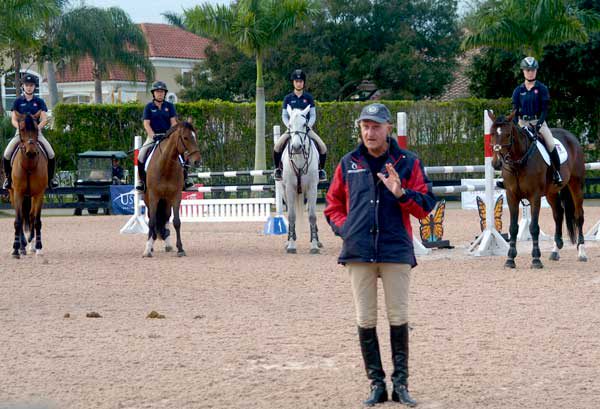
In the first five days of January, George Morris would come to the arena every morning around 7:30 AM; looking neat and precise: polished boots, shiny spurs, riding pants, a simple and solid-colored belt, and on days when the Florida weather was pleasant, a polo shirt, and on cooler days, a checkered flannel shirt.
George Morris speaks with attendees and riders at his Horsemanship clinic in January.
This Olympic silver medalist and former coach of the United States show jumping team would sometimes start days by asking the young riders gathered around him questions about topics such as the German training scale—rhythm, suppleness, contact, impulsion, straightness, and collection—or about the rhythm of walk, trot, and canter, which have four beats, two beats, and three beats, respectively.
On another day, he also talked about riding without stirrups to improve the physical strength and balance of the riders.
His mission was to share some of the classical and correct principles of riding that he had learned over the past 65 years with the riders who participated in the eighth annual George H. Morris Horsemanship clinic at the Palm Beach International Equestrian Center in Wellington.
These riders, aged between 15 and 21, were selected to attend this program due to their success in equitation, jumper, and hunter competitions in 2013.
He told them and the 100 to 150 listeners who attended each day, "What matters is that you build a system based on correct classical principles for yourself."
Among the attendees were notable figures in the equestrian sport, including Anne Kursinski, an Olympian in the discipline, who gave a riding demonstration earlier in the week, and Michael Barisone, an Olympic dressage rider, who said he came to be influenced by George's "attitude and self-discipline and perfectionism."
This comprehensive program, designed to cultivate the next generation of horse masters for the United States equestrian teams, included not only daily riding lessons with George but also stable management, veterinary care, and farriery.
This article recounts 15 educational points from him; important points for equestrians of all levels and ages.
1. Create impulsion George would start each riding session by having the riders walk and use their legs to ask the horses to move forward and create impulsion.
He said, "It starts from the hind leg."
By encouraging the horse's hind legs to move forward and come under the body, the rider eliminates its resistance.
When this happens, the horse's croup begins to lower.
Then the base of the neck, where it connects to the shoulder, rises.
As a result, the horse's head lowers, and its body begins to round.
In one of the sessions, when the riders were pushing their horses forward with their legs, George told them to keep their hands above the withers and in a straight line with the bit.
As he walked beside one of the riders and raised his hands, he said, "You have to use your legs to bring the horse to the bit.
That means contact."
The next day, he elaborated: "You should have the feeling that you are sending your head down onto the horse's head; not pulling the horse's head down."
He added that taking and giving is very important.
"When I feel the outside rein and the horse comes back, I immediately give."
He repeated these points several times throughout the week; when the riders were working in walk, trot, and canter.
2.
Keep the horse straight Throughout the week, George reminded the riders to use the inside leg in the tight spot of the horse to guide the horse towards the outside rein; a method for creating and maintaining the correct alignment that is essential for collection from back to front.
He explained that there are two types of correct alignment.
First, the lower line of the horse's body.
Does the left hind hoof fall in the place of the left front hoof and the right hind in the place of the right front?
Most horses naturally move slightly with their hindquarters inwards.
The second type of correct alignment is the upper line of the horse's body; from the base of the tail to the poll.
He said on a straight line, the horse should move completely straight and on a circle, its body should bend according to the curve.
According to him, many riders over-bend their horses, which causes crookedness.
He also reminded the riders that to achieve the correct alignment, they must first feel the quality of the horse's forward movement.
George said about the canter that he wants the riders to work from the inside leg to the outside rein, with a slight bend inwards; just enough so that the back corner of the horse's inside eye can be seen.
But he warned: "That's all"; that was the extent of the bend he wanted.
3.
Keep the hands On the fourth day of this training course dedicated to work without stirrups, George rode a horse whose body type made it easily resistant to contact and kept its head up.
George said to ask the horse to round, he uses "an old French system with my hands."
"I show the horse from the very first lessons that it cannot raise its head above my hands.
.
.
.
I keep my hands up and send it forward with the inside leg, while the main support is on the outside rein.
When the horse's neck finds a beautiful arch and its body rounds, I soften my hands and lower them.
" He said he does not use tools like draw reins or harsher bits.
He added: "You won't see me saw the horse's mouth."
George taught this method to the riders throughout the week.
For example, when one rider's horse resisted, he told him to raise his hands, close his fingers, and push with his leg.
"You must resist against the horse's resistance so that the horse gradually accepts the contact."
When the horse softened in the mouth, George told the rider to definitely release with his hands so that this act would be a reward for the horse.
He explained that many riders are taught if they feel resistance to lower their hands, "but this means rewarding the horse for disobedience."
Point 3: To make the horse round, George raises his hand and drives the horse forward with the inside leg towards the outside rein.
When the horse accepts the contact, George reduces the pressure of the aids and lowers his hand.
4.
Make every transition effective George told the riders throughout the session to work on the transitions between gaits and reminded them that "every transition should matter."
He wanted the horses to move upward in the transition and be in front of the rider's legs.
In the transition from walk to halt, he told the riders to use four parts of their body to ask for the halt: the back, seat, legs, and hands.
He told them to stretch their spines to gain more power, to maintain their legs, and to keep their hands steady.
When the horses responded, he said the riders should show some flexibility in their aids.
He also asked the riders to work on transitions within the gaits.
In the counter, he instructed them to take 10 longer strides and 10 shorter strides.
To lengthen the strides, they only needed to release their hands, as the horses were already moving forward.
Regarding collection, he said, "I want to see how slowly they go."
If a horse resists the bit, he said, "We close the fingers.
We do not give in and do not drop our hands."
5.
Establish rhythm with cavaletti During the flatwork session, George asked the riders to pass over cavaletti in the trot to help create a consistent rhythm.
In one exercise, the riders trotted over two cavaletti arranged on a short curved line.
They approached with the right rein, passed over the first cavaletti in the trot, followed the curved line to the left, passed over the second cavaletti in the trot, and then turned to the right.
This continuous change of bend helped soften the horses.
In another exercise, the riders trotted through a spiral pattern of three cavaletti set across the width of the arena.
Again, the focus was on maintaining a steady rhythm.
George said this exercise also helped the horses feel more comfortable when jumping small obstacles.
6.
Soften the horse with lateral movements In each of the flatwork sessions, George instructed the riders to perform a series of basic lateral movements — leg yield and shoulder-in — followed by more complex movements — shoulder-out, haunches-in, and the more advanced haunches-out.
He explained that these exercises encourage the horse to accept the rider's leg and eliminate resistance in the hindquarters to make the horse softer.
He said this also collects the horse quickly from back to front, which is called "engagement."
This makes the horse accept the rider's leg.
One day, the riders worked on shoulder-in; a movement where the horse's inside hind leg steps between the two front legs and the angle of the front part of its body is less than 15 degrees.
George told them to bring both hands a few inches inward when moving left and to bend the horses with their left inside leg, guiding them towards the right rein.
If a horse started to stiffen on the inside rein, he said the rider should work with it with utmost finesse.
After a few strides in shoulder-in, the riders drove the horses straight and forward.
Then they executed haunches-in and switched between these two movements every few strides.
George said, "Let the horse's hindquarters dance."
After that, the riders established stretch and forward movement again in the trot, changed direction, and repeated the lateral work.
George also reminded that all horses have one side that is drier and stiffer and said, "Our goal is to make both sides as similar as possible.
Crooked horses cannot collect."
This is done by practicing on circular and figure-eight lines, especially in lateral movements.
7.
Spiral in and out To continue softening the horses throughout their bodies, George asked the riders to come in on three circles in a spiral during the counter.
They were moving the horse's hindquarters inward with the outside leg while simultaneously bending the horse around the inside leg.
If a horse resisted, the rider could use the inside rein and the outside rein on the neck.
When the horses were released a bit, George said the riders could give a little with the inside rein, while the outside rein should remain firmer and steadier.
Then they would spiral back out again.
After three circles, the riders would take the horses straight.
They repeated this exercise several times in one direction and then changed direction and did the same again.
8.
Counter canter for collection and balance George asked the riders to perform one of his favorite exercises in counter canter throughout the week: to do a half-turn and maintain the counter canter in the opposite direction.
He loves this exercise because it makes the canter more collected and balanced.
So the riders on the right lead would do a half-circle towards the wall to move left while still on the right lead.
The outside left leg (which was now on the inside of the circle) was behind the girth and regulated the speed, the important inside leg was at the girth, and the right inside rein worked by giving and taking, releasing whenever the horse softened in the jaw.
George said, "That inside rein is impatient to be released."
The riders did these half-turns several times to change direction while maintaining the counter canter.
This also helped the horses gradually reach self-carriage.
George explained, "Self-carriage means the horse carries itself and maintains its balance and stretch."
9.
Stay straight in the flying change George said many horses today do not sit on their haunches during the flying change but rather their haunches rise and they become dissatisfied.
To correct this, he asked the riders to do large half-turns and sit deep in the saddle in the turn so that the horses learn to accept the rider's seat and not pull the rider out of the saddle.
Then he wanted the riders to keep the horses completely straight using the inside leg at the girth towards the outside rein.
When the riders called for a change of lead, he told them to just change their aids; to place the new inside leg at the girth and apply pressure with it, especially if the horse was kicking out or had its haunches high, while maintaining contact with the new outside rein.
The outside leg is positioned further back and its role is passive.
He said many people simply pull the new inside rein to request a change of lead; something that bends the horse and often causes a delay in the change in the hind legs.
He wanted the horse to perform the change of lead solely based on the rider's leg aids.
He said, "If you use your hands, you’ve cheated."
10.
Sit lighter Whenever the riders wanted more rhythm and speed from the horse, like when they were cantering or jumping, George encouraged them to apply less pressure on the horse's back by closing the hip angle and bringing the upper body forward about 30 degrees.
This made the ride smoother and more fluid while not disturbing the horse's natural balance and self-carriage.
George said, "Watch Olympic Nick Skelton."
He is a master at this, as most of the time he positions himself above his horse and allows the horse to do its job.
At the beginning of the final training session, George explained to the riders and attendees that Federico Caprilli from Italy revolutionized fast riding, meaning galloping and jumping, in the early 1900s.
Before that, people rode with long stirrups and sat back during jumps and competitions; a method that limited the movement of the horse's hindquarters.
Caprilli advocated for shorter stirrups so that the rider could separate slightly from the horse's back, making it easier for the horse to perform.
Of course, there are times when the rider needs to have a more defensive position; for example, over an obstacle that the horse is afraid of.
But George said when riders are confident that their horses can jump such obstacles, they can return to that lighter position again.
11.
Ride with rhythm and speed to the base of the obstacle on the third day, George asked the riders to warm up over a small triple bar that was located on the short side of the arena.
He wanted them to reach the obstacle with enough rhythm and speed, take the corner a bit shorter, and allow the horses to move forward toward the obstacle.
This exercise helped create forward energy and softness in the movement.
He said, "When I allow the horse to go forward, I measure the distance to the obstacle."
When the riders saw a distance, he told them to ride a little ahead so that the horse would jump correctly from the base of the obstacle.
He explained, "With rhythm and speed to the base of the obstacle."
Note 11: Lisa Finnegan galloped forward over the triple bar and rode to the base of a triple bar; something that, according to George, teaches the horse to collect on its haunches and jump upward.
On the final day, George asked them to gallop in a straight line toward a vertical obstacle, to reach the take-off point and then release the reins.
This exercise teaches the horse to separate from a deeper distance, jumping upward by shifting weight back and collecting on its haunches.
After that, the horse learns to jump round and carefully; something that helps improve its jumping arc; the same thing that George referred to as the "holy grail of jumping."
12.
The exercise of what is difficult after the horses were guided over the triple bar with a forward tendency, George asked the riders to work over a Liverpool to a vertical obstacle; an obstacle that was positioned on a curved line to the right and had a distance from the outer corner to the outer corner of 52 feet.
The riders first traversed the outer part of this line in 4 calm strides to teach the horse to collect.
Then the riders gave their horses more space and jumped this line in 3 strides.
After that, the riders stopped and traversed the same line again in 4 strides.
Note 12: Lily Keenan and Balance jump from the last obstacle in a difficult curved line from Liverpool to the vertical obstacle; a line that the riders also traversed in both 3 strides and 4 strides.
If a horse raises its head or tilts its body while settling in 4 strides, George would tell the rider not to get "flustered," not to lose their position, and not to give up.
Instead, he wanted the riders to stick to their decision and continue to ask the horses to settle in the same strides.
He said riders often try to protect their horses too much instead of doing what is difficult, keeping them "in a cocoon."
13.
In the exit from the turn, release the horse. George explained the nuances of riding in the turn during the final day’s jumping course.
At the peak of a big rollback from one oxer to another big oxer, the rider must be calm, release the horse, and focus on the line and distance to the next obstacle.
He said if you do this, “you will measure the obstacle infinitely better.”
George said if the horse does not listen to the half halt or goes into a cross canter until reaching the peak of the turn, the rider should go home and practice; “this becomes homework.”
He said such problems cannot be resolved on the competition course and inside the arena.
14.
Continue riding until reaching the difficult distance. George concluded one of the jumping sessions that day with this exercise where riders would pass over a large cross rail; an obstacle that he said was “poorly constructed,” but simple and inviting to maintain the line.
When one of the riders lost their distance to the jump, George said, “If the distance is hard, solve it yourself. Don’t give up.”
He told that rider to hold the horse a little and use the leg to help him.
He said the rider cannot reach an inappropriate distance while having soft legs and hands at the same time.
15.
Stay positive. When some horses had issues on the final day’s jumping course and refused to jump, George reminded the riders not to be hesitant, as the horse senses this hesitation and becomes uncertain about whether to jump or not.
He said, “The relationship between horse and rider is closer than the relationship of any other two beings, even if you are a couple,” and added, “When the horse becomes hesitant, you do not become hesitant. This is the kiss of death. You must be positive.”
Note 15: Sydney Shulman and Countino 44 confidently navigate the final day’s course.
George said when other riders were hesitant, their horses sensed this hesitation.
He told them, “Be positive.”
At the end of this week’s training session, George explained that the goal was to strengthen a rider’s professional mindset in all aspects of horse care.
He said, “Every individual has their own riding system and specific way of working with the horse. The foundation of this clinic was classical and correct riding.”
The horsemanship training session by George H. Morris was held in 2014 with the support of the United States Hunter Jumper Association and received backing from the United States Equestrian Federation, the United States Equestrian Team Foundation, Practical Horseman, and the Winter Equestrian Festival.
This article was first published in the April 2014 issue of Practical Horseman.
Source: Practical Horseman – Training