Breeding sport horses with dressage
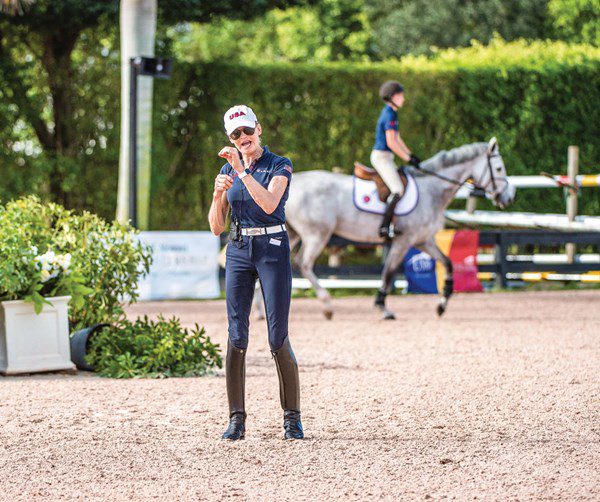
There were perhaps 12 riders present at the training session of master horseman George H. Morris.
They imagined that on the first day of the clinic, Olympic medalist Christine Traurig would be easier on them.
Anyway, George was not there; the last day of 2015 was unusually warm and humid, and it was time for the dressage day.
When Christine carefully and kindly checked the bit and reins of each horse before the ride, it seemed that the start of the tenth annual session of this clinic was softer compared to George's rigorous legacy.
However, when this tall dressage figure went to the center of the arena, it seemed to showcase George's blunt and straightforward style.
While Christine was carefully training the horses and riders, she continuously reminded them of the theoretical points of dressage and made no concessions under the sun of South Florida.
Christine, who is also the trainer of young horses for the United States Equestrian Federation, said, "Raising and developing a horse is a journey and a process.
"It’s not just about jumping over a specific height obstacle and then being able to go to a bigger obstacle; every equestrian athlete must grow, go to the gym, and become stronger.
"It is very important for these young people to understand that the growth of a horse's physical ability improves its performance.
"She emphasized that paying attention to correct flatwork improves the horse's response when moving from one obstacle to the next; it develops the horse's strength, muscle tone, and way of movement; and it helps with its health and soundness.
Christine told Daisy Frisch, T.J. O'Mara, Mitch Endicott, and Danny Raskin, "When we stand in front of our horses, we touch both rings of the bit and pull the reins slightly down; we want to see if there is just a small wrinkle on the right and left.
"Although George had set aside teaching this session for a while, Christine, along with Beezie Madden and Laura Kraut, two Olympic gold medalists, took his place to conduct three days of intensive training centered on 'What would George Morris do in this situation?' at the Palm Beach International Equestrian Center in Wellington, Florida.
This clinic, designed to identify and nurture a new generation of talented American riders, included Victoria "Tori" Calhoun, Kelly Crochetti, Eilish Caniff, Lucy DeLorie, Mitch Endicott, Daisy Frisch, Eve Jobs, T.J. O'Mara, Ransom Rombauer, Daniel "Danny" Raskin, Katherine Strauss, and Vivian Yovan.
The days were filled with an intensive schedule of dressage, gymnastics, and show jumping.
In the first part of a three-part series, Christine worked on improving the flatwork of the show jumping horses with their riders.
Katherine Strauss, a 17-year-old rider who was riding Executive, said, "Christine talked about building the horse's muscles along the top line of the body.
"Christine used this time to show the components of the 'scale of training' in dressage as successive steps to build athletic horses; elements that are also key for show jumping riders to gain a competitive edge.
The foundation of dressage is the 'scale of training,' which includes rhythm, relaxation, connection, impulsion, straightness, and collection.
Katherine Strauss, a 17-year-old rider, said, "Christine talked about building the horse's muscles along the top line of the body," adding that dressage also translates to show jumping.
She said, "Everything was interconnected."
These muscles play a completely essential role in what we want from our horses.
After Christian examined the bit and the fit of the reins of each horse; a habit he says he learned from a young age; he explained: "When we stand in front of our horses and touch both rings of the bit and pull the reins slightly down, we want to see that there is only a small wrinkle on the right and left.
He said: "The bit should not be placed so low in the horse's mouth that the horses play with it with their tongues or want to pull the bit up and down.
Rhythm and relaxation in warming up Christian emphasized to Lucy DeLorenzo, riding Hamlet, that unless he himself wants to go into a two-point position, he should not be pulled out of the saddle.
Christian said: "The seat is the supporting factor between the legs and hands."
| Amy K.
During the warm-up, Dragoo told the riders to walk with loose reins.
He said: "The horse should move with an active and ground-covering step and, while maintaining the pace and tempo, show a willingness to move forward without constant urging from the rider; this way, rhythm and relaxation, the first two components of the dressage training scale, are maintained.
While still moving forward, the riders took more contact with the reins; just enough to feel the horse's mouth softly and long enough to allow forward movement.
Christian said: "I always say the ring finger is the thermometer of the horse's mouth.
Connection is never imposed.
Connection is built, and the more you can establish this connection, the more you can influence the position of the neck, and the neck is an extension of the back."
He continued: "When you are faced with a sharp and energetic horse, you may not want to start with the reins too high.
If a moment of stubbornness or excessive excitement occurs, having some contact in the reins allows you to regain control.
The riders were told to change to a light sitting trot so that the horses could relax their bodies.
Christian believes that for jumping horses, the rider does not need to go in a sitting trot for a long time.
He said: "Many times in equitation classes, I see that to make it easier, the horse slows down to a speed of 0.0 miles per hour.
If you have to do this for a sitting trot, it means the horse is not working properly from its back.
To solve this problem, you need to go in a light sitting trot and move forward.
Christian said: "Make sure in the light sitting trot, your seat is light.
You should not lean your upper body too far forward over the horse's withers.
The upper body should be slightly close to vertical."
When rising in the light sitting trot, the weight should sink into the heels.
He added: "But at the moment you sink into the saddle, do not tuck the angle of the pelvis.
" At the lowest point of the rising movement in the trot, the rider sits in the saddle.
He said: "I am not saying to put excessive pressure on the sitting bones.
But really feel that for a moment you are sinking into the saddle.
Sit in the saddle, even if this contact is as soft as the touch of a velvet glove.
Very soft."
Christian asked Lucy DeLorenzo to only leave the saddle when he himself decides to go into a two-point position.
Christian said: "The seat is the support between the leg and hand.
You sink in.
But you do not sit heavily on the horse's back."
If the horse passes over your reins, you may put more weight on the bones of your seat; not for riding, but to stabilize the torso so that you have a calming and stabilizing effect on the direct rein.
The essence of torso work is this: lower back, belly, and knee.
Sitting is not just dead weight on the hips.
It is not your horse that determines where you should sit in the saddle.
» Christian emphasized softness once again; this time when he was talking about leg pressure, especially on hot and sensitive horses that need contact from the leg to some extent.
He said, "It is very important that the more sensitive and hot the horse is, your leg does not completely leave the horse's body, because eventually, at some point, you have to give leg pressure.
Even if this contact on a hot horse is slight, make sure that when you stabilize the tempo, your leg gently wraps around the horse's ribs.
Very softly.
» Christian reminded Tory Colvin, the rider of Whisper, that being "in front of the leg" does not mean the horse is escaping from the leg and tempo; rather, it means it has the inclination to move forward.
Christian advised 18-year-old Tory Colvin to remember that a horse that is in front of the leg does not necessarily escape from the leg and tempo; rather, it means it is ready and willing to go forward.
As the lesson continued, the contact between the horse and rider was developed to enhance the horse's continuity from back to front and the softness of its body while maintaining rhythm and keeping its tempo more consistent; the same regular repetition of footfalls.
A healthy horse has only three correct rhythms: walk four-beat, trot two-beat, and canter three-beat.
When Christian asked the riders to bring the horses onto a circle to assess their bend and straightness, he explained the concept of rhythm.
He said, "In the scale of training, when we talk about rhythm, we are talking about activity.
We are talking about the inclination to move forward, without rushing.
For one step to be like the next, it is very important that the horse accepts contact with its mouth.
If the horse feels that contact with its mouth is a kind of annoyance, the rhythm will rarely be regular.
» Christian said that contact with the horse's mouth is not just from the fingers to the reins.
Contact starts from the shoulder, and it is the shoulder that allows for the connection, then the forearm facilitates this connection, and then the wrist.
17-year-old Ransom Rombauer worked on solidifying the basic principles; including keeping his horse in front of the leg.
He was reminded not to move his hands left and right with the reins, but to guide the horse forward and toward the reins by engaging the hindquarters.
18-year-old Kelly Crociati was also told to keep the horse's hind legs active.
Kelly said, "I really like this point that he says instead of pulling the horse into the reins, push it toward the reins.
"In this way, you get a more real form, the back of the horse comes up higher, and it becomes softer on the reins.
» The connection and straightness of Daisy Frisch while riding Double Play were discussed regarding how much leg and connection are needed to both collect the horse and move it forward.
Christian said if you put together the concepts of rhythm, basic contact, and softness, you are already paying attention to the idea of "connection"; he described this concept as the horse's acceptance of being ridden from the leg to the hand.
If you want to connect with the horse, you must consider its entire body: from the hindquarters to the reins.
You need to establish a contact in which the trustworthy horse moves smoothly along the upper line of its body, uses its neck, and does not ignore your hand while chewing the bit.
He continued that the head of the horse should remain in front of the shoulders whether moving straight towards an obstacle or bending in a turn to approach it.
Similarly, the horse's shoulders should also be in front of the hind part of its body to maintain its alignment.
Christian mentioned regarding bending that he often sees jumping horses bending too much and suggests that riders think about how the bend should form in the horse's body and around the inside leg, from the poll to the tail.
If the horse is bent too much, it may escape this bend through the outside shoulder and from the outside rein or with its hindquarters against the outside leg.
While working with 17-year-old T.J. O'Mara and focusing on bending, he reminded him not to apply too much pressure and to allow the horse to stay in soft contact.
He also told him to drive the horse from back to front to be helpful in facing obstacles.
Christian asked the riders to perform an exercise designed to improve the straightness and curvature of the horse's body.
It is important that whether in a straight line or in the bend of a turn, the entire body of the horse remains aligned; however, sometimes it is difficult to determine whether all parts of the horse's body are organized and structured, especially when a part of the body "sticks out."
To help riders think about straightness, he asked them to choose a point on a line or circle and drive towards that point.
The horse's forehead should look along the curve line to that same point.
Care must be taken to ensure that the neck remains centered between the shoulders so that the horse's body is kept in a line.
Christian said, "At this stage, it is very important to remember that the inside aids and outside aids always correspond with each other.
"If you are bending your horse around your inside leg [on the girth] and feel that the horse is stiff and the hips are falling out, then you need to pay attention to the importance of the outside leg [slightly behind the girth]; the leg that protects the hips and keeps them on the line.
"As the outside rein compensates for the horse's tendency to over-bend its neck and stick out from the shoulder area, the outside leg is also responsible for keeping the hindquarters on the bending line you have chosen.
"Using the reins and legs helps the horse to be truly straight.
"When Christian asked the riders to change direction, he told them to demonstrate this change with a slight movement of the inside rein away from the horse's neck — which is also called the 'opening rein' — while maintaining contact with the outside rein.
The outside rein controls the direction and should be kept low to fulfill its role in maintaining the boundaries of the neck and shoulder.
You should also change the leg aids; meaning that your new inside leg should be on the girth and your new outside leg should be slightly behind the girth, as it needs to prevent the hips from falling out.
He said, "Flexibility is not just about increasing the lateral flexibility of the neck.
"It is more about the horse's body accepting the aids.
"The side that is stiffer should become softer and the hollow side, where you may not feel the real contact, should become straighter.
"If you think to yourself, 'Oh, this bending is easy,' be sure to note that this bending may be incorrect.
"It may be crooked and hollow.
"This means that when the horse becomes hollow to one side or the other, it is likely compensating for this situation by bringing the hindquarters in and the shoulders out.
"And this, of course, disrupts alignment.
"Danny Roskens said he has learned to push the horse more towards his hand and bring the hindquarters of the horse under its body.
"He said, 'My horses are a bit lighter, so it becomes easy to ride without enough power.
"I don't necessarily mean to weigh down the hand, but rather to ensure I have a firm leg and a steady contact with my hand.
"It is important to keep them properly balanced.
"The sacred law of Eve Jobs said she has learned to focus on bringing Spirit 373 more towards her hand and making the horse yield down and into the rein.
| Amy Key.
Drago then explained his sacred law about connection and maintaining softness.
He said, 'The horse always moves away from the inside leg, around it, and in front of it.
The destination of the sacred rule is the outside rein and the outside leg.
A horse that is in front of the leg is not a horse that escapes from the leg.
When you stabilize the rhythm, with a direct rein and accompanied by soft pressure from the leg, you tell your horse to slow down.
Horses later feel secure from contact.
This is a triple contact that you guide the horse with: leg, seat, and hands.
"Christian considers softness and flexibility synonymous; both laterally, meaning from one side to the other, and longitudinally, meaning from front to back.
He used many changes; both with changes of direction, from one movement to another, and within the same movements.
He said, 'The downward change does not eliminate the forward tendency.
The entire system of training this athlete lies in every change and all changes.
The subject is developing the top line of the body by performing softening work laterally and longitudinally.
"Longitudinal softness depends on the horse using its back and lifting it up.
To achieve this goal, the horse must trust the contact to let its neck go forward and down, into the contact.
This does not mean the horse falls onto the front hand.
Rather, it is a stretch along the curve of the top line of the body.
The collection of riders in the Horsemanship session of George H. Morris in 2016 — top (from left): Tori Colvin, TJ O'Mara, Eve Jobs, Catherine Strauss, Christian Traurig, Ransom Rombauer, and Vivian Yuan; bottom (from left): Mitch Endicott, Daisy Frisch, Ilse Kaniff, Lucy DeLurier, and Danny Roskens ultimately, Christian worked on collection; the highest level in the training scale of dressage.
He explained that collection is one of the components of active body engagement."
Collecting means increasing weight tolerance on the hindquarters, bending and functioning of the joints (hip, knee, and hock), and as a result, lightening the front part of the horse's body.
A horse that is light in front is the most agile horse; a topic that is very important for a show jumping horse in tight turns.
Dizzy Frisch, a 15-year-old, was trained to recognize how much flexion and how much connection is needed for collecting the horse while simultaneously moving it forward; a valuable skill when jumping a course.
This is Mitch Andikate's second appearance in the George H. Horsemanship training session.
Morris was there and described this experience as incredible.
Among all the things this 17-year-old rider learned from Christian, the most important lesson he will take to the show jumping arena is maintaining connection with the horse to build energy when approaching obstacles.
17-year-old Eve Jobs said she learned to focus on getting her horse to come more to her hand and to stretch down into the rein.
She said, "Honestly, the most important thing I learned is that forward is the same as collecting, and collecting is the same as forward."
She added that while riding a course, she needs to work on adjustability so that her horse moves in front of her leg and responds to her aids.
She said, "This is the first year I am participating in the WEF circuit, and I couldn't imagine a better way to start it."
Next month: Bizi Maden on gymnasticizing your horse. This article was first published in the April 2016 issue of Practical Horseman.
Source: Practical Horseman – Training